
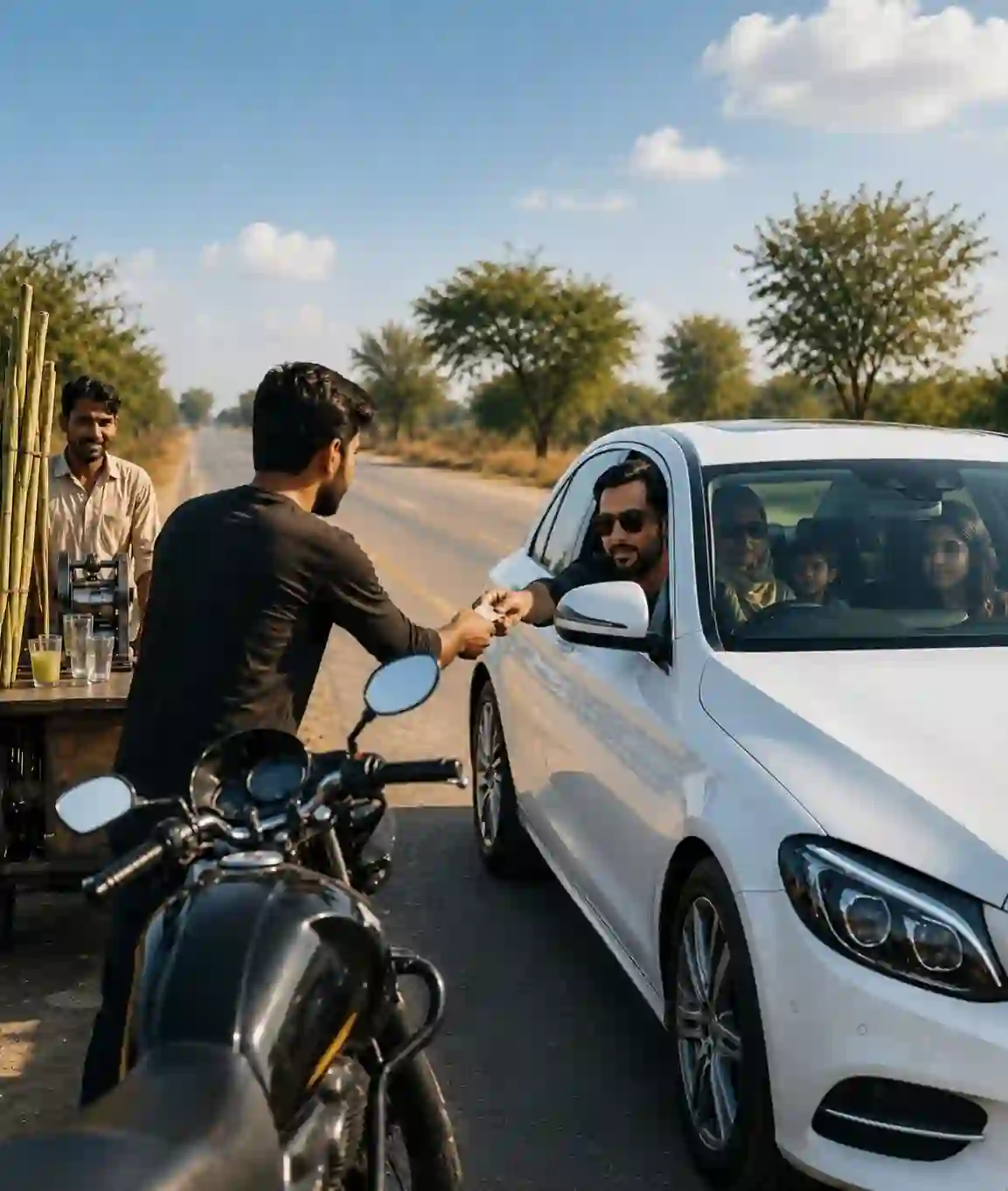
One Encounter on a Quiet Road happened when I least expected it. The street was almost empty, the air felt unusually calm, and I was simply trying to get home after a long day. But within a few minutes, a stranger’s presence and a simple conversation made me question things I had ignored for years. That quiet road became the beginning of a life lesson I still carry with me today.
My motorcycle was cutting through the empty stretch of road, the engine humming steadily beneath me, when suddenly a white Mercedes sped past and overtook me. It was one of those sleek, expensive models that you usually only see in big cities, not on a lonely road between two towns. At first, I did not think much of it as people with money often drove like they owned the road.
But then something strange happened.
After overtaking me, the car did not continue at its speed. Instead, it slowly began to reduce its pace, almost deliberately. The way it moved reminded me of those scenes in movies where police cars slow down in front of a fleeing motorcyclist to force them to stop. It felt staged, intentional.
The road around us was quiet and nearly deserted. The sun was blazing overhead, making the asphalt shimmer. There were no shops, no houses, no sign of life only just a long stretch of road and the relentless heat. A place like this was not ideal for stopping unless you had a good reason.
As I approached the car again, trying to pass it, the window on the driver’s side rolled down. A pale face appeared which was clearly of Pakistani origin, but with the complexion and demeanor of someone who had lived abroad for a long time. The man called out to me in a British-accented English, asking me to stop

At first, I hesitated.
Stopping in such an isolated place was not exactly a smart decision. You hear stories. You learn to be cautious. For a moment, I considered ignoring him and riding on.
But then I glanced inside the car.
On the back seat, I saw a middle-aged woman and two children, probably around eight or ten years old. In the front passenger seat sat a young, well-dressed woman, elegant, composed, and clearly not from around here. The presence of a family changed everything. This did not look like a trap. It looked like people who genuinely needed help.
So I slowed down and stopped.
They pulled over as well. I parked my bike, got off, and walked toward the driver’s side.
Up close, the man looked exhausted. There were signs of frustration and fatigue on his face. The young woman beside him looked equally drained, her expression carrying a mix of discomfort and impatience.
He explained their situation.
They were originally from Pakistan but had been living in England for many years.
They had come back for a visit and were now traveling from Karachi. They had exited the motorway because they needed to reach a smaller city which was the same one I was heading toward. But the journey had not gone as smoothly as they expected.
The heat had taken a toll on them.
They were thirsty, tired, and clearly not used to this kind of environment anymore. Their biggest mistake, as the man admitted with a sigh, was that they had not brought along anyone local that is someone who understood the routes, the conditions, and the realities of traveling through such areas.
Now they were stuck.
He asked me if there was a nearby hotel where they could rest for a few hours, freshen up, and continue their journey.
I paused for a moment before answering.
“There is no hotel nearby,” I told him honestly. “The closest one is about fifty kilometers from here.”
His face fell immediately.
The frustration that had been simmering beneath the surface now became more visible. The young woman glanced away, clearly disappointed.
I looked around.
A little distance away, under the shade of a tree by the roadside, there was a small cart of a sugarcane juice vendor. A simple wooden setup with a machine, a few glasses, and a man trying to earn his living under the scorching sun.
I pointed toward it.
“You should try that,” I suggested. “Sugarcane juice. It will help with the heat, give you energy, and quench your thirst.”
The young woman turned to the man and said something in English, her tone uncertain. I could not catch every word, but I understood the hesitation.
The man then explained to me, “She’s my niece. She is asking if it’s safe… what if it’s not hygienic?”
I smiled slightly.
“You can tell her,” I said, “this is one of the purest drinks you will find here. It’s natural, refreshing, and perfect for this weather. Honestly, it’s like a gift of summer.”
He translated my words to her, adding his own reassurance.
After a brief moment of hesitation, she nodded.
“Alright,” he said to me. “Come with us and help us get it.”
I agreed.
We walked together to the cart. The vendor looked up as we approached, his eyes immediately scanning the expensive car parked nearby and the well-dressed family. I asked him to prepare glasses of sugarcane juice for all of us.
He got to work.
The machine whirred as he fed the sugarcane stalks through it, extracting the juice into a container. He added a bit of ice, a squeeze of lemon, and poured the fresh juice into glasses.
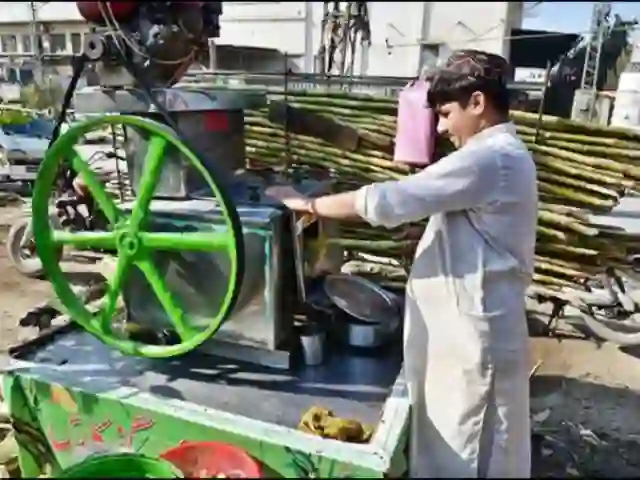
I took the glasses and handed them to the family.
For a moment, they hesitated for just a second.
Then they took their first sip.
And everything changed.
Their expressions softened almost instantly. The tension melted away. The exhaustion in their faces gave way to surprise and then to genuine enjoyment.
“This is… actually really good,” the young woman said, her tone shifting completely.
They drank eagerly.
One glass turned into two. The children smiled. Even the middle-aged woman seemed relieved.
I stood there quietly, watching them. There was a simple kind of satisfaction in that moment, helping someone in a small but meaningful way.
When they finished, the man asked me, “How much is it?”
I turned to the vendor and asked the price.
He told me.
I paused.
Then I turned back to the man and said, “It is seventy rupees per glass.”
I only told him the amount for their drinks, leaving mine out of it. I reached into my pocket to pay.
He immediately tried to stop me.
“No, no, we will pay,” he insisted.
But I shook my head. “It’s fine.”
Before he could argue further, I handed the money to the vendor.
That is when things took an unexpected turn.
The vendor, seeing the car, the clothes, and perhaps sensing an opportunity, had actually charged double, one hundred and fifty rupees per glass. He had quietly told me the inflated price.
I had tried to reason with him.
“Don’t do this,” I said. “Be fair.”
But he refused.
“This is my rate,” he replied stubbornly.
I did not want to create a scene.
And more importantly, I did not want the family to feel cheated or uncomfortable. So I quietly paid the full amount from my own pocket, without telling them the truth.
It was not about the money.
It was about preserving the moment—the trust, the goodwill.
After settling the payment, I turned back toward my bike.
They began heading toward their car as well.
Just as I was about to leave, the young woman called out, “Hello, mister!”
I stopped and looked back.
She was leaning slightly out of the car window, speaking softly to her uncle. I walked back toward them.
The man stepped out, reached into his wallet, and pulled out some cash.
He extended it toward me.
“These are for you,” he said.
I looked down.
Five thousand rupees.
I was taken aback.
“No, no… that is not necessary,” I said quickly. “I did not do anything.”
But he insisted.
“You helped us when we needed it,” he said. “Please take it.”
I refused again.
He insisted again.
It went back and forth—my refusal, his insistence.
And eventually, his insistence won.
Reluctantly, I accepted the money.
To be honest, it did not feel entirely right. I had not helped them expecting anything in return. The idea of my small act of kindness being “paid” for felt a bit uncomfortable.
But there was something in their gesture.
It was not arrogance. And also it was not about showing wealth.
It was genuine appreciation.
You may also like: Kindness vs Nature: The Story That Will Make You Think Twice
As I held the money, I glanced at the young woman. She smiled slightly—not the kind of smile that comes from privilege, but the kind that reflects gratitude and respect.
I nodded in return.
Then I turned, walked back to my motorcycle, and started the engine.
As I rode away, the road stretched ahead of me once again—quiet, sunlit, endless.
But something felt different.
Sometimes, on a lonely road between two cities, a simple encounter can remind you of something important: kindness doesn’t always need a reason… and even the smallest gesture can leave a lasting impact.
If this story touched your heart, don’t just scroll away—share it with someone who still believes in kindness.
Because sometimes, a small act on a lonely road can restore faith in humanity.
Stay with us for more real, powerful stories that remind you the world still has good people in it.
Related Posts
- 10 Everyday Signs Your Body is Healthy Than You Think

- 10 Powerful Life Lessons for Women That Can Transform Your Life and Help You Avoid Common Mistakes
- 10 Strange and Funny Signs That Prove People Have a Great Sense of Humor
- 10 Things Men Never Tell Women (But Often Feel Inside)




About the Author
Hassan is the founder and editor of MidnightReads, a publication featuring thoughtful stories, human-interest articles, history, relationships, and entertaining reads.
He is involved in researching, writing, and editing content for the site, with a focus on creating original, clear, and useful articles that give readers something meaningful to take away.
Hassan believes good content should inform, entertain, and encourage curiosity.
— Hassan, Founder & Editor, MidnightReads