
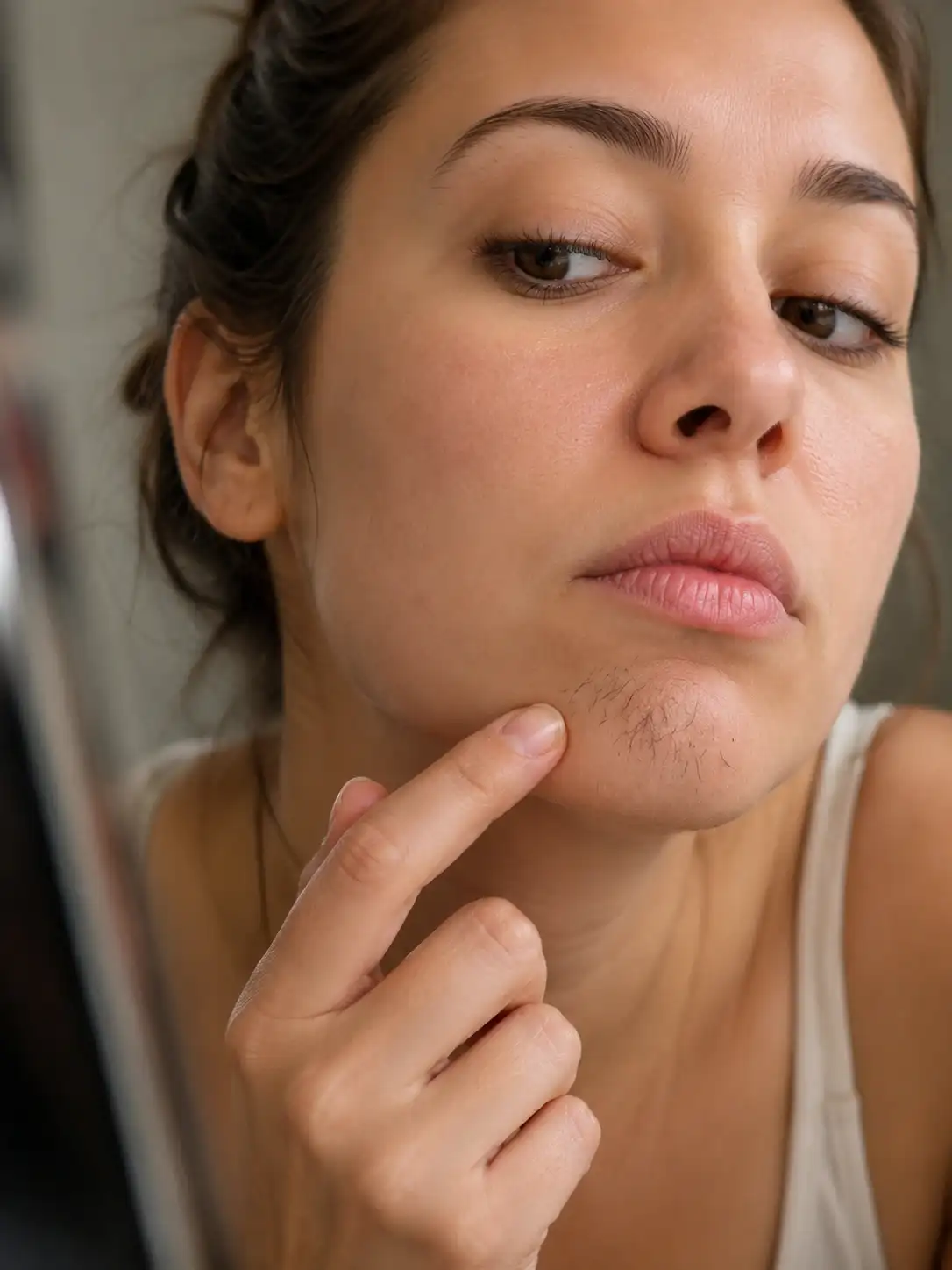
You notice it while looking in the mirror.
At first, you think it is just a shadow.
Then you move closer.
There it is—a dark, stubborn hair on your chin where you don’t remember seeing one before.
You pull it out.
Problem solved.
Or so you think.
A few weeks later, another one appears.
Then perhaps another.
And suddenly, a tiny hair that seemed completely meaningless has you wondering:
Why is this happening?
The truth is that a chin hair in a woman can have several explanations. Sometimes it is nothing more than normal variation. Sometimes it is related to getting older or changing hormones. And when facial hair becomes noticeably heavier—especially alongside other symptoms—it can occasionally be a clue worth discussing with a healthcare professional.
So before you panic or start searching for the worst possible explanation, let’s look at what may actually be happening.
First: One Chin Hair Usually Isn’t a Reason to Panic
The human body is covered in hair.
Most of the hair on the face is extremely fine and difficult to notice. This is often called vellus hair.
But some follicles can produce terminal hair—the thicker, darker and more noticeable type of hair you see on areas such as the eyebrows, eyelashes and scalp.
Hormones called androgens can influence whether certain facial hairs become thicker and darker. Everyone has androgens, although levels and sensitivity vary from person to person.
That means a woman can occasionally discover one surprisingly thick hair on her chin without having a medical problem at all.
In fact, facial hair patterns naturally differ between women, and genetics can play an important role.
So if you have one random chin hair that seems to have appeared out of nowhere, there is no reason to immediately assume something is wrong.
But there is a reason to pay attention if the pattern starts changing.
Why Does It Seem to Happen Out of Nowhere?
This is the part that surprises many women.
You may have gone through most of your life without noticeable facial hair.
Then suddenly, your chin seems to have developed a mind of its own.
One reason is that your hormones don’t stay exactly the same throughout your entire life.
Hormonal changes occur during puberty, pregnancy and menopause, among other stages of life. These changes can affect the way hair grows on different parts of the body.
And there is an especially interesting twist.
Some women notice more coarse hair on the chin while simultaneously noticing thinner hair on the scalp.
It sounds contradictory.
How can hair be disappearing from one place while appearing in another?
Because different hair follicles respond differently to hormonal changes.
A change in androgen activity can encourage thicker facial hair while contributing to scalp hair thinning in some women.
That is one reason a new chin hair can sometimes appear during the same period when a woman notices changes in the hair on her head.
Age Can Be Part of the Explanation
If you’re older and have recently started noticing chin or jawline hairs, hormonal changes associated with aging may be involved.
This is particularly common around menopause, when reproductive hormones change.
Some women notice that their scalp hair becomes thinner while unwanted hair appears on the upper lip, chin or jawline.
So that unexpected hair doesn’t necessarily mean your body is “producing too much testosterone.”
Sometimes it is simply part of the complicated way the body changes with age.
And that’s an important distinction.
But What If There Are Suddenly A LOT More Hairs?
This is where the story becomes more interesting.
One or two hairs are very different from a noticeable increase in thick, dark facial hair.
When a woman develops excessive coarse hair in areas such as the chin, upper lip, chest, abdomen or back, doctors may use the term hirsutism.
Hirsutism is often associated with increased androgen activity.
But even then, there isn’t one single explanation.
Several factors can contribute.
And one of the most common conditions doctors consider is polycystic ovary syndrome, or PCOS.
Could Chin Hair Be Connected to PCOS?
Sometimes, yes.
PCOS can involve increased androgen activity, which may lead to symptoms such as unwanted facial or body hair.
But there is something extremely important to remember:
A chin hair does not mean you have PCOS.
PCOS is a broader medical condition. Depending on the person, it can involve irregular periods, acne, difficulty becoming pregnant, increased facial or body hair and other hormonal or metabolic features.
So if you find one hair on your chin, don’t diagnose yourself with PCOS.
Instead, look at the bigger picture.
Are your periods changing?
Has facial hair increased significantly?
Are you suddenly experiencing severe acne?
Has the hair on your scalp become noticeably thinner?
Those details are much more meaningful than one isolated hair.
Your Family May Have Something to Do With It
Sometimes the answer isn’t hidden in a laboratory test.
It’s in your family.
Some women naturally grow more facial or body hair than others. Genetic and inherited differences can influence hair distribution and thickness.
This is one reason comparing yourself with another woman can be misleading.
Your friend might have almost no visible facial hair.
You might have several.
That doesn’t automatically mean one of you is healthier than the other.
Bodies simply don’t follow one universal pattern.
What If You Are Getting More Acne Too?
Now you’re looking at a more useful clue.
Suppose you didn’t just notice chin hair.
You also started experiencing unusually persistent acne.
Or perhaps your scalp hair has become thinner.
Or your menstrual cycle has become irregular.
When several of these changes occur together, hormonal activity becomes more relevant.
Excess androgen activity can be associated with unwanted facial hair, acne, scalp hair loss and menstrual changes.
Again, that doesn’t tell you exactly what is happening.
It simply gives a doctor more information to work with.
When Should You Actually See a Doctor?
This is probably the most useful part of the whole story.
You don’t need to make a doctor’s appointment every time you discover one chin hair.
But you should consider getting checked if the change is rapid, significant or accompanied by other unusual symptoms.
Pay particular attention if you experience:
- A sudden increase in thick, dark facial hair
- New or worsening acne
- Irregular or missing periods
- Noticeable thinning of scalp hair
- New hair growth on the chest, abdomen or back
- A deepening voice
- Increased muscle mass or other rapid physical changes
Rapid or marked facial-hair growth, especially when accompanied by signs of increased androgen activity, deserves medical evaluation.
Rare medical conditions can cause excessive androgen production, so doctors don’t simply look at the hair itself. They consider the speed of the change and what else is happening in the body.
And Yes, You Can Remove It
If the hair bothers you, you have plenty of options.
Tweezing is convenient when there are only a few hairs.
Shaving, threading, waxing and certain hair-removal products are also commonly used.
For longer-term reduction, treatments such as laser hair removal or electrolysis may be considered depending on the individual.
But remember one important thing:
Removing the hair doesn’t necessarily remove the reason the hair is growing.
If hormones are contributing to increased facial hair, the hair may continue to return after it is removed.
That’s why persistent or rapidly increasing facial hair may be worth discussing with a healthcare professional rather than simply treating the symptom over and over again.
Does Plucking Make It Grow Back Thicker?
You’ve probably heard this one before:
“Don’t pluck it. It’ll come back thicker.”
But plucking doesn’t change your hormones or turn a normal hair follicle into a completely different one.
What can happen is that a new hair becomes noticeable when it grows back, making it feel as though it has become stronger.
So if you have one annoying chin hair, reaching for the tweezers isn’t going to cause a hormonal disaster.
The Part Nobody Talks About
There is another reason chin hair can feel like such a big deal.
It isn’t just about the hair.
For many women, facial hair is connected to how they see themselves.
A woman may spend years believing that smooth, hairless skin is simply part of being feminine. Then one day she discovers a dark hair on her chin, and suddenly she feels embarrassed by something that is actually a normal biological variation.
That feeling is real.
But the hair itself isn’t a measure of femininity.
Some women remove every visible hair.
Some leave them alone.
Some do a little of both.
There is no health requirement that says a woman must have a completely hairless face.
The important thing is knowing when a change is simply cosmetic and when it might be worth investigating.
So, What Is That Chin Hair Really Telling You?
The answer isn’t as dramatic as the internet sometimes makes it sound.
One chin hair does not automatically mean a hormone problem.
It may simply be a normal hair follicle producing a darker, thicker strand.
It may be influenced by genetics.
It may appear as hormones change with age.
But if facial hair becomes noticeably heavier or appears rapidly—especially together with irregular periods, acne, scalp hair loss or other physical changes—it can be worth talking to a healthcare professional.
So the next time you discover that mysterious little hair in the mirror, don’t immediately assume the worst.
You can remove it if you want.
Or you can simply laugh at it and move on.
But if you suddenly find yourself going from one stubborn hair to many, that’s when the question becomes more interesting.
Because sometimes the body whispers before it shouts.
And sometimes…
a tiny hair is simply a tiny hair.
Disclaimer
This article is for general informational and educational purposes only. It is not intended to provide medical advice, diagnosis, or treatment. Facial hair can have many different causes, and the information in this article does not apply equally to everyone. If you experience sudden or significant changes in facial hair, or have other concerning symptoms, speak with a qualified healthcare professional for proper evaluation and advice. Do not make medical decisions based solely on this article.
Related Latest Posts
- 10 Everyday Signs Your Body is Healthy Than You Think

- 10 Powerful Life Lessons for Women That Can Transform Your Life and Help You Avoid Common Mistakes
- 10 Things Men Never Tell Women (But Often Feel Inside)
- 11 Relationship Truths About Men and Women That Can Improve Your Relationship




About the Author
Hassan is the founder and editor of MidnightReads, a publication featuring thoughtful stories, human-interest articles, history, relationships, and entertaining reads.
He is involved in researching, writing, and editing content for the site, with a focus on creating original, clear, and useful articles that give readers something meaningful to take away.
Hassan believes good content should inform, entertain, and encourage curiosity.
— Hassan, Founder & Editor, MidnightReads