
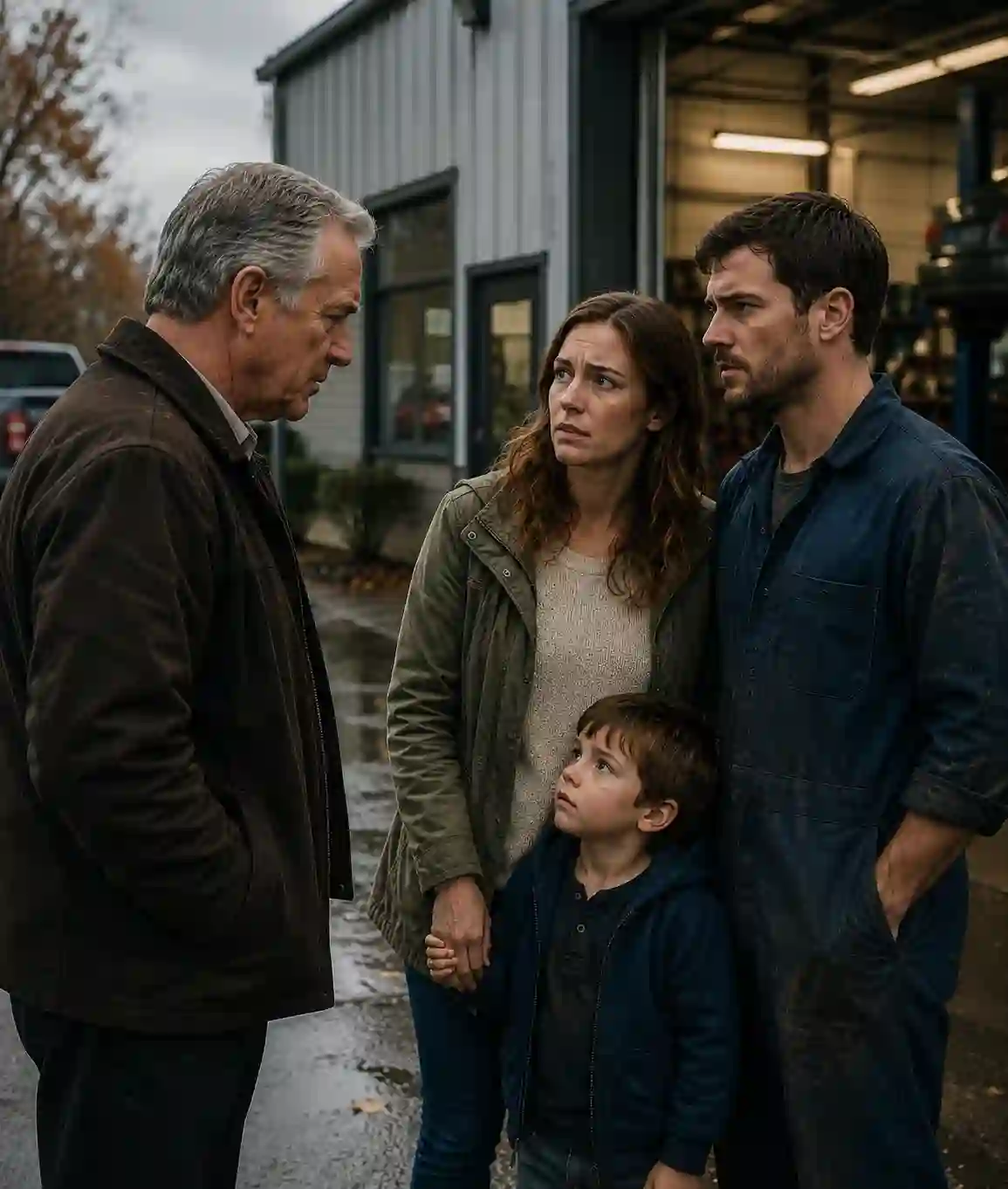
My father looked across the dinner table at my five-year-old son and told him, without saying the words directly, that his father was not good enough. What he did not know was that the man he had spent years dismissing was quietly building something that would eventually change the lives of dozens of young people.
It happened on a rainy Sunday evening in October at my parents’ house outside Columbus, Ohio. My husband, Daniel, had been called into the repair shop that afternoon because of an emergency job, so I brought our son, Noah, alone. I almost canceled, but my mother had been looking forward to seeing her grandson, and I didn’t want another family argument to start over something as small as dinner.
For the first half hour, everything was normal. My mother had made roast chicken and mashed potatoes, Noah was happily eating, and my sister Vanessa was telling us about the new SUV her husband had bought her. I tried to stay out of the conversation because I already knew where it usually led.
“Seventy-two thousand dollars,” Vanessa said proudly when my mother asked how much the SUV had cost. “Mark said I deserved something nice.”
My father smiled approvingly. “That’s what happens when you marry a man who knows how to provide.”
I kept eating, but Dad soon turned his attention toward me.
“What are you and Daniel driving these days?”
“His truck,” I said.
“The old one?”
“It’s reliable.”
Dad shook his head. “Emily, sometimes I wonder what happened to you. You had a good education, plenty of opportunities, and then you married a mechanic.”
I put down my fork. “Daniel works hard.”
“Working hard isn’t the same as getting ahead.”
Vanessa glanced at me. “Dad has always said you could have married someone with more ambition.”
I felt my patience thinning. “Daniel owns half the repair shop now.”
Dad gave a dismissive laugh. “Half of a small garage isn’t exactly success.”
“I never said he was rich.”
“Then why are you defending him?”
“Because he’s my husband.”
Dad leaned back in his chair. “You married a poor man, Emily. That’s simply the truth.”
The room fell silent.
Noah stopped eating. He looked from my father to me, clearly trying to understand what the conversation meant.
Then he whispered, “Mommy, is Daddy poor?”
My chest tightened.
I reached beneath the table and held his hand. “No, sweetheart. Daddy works hard, and he takes very good care of us.”
My father sighed. “Children shouldn’t be protected from reality.”
I looked directly at him. “Reality is that people aren’t more valuable because they drive expensive cars.”
Vanessa gave a small laugh. “Nobody is saying Daniel is worthless.”
“You’re talking about him as though his job makes him less of a person.”
Dad’s expression hardened. “This is my house.”
“I know.”
“And if you don’t like what I say at my table, you can leave.”
My mother finally spoke. “Richard, please.”
But her voice was so quiet that it changed nothing.
Dad pointed toward the hallway. “Take your son and go. And don’t come back for Thanksgiving. We’re happier without all this drama.”
Noah looked frightened.
I didn’t argue. I helped him into his coat and picked up his backpack. As I reached the doorway, my father added, “Maybe someday you’ll realize how much you threw away.”
I turned around.
For years, I had wanted my father to understand that my life wasn’t a failure simply because it didn’t look like his.
That night, I stopped trying to convince him.
“You just lost us, Dad.”
Then I took Noah’s hand and walked out.
The drive home was quiet. Rain streaked across the windshield, and Noah watched the passing lights without saying anything until we were almost home.
“Mommy?”
“Yes?”
“Is Daddy poor?”
I glanced at him in the rearview mirror. “No. Grandpa was talking about money.”
“But Daddy fixes cars.”
“Yes.”
“Is fixing cars bad?”
“No, honey. Your daddy helps people. When their cars break down, he works hard to get them back on the road.”
Noah thought about that.
“Then Daddy is rich.”
I smiled despite everything. “Why?”
“Because he knows how to fix things.”
I laughed softly. “That’s a pretty good definition of rich.”
When we arrived home, Daniel was already there. His emergency job had finished earlier than expected, and he was sitting at the kitchen table with a cup of coffee.
He knew something was wrong before I said a word.
He stood and hugged me.
I held onto him for a long time before finally telling him what had happened.
Daniel listened quietly. When I finished, he looked toward the living room, where Noah was playing with his toy cars.
“I’m sorry he heard that,” he said.
“So am I.”
Daniel sat down beside me. “Your dad has always measured people by what they own.”
“He thinks I settled for you.”
Daniel looked at me. “Did you?”
I shook my head.
“No.”
“Then that’s all I need to know.”
I thought that was the end of it.
Then Daniel added, “There’s something I’ve been working on that I haven’t told you about.”
I looked at him.
“What?”
He smiled slightly. “It’s not ready yet.”
“What isn’t?”
“You’ll see.”
At the time, I assumed he meant the repair shop.
I had no idea he had been working on something much bigger.
Daniel and I had been married for seven years. We weren’t wealthy, but we had never considered ourselves poor. We had a modest home, reliable vehicles, some savings, and enough income to give Noah a comfortable childhood.
Daniel had learned about cars as a teenager. His family didn’t have much money, so when their old truck broke down, he learned how to repair it himself. Eventually, a local mechanic noticed his talent and offered him a job.
Years later, Daniel and his friend Mike bought half of a small repair shop.
The business grew slowly.
There were no flashy offices or expensive cars.
Daniel simply worked.
He arrived early, stayed late when customers needed help, and treated people fairly. If an elderly customer couldn’t afford an unnecessary repair, he told them so. If a young person wanted to learn, he showed them what he knew.
My father noticed none of that.
He only saw an old truck, dirty work clothes, and a small business.
About a week after the dinner, Daniel started spending even more time away from home. He made phone calls after Noah went to bed and sometimes left early on weekends.
One Friday night, I finally asked him what was happening.
“Are you going to tell me what you’re working on?”
He smiled. “Soon.”
“You’ve been saying that for weeks.”
“I know.”
“Daniel, now I’m curious.”
He laughed. “Just trust me.”
I did.
That was the difference between Daniel and my father.
I didn’t have to prove anything to him, and he didn’t have to prove anything to me.
Three weeks later, Daniel asked me to come with him after work.
He drove past the repair shop and into an industrial area on the edge of town. Eventually, he stopped outside a large commercial building that looked almost empty.
I looked at him.
“Why are we here?”
“Come inside.”
When he opened the door, I saw construction workers, stacks of equipment, tool cabinets, and several automotive lifts waiting to be installed.
I stared at him.
“What is this?”
Daniel handed me a folder.
Inside were architectural drawings.
At the top of the first page was a name:
Central Ohio Automotive Training Center.
I looked at him again.
“You’re building this?”
He nodded.
“For almost three years, Mike and I have been saving money and looking for the right property.”
I turned through the drawings.
There were repair bays, classrooms, a computer lab, offices, and a large training area.
“This isn’t just another repair shop.”
“No.”
Daniel took a breath.
“It’s an apprenticeship center.”
“For who?”
“For people who want a career but can’t afford traditional training.”
He explained that the program would offer paid apprenticeships to young adults and career changers. They would learn automotive repair, diagnostics, electrical systems, customer service, and business skills while working toward professional certifications.
I looked at the plans again.
“How long have you been planning this?”
“Almost three years.”
“Why didn’t you tell me?”
“Because I didn’t want to announce something before I knew we could make it happen.”
He pointed toward the training room.
“I remember being sixteen and wondering what kind of future I could afford. I was lucky someone gave me a chance. I want to do the same for other people.”
I felt tears gathering in my eyes.
My father had called this man poor.
But Daniel wasn’t measuring his life by what he could buy.
He was measuring it by what he could build.
The months that followed were exhausting.
Daniel worked at the repair shop during the day and spent evenings at the new center. I watched him come home tired, eat dinner with us, help Noah with his homework, and then return to the building to solve another problem.
But slowly, the place began to take shape.
The first applications came in January.
One was from Marcus, a nineteen-year-old whose mother worked two jobs. He had started college but couldn’t afford to continue.
Another came from Lily, who had grown up helping her father repair farm equipment. She wanted to become an automotive technician but had been repeatedly told that the field wasn’t suitable for women.
Daniel accepted them both.
He accepted ten other applicants as well.
Those twelve people became the center’s first class.
At first, they were nervous.
Some had never used professional diagnostic equipment. Others weren’t sure they belonged there.
Daniel treated them all the same.
He expected them to work hard, but he also expected them to make mistakes and learn from them.
I watched Marcus slowly become confident. Lily became one of the strongest students in the group. Others discovered skills they hadn’t known they possessed.
The center was no longer just a building.
It had become a second chance for people who needed one.
And somewhere along the way, I stopped caring what my father thought about it.
Then, in early November, my mother called.
“Emily, your father wants you to come for Thanksgiving.”
I almost laughed.
“He told me not to come.”
“I know.”
“Then why is he asking?”
There was a long silence.
“He heard about Daniel’s center.”
I looked toward the kitchen, where Daniel was helping Noah decorate cookies.
“What did he hear?”
“That Daniel bought the building.”
“Daniel and Mike bought it together.”
“I know.”
My mother’s voice softened.
“Your father didn’t realize how much Daniel had accomplished.”
I didn’t respond.
Then she said, “He wants to apologize.”
I sat down.
“Does he actually mean it?”
“I think he does.”
I wasn’t ready to forget what happened.
But I agreed to think about it.
Thanksgiving morning arrived with cold rain tapping against the windows.
Daniel was in the kitchen trying to stop Noah from eating the dessert before lunch. I was setting the table when someone knocked at the door.
I opened it and found my mother holding a pie.
My father stood behind her.
Vanessa was beside him.
For several seconds, nobody spoke.
Then Dad said, “Can we come in?”
I stepped aside.
We sat in the living room while Noah played nearby. Daniel stayed in the kitchen until my father finally spoke.
“I was wrong.”
Those words surprised me.
Dad looked at me.
“I was wrong about Daniel. I was wrong about you. And I was especially wrong to say what I said in front of Noah.”
I didn’t immediately forgive him.
“You hurt me.”
“I know.”
“You made my son question whether his father was someone to be ashamed of.”
Dad lowered his eyes.
“I know.”
He took a breath.
“I spent too much of my life believing that money was proof of success.”
Then he looked toward Daniel.
“I didn’t understand what he was doing.”
My father explained that he had read about the training center after hearing about it from someone he knew.
“I saw the apprentices. I saw what the program was doing for them.”
He paused.
“And I realized that the man I called poor was giving people something more valuable than anything I was talking about at that dinner.”
I asked quietly, “What?”
“A chance.”
The room became silent.
Dad looked at Daniel.
“I’d like to see the center.”
Daniel nodded.
“You can.”
A few days later, Daniel took my father to the training center.
I stayed home with Noah.
They were gone for several hours.
When my father returned, he didn’t talk about the building first.
He talked about Marcus.
“I met that young man,” he said.
I smiled.
“Marcus?”
“Yes. He’s impressive.”
“He is.”
Dad nodded.
“He told me Daniel was the first person who believed he could actually build a career.”
I didn’t say anything.
Dad looked around my living room.
“I spent years telling you that you needed a man who could give you a better life.”
He paused.
“I didn’t realize you already had one.”
That was the first time I feel his apology was genuine.
Not because he had discovered Daniel was successful.
Because he had finally understood what success meant.
The training center officially opened the following spring.
The local newspaper published a small article about the program. There was no headline about Daniel becoming rich, because that wasn’t what the story was about.
It was about twelve people being given a chance to learn a trade and build careers.
At the opening ceremony, my father stood in the crowd beside my mother.
Vanessa came too.
When Daniel finished speaking, Dad approached him.
“I owe you another apology.”
Daniel smiled. “You do not have to.”
“Yes, I do.”
Dad held out his hand.
Daniel shook it.
Then my father said, “If you ever need help connecting with local businesses, let me know.”
Daniel smiled.
“I might.”
Dad laughed.
“Good.”
It was not a perfect reconciliation.
Families don’t become perfect because someone says sorry.
But it was a beginning.
The following Thanksgiving, we sit around the same table again.
This time, Daniel was beside me.
Noah was six and more interested in dessert than the conversation.
My mother brought the turkey. Vanessa brought a pie. My father sat across from me.
After dinner, Dad looked at Daniel.
“You know, I owe you one more apology.”
Daniel smiled.
“For what?”
“For calling you a poor man.”
Daniel laughed. “Technically, I still don’t own a seventy-two-thousand-dollar SUV.”
Everyone laughed, including my father.
But Dad shook his head.
“That isn’t what I mean.”
He looked around the table.
“I spent so much time measuring people’s lives by what they owned that I forgot to ask what they were doing with what they had.”
He looked at Daniel.
“You built something that gives other people a future.”
Then he looked at me.
“And my daughter chose someone who understands what matters.”
I felt tears come to my eyes.
Noah lifted his glass of apple juice.
“My daddy is rich!”
Everyone laughed.
Daniel leaned toward him.
“Rich in what?”
Noah thought for a second.
“Everything important.”
The table went quiet for just a moment.
Then my father smiled.
I looked around at the people sitting with us and remembered the night I had walked out of my parents’ house believing something had been broken beyond repair.
Maybe it had.
But sometimes broken things can be rebuilt differently.
I had spent years trying to convince my father that I hadn’t made a mistake by marrying Daniel. I no longer needed to convince him of anything.
Daniel had not become wealthy overnight. He hadn’t bought a mansion or a luxury car to prove my father wrong. He had done something much harder: he had built a business that created opportunities for people who might otherwise have been overlooked.
That was the kind of example I wanted Noah to remember.
Because money can buy a bigger house, a newer car, or a more impressive dinner.
But it can’t buy the feeling of knowing that someone’s life is better because you gave them a chance.
My father had once looked at my husband’s old truck and decided he knew exactly what kind of man Daniel was.
He had been looking at the wrong thing.
And I had finally stopped caring whether he saw it.
Real success is not always found in what a person owns. Sometimes it’s found in what they build, who they help, and the kind of people they become along the way.
Author’s Note
This story is a work of fiction created for entertainment and reflection. The characters, names, places, businesses, and events are fictional. Any resemblance to real people or actual events is purely coincidental.
The story explores family expectations, the way we measure success, and the importance of judging people by their character rather than their possessions.
Virals posts
- I Found a Six-Year-Old Girl Cleaning My Study at 2 A.M. With a Baby on Her Back, Then She Pointed to My Library Wall and Asked Why Someone Was Knocking Behind It

- Poor Girl Was Mocked for Her Cheap Yellow Dress at a Luxury Wedding—Minutes Later, She Stopped to Help an Elderly Woman Who Changed Her Life
- Two Traffic Officers Pulled a Young Woman From Her Car and Handcuffed Her, Then One Thing in Her Pocket Changed the Entire Stop

- The Billionaire Saw His Fiancée Push the Maid Off the Building, What He Did Next Left the Entire City in Shock




Hammad Ali
Co-Owner & Author
Hammad Ali is a co-owner and author at MidnightReads, contributing thoughtful and engaging articles across human-interest, life, history, relationships, and entertainment topics.
They help develop and create original, useful content designed to inform, entertain, and give readers something meaningful to take away.