An Old Family Photo Revealed a Mystery No One Expected
When my grandmother died, our family spent several days sorting through the things she had collected during her long life. Her house seemed to contain a memory from every decade—old birthday cards, handwritten recipes, Christmas decorations, letters, and photographs stacked inside drawers and boxes.
I wasn’t looking for anything valuable. I only wanted something that would remind me of her. My grandmother had always saved everything, even things most people would have thrown away years earlier. She believed ordinary objects could become important once the people connected to them were gone.
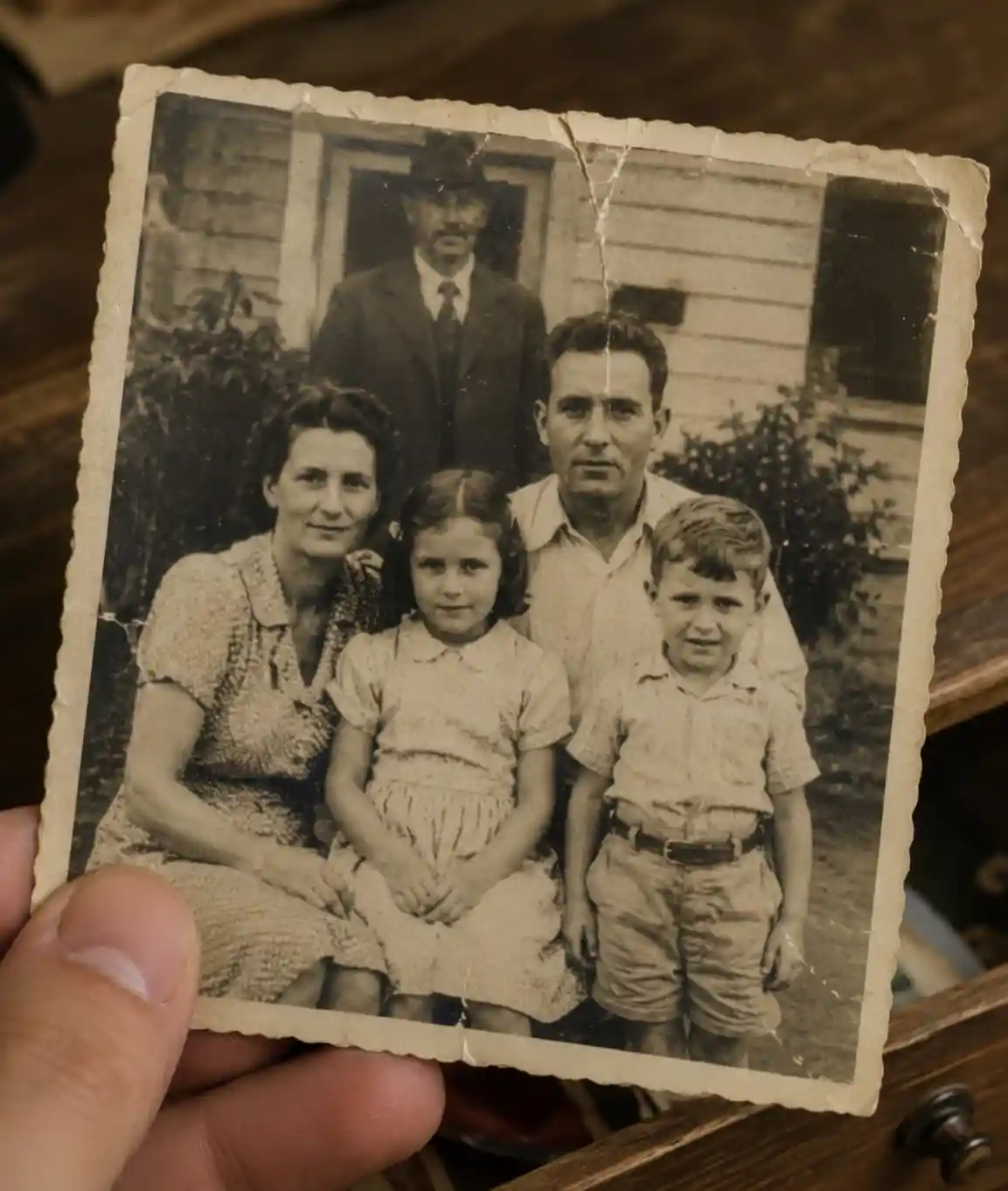
One afternoon, I opened the bottom drawer of an old wooden cabinet in her bedroom. Beneath several envelopes and a faded photograph album, I found a small picture with a white border. I didn’t recognize it, so I turned it over.
Three words were written on the back in my grandmother’s handwriting.
“Summer. Don’t forget.”
I turned the photograph over again.
It showed my grandparents standing outside their old house with my mother between them. My mother looked about eight or nine years old. My grandfather was smiling, my grandmother had one hand resting on my mother’s shoulder, and an old car sat beside the driveway.
It looked like an ordinary family photograph.
Then I noticed the man in the background.
He was standing beside the wooden fence several yards behind my family. He wasn’t smiling, and he wasn’t looking at the house. He was looking directly at the camera as if he knew someone was taking the picture.
I stared at him for several seconds.
I didn’t recognize him.
So I took that old family photo downstairs and showed it to my mother.
“Do you know this man?”
She looked at the picture, then moved it closer to her face. For a moment, she said nothing. Finally, she shook her head.
“No. I’ve never seen him before.”
“Maybe he was a neighbor?”
“Maybe,” she said, although her voice didn’t sound convinced.
I showed it to my uncle later that evening. He barely looked at it before his expression changed.
“Where did you find that?”
“In Grandma’s drawer.”
He took the photograph from my hand and studied it more carefully.
“Do you know him?” I asked.
He didn’t answer immediately. Then he handed the photograph back.
“No.”
His answer was too quick.
“Are you sure?”
He looked toward the kitchen.
“Just put it back where you found it.”
That was when I knew there was something about the photograph that my family wasn’t telling me.
That night, I enlarged the picture on my phone. The man’s face was too blurred to identify, but I noticed something else.
He was holding a small object in one hand.
It looked almost like an envelope.
I couldn’t explain why, but I suddenly felt that the photograph wasn’t just an old family picture.
It was a piece of a story.
The next morning, I asked my mother about the house in the photograph. She remembered it clearly. My grandparents had lived there when she was a child before eventually moving to another town.
“Why did they leave?” I asked.
“Grandpa got a better job,” she replied.
“Was that the only reason?”
She looked at me.
“What makes you ask that?”
I showed her the photograph again.
She stared at it for a long time.
Then she quietly said, “Your grandmother didn’t like talking about that summer.”
I sat down beside her.
“What happened that summer?”
“I don’t know,” she said. “At least, I never knew the whole story.”
That answer made me even more curious.
My mother remembered being told not to go near the fence behind the house. She also remembered seeing a man standing there once.
“Was it him?” I asked.
She nodded slowly.
“I think so.”
“What did he do?”
“Nothing. He just stood there.”
“Did he speak to you?”
“No.”
“Then why were you told to stay away?”
My mother sighed.
“I don’t know. Your grandfather saw him and immediately told me to go inside.”
There was one thing she did remember.
Her grandmother—my great-grandmother—had once said that the man was “someone from before.”
At the time, my mother hadn’t understood what that meant.
Now I wanted to find out.
I returned to my grandmother’s bedroom and began searching through the boxes again. This time, I wasn’t simply looking for photographs. I was looking for anything connected to that summer.
Behind a stack of old recipe books, I found another photograph.
It showed the same house from a slightly different angle.
There was no one standing in the foreground.
But the man was there again.
Same fence.
Same summer.
Same man.
My mother looked at the second photograph and immediately became quiet.
“I remember him now,” she said.
“Who was he?”
“I don’t know his name.”
“But you’ve seen him before.”
“Yes.”
She closed her eyes for a moment.
“I remember Grandma being upset when he came around.”
That afternoon, we called an elderly relative who had known my grandparents when they were young. When we described the man, there was a long silence on the phone.
Then she said something that neither of us expected.
“That sounds like Daniel.”
My mother looked at me.
“Daniel who?”
The relative gave us the last name.
My mother immediately recognized it.
Daniel was my grandfather’s younger brother.
For decades, nobody in our immediate family had spoken about him.
The discovery raised more questions than it answered.
Why had my grandfather refused to acknowledge his own brother?
Why had Daniel stood outside the house instead of simply knocking on the door?
And why had my grandmother kept those photographs hidden?
We searched through the old documents again until we found a bundle of letters tied with faded string.
Most were ordinary family letters, but one was from Daniel.
It had been written shortly after the photograph was taken.
The letter explained that Daniel had returned to town because he had something he wanted to give my grandmother.
He didn’t explain what it was.
He only wrote that he didn’t expect to be welcomed.
Then he wrote a sentence that made us stop.
“I know he doesn’t want me there, but I couldn’t leave without seeing her once.”
My mother read the sentence twice.
“Why would Grandpa hate his own brother that much?”
We looked at each other.
For the first time, the photograph no longer felt like an old family memory.
It felt like evidence of something that had been hidden from us for decades.
And we still didn’t know what Daniel had come back to give my grandmother.
To be continued in Part 2…
Explore much more like : My brother demanded my penthouse one day before his wedding. Then, while eight months pregnant, I fell and discovered my family had planned to take far more than my home.
Part ::2
After finding Daniel’s letter, my mother and I spent the rest of the afternoon going through my grandmother’s belongings. We had finally learned who the mysterious man in the photographs was, but we still didn’t understand why he had been standing outside the house or why my grandfather had refused to let him inside.
The more we searched, the more obvious it became that my grandmother had deliberately kept parts of the story hidden.
We found another bundle of letters tucked inside an old box. Most were ordinary family correspondence, but one was written by my grandfather. It was dated several months before the photograph was taken.
The letter described a bitter disagreement between the two brothers.
Daniel and my grandfather had once been extremely close. They had grown up together, worked together, and even talked about starting a small business. But something happened involving money and a decision that neither brother could forgive.
Daniel believed he had been treated unfairly.
My grandfather believed Daniel had betrayed him.
The disagreement became so serious that the brothers stopped speaking.
Years passed without either one making the first move.
Then Daniel became seriously ill.
That was why he had returned to the old house.
He wasn’t there to demand money.
He wasn’t there to reopen the argument.
He wanted to see his brother one more time.
My mother sat quietly after reading the letter.
“All these years, I thought Grandpa simply hated him,” she said.
“Maybe he did,” I replied. “But maybe it was more complicated than that.”
We continued searching.
Eventually, we found another letter from Daniel. Unlike the first one, this letter wasn’t angry or defensive. It was short and almost painfully simple.
Daniel wrote that he knew my grandfather didn’t want to see him. He said he understood why.
Then he explained why he had come.
He was sick, and the doctors had told him that he didn’t have much time left.
He wanted to apologize.
That was all.
He didn’t ask for money.
He didn’t ask to be welcomed back into the family.
He only wanted the chance to say that he was sorry.
Suddenly, the photograph looked different.
The man standing near the fence wasn’t mysterious anymore.
He was someone who had returned home after years of separation, unsure whether he would be allowed through the front door.
But there was still one question.
What was he holding?
I remembered the small object in his hand and went back through the photographs.
Then my mother remembered something.
“Grandma used to keep a small envelope inside her recipe book.”
We found the recipe book in another box.
It took several minutes, but eventually we discovered a folded envelope hidden between two pages.
My grandmother had written Daniel’s name on the front.
Inside was a small photograph.
It showed two boys standing beside a wooden fence.
The boys were young—probably around ten and twelve.
My mother immediately recognized them.
“That’s Grandpa.”
She pointed at the other boy.
“And that’s Daniel.”
The two brothers were smiling at the camera.
They looked happy.
They looked inseparable.
For several seconds, nobody spoke.
Then we found a handwritten note underneath the photograph.
It was from my grandmother.
She explained that Daniel had brought the photograph with him when he returned to the house.
He had carried it for years.
He wanted her to keep it because he was afraid that once he was gone, nobody would remember how close the brothers had once been.
My grandmother wrote that Daniel had stood outside the fence because he didn’t know whether my grandfather would allow him inside.
She had seen him from the window.
She asked my grandfather to let Daniel come in.
He refused.
Daniel waited.
Then he turned around and walked away.
But that wasn’t the end.
Several weeks later, Daniel returned.
This time, my grandfather wasn’t home.
My grandmother met him at the fence.
They talked for almost an hour.
Daniel apologized for everything that had happened between the brothers.
My grandmother told him that she had never stopped caring about him.
Before he left, Daniel gave her the childhood photograph.
Then he asked her to promise that she would never let the family forget that there had been good years between the brothers.
She promised.
My grandmother ended the note with a sentence that made my mother cry.
“People remember the argument. They forget the years before it.”
We sat quietly with the photograph between us.
For years, our family had remembered Daniel as the brother who had caused trouble.
Nobody remembered the boy in that old picture.
Nobody remembered the brother who had once shared everything with my grandfather.
Nobody remembered that he had come back not to fight, but to apologize.
And my grandmother had apparently been carrying that truth alone.
There was one final piece of the story.
At the bottom of the envelope was another note.
It explained that Daniel died several months after that final visit.
He never got to speak to my grandfather again.
My grandfather never apologized.
But my grandmother had forgiven Daniel.
She had kept his childhood photograph because she believed people should be remembered for more than the worst moment of their lives.
My mother wiped her eyes.
“Why didn’t Grandma ever tell me?”
I didn’t know what to say.
Maybe she wanted to protect her daughter from an old family conflict.
Maybe she didn’t believe it was her place to reveal someone else’s private pain.
Or perhaps she had simply hoped that one day we would find the photographs and ask the right questions.
We looked at the original picture one more time.
The man standing near the fence was still there.
But now I noticed something I hadn’t seen before.
He didn’t look angry.
He looked nervous.
Almost uncertain.
He wasn’t standing outside because he wanted to stay away.
He was standing there because he didn’t know whether he was still welcome.
And suddenly, the three words written on the back of the photograph made perfect sense.
“Summer. Don’t forget.”
My grandmother wasn’t asking us to remember a family argument.
She was asking us to remember a person.
Someone who had made mistakes.
Someone who had been hurt.
Someone who had come home hoping for forgiveness.
I kept both photographs.
The first one—the picture of Daniel standing outside the fence—is still one of my most important family photographs.
But I keep the second one beside it.
The photograph of the two brothers as children.
Whenever I look at them together, I think about how easily a person’s entire life can be reduced to one disagreement.
We often remember the ending of a relationship and forget everything that came before it.
We remember who was angry.
We remember who walked away.
We remember the argument.
But we don’t always remember the years when those same people laughed together, helped each other, and believed they would always remain family.
My grandmother did.
That was why she kept the photographs.
And perhaps that was why she wrote those three words.
Summer. Don’t forget.
I used to think the most important person in a photograph was always the one standing in the center.
Now I look at old photographs differently.
Sometimes the person standing quietly in the background is carrying the part of the story everyone else forgot.
And sometimes, when we finally learn the truth, the mystery isn’t frightening at all.
It’s simply human.
What we learn
Families don’t always pass their stories down exactly as they happened. Sometimes an old argument survives while the reasons behind it disappear. A person’s mistakes may be remembered long after their apology has been forgotten.
That’s why old photographs can be so powerful.
They don’t explain everything, but they preserve clues—a face, a place, an expression, or a moment that later generations may finally understand.
My grandmother’s photograph taught me that there is often more to a family story than the version we were told.
And sometimes, the person we almost overlook is the person we should have noticed first.
Author’s Note
This is an original fictional family mystery written for Midnight Reads. It explores family conflict, forgiveness, memory, regret, and the way old photographs can preserve stories that later generations may not fully understand. It is not presented as a documented real-life event.
Popular Posts
- On My Wedding Day, My Brother Sank My Grandfather’s Vintage Mustang Into a Lake—Then I Asked One Question That Wiped the Smiles Off Their Faces

- Tyler Cameron and Tate Madden Are Expecting a Baby Girl, but His Emotional Tribute to His Late Mother Made the Announcement Even More Meaningful
- I Pretended I Was Dying to Find Out If My Struggling Girlfriend Loved Me or My Money—Then She Disappeared for Five Days and Returned With Something That Made Me Break Down in Tears
- My Son’s Best Friend Wore a Bright Red Dress to His Funeral, The Reason Left Us all in Tears
- My Daughter Abandoned Me at My Wife’s Grave, 190 Miles From Home—Four Days Later, Her Husband Saw Me in the Chairman’s Seat

- 20 Funny Comics That Turn Everyday Moments Into Unexpected Laughs



About the Author
Hassan is the founder and editor of MidnightReads, a publication featuring thoughtful stories, human-interest articles, history, relationships, and entertaining reads.
He is involved in researching, writing, and editing content for the site, with a focus on creating original, clear, and useful articles that give readers something meaningful to take away.
Hassan believes good content should inform, entertain, and encourage curiosity.
— Hassan, Founder & Editor, MidnightReads