
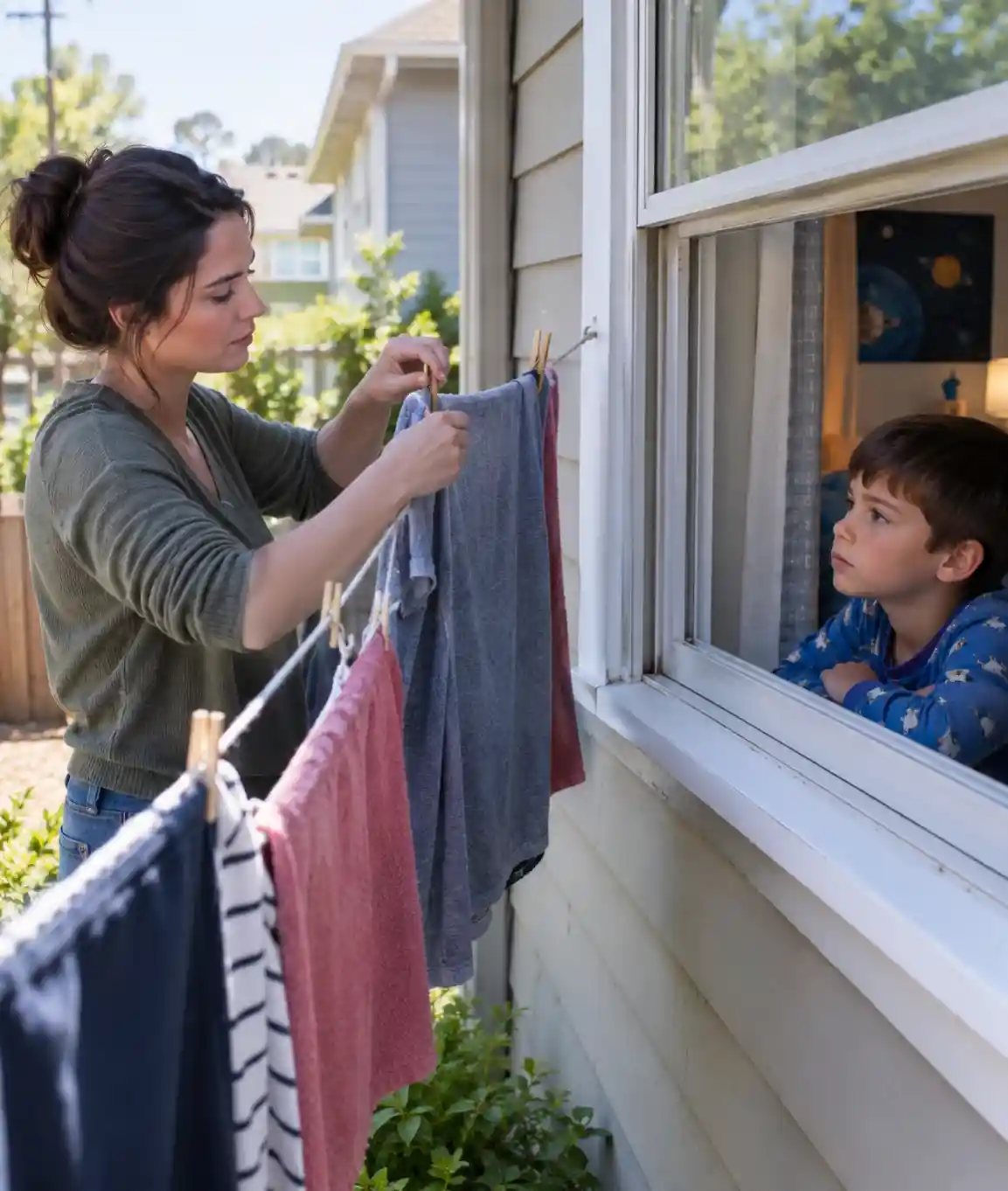
The first time I saw a pair of women’s underwear hanging directly outside my eight-year-old son’s bedroom window, I assumed I was seeing it wrong.
The clothesline belonged to my new neighbor, Lisa, and it ran along the back of her yard. Most of the laundry was ordinary—shirts, towels, jeans, and bedsheets.
But that morning, several pieces of her personal laundry were hanging directly in front of Jake’s window.
I closed his curtain and walked away.
I didn’t want to make an issue out of something that could easily have been accidental.
The next morning, they were there again.
This time, I noticed the position of the clothesline. Lisa had plenty of room farther inside her backyard, but the section holding her personal laundry was positioned almost directly opposite my son’s window.
I stood there for a moment, wondering whether I was being unreasonable.
Then Jake walked into the room.
“Mom, why does Mrs. Lisa keep putting those clothes there?”
My face went warm.
“Don’t worry about it,” I said. “I’ll talk to her.”
Jake looked confused.
“Are we not supposed to look outside anymore?”
“No. You can look outside.”
I just didn’t know how to explain something I hadn’t yet understood myself.
Lisa had only moved into the house next door a few weeks earlier. She seemed quiet and kept mostly to herself.
I’d welcomed her when she arrived, and we’d exchanged the usual neighborly conversation. Nothing about her had seemed hostile.
So I decided to ask her directly.
That afternoon, I found her in the backyard.
“Lisa, can I ask you something?”
She turned around.
“Sure.”
I carefully explained that some of her personal laundry was directly outside Jake’s bedroom window.
“I was wondering if you could move that part of the clothesline a little farther over.”
She stared at me.
“Why?”
“Because it’s right outside my son’s window.”
Lisa looked toward the house.
Then she looked back at me.
“It’s my backyard.”
“I know. I’m not telling you that you can’t hang laundry outside.”
“Then what’s the problem?”
I hesitated.
“I just don’t think my eight-year-old needs to be looking directly at someone’s personal laundry every morning.”
Her expression hardened.
“Then tell him not to look.”
I wasn’t expecting that response.
“I’d rather not have to close his curtains because of something that could easily be moved.”
She folded her arms.
“I have every right to use my clothesline.”
“I never said you didn’t.”
“That’s what it sounds like.”
The conversation ended there.
I walked back inside frustrated.
I kept thinking about her response.
Maybe she was right.
It was her backyard.
But surely she could understand why I felt uncomfortable.
For the next few days, I avoided saying anything.
Jake stopped asking about it.
I thought the situation might simply disappear.
Instead, it got worse.
Lisa began hanging more personal laundry on that section of the line.
One afternoon, I looked outside and saw several delicate garments hanging directly across from Jake’s window.
I immediately pulled the curtain shut.
This time, I was angry.
I considered speaking to her again, but I didn’t want the disagreement to become a neighborhood feud.
So I decided to find out exactly where the clothesline stood.
I went outside and examined the fence.
That’s when I noticed something strange.
One of the clothesline posts was attached to an old wooden stake near the boundary.
I had assumed the stake belonged to Lisa.
But when I looked closely, it appeared to be on our side of the property line.
I went inside and found the survey from when we’d purchased our house.
The boundary wasn’t exactly where the fence was.
There was a narrow strip of land between the fence and the actual property line.
And the clothesline post appeared to be sitting inside that strip.
I didn’t want to accuse Lisa of trespassing.
So I called the property office.
The answer surprised me.
The post was indeed technically on our property.
But that wasn’t the strangest part.
The representative found an old note attached to the property’s historical records.
Years earlier, the previous owner of our house had allowed the previous owner next door to place a clothesline there.
It wasn’t a formal easement.
It was simply an old neighbor-to-neighbor arrangement.
Suddenly, I understood why Lisa had been so defensive.
She wasn’t deliberately trying to annoy us.
She had inherited the setup without knowing its history.
But there was still one question bothering me.
Why did she keep putting her personal laundry directly in that particular section?
The following afternoon, I went over again.
“Lisa, I found something about the clothesline.”
She immediately looked annoyed.
“If this is another complaint, I really don’t want another argument.”
“It’s not.”
I told her what the property office had explained.
She looked genuinely shocked.
“I had no idea.”
“Neither did I.”
She stared at the clothesline.
Then she sighed.
“I owe you an apology.”
I wasn’t expecting that.
“I’ve been trying to figure out why you were so upset about where I hung things,” she continued. “I thought you were trying to tell me what I could do in my own yard.”
“I probably came across that way.”
She shook her head.
“I shouldn’t have responded the way I did.”
Then I asked the question I’d been wondering about.
“Can I ask why you keep hanging your personal laundry on that part of the line?”
Lisa hesitated.
For a moment, I thought she might refuse to answer.
Instead, she said quietly, “Because that’s the only section where nobody can see it from the street.”
I looked toward the front of her property.
She explained that her backyard was visible from a nearby road and from several houses farther down the street.
The section closest to the fence was partly hidden by the angle of the neighboring houses.
She had deliberately chosen that spot because she didn’t want strangers seeing her personal laundry.
“I never thought about your son’s window,” she admitted. “I was thinking about the people on the street.”
That made sense.
She wasn’t trying to put anything outside Jake’s window.
She was trying to keep it away from everyone else’s view.
I felt embarrassed.
I’d been interpreting her actions through the worst possible explanation.
“I understand now,” I said.
“But I understand your concern too,” Lisa replied.
She looked toward Jake’s window.
“He’s a kid. I wouldn’t want my laundry hanging directly outside his room either.”
We stood there for a moment.
Then she pointed toward another part of the yard.
“What if I move the line over there?”
We walked over.
There was a spot behind a tall row of shrubs where the laundry would be hidden from the street and completely out of Jake’s view.
It wasn’t perfect.
But it worked.
“I can move it this weekend,” she said.
“Thank you.”
“No,” she replied. “Thank you for explaining instead of getting someone else involved.”
That was the end of the argument.
At least, officially.
The following Saturday, Lisa moved the clothesline.
Jake’s window was clear again.
The first thing he did was open it and look outside.
“Mom!”
“What?”
“I can see the tree again!”
I laughed.
“You missed the tree?”
“Yes.”
He leaned against the window.
Then he asked, “Did Mrs. Lisa move her clothes?”
“She did.”
“Good.”
A few days later, Jake came home from school carrying a small paper bag.
“Mrs. Lisa gave me cookies.”
I looked at him.
“She did?”
He nodded.
“She said she was sorry about the clothes thing.”
I smiled.
Apparently, Lisa had decided to apologize to him herself.
She didn’t give him any complicated explanation.
She simply told him that sometimes adults misunderstand each other and that she was glad they had figured things out.
That evening, Lisa knocked on our door.
She was holding a basket.
“I made too much dinner.”
I invited her in.
We ended up talking for nearly an hour.
She told me that moving had been harder than she expected. She had left a difficult situation behind and was trying to rebuild her life without spending more money than necessary.
The clothesline had been one of the ways she saved money.
I told her that I understood.
Then she laughed.
“You probably thought I was deliberately putting my underwear outside your son’s window.”
I laughed too.
“Honestly? At first, yes.”
She covered her face.
“That’s terrible.”
“It looked pretty suspicious.”
“I swear I wasn’t thinking about his window at all.”
“I believe you.”
From that day forward, things between us changed.
Lisa and I never became inseparable friends, but we became good neighbors.
She watched Jake for a few minutes when I was bringing groceries inside.
I collected her packages when she was away.
During a winter storm, we cleared snow from the sidewalk together.
The clothesline became an occasional joke between us.
Whenever she moved it slightly, she’d call over the fence, “Property line okay?”
I’d answer, “I’ll get the survey.”
And we’d both laugh.
Months later, Jake was sitting by his bedroom window doing his homework when he suddenly called me.
“Mom, look.”
I walked over.
Lisa was in her backyard, hanging laundry on the new line she’d installed behind the shrubs. Nothing was visible from Jake’s window anymore.
He smiled and went back to his homework.
I stood there for a moment, remembering how angry I’d been the first time I’d seen that laundry.
What had looked deliberate had turned out to have an explanation I couldn’t see from my side of the fence.
That experience changed the way I handle problems with neighbors.
If something feels wrong, I still speak up. Being polite doesn’t mean ignoring a legitimate concern, especially when children and privacy are involved.
But now I try one thing before deciding what someone meant by their actions.
“Can I ask you something?” I said. “Why do you always hang the personal laundry on that particular section?”
Lisa didn’t answer immediately.
She looked toward the street, then back at the clothesline.
“Because I don’t want anyone out there seeing it.”
I frowned.
“What do you mean?”
She took a breath.
“Before I moved here, someone broke into my house.”
I hadn’t expected that.
She explained that her previous home had been robbed while she was away. The thieves had apparently watched the house for several days before breaking in.
“After that, I became very careful about what people can see from outside,” she said. “I don’t leave expensive things near windows. I keep the curtains closed when I’m gone. And I don’t like having personal laundry where anyone driving past can see it.”
She pointed toward the street.
“From there, everything is visible.”
Then she pointed toward the section of the clothesline near our fence.
“But from this angle, the fence and the houses block the view. Nobody on the road can see what’s hanging here.”
I looked at the clothesline again.
Suddenly, the whole thing made sense.
She hadn’t chosen that spot because it was closest to Jake’s bedroom.
She had chosen it because, from her perspective, it was the most private part of her yard.
“I never realized that,” I said.
“I never realized your son’s window had such a clear view of it,” she replied.
We stood quietly for a moment.
Then Lisa looked embarrassed.
“I probably should have explained that when you first asked.”
“And I probably should have asked instead of assuming you were doing it deliberately.”
She smiled.
“Sounds like we’re both guilty.”
I laughed.
Then I looked toward another corner of her yard.
“What about putting the line behind those shrubs?”
Lisa walked over and looked.
She stared at the spot for several seconds.
“Wait…”
She moved a branch aside.
“You’re right. From the street, you can’t see anything there.”
“And Jake wouldn’t see it either.”
She smiled.
“Problem solved.”
We eventually moved the clothesline together.
What had seemed like a deliberate act of disrespect turned out to be the opposite. Lisa had been trying to protect her privacy; she simply hadn’t realized that the place she considered most private was directly visible from my son’s bedroom.
That was the part I kept thinking about afterward.
Two people can look at exactly the same thing and see completely different stories.
I saw a neighbor deliberately hanging personal laundry outside my child’s window.
Lisa saw the safest, most private corner of her backyard.
Neither of us was lying.
We simply didn’t have the same information.
That small difference matters.
In a neighborhood, people live remarkably close together. Their driveways, fences, trees, pets, children, and daily routines often overlap in ways nobody planned. A small disagreement about parking, noise, a fence, a tree, or a clothesline can become surprisingly personal when both sides start making assumptions.
Sometimes the best solution isn’t found by proving who is right.
It’s found by discovering what the other person knows that you don’t.
Lisa still hangs her laundry outside.
Jake still sits by his window.
And every now and then, when I see her carrying a basket toward the clothesline, she’ll look over and ask with a grin, “Am I in the approved zone?”
I point toward the fence.
“You’re good.”
She laughs.
Then we both go back to our day.
The strange thing is, I once thought that clothesline was the beginning of a problem with my new neighbor.
Instead, it became the reason we finally learned how to be good neighbors.
Editor’s Note: This story explores a misunderstanding between two neighbors and how an honest conversation helped them see the situation from each other’s perspective. It is presented as a fictionalized human-interest story about communication, boundaries, and everyday relationships.
Related Posts
- I Found a Six-Year-Old Girl Cleaning My Study at 2 A.M. With a Baby on Her Back, Then She Pointed to My Library Wall and Asked Why Someone Was Knocking Behind It

- Poor Girl Was Mocked for Her Cheap Yellow Dress at a Luxury Wedding—Minutes Later, She Stopped to Help an Elderly Woman Who Changed Her Life

- Two Traffic Officers Pulled a Young Woman From Her Car and Handcuffed Her, Then One Thing in Her Pocket Changed the Entire Stop

- The Billionaire Saw His Fiancée Push the Maid Off the Building, What He Did Next Left the Entire City in Shock
- I Came Home From the Military Early and Found My Wife Unconscious in the Snow while My Mother Said, “She Finally Learned Where She Belongs”
- My Divorce Had Been Final for Seven Months When a Midnight Hospital Call Revealed My Ex-Wife Had Given Birth to My Twin Sons, then a Brass Key Exposed Why She Hid Them








Hammad Ali
Co-Owner & Author
Hammad Ali is a co-owner and author at MidnightReads, contributing thoughtful and engaging articles across human-interest, life, history, relationships, and entertainment topics.
They help develop and create original, useful content designed to inform, entertain, and give readers something meaningful to take away.