
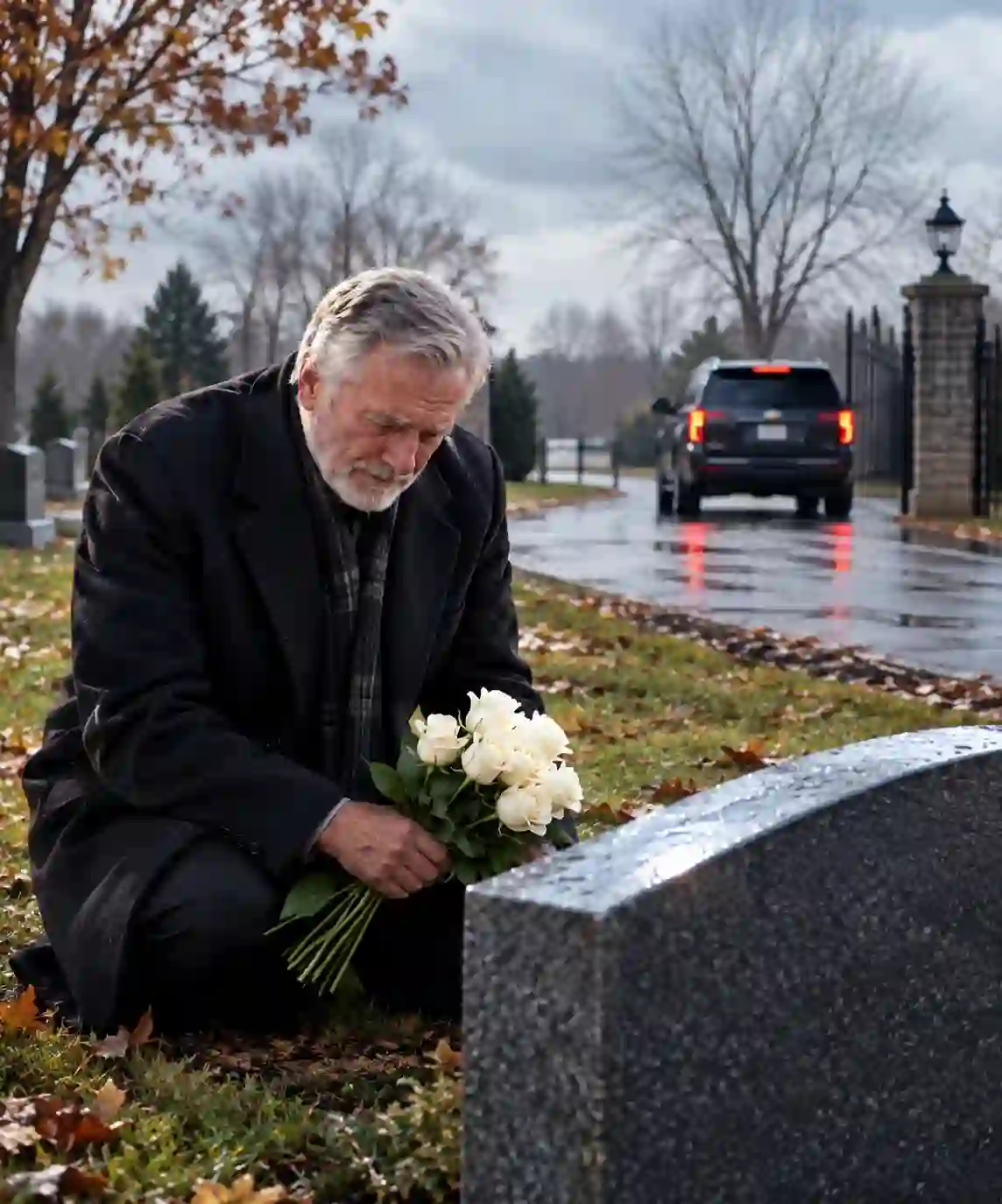
The message arrived just as my daughter’s black SUV disappeared beyond the cemetery gates.
“You’re a burden. Walk home.”
I stared at the words on my phone, hoping I had misunderstood. Then another message appeared.
It was from Vanessa, my only daughter.
“Don’t wait, Dad.”
I was seventy-one years old, standing alone beside my wife’s grave on a freezing November afternoon. I had traveled 190 miles from home to visit the woman I had loved for forty-three years. Now, my own daughter had left me stranded in a cemetery, with no car and no idea how I was supposed to get home.
I could have called after them. I could have begged them to return.
Instead, I slipped my phone into my coat pocket and looked down at the white roses resting against Eleanor’s headstone.
“Looks like it’s just you and me again, sweetheart,” I whispered.
Two years had passed since I buried my wife, but grief had never followed the schedule other people expected. Some mornings, I could make breakfast, tend the garden, and read the newspaper without feeling the emptiness she had left behind. On other days, a familiar song or an old photograph could bring everything rushing back.
This was one of those days.
Eleanor had loved November. She used to tell me that bare trees were proof that something could look empty and still be full of life beneath the surface.
I had asked Vanessa and her husband, Derek, to drive me to the cemetery because my car was being repaired. They agreed, although Derek made it clear that the trip was an inconvenience.
“We have things to do, Harold,” he had said that morning. “We can’t spend the entire afternoon sitting around a grave.”
I said nothing. I had learned that arguing with Derek usually accomplished very little.
When we arrived, I asked them to give me a few minutes alone. I wanted to tell Eleanor about the rosebushes she had planted, the neighbor who kept bringing me homemade soup, and the quiet that had swallowed our house since she died.
Twenty minutes later, Derek checked his watch.
“We’re leaving in five minutes.”
“Please,” I said. “Just ten more minutes.”
Vanessa sighed from beside the car.
“Dad, you always do this. Everything has to revolve around you.”
I turned toward her, surprised by the bitterness in her voice.
“Your mother died two years ago today, sweetheart. I just need a little more time.”
Derek muttered something about emotional blackmail. Vanessa opened the passenger door and climbed inside without answering me.
I thought they were trying to pressure me into hurrying.
Then the engine started.
I watched their vehicle pull away, convinced they would stop near the gate and wait for me. They didn’t. A few seconds later, my phone lit up with Derek’s message, followed by Vanessa’s.
I stood there until the taillights vanished.
For the first time that afternoon, I felt something stronger than sadness.
I felt ashamed that I had spent so long making excuses for people who treated my love as a weakness.
Three months earlier, Derek had visited my house carrying a folder of documents.
“We should get your estate organized,” he said, placing the papers on my kitchen table. “It would make sense to transfer the house into Vanessa’s name now. That way, there won’t be complications later.”
Vanessa sat beside him, wearing the reassuring smile she had used since childhood whenever she wanted something.
“We’re only trying to protect you, Daddy.”
I asked why they were suddenly in such a hurry.
Derek leaned back in his chair.
“At your age, you have to be realistic. You could become forgetful. You could make bad financial decisions. Wouldn’t it be better to let us handle things?”
I had managed my own affairs for decades. I understood perfectly well what those documents meant. Signing them would mean giving up control of the home Eleanor and I had built our life around.
So I refused.
The warmth disappeared from their faces almost immediately.
After that, every disagreement became evidence that I was becoming difficult. Every forgotten appointment was proof that I could no longer manage my life. Whenever I questioned their plans, they accused me of being stubborn.
I kept hoping their behavior was temporary. Perhaps they were stressed. Perhaps they were worried about me and simply expressed it badly.
Eleanor had never believed those excuses.
Near the end of her life, she once took my hand and said, “Harold, don’t confuse being needed with being loved. Some people will keep asking for pieces of you until there is nothing left to give.”
I hadn’t understood how deeply those words applied to our daughter.
Now, standing beside Eleanor’s grave, I remembered the letter she had left among her personal papers. I had finally opened it the previous night, after avoiding it for months because I knew how much I would miss her handwriting.
Her words were simple.
“Harold, if Vanessa ever makes you feel that you must purchase her love, remember that you already gave her everything a father should. Don’t give her your dignity, too. Love her, but don’t let love blind you.”
I folded the letter carefully and placed it back inside my coat.
Then I looked at the messages on my phone again.
I would not apologize for grieving my wife. I would not beg my daughter to treat me with basic kindness. And I would not spend another year pretending that cruelty was simply a different way of showing concern.
I opened my contacts and found a name I hadn’t called in six years.
Richard Mercer.
He had been my corporate attorney for twenty-seven years, long before our industrial logistics company became a major business. Richard had handled our contracts, acquisitions, and the complicated legal work that came with building a company from almost nothing.
He answered after the second ring.
“Harold Bennett? It’s been a long time. Is everything all right?”
“No, Richard,” I said. “But I think it’s time we finished what Eleanor and I discussed.”
The silence on the other end lasted several seconds.
“Are you sure you want to do this?”
I looked at my wife’s name carved into the stone.
“Yes. I’m sure.”
“Where are you?”
I gave him the cemetery’s address. He arranged a car and promised to meet me that evening.
As I waited, I thought about the company I had built over thirty-eight years, starting with two borrowed trucks and a handful of customers who were willing to take a chance on me.
I remembered the long nights, the missed holidays, and the years Eleanor spent helping me keep the business alive when we could barely afford our next delivery.
Eventually, we built something much larger than either of us had imagined. I stepped away from daily operations, trusting a professional management team to run the company while I focused on life outside the office.
But stepping away from daily work had never meant giving up every responsibility or surrendering the decisions that mattered most.
I had also trusted my family to understand that money was never supposed to be a measure of love.
Perhaps that had been my greatest mistake.
Three hours later, I was sitting in a chauffeured sedan, heading toward the city. Richard called while we were on the highway.
“The board meeting is already scheduled for Friday,” he said. “Derek’s promotion is on the agenda. He’s expecting to become executive vice president.”
I sat up straight.
“Is that right?”
“Yes. But before we discuss anything else, I need to make sure you understand the implications of your decision.”
“I understand.”
“Once we begin, things may never return to the way they were.”
I pictured Vanessa’s final message.
Don’t wait, Dad.
“No,” I said quietly. “They won’t.”
Then Richard told me something that made the situation even more interesting.
“As far as Derek knows, you’re still the retired chairman who stays out of company business. He has no idea you’re considering attending Friday’s meeting.”
I looked out the window at the passing lights.
“Then let’s keep it that way.”
Over the next four days, we reviewed documents, spoke with independent advisers, and prepared for the meeting. I wasn’t interested in revenge for its own sake. I wanted to protect what Eleanor and I had spent our lives building, and I wanted to stop allowing my family’s expectations to determine how I lived the rest of mine.
Meanwhile, Derek was preparing for the biggest moment of his career. Vanessa was probably imagining how their lives would change once her husband reached the top.
Neither of them called to ask whether I had made it home safely.
Neither apologized for leaving me alone beside Eleanor’s grave.
And neither had the slightest idea what was waiting for them.
On Friday morning, Derek walked confidently into the company’s headquarters, wearing a charcoal suit and carrying a leather briefcase.
He greeted the receptionist, exchanged jokes with two executives, and headed toward the boardroom. He expected congratulations, handshakes, and the promotion he believed he had earned.
Then he opened the door.
The conversation inside stopped.
Several directors were already seated around the long conference table. Richard Mercer sat near the end, with the company secretary beside him.
And at the head of the room, in the chairman’s seat, sat me.
Derek froze.
His eyes widened. He looked at me, then at Richard, as if he were trying to work out whether he had entered the wrong room.
“Harold?” he finally said.
I folded my hands on the table.
“Good morning, Derek. Please take your seat.”
He stepped inside slowly, his confidence visibly slipping.
He had left a seventy-one-year-old man alone at a cemetery, nearly 200 miles from home, believing there would be no consequences beyond an angry phone call.
Now he was standing in front of the very man whose company he hoped to lead.
But he still didn’t know why I had returned, what the board was about to hear, or what my decision would mean for his future.
And when Richard opened the folder in front of him, Derek finally realized that this meeting was about much more than a promotion.
Continue to Part 2 to discover what happened when Derek faced the man he had underestimated.
Four Days Later, My Son-in-Law Discovered Who Really Held the Power
Derek remained beside the boardroom door for several seconds, unable to hide his surprise.
Then he straightened his tie and walked toward an empty chair.
“Harold, I wasn’t aware you were attending today,” he said, attempting to recover his usual confidence.
“I’m aware,” I replied. “You weren’t expecting me.”
He pulled out the chair and sat down, glancing around the room.
“If this is about Vanessa, I’m sure we can discuss it privately. There’s no reason to involve the board in family matters.”
“Today is about business,” I told him. “But before we begin, I think you should understand why I’m here.”
I turned toward the company secretary, who distributed a statement confirming my continued role as chairman and the ownership rights I had retained after stepping away from daily management.
Derek read the first page, then turned to the next.
He had known I founded the company. What he apparently hadn’t understood was how much responsibility and authority I had retained, even after leaving the day-to-day decisions to the management team.
“Why didn’t you tell me you were coming back?” he asked.
“Because I wasn’t coming back to surprise you. I was coming back because it was time.”
Richard opened his folder.
“The board has two matters to consider today,” he explained. “First, the proposed executive promotion. Second, a review of leadership standards and succession planning requested by the chairman.”
Derek straightened in his chair.
“Of course,” he said quickly. “I’m happy to answer any questions.”
The meeting began with a review of company performance, staffing, and the responsibilities attached to the proposed role.
Derek presented his achievements with his usual confidence. He described the contracts he had helped secure, the improvements he claimed to have introduced, and the plans he had for expanding the company’s operations.
He was a capable businessman. I had never denied that.
But being capable at work was not the only quality required of someone entrusted with significant responsibility.
When the discussion turned to leadership, Richard asked him a question.
“Derek, what do you believe makes someone fit to lead a company beyond their technical performance?”
Derek paused briefly.
“Judgment, accountability, and the ability to make difficult decisions,” he answered.
“Agreed,” Richard said. “And how important is trust?”
“Essential.”
I watched him carefully.
“Then let me ask you something,” I said. “What would you do if someone who depended on you became inconvenient? Someone who needed your patience, your time, or a little compassion when you had other plans?”
Derek shifted in his chair.
“I’m not sure how that relates to the promotion.”
“I’m asking about judgment.”
He glanced toward the other directors.
“I would assess the situation and find a practical solution.”
“Even if that person were an elderly member of your family?”
His expression changed.
I continued before he could answer.
“Four days ago, you drove me to my wife’s grave. When I asked for ten more minutes, you left me there, nearly two hundred miles from home. Then you sent me a message telling me to walk home because I was a burden.”
Nobody moved.
“And my daughter,” I continued, “the child I raised, followed your message with three words of her own: ‘Don’t wait, Dad.’”
Derek leaned forward.
“Harold, that was a private family disagreement. I was frustrated. It didn’t happen the way you’re making it sound.”
I placed my phone on the table.
“Then perhaps you would like to explain your message.”
He stared at the screen without touching it.
“I was angry,” he muttered. “Anyone can say something they don’t mean.”
“That’s true,” I said. “But anger doesn’t force a person to be cruel. It simply makes it easier to stop pretending they aren’t.”
For several seconds, the only sound in the room was the faint hum of the air-conditioning.
Then Derek tried another approach.
“With respect, this company should be run on merit. Personal matters shouldn’t determine professional decisions.”
He was right about one thing. A promotion should not be decided simply because a chairman was angry with someone.
“That’s why the board will make its decision after considering the full record,” I replied. “Your personal conduct has made me question your judgment, but it won’t replace a proper evaluation.”
Richard explained that the directors would review the promotion against the company’s leadership criteria and make their decision independently. My concerns would be recorded, and Derek would have an opportunity to respond.
For the first time that morning, Derek looked genuinely uncertain.
He had expected a celebration. Instead, he faced questions he could not answer with a polished presentation.
The board recessed for deliberation.
Derek remained in the hallway while the directors reviewed the matter. Through the glass, I saw him pacing with his phone pressed to his ear.
I knew who he was calling.
Vanessa.
When the meeting resumed, the board announced that Derek’s promotion would not proceed at that time. The directors wanted further leadership review before making a decision about his advancement.
Derek stared at them as though he had heard a foreign language.
“You can’t be serious,” he said.
The board’s decision stood.
I did not celebrate. I did not smile at his embarrassment. A man losing an opportunity was not, by itself, a victory for me.
But I had finally stopped pretending that family loyalty required me to ignore everything I saw.
After the directors left, Derek approached my chair.
“What do you want from me?” he asked. “An apology? Fine. I’m sorry about the cemetery. I shouldn’t have sent that message.”
“An apology is a beginning,” I said. “It isn’t a way to erase what happened.”
He looked down.
“Vanessa will be devastated.”
I felt the old ache in my chest at the mention of my daughter.
“Yes,” I replied. “She may be.”
Then I gathered my papers and stood.
“There is one more thing. Richard will handle the legal arrangements concerning my estate. My house, my finances, and my future will remain under my control. No one will pressure me into signing documents I don’t understand or don’t want to sign.”
Derek’s face tightened.
“Are you cutting Vanessa out of your life?”
“No. I’m setting boundaries. There is a difference.”
I left the boardroom without another word.
That evening, Vanessa arrived at my house. She was crying before I even opened the door.
“How could you do this to us?” she demanded. “Derek’s career is in danger, and you embarrassed him in front of everyone.”
I let her finish.
Then I asked a question that silenced her.
“Vanessa, did you think about what might happen to me when you drove away from that cemetery?”
She looked toward the floor.
“I was upset.”
“So was I. I had just visited your mother’s grave. But I didn’t leave you stranded in a place you didn’t know, hundreds of miles from home.”
Her eyes filled with tears.
“Dad, I didn’t think you’d take it this far.”
I nodded slowly.
“That’s the problem, sweetheart. You didn’t think about me at all.”
She began to apologize. Some of it sounded sincere. Some of it sounded like fear about what she might lose.
I could not tell the difference that night, and I didn’t need to.
“I love you,” I told her. “You’re my daughter, and that will never change. But love doesn’t mean I have to accept disrespect. If you want a relationship with me, we can start rebuilding one. Slowly, honestly, and without demands.”
She stood in the doorway for a long time before leaving.
I didn’t know whether she would return with a changed heart or simply wait until she wanted something again.
That uncertainty hurt more than I expected.
But the next morning, I went into the garden and pruned Eleanor’s rosebushes. I made breakfast, opened the curtains, and sat by the window where she used to read.
For the first time in years, my decisions belonged entirely to me.
I had spent decades building a company, believing success meant leaving something valuable behind for the people I loved.
Eleanor had taught me that a legacy was more than money, property, or a name on a building. It was also the example you set, the dignity you protected, and the way you treated people when they had nothing left to offer you.
My daughter and son-in-law had mistaken my patience for weakness.
I hoped one day they would understand the difference.
Until then, I would keep my door open to genuine love, but I would never again leave my dignity outside it.
Because at seventy-one, I had finally learned something worth more than any promotion or fortune:
You can love your family with your whole heart without giving them permission to break it.
Editor’s Note: This fictional family drama explores grief, family responsibility, personal dignity, and healthy boundaries. Genuine care should never depend on money, control, or personal convenience. Although family relationships can be complicated, respect, honest communication, and compassion are important foundations for rebuilding trust.
Related Posts
- My Brother Destroyed My $78000 SUV Because I Refused to Give It to His Wife—Then the Police Asked One Question That Silenced My Entire Family

- Every Ride Home Left Me With Missing Memories And I Thought My Husband Was Worried About My Blackouts Until I Heard His Voice on the Recording



About the Author
Hassan is the founder and editor of MidnightReads, a publication featuring thoughtful stories, human-interest articles, history, relationships, and entertaining reads.
He is involved in researching, writing, and editing content for the site, with a focus on creating original, clear, and useful articles that give readers something meaningful to take away.
Hassan believes good content should inform, entertain, and encourage curiosity.
— Hassan, Founder & Editor, MidnightReads