
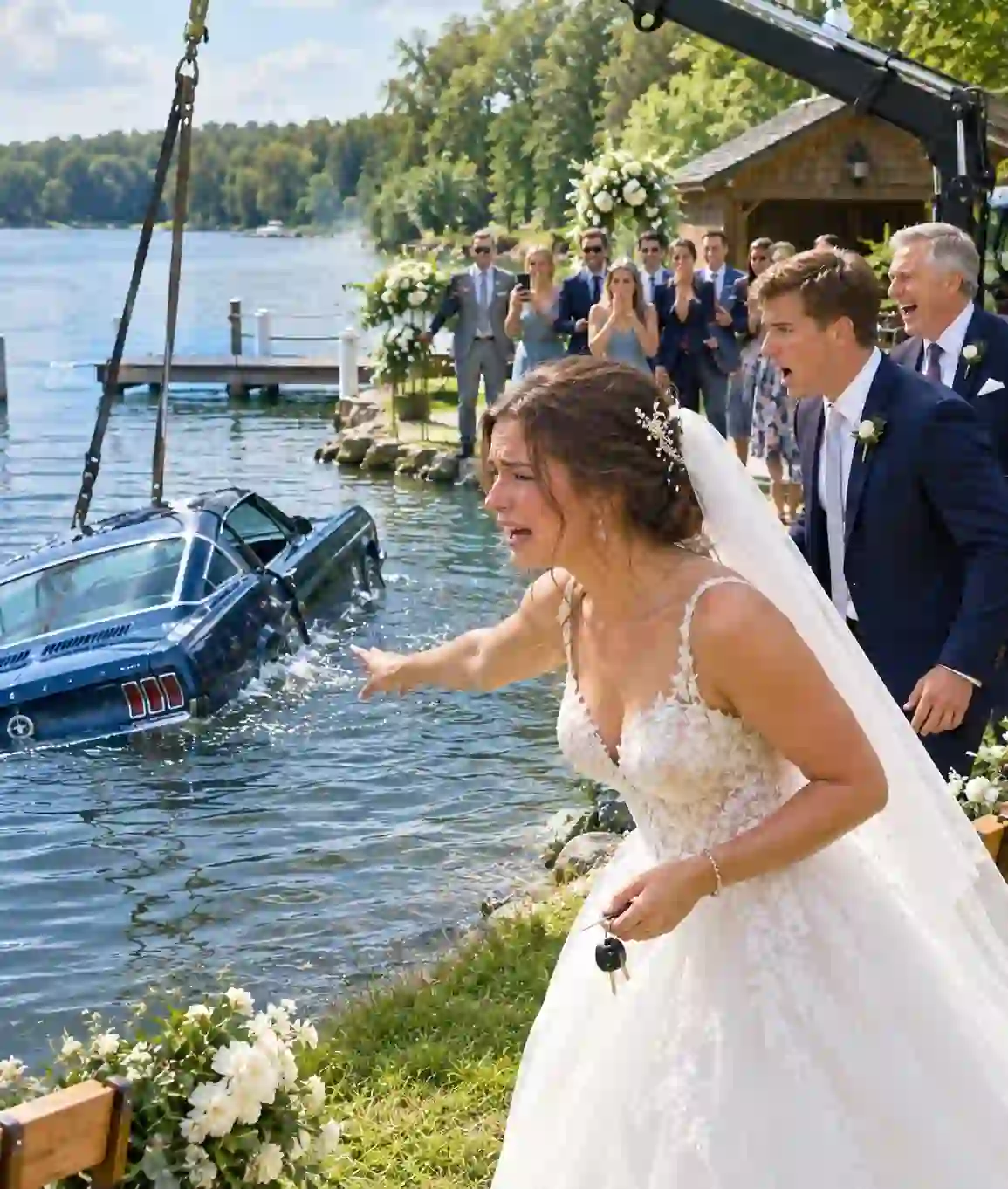
The moment my grandfather’s 1967 Ford Mustang disappeared beneath the water, my brother tossed me the keys and grinned.
“Good luck parking it now, sis.”
A few of our relatives burst out laughing. My father laughed so hard that he had to lean against the boathouse railing. My brother, Dylan, stood beside him, looking as pleased with himself as a child who had just pulled off the greatest prank of his life.
I was still wearing my wedding dress.
For a few seconds, I couldn’t speak. I stared at the lake on my parents’ Michigan property, watching the last ripples spread across the surface where my grandfather’s car had disappeared.
Then I looked at my brother.
“Did you check the trunk before you put it in the water?”
His smile vanished.
My father’s laughter stopped.
And suddenly, nobody seemed to think the prank was funny anymore.
But to understand why that single question changed everything, you need to understand what that Mustang meant to me.
My grandfather, Walter, bought the car when he was a young man. He wasn’t wealthy, and he never pretended to be. He worked long hours at an auto repair shop, saved what he could, and spent years taking care of that Mustang.
When I was twelve, he started teaching me how to work on it.
He showed me how to check the oil, change a tire, recognize unusual engine noises, and understand that a machine could tell you what was wrong if you learned how to listen.
“Never trust somebody who says something is impossible to fix before they’ve even looked under the hood,” he used to tell me.
I loved spending Saturdays with him in his garage. While other kids my age were shopping at the mall or playing video games, I was learning how to replace worn parts and clean old chrome without damaging it.
When Grandpa died, the Mustang became one of the few things I had left that made me feel close to him.
After college, I decided to restore it properly.
The work took six years. I paid for replacement floor panels, electrical wiring, upholstery, paint, and countless smaller parts. I spent weekends tracking down components and evenings studying repair manuals. Sometimes I had to save for months before I could afford the next stage.
There were moments when I wanted to give up.
Then I’d remember Grandpa standing beside me in his garage, smiling whenever I figured something out for myself.
I kept going.
By the time the restoration was finished, the Mustang looked beautiful without losing its character. Its dark blue paint caught the sunlight, the chrome gleamed, and the engine ran with the deep, steady sound I remembered from childhood.
It wasn’t just a car.
It was a piece of my family history, something I’d worked hard to preserve.
Dylan knew all of that.
He also knew why I had refused to lend it to him for his bachelor weekend.
Two years earlier, he’d borrowed our father’s pickup truck and returned it with a damaged bumper and a broken headlight. He’d laughed about that, too, until Dad received the repair bill.
When I refused to hand over the Mustang, Dylan called me selfish.
“You act like it’s a priceless museum piece,” he complained.
“It’s mine, and I’m not lending it to you,” I replied.
He never forgot that answer.
Apparently, he had been waiting for an opportunity to get even.
Unfortunately, he chose my wedding day.
My husband, Ethan, and I had planned a small outdoor ceremony at my parents’ lakeside property. We wanted something simple, with family, close friends, good food, and photographs we’d enjoy looking at years later.
The Mustang had been parked near the gravel drive, where our photographer had taken several pictures of me beside it earlier that morning.
My grandfather would have loved that.
Ethan understood how much the car meant to me. He’d listened to my stories about Grandpa for years, and he’d helped me search for a few hard-to-find restoration parts when we were dating.
When the wedding ceremony ended, Ethan and I went inside to greet guests and take family photographs.
That was when Dylan made his move.
According to what I learned later, he convinced two friends that lowering the Mustang into the lake would be a hilarious wedding surprise. He contacted a local equipment operator named Owen, claiming the family had approved a staged stunt involving an old car that was no longer important to anyone.
Owen apparently had no idea the vehicle belonged to the bride or that it was in excellent running condition.
Dylan had also failed to mention that nobody had my permission.
By the time Ethan and I returned to the boathouse, the crane was already in position.
I watched helplessly as the car was lowered toward the water.
At first, I thought it had to be some kind of misunderstanding. Surely nobody would actually put my grandfather’s Mustang into a lake.
Then the front end touched the water.
The car tilted.
And within moments, it was gone.
Dylan tossed me the keys.
“Good luck parking it now, sis.”
Dad laughed beside him.
I couldn’t understand how the two people who had known me my entire life could watch me lose something so precious and find it entertaining.
Ethan stepped forward, his expression hardening.
“What were you thinking?” he demanded.
Dylan shrugged. “Relax. It’s a car. Insurance exists for a reason.”
“You deliberately destroyed something that didn’t belong to you,” Ethan replied.
Dad shook his head. “It’s a joke. Claire needs to learn to take one.”
I ignored them both.
I bent down, picked up the keys from the grass, and looked directly at Dylan.
“Did you check the trunk?”
His expression changed so quickly that even our relatives noticed.
“What are you talking about?” he asked.
“The trunk. Did you open it before you moved the car?”
He glanced at Dad.
Dad looked back at him.
Neither answered.
That was when I knew they had no idea what they’d actually done.
Earlier that morning, Ethan and I had packed most of our luggage into his SUV. We planned to leave the reception early and spend the night at an airport hotel before beginning our honeymoon the following morning.
But I’d left one thing in the Mustang’s trunk: a locked metal document case.
Inside were the original ownership records for the car, my grandfather’s restoration documents, and signed purchase paperwork for a small lakeside house Ethan and I had bought that morning.
Those documents were valuable, but they weren’t the reason Dylan had suddenly gone pale.
The case also contained a sealed evidence package entrusted to Ethan’s law firm.
Ethan worked as an attorney handling complex financial disputes. A client had provided his firm with an original storage drive and supporting records connected to an ongoing federal financial fraud investigation.
The evidence had been secured, documented, and prepared for transfer to a forensic laboratory. The authorized courier had unexpectedly canceled, and Ethan had agreed to arrange the transfer through the firm’s approved process on Monday morning.
The sealed package was supposed to remain secure until then.
It had been placed inside the locked case in the trunk, where Ethan believed it would be safe while we attended the wedding.
Neither of us had imagined that my own brother would deliberately sink the car.
Ethan took out his phone.
“Claire,” he said quietly, “please tell me the case wasn’t still inside.”
I swallowed.
“It was.”
His face tightened.
Dylan stared at us. “What evidence?”
Ethan turned toward him.
“Evidence that belongs to a client involved in an active federal investigation.”
Dad frowned. “Wait. You’re saying there’s paperwork in the car?”
“More than paperwork,” Ethan replied. “And you have no idea what you’ve just interfered with.”
For the first time that afternoon, Dad looked genuinely worried.
“How expensive could it be?” he asked.
Ethan didn’t answer immediately. He was already calling the appropriate contact at his firm and explaining what had happened.
I stood beside him, still holding the keys to a car that was now sitting somewhere beneath the lake.
My wedding dress brushed against the damp grass. My hands were trembling, but I refused to cry in front of Dylan.
He had wanted a reaction. He’d wanted me to shout, scream, or make a scene so he could tell everyone I was overdramatic.
I wasn’t going to give him that satisfaction.
Instead, I watched him as the reality of the situation began to settle in.
“Can the case be recovered?” I asked Ethan.
“We need to get the recovery operation organized and determine the condition of its contents,” he replied. “Don’t touch anything else, and don’t let anyone move equipment until the operator has documented what happened.”
Owen, the crane operator, approached us. His earlier confidence had disappeared.
“I was told this was approved,” he said. “Your brother said the family owned the car together and that it was going to be scrapped.”
I looked at Dylan.
“Is that what you told him?”
Dylan said nothing.
Owen rubbed the back of his neck. “If I’d known it was a running classic car, I wouldn’t have agreed to this. I thought it was an old wreck.”
Dad stepped between us.
“Let’s not make this bigger than it needs to be. We’ll pay for the car.”
I stared at him.
“You can’t pay to replace something that belonged to Grandpa and took me six years to restore.”
“Then we’ll find another car.”
“There isn’t another one.”
He sighed impatiently, as though I were making the situation difficult on purpose.
That familiar expression hurt more than I expected.
For years, Dad had treated Dylan’s mistakes as harmless adventures. When Dylan damaged something, Dad found an excuse. When I worked hard to accomplish something, Dad called me too serious.
When I restored the Mustang, he said I was wasting my money.
When I refused to lend it to Dylan, he called me selfish.
Now that Dylan had deliberately destroyed it, Dad was still looking for a way to make the consequences disappear.
But this time, the consequences weren’t going to disappear simply because Dad wanted them to.
Ethan ended his call and turned toward Owen.
“We need a proper recovery plan,” he said. “Please preserve your records, including any messages or instructions you received before this happened. Our insurance representatives and the appropriate authorities will need accurate information.”
Owen nodded immediately.
Dylan’s voice rose.
“Are you seriously getting the police involved over a car?”
“No,” I replied. “I’m making sure what happened is documented.”
“Claire, come on. It was a joke.”
I looked at him for a long moment.
“Then explain the joke to Grandpa.”
His mouth opened, but no words came out.
Around us, the relatives who had laughed only minutes earlier were suddenly very interested in the ground. A few quietly moved away. Our photographer had lowered her camera.
Nobody was laughing anymore.
Then Ethan’s phone rang again.
He listened without interrupting, occasionally asking a brief question. His expression grew more serious with every passing second.
When the call ended, he turned to me.
“The firm is arranging for the evidence custodian to coordinate the next steps. We’ll need to document the package, its condition, and the recovery process. We can’t assume the contents are ruined, but we also can’t assume they’re safe.”
I nodded, trying to absorb what he was saying.
Then he added something that made me look at Dylan again.
“There’s another problem. The case was sealed and documented before it was placed in the trunk. If the seal has been compromised, the firm will need a full account of how that happened and who had access to it.”
Dylan’s face drained of color.
Dad finally stopped trying to defend him.
And for the first time since the Mustang went beneath the water, I understood that the worst part of this day might not be the car itself.
It might be what my family would do when they realized that their actions could no longer be dismissed as a harmless prank.
I slipped the keys into my wedding dress pocket.
Then I looked at my brother and asked one final question.
“Dylan, before you had Grandpa’s car lowered into that lake, did you know what was inside the trunk?”
He shook his head too quickly.
“No.”
Ethan watched him carefully.
I wanted to believe him. I really did.
But as Dylan looked toward the road instead of meeting my eyes, I remembered something I’d noticed earlier that morning: he’d been unusually interested in where I’d parked the Mustang.
And suddenly, I wasn’t sure this had ever been about a joke.
End of Part 1.
Part 2: What My Brother Was Really Afraid Of
The first thing I learned that afternoon was that recovering a submerged car wasn’t as simple as hooking it to a crane and pulling it out.
The Mustang had to be brought up carefully to avoid causing additional damage. The recovery team needed to assess its position, account for the lake conditions, and determine the safest way to lift it.
Ethan stayed on the phone with the appropriate professionals while Owen provided details about the equipment and the instructions he’d received.
I changed out of my wedding dress in a guest bedroom and borrowed a pair of jeans and a sweater from my mother.
When I returned outside, Dylan was standing beside Dad near the boathouse.
They stopped talking when they saw me.
“What?” I asked.
“Nothing,” Dad replied.
That answer had never meant nothing in our family.
Ethan came over and put an arm around my shoulders.
“The recovery team is being organized,” he said. “The insurance company has been notified, and the firm is documenting the evidence issue. We’ll take this one step at a time.”
I nodded.
“Do you think the drive is ruined?”
“I don’t know yet. We shouldn’t make assumptions before the specialists examine it.”
That was the truth, and I appreciated him for telling me.
The sealed evidence package had to be handled according to the client’s legal and forensic requirements. Nobody could simply open it, dry it out, or plug the drive into a computer to see whether it worked.
Its condition would have to be documented, and any examination would need to follow the appropriate procedures.
For the first time that day, I felt a little less helpless.
We didn’t know what had survived.
But we did know what had happened, who had arranged it, and where the car had gone.
Those facts mattered.
The recovery operation took several hours to organize. During that time, our wedding reception slowly fell apart.
Guests left early. The caterers packed away untouched food. The music stopped, and the flowers we’d chosen so carefully sat on tables nobody was using.
My wedding day had become a scene I never could have imagined.
Yet I found myself thinking less about the reception and more about my grandfather.
He had never been a wealthy man, but he understood the value of taking responsibility.
If he made a mistake, he admitted it. If he broke something, he tried to repair it. And if he couldn’t fix what he’d damaged, he did everything he could to make things right.
Dylan had done none of those things.
He’d destroyed something precious, laughed at my pain, and assumed Dad would protect him.
That assumption had shaped our family for years.
When we were children, Dylan could break a neighbor’s window and Dad would call it an accident. If I complained, I was told to stop making trouble.
When Dylan quit jobs after a few weeks, Dad said he was searching for the right opportunity. When I worked two jobs to pay my college expenses, Dad told me I was making life harder than it needed to be.
I used to believe that if I worked hard enough, Dad would eventually understand me.
The Mustang had been one of the few things I had never needed his approval to love.
Now even that had been taken from me.
As evening approached, one of the recovery professionals came to speak with us.
The Mustang had been located, and the team was preparing to raise it.
I gripped Ethan’s hand as we watched from a safe distance.
The crane cables tightened.
Slowly, the dark blue roof emerged from the water.
Then the windows, the hood, and the chrome trim appeared.
Water poured from the body as the car rose into the evening light.
My knees weakened.
Even from a distance, I could see that the Mustang had suffered serious damage. The interior was soaked, and the water had reached every part of the car.
But the vehicle was intact enough to be recovered.
I couldn’t tell what that meant for its future.
I only knew that I could see it again.
For a few seconds, I forgot about Dylan and Dad. I forgot about the evidence package and the ruined wedding.
I remembered Grandpa teaching me to hold a wrench correctly, his hands guiding mine as I struggled to loosen a stubborn bolt.
“Take your time,” he’d told me. “You can’t force everything into working order.”
I had to turn away.
Ethan held me while I cried.
Not because the car was expensive.
Not because the reception had been ruined.
I cried because the last physical connection to a man who had made me feel valued had been treated like a disposable toy.
When I could finally speak, I whispered, “I don’t know if I can restore it again.”
“You don’t have to decide that tonight,” Ethan said.
He was right.
The car would need professional assessment. Its mechanical systems, electrical components, interior, and body would all have to be examined. The restoration might be possible, but it would take time, money, and patience.
For now, the important thing was documenting the damage and protecting whatever could still be preserved.
The recovery team secured the vehicle for transport.
The document case was removed under appropriate supervision and handled according to the evidence custodian’s instructions. The original purchase documents and restoration records would need careful examination because they had been exposed to water.
The sealed evidence package was treated separately, with its condition documented before any further examination.
Ethan remained in contact with the firm throughout the process.
Later that evening, he received an update.
The evidence custodian had confirmed the next steps for assessing the drive. There was no guarantee it would be usable, but the specialists believed recovery could not be ruled out until they examined it.
I felt a small measure of relief.
At least we hadn’t lost everything.
Then Ethan asked me to sit down.
“There is something else you should know,” he said.
I looked at him.
“The client has been informed of the incident. The firm will preserve the relevant communications and make any required notifications. I also need to make sure our records clearly establish what happened and that the evidence was not intentionally altered.”
“Do you think Dylan did this because of the package?”
“I don’t know. We shouldn’t assume that without evidence.”
That was fair.
I had been so angry that I’d begun searching for a more sinister explanation. But the truth was that Dylan had a long history of careless behavior and resentment toward me.
A cruel prank was entirely consistent with that history.
Still, one question remained.
Why had he been so frightened when I mentioned the trunk?
I found him alone near the edge of the lawn shortly after nine that evening.
He looked exhausted.
“Did you know the case was in the trunk?” I asked.
“No.”
“Then why did you look so terrified?”
He rubbed his face.
“Because I knew I’d messed up.”
“You didn’t just mess up. You deliberately destroyed my car.”
“I thought it would be funny.”
“Why?”
He looked at me, then away.
“Because you always act like you’re better than everyone.”
The answer was so familiar that it almost made me laugh.
“I spent six years restoring that car. I worked for it. I paid for it. How does that make me think I’m better than you?”
“You always have to be right.”
“No, Dylan. I just wanted you to respect one thing I cared about.”
He shook his head.
“You could have bought another car.”
I stared at him.
There it was again. The same assumption that anything important to me could be replaced with money.
“Grandpa gave me that car because he trusted me to take care of it,” I said. “I spent years preserving it. You knew what it meant to me, and you chose to destroy it on my wedding day because I wouldn’t lend it to you.”
He didn’t answer.
“Did Dad know what you were planning?”
Dylan hesitated.
That hesitation told me more than his words had.
“He knew you wanted to pull a prank,” I said.
“He thought we’d just scare you.”
“By lowering my car into a lake?”
“Dad said the operator wouldn’t actually put it all the way in.”
I felt cold.
“So you both expected someone else to stop you before anything happened?”
Dylan looked down.
“We thought you’d get mad, we’d pull it back up, and everyone would laugh about it later.”
“You didn’t ask me. You didn’t check the car. You didn’t check the trunk. You didn’t even make sure the operator understood what was happening.”
“I said I was sorry.”
“No, you haven’t.”
He opened his mouth.
Then closed it.
For once, he had nothing clever to say.
I walked away before the conversation could turn into another argument.
The following morning, Dad called Ethan and me into the sitting room at my parents’ house.
He had spent the night discussing the situation with Dylan and now wanted to reach an agreement.
“We’re family,” he began. “We need to handle this privately.”
I sat down but said nothing.
Dad continued.
“Dylan made a mistake. A terrible mistake, yes, but we can work out the costs. We’ll help with the repairs, and then everyone can move on.”
“Everyone?” I asked.
He sighed. “Claire, don’t make this a permanent family feud.”
“You watched him do it.”
“I didn’t think he’d actually sink the car.”
“You laughed while it happened.”
Dad looked uncomfortable.
“I thought it was a joke.”
“It stopped being a joke when the car went underwater.”
He leaned forward.
“I’m offering to pay. What else do you want?”
I thought about that question.
For years, I had wanted Dad to admit that Dylan’s behavior wasn’t harmless simply because Dylan was the one doing it.
I had wanted him to stop treating my feelings as an inconvenience.
I had wanted him to understand that loving someone didn’t mean shielding them from every consequence.
But I knew I couldn’t force him to understand any of those things.
“I want you to stop pretending this happened by accident,” I said. “Dylan arranged it. You encouraged him. The car was mine, and neither of you had permission.”
Dad’s jaw tightened.
“You’re really going to involve lawyers over a family prank?”
“Ethan is already making sure his client’s evidence is handled properly. The car damage and the unauthorized removal are separate matters. The appropriate people will determine what happens next.”
Dad stared at me.
For the first time, he seemed to understand that I wasn’t asking for his permission.
I was informing him of my decision.
“I never thought you’d do this to your own brother,” he said.
I almost couldn’t believe what I was hearing.
“You’re worried about what happens to Dylan,” I replied. “Have you once asked how I’m doing?”
He didn’t answer.
I stood up.
“I loved Grandpa. I loved that car. And I wanted one peaceful wedding day with the people I care about. You helped turn it into something I’ll remember for the rest of my life.”
My voice trembled, but I kept going.
“You don’t have to agree with me. But you don’t get to decide that what happened was harmless just because admitting the truth is uncomfortable.”
I left the room.
For the first time in years, I didn’t stay behind hoping Dad would call me back.
The weeks that followed were difficult.
The insurance claim required documentation, photographs, repair estimates, and a detailed account of how the Mustang had been moved and submerged. The final assessment would determine the extent of the damage and what could realistically be restored.
Ethan’s firm followed its procedures for the evidence incident. The forensic specialists assessed the sealed package and its contents, and the client was kept informed through the appropriate channels.
I didn’t interfere with that process, and I didn’t ask Ethan to tell me confidential details about the investigation.
All I knew was that the evidence issue was being handled professionally, and that nobody was pretending the incident had never happened.
As for Dylan, he initially sent me a message saying he was sorry I had been upset.
I didn’t respond.
A few days later, he sent another message.
This time, he admitted that he had arranged the stunt because he was angry about my refusal to lend him the Mustang.
He also admitted that he had ignored Owen’s questions about whether the car was safe to move and whether he had the owner’s permission.
It wasn’t a perfect apology, but it was the first time he had acknowledged what he’d actually done.
I saved the message.
Not because I wanted to use it against him, but because I wanted an honest record of what had happened.
Eventually, the repair assessment arrived.
The Mustang had sustained extensive water damage. Restoring it would be expensive, and some components would need to be replaced rather than repaired. The original interior would be particularly difficult to preserve.
I read the report twice.
Then I called the restoration specialist who had helped me with the final stage of Grandpa’s car years earlier.
“I don’t know if it can ever be the same,” I told him.
“Maybe not exactly the same,” he said. “But we can assess what’s salvageable and make a plan.”
I looked at the photographs of the damaged Mustang spread across my kitchen table.
For a moment, I imagined Grandpa standing beside me in his garage.
I could almost hear him telling me not to force everything into working order.
“Let’s see what we can save,” I said.
The restoration would take time. I would have to make difficult decisions about which original components could be preserved and which needed replacement. But I decided that the car deserved a chance.
I also decided that I wasn’t going to let its restoration become another way for my family to measure my worth.
I would do it because I loved the Mustang.
Not because I needed to prove anything to Dylan or Dad.
Months later, Dylan came to my house without warning.
I nearly closed the door when I saw him.
Instead, I stepped aside and let him enter.
He stood awkwardly in the living room, looking around as though he wasn’t sure he belonged there.
“I wanted to talk,” he said.
“About what?”
“The car. The wedding. Everything.”
I waited.
He took a breath.
“I was jealous.”
I hadn’t expected that answer.
“Jealous of what?”
“You finished something. You worked on that car for years, and you actually did it. You had your own money, your own life, and you didn’t need Dad to fix everything for you.”
He looked embarrassed.
“I kept telling myself you thought you were better than me. It was easier than admitting I was angry with myself.”
For the first time, his explanation sounded like an attempt to understand his own behavior rather than excuse it.
“But I wanted to hurt you,” he continued. “I knew the car mattered to you. That’s why I picked it.”
The honesty was painful.
I sat down.
“Thank you for finally telling the truth.”
He nodded.
“I know an apology doesn’t fix anything. I’ll pay what I’m responsible for, and I’ll cooperate with whatever process follows.”
I looked at him carefully.
“That’s a start. But I need you to understand something. You don’t get to decide how quickly I forgive you.”
“I understand.”
“I don’t know when I’ll trust you again.”
“I understand that, too.”
I wanted to believe him.
But I had learned that apologies were only the beginning. What mattered was what someone did afterward.
We didn’t hug. We didn’t pretend everything was fine.
He left quietly.
For the first time, that felt more honest than a forced reconciliation.
My father took longer.
He continued to insist that he had never intended for the prank to go so far. Eventually, he acknowledged that laughing along had made it worse, but he still struggled to understand why I couldn’t simply move on.
I stopped trying to convince him.
I could love my father without accepting his version of events.
I could hope Dylan changed without pretending his apology had erased the damage.
And I could remember my grandfather without allowing the worst day of my life to define the years I had spent restoring his car.
Almost a year after the wedding, the Mustang was finally ready to return to the road.
It wasn’t exactly as it had been before. Some components had been replaced, and the restoration specialist had preserved the original parts wherever it was practical and safe to do so.
But the dark blue paint gleamed again.
The chrome caught the afternoon sunlight.
And when the engine started, I heard the familiar rumble that had accompanied so many Saturdays in Grandpa’s garage.
I sat behind the wheel and rested my hands on it.
For a moment, I was twelve years old again, listening to Grandpa explain why patience mattered more than force.
I smiled through my tears.
Then I drove the Mustang down the road.
I didn’t take it to my parents’ house.
I didn’t call Dylan to tell him it was finished.
I drove to the small lakeside property Ethan and I had purchased on our wedding morning. We had spent months fixing it up, turning it into a quiet place where we could build our life together.
I parked beside the house and stepped outside.
Ethan was waiting on the porch.
“How does it feel?” he asked.
I looked back at the Mustang.
“Like I finally got something back.”
He wrapped his arms around me.
“You did more than get it back,” he said. “You decided what happened next.”
I thought about that for a long time.
My brother had wanted to embarrass me. My father had wanted me to laugh it off. Both had expected me to accept their version of events because challenging it would be inconvenient.
But I hadn’t needed to shout to stand up for myself.
I hadn’t needed to destroy a relationship to establish a boundary.
I had simply refused to pretend that something cruel was harmless.
And that changed more than I had expected.
I still hoped my family would learn to treat one another differently. I still wanted a future in which Dylan could become someone I trusted and Dad could admit when he was wrong.
But I no longer believed that family love required me to accept every hurt without complaint.
Grandpa’s Mustang had survived because people who understood its value had been willing to take the time to repair it.
I decided my relationships would be judged by the same principle.
Not by promises.
Not by shared history alone.
But by honesty, accountability, and the effort people were willing to make after causing harm.
That afternoon, I took one last look at the car before going inside.
The wedding day had not turned out the way I’d imagined.
But it had taught me something I needed to understand: forgiving someone is a choice, not an obligation, and being family does not give anyone permission to treat you carelessly.
I couldn’t change what my brother had done.
I couldn’t make my father understand everything I felt.
But I could decide what I would carry into the rest of my life.
And I chose to carry my grandfather’s lessons with me—not the laughter from the lake, but the patience, the hard work, and the quiet belief that some things are worth repairing.
Even when the repair takes a long time.
End of Part 2.
Author’s Note
This is a fictional story created for entertainment. The characters and events are fictional, and any resemblance to actual people or events is coincidental. The story explores family boundaries, personal responsibility, and the importance of respecting the things others value.
Related Posts
- My Daughter Abandoned Me at My Wife’s Grave, 190 Miles From Home—Four Days Later, Her Husband Saw Me in the Chairman’s Seat

- My Father-in-Law Lived Under My Roof for 20 Years, and I Called Him a Burden, Until His Lawyer Opened a Blue Ledger at His Funeral and Revealed What He’d Been Hiding All Along

- My Ex-Husband’s Mother Arrived With Two Moving Trucks Minutes After Our Divorce—She Demanded My Mansion, but She Had No Idea What My Attorney Had Discovered2.

- My Mother-in-Law Pushed Me Down the Stairs at Nine Months Pregnant—She Never Expected Her “Unemployed” Son to Arrive With the Entire Board of Directors


Hammad Ali
Co-Owner & Author
Hammad Ali is a co-owner and author at MidnightReads, contributing thoughtful and engaging articles across human-interest, life, history, relationships, and entertainment topics.
They help develop and create original, useful content designed to inform, entertain, and give readers something meaningful to take away.