My Millionaire Ex-Husband Tried to Take Our Baby, Then a Powerful Lawyer Walked Into Court
“She’s broke, works twelve-hour night shifts, and lives in a cramped apartment. She’s clearly unfit to be a mother.”
Those words echoed through the courtroom.
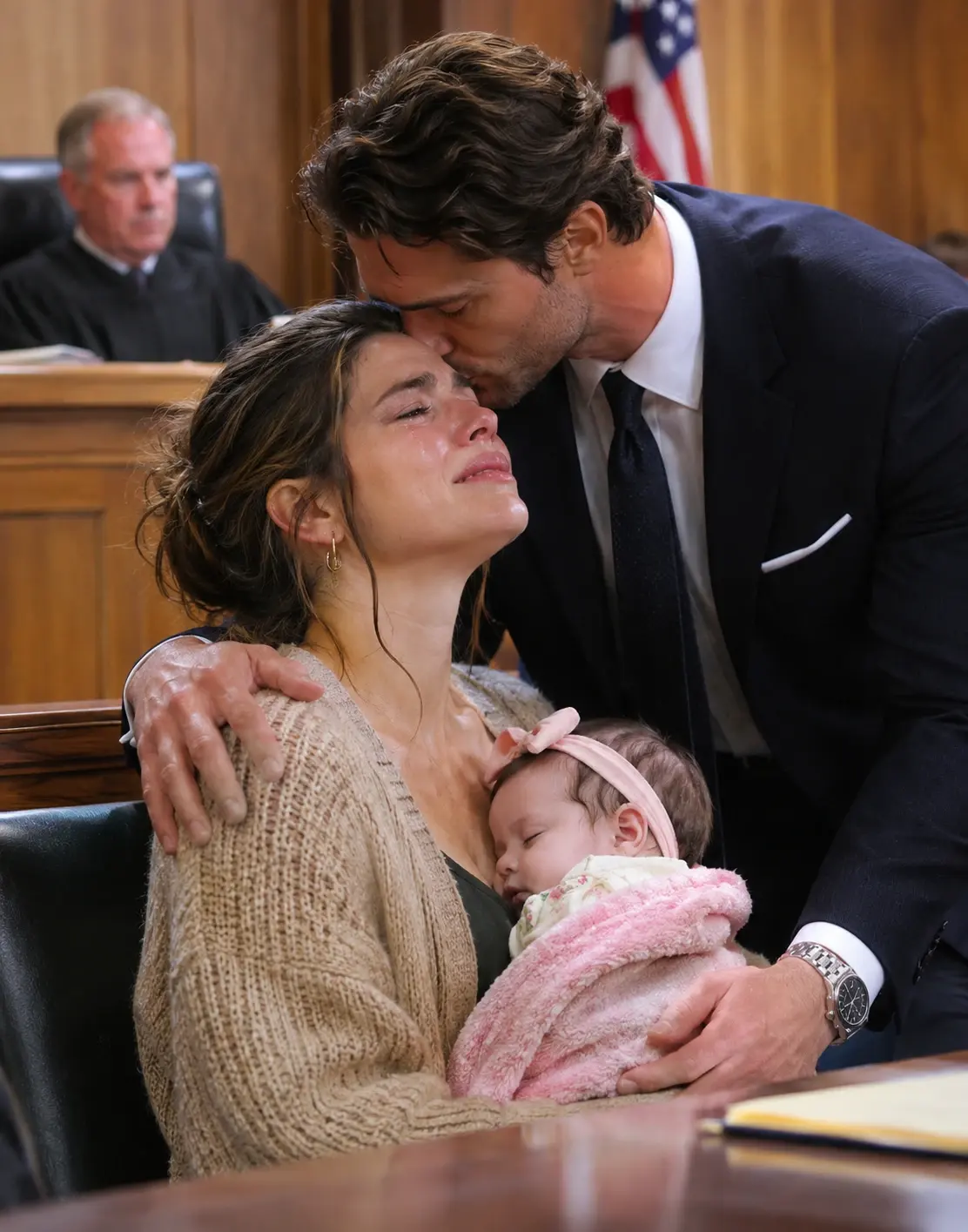
I sat frozen at the defendant’s table, clutching a small photograph of my baby girl, Willow. She was only a few months old, and I had spent every day since her birth doing everything I could to give her a safe and loving home.
Now, my millionaire ex-husband was trying to take her away.
And his attorney was making it sound as though my greatest crime was not having enough money.
“Your Honor,” the attorney continued, adjusting his expensive suit, “my client can provide a private estate, professional childcare, private medical care, and every opportunity this child could possibly need. The mother, on the other hand, works exhausting overnight shifts and lives in an apartment barely large enough for herself and the baby.”
He paused before delivering his final argument.
“This is not about judging her financial circumstances. It is about determining what environment is best for an innocent child.”
I stared at him in disbelief.
Not judging my financial circumstances?
That was exactly what he was doing.
Across the courtroom, Quentin leaned comfortably in his chair. My ex-husband wore a perfectly tailored navy suit and an expensive watch. His expression carried the same confidence I’d seen throughout our marriage whenever he believed money gave him control over everyone around him.
He looked at me and smiled.
It was a smile I knew all too well.
For three years, I had been married to that man. I knew how charming he could appear in public and how cruelly he could behave when nobody else was watching.
Leaving him had been the hardest decision of my life.
But I had made it because I wanted Willow to grow up in a home where love didn’t come with conditions, threats, or humiliation.
Now Quentin was using the very circumstances I had struggled to survive to destroy my chances of keeping her.
I worked overnight shifts because someone had to pay the bills. I lived in a small apartment because I couldn’t afford anything larger. Some nights, I returned home so exhausted that I could barely keep my eyes open.
But Willow was always fed, clean, safe, and loved.
I had never missed a doctor’s appointment. I had never left her without proper care. And whenever I was working, my trusted neighbor watched her.
Yet none of that seemed important to Quentin’s attorney.
“Your Honor,” he continued, “my client is prepared to give this child everything she needs. There is simply no reason to leave her in an environment that offers so little.”
I couldn’t take it anymore.
“That’s not true!”
My voice shook as I stood.
“Everything I do is for my daughter. I work those hours because I want her to have a better life. I may not have a mansion, but she has everything a baby needs. She has a mother who loves her!”
The judge looked up sharply.
“Please sit down and allow the proceedings to continue.”
“But he’s making it sound like I’m neglecting her!”
“Ma’am, you will have an opportunity to speak when appropriate.”
I slowly sat down, wiping the tears from my cheeks.
Then I looked directly at Quentin.
“He doesn’t want Willow because he suddenly wants to be a father,” I said. “He wants her because I left him. He’s doing this to punish me.”
Quentin’s smile disappeared for a moment.
His attorney immediately stood.
“Objection, Your Honor. The mother is making emotional accusations without evidence.”
The judge raised one hand.
“Enough. I have heard the arguments from both sides.”
My heart began pounding.
The judge looked through the documents in front of him.
“The difference between the two proposed living arrangements is substantial. One parent has considerable financial resources, while the other faces obvious economic difficulties.”
I gripped the edge of the table.
Then he reached toward the wooden gavel.
“I am prepared to make a ruling.”
My entire world seemed to stop.
Was this really happening?
Was I about to lose my daughter simply because I couldn’t afford a bigger house?
I looked at Quentin one last time.
He was smiling again.
I closed my eyes, trying to hold back the sob building in my throat.
And then—
BOOM!
The enormous oak doors at the back of the courtroom swung open.
Every head turned.
A tall man in a charcoal-gray suit entered, followed by six attorneys carrying thick leather folders.
He didn’t look around or hesitate.
He walked straight down the center aisle with the confidence of someone who had no intention of asking permission to be there.
I recognized him immediately.
Jameson King.
He was the founder and CEO of one of the most powerful litigation firms in the country. His name appeared in major legal headlines, and even Quentin’s expensive attorneys knew better than to underestimate him.
But why was he here?
Jameson had never been part of my divorce proceedings.
He had no reason to attend a custody hearing involving a struggling mother and her wealthy ex-husband.
Or so I thought.
Quentin’s attorney suddenly stood up.
“Mr. King?”
His voice sounded noticeably different now.
Jameson didn’t answer.
He continued walking until he reached my table.
Then his eyes met mine.
I had seen those unmistakable blue eyes before, but the expression in them was different from anything I remembered.
He placed one reassuring hand on my trembling shoulder.
“It’s going to be all right,” he whispered.
I couldn’t speak.
The entire courtroom had gone silent.
Quentin was no longer smiling.
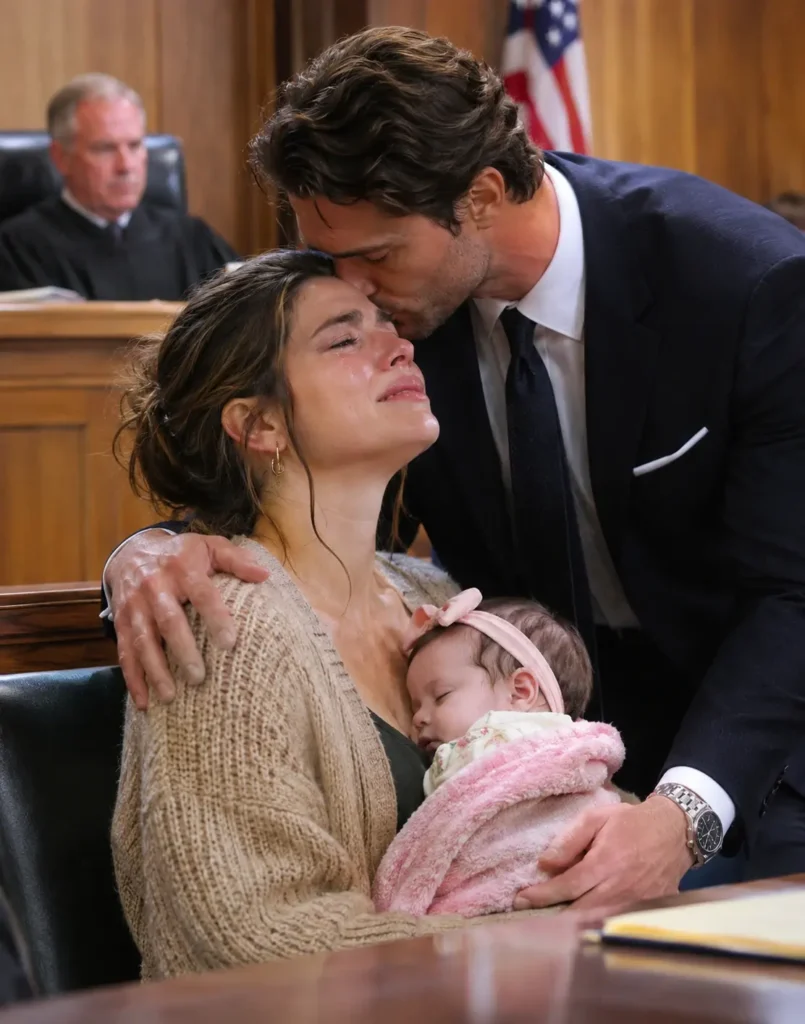
Then Jameson leaned down and gently kissed my forehead.
My ex-husband’s face turned pale.
“What is the meaning of this?” Quentin demanded.
Jameson finally looked in his direction.
He straightened his jacket, placed a thick folder on my table, and turned toward the judge.
“Your Honor, I apologize for arriving during the proceedings. However, I believe this court is about to make a serious mistake.”
The judge frowned.
“And who exactly are you?”
Jameson opened the folder.
“Jameson King. And I am here to represent the child’s mother.”
Quentin immediately leaned toward his attorney.
But Jameson wasn’t finished.
He removed a sealed envelope from the folder and placed it in front of the judge.
“Before you issue any ruling, I respectfully request that you examine these documents. They concern the real reason Mr. Caldwell is seeking custody of this child.”
For the first time that afternoon, Quentin looked genuinely frightened.
The judge opened the envelope.
He examined the first document, then slowly looked up at Quentin.
“Mr. Caldwell, can you explain this?”
Quentin’s expression changed.
“I don’t know what he’s trying to prove.”
Jameson calmly placed another document on the table.
“Perhaps this will help.”
I looked between them, struggling to understand what was happening.
Then Jameson leaned toward me and whispered something that made my heart stop.
“Your ex-husband isn’t fighting for your daughter for the reason you think. And your father discovered the truth before he died.”
I stared at him.
What had my father discovered?
And why had Quentin gone so pale?
I was about to learn that the custody battle was only the beginning of a much bigger story.
PART 2: The Secret My Millionaire Ex-Husband Never Wanted Revealed
I couldn’t stop thinking about Jameson’s words.
My father had been gone for years. He had never told me anything about Quentin’s finances or any secret that could explain what was happening.
“What did my father discover?” I whispered.
Jameson looked toward the courtroom doors to make sure Quentin was out of earshot.
“Your father discovered that Quentin had been hiding serious financial problems from you. He was deeply concerned about the kind of man you had married.”
I shook my head.
“My father never mentioned anything like that.”
“He didn’t want to frighten you. He was gathering information before he could confront Quentin. Unfortunately, he passed away before he had the chance.”
Jameson opened his briefcase and removed another folder.
“Your father left instructions with his estate attorney. He wanted certain documents delivered to me if anything happened to him.”
I took the folder with trembling hands.
Inside were copies of financial statements, correspondence, and a handwritten letter addressed to me.
I recognized my father’s handwriting immediately.
My eyes filled with tears as I began reading.
My dearest daughter,
If you’re reading this, something has happened that prevented me from telling you what I discovered. I want you to understand that you should never measure your worth by the money someone has or the lifestyle they promise to provide.
I have concerns about Quentin’s financial dealings and the way he treats you. Please protect yourself. And remember, no amount of wealth can replace honesty, kindness, or genuine love.
I pressed the letter against my chest.
My father had known something was wrong.
He had tried to protect me, even when I didn’t understand what was happening.
Jameson waited until I had finished reading.
“There is more,” he said gently. “Your father discovered that Quentin had been moving money through several companies. Some of those transactions involved funds that were supposed to be protected for family beneficiaries.”
“Was he stealing?”
“That is what the financial records suggest. The authorities and the relevant trustees will have to determine the full extent of it.”
I looked down at the documents.
“Then why did he want custody of Willow?”
Jameson answered without hesitation.
“Because he believed gaining legal control over your daughter would strengthen his position regarding the family trust. He was more interested in controlling the financial arrangements than he was in becoming a responsible father.”
I felt sick.
For months, I had blamed myself for not being able to provide Willow with the luxurious life Quentin could offer.
Now I was beginning to understand that his intentions had never been as noble as he claimed.
The following weeks were difficult.
Jameson’s legal team submitted the additional evidence, and an independent financial investigation was initiated. Quentin’s attorneys eventually withdrew several of their earlier claims after the documents were examined.
The custody proceedings continued, but the situation had changed dramatically.
The court appointed an independent evaluator to assess both parents and determine what arrangement would best serve Willow’s interests.
I cooperated with every interview and home visit.
I showed the evaluator Willow’s sleeping area, her feeding supplies, her medical records, and the schedule I followed while working overnight shifts.
I also explained how my neighbor helped care for her whenever I was at work.
I didn’t pretend my life was perfect.
I simply told the truth.
Quentin, meanwhile, struggled to explain the financial evidence. His claims that he wanted custody purely for Willow’s benefit became increasingly difficult to support.
Several months later, we returned to court for the final hearing.
I wore the same simple blue dress I had worn during the first hearing.
This time, however, I wasn’t sitting alone.
Jameson was beside me, along with my legal team.
Quentin entered looking noticeably different. His expensive confidence had disappeared, and the familiar smile was nowhere to be seen.
The judge reviewed the evaluator’s report before addressing both parties.
“The court has considered the evidence, the child’s needs, the caregiving history, and the circumstances surrounding this dispute.”
I held my breath.
“The evidence does not establish that the mother’s financial limitations make her an unfit parent. On the contrary, the assessment shows that she has consistently provided appropriate care, maintained a stable routine, and demonstrated a strong emotional bond with her daughter.”
My eyes filled with tears.
The judge continued.
“Furthermore, the court has serious concerns regarding the father’s motives and the financial issues brought to its attention.”
He paused before announcing the decision.
“Primary physical custody of Willow will remain with her mother. The father may have supervised visitation under the conditions outlined in the court’s order. Any future modification will depend on the child’s welfare and the father’s demonstrated ability to meet his parental responsibilities.”
I covered my mouth.
I had won.
Not because I had become wealthy.
Not because I had suddenly moved into a mansion.
But because the court finally looked beyond my bank account and considered the kind of mother I actually was.
Quentin stared at the judge.
Then he turned toward me.
For a moment, I thought he might say something.
Instead, he gathered his belongings and walked out with his attorney.
I watched him leave without feeling the need to follow.
The man who had once made me believe I was nothing without his money no longer had the power to define my life.
Outside the courthouse, Jameson congratulated me.
“You did it,” he said.
I shook my head.
“No. We did it.”
He smiled.
“Your father would have been proud.”
Those words brought fresh tears to my eyes.
A few months later, my life looked different.
I still worked, but I had found a position with more reasonable hours. I moved into a comfortable two-bedroom apartment with enough space for Willow to have her own little room.
It wasn’t a mansion.
There were no private nurses or expensive decorations.
But there were colorful toys on the floor, family photographs on the walls, and a little girl who woke up every morning knowing her mother was there.
Quentin’s financial dealings continued to be investigated separately, and the court’s custody order remained in place. He was required to follow the visitation arrangements and demonstrate that he could put Willow’s needs before his personal interests.
Jameson remained a friend and a source of support, but he never made me feel indebted to him.
One afternoon, while Willow was sleeping in her crib, I found myself looking at my father’s letter again.
I finally understood what he had wanted me to learn.
Money can buy a beautiful house, expensive clothes, and endless comforts.
But it cannot automatically make someone a good parent.
And being poor does not make someone incapable of giving a child a wonderful life.
The most important thing Willow needed was never a mansion.
It was a mother who would stand beside her, protect her, and love her without conditions.
I kissed my daughter’s forehead and whispered, “We’re going to be okay, sweetheart.”
She smiled in her sleep.
For the first time in a long time, I believed it.
Because I had finally learned that being a good mother was never about how much money I had. It was about how much love I had to give.
And no courtroom, millionaire, or expensive attorney could ever take that truth away from me.
Editor’s Note: This story is a work of fiction created for entertainment purposes. The characters, names, events, and situations are entirely fictional. Any resemblance to actual people or events is purely coincidental. The story explores the importance of love, parental responsibility, and the belief that a parent’s worth should never be measured by financial status.
Related Posts
- She’s struggling to pay her rent. She has a younger sister in college. And she’s standing in front of $400,000. Let’s see what she does.

- My Millionaire Ex-Husband Tried to Take Our Baby, Then a Powerful Lawyer Walked Into Court

- My Pregnancy With Seven Babies Was Already Unbelievable, but the Delivery Took an Unexpected Turn

- After spending two peaceful weeks visiting my sister in Florida, I returned and found 15 strangers sleeping in my living room.
- After serving almost four years in prison for a crime I maintained I never committed, I was released with $75, a small bag of clothing, and nowhere to go.

- My 14-Year-Old Stepdaughter Pulled My Little Boy Away From His School Bus, and the Missing Piece of His Backpack Explained Everything






About the Author
Hassan is the founder and editor of MidnightReads, a publication featuring thoughtful stories, human-interest articles, history, relationships, and entertaining reads.
He is involved in researching, writing, and editing content for the site, with a focus on creating original, clear, and useful articles that give readers something meaningful to take away.
Hassan believes good content should inform, entertain, and encourage curiosity.
— Hassan, Founder & Editor, MidnightReads