Eleven days after undergoing surgery, I was still struggling to move around my own house without feeling a sharp pull in my abdomen.
My doctor had been very clear about my recovery: no heavy lifting, no bending unnecessarily, and absolutely no rushing back into household responsibilities. Yet, somehow, following those instructions seemed to be causing more trouble in my marriage than the surgery itself.
My name is Natalie Miller. I’m thirty-one years old, married to Paul, and the mother of two children: Annie, our ten-year-old daughter, and Ben, our five-year-old son. I also work full-time as an insurance coordinator, which means my days are usually filled with phone calls, paperwork, school reminders, grocery lists, and the countless little responsibilities that keep a family running.
Paul works as a sales manager for a regional supply company. His salary is slightly higher than mine, and over the years, we had fallen into a familiar arrangement. He concentrated on his job, while I handled most of the household responsibilities and managed the children’s schedules. We occasionally argued about the imbalance, but I had convinced myself that this was simply how our marriage worked.
Everything changed when I needed surgery.
Before bringing me home from the hospital, Paul promised that I wouldn’t have to worry about anything. He said he would handle the children, prepare meals, keep the house organized, and make sure I had enough time to recover.
“Just concentrate on getting better, Nat,” he told me as he helped me settle onto the living room sofa. “I’ll take care of everything.”
For the first few days, I believed him. Ben went to kindergarten in clean clothes, Annie arrived at school on time, and the refrigerator somehow stayed stocked with groceries. I was too exhausted to investigate how everything was getting done, and I appreciated not having to ask.
However, as the second week approached, the house began looking increasingly neglected. Dirty dishes accumulated beside the kitchen sink, laundry baskets overflowed, and the bathroom towels remained scattered across the floor. Even the kitchen table had developed a sticky patch that nobody seemed interested in cleaning.
Paul, meanwhile, had started making comments that sounded increasingly like complaints.
“Why does the dishwasher always seem full?”
“Where do you keep the extra trash bags?”
“Didn’t we just buy laundry detergent?”
He asked these questions while standing in front of the very things he was complaining about, as though the household supplies were supposed to organize themselves.
One afternoon, I suggested hiring someone to help with the cleaning until I recovered.
Paul immediately frowned. “Really? You’re going to spend money on that?”
“I’m not asking someone to renovate the kitchen. I just need help with the bathrooms, floors, and laundry room. I can’t bend properly yet.”
He sighed before looking away. “Fine. Do whatever you think is necessary.”
I booked a three-hour cleaning appointment through an online service, using my own card. I listed the kitchen counters, bathrooms, vacuuming, and laundry room floor as priorities. It seemed like a simple solution that would allow everyone to get through the next few weeks without unnecessary arguments.
The cleaner arrived at nine the following morning.
Her name was Linda Collins. According to her profile, she was fifty-three and had several years of experience working in private homes. She carried a large canvas bag filled with cleaning supplies and wore a neatly pressed blue shirt.
I opened the door slowly, keeping one hand near my abdomen.
“Good morning. I’m Natalie.”
Linda looked at me, then glanced past my shoulder into the hallway.
“You’re the homeowner?”
“Yes.”
She studied me for another moment. “You’re quite young.”
I gave her a polite smile and explained where the cleaning supplies were kept. I also mentioned that I had recently undergone surgery and might need to rest in the living room while she worked.
She nodded without saying much and followed me toward the kitchen.
The moment she stepped inside, however, her expression changed.
“Oh, my goodness.”
I turned around. “Is something wrong?”
She looked at the dishes stacked beside the sink and shook her head.
“Somebody has certainly let things go.”
I assumed she was joking, so I smiled awkwardly.
“That’s why I hired you.”
She didn’t smile back.
“People used to take much more pride in their homes. These days, everybody wants somebody else to do everything.”
I reminded her that I was recovering from surgery, but she simply waved her hand.
“Honey, I raised three children. I didn’t get to spend my days lying around whenever I felt uncomfortable.”
For a moment, I wasn’t sure whether I had heard her correctly.
“I had an operation,” I explained.
“Of course. I’m just saying that responsibilities don’t disappear because we’re having a difficult week.”
She turned toward the sink and began running the water.
I returned to the living room, hoping the conversation would end there. Unfortunately, Linda seemed determined to share her opinions, whether anyone had requested them or not.
Over the next twenty minutes, I heard her complain about younger women who relied on delivery services, hired cleaners, and expected their husbands to handle everything. She described a former client who supposedly spent her afternoons shopping while her husband worked long hours.
Then she called out from the kitchen.
“Does your husband work?”
“Yes,” I answered.
“Full-time?”
“Yes. So do I.”
There was a brief silence.
“Well, that’s something, at least,” she replied. “Some men work awfully hard to provide comfortable lives for their families.”
I closed my book.
“I contribute financially to this household, too.”
She gave a little laugh.
“Then you should understand how difficult it is to earn money. You wouldn’t be so quick to pay somebody else to wash your dishes.”
I felt my face getting warm. I wanted to tell her that my medical recovery wasn’t a luxury and that I hadn’t hired her because I was unwilling to clean. I had hired her because my surgeon had specifically instructed me not to strain myself.
Instead, I took a breath and tried to ignore her.
A few minutes later, Annie came downstairs. School had a delayed start that morning because of a teacher training session, and she had been upstairs getting ready.
“Mom, do you need more water?” she asked.
“That would be lovely, sweetheart.”
She walked into the kitchen, filled a glass, and brought it to me.
Linda watched her with an approving expression.
“What a polite little girl. Do you help your mother with the housework?”
Annie nodded.
“Sometimes.”
“Good. You should learn while you’re young. A girl needs to know how to look after a home. Nobody wants to marry a woman who doesn’t know how to clean her own kitchen.”
I immediately sat up straighter.
“Excuse me?”
Linda looked surprised by my reaction.
“I’m complimenting your daughter.”
“No, you’re telling a ten-year-old that her value depends on how well she cleans a house.”
“Oh, don’t be so sensitive. Children need to learn responsibility.”
“Responsibility is one thing. Making her feel that domestic work determines her worth is something else entirely.”
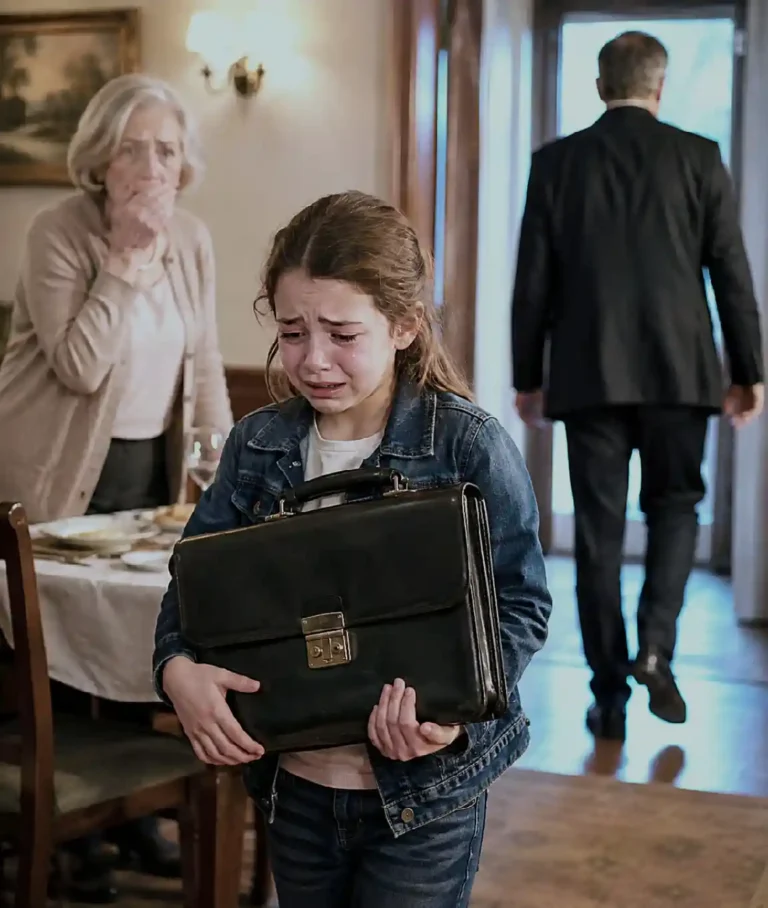
Annie stood quietly between us, holding the empty water pitcher. I noticed that she wasn’t looking at Linda anymore. Instead, she was staring at the floor.
That was enough for me.
“Mrs. Collins, I think we’re finished.”
She blinked. “What?”
“I’m ending the appointment. I’ll pay you for the hour you’ve worked.”
Her expression hardened.
“You’re sending me away because I told your daughter to learn some manners?”
“I’m sending you away because I hired you to clean my home, not criticize me or make my daughter uncomfortable.”
Linda packed her supplies with irritated movements. At the front door, she turned around one final time.
“I hope you appreciate your husband, young lady. Some women don’t understand how fortunate they are.”
I didn’t respond.
She adjusted her bag and walked away.
When the door closed, I finally allowed myself to relax against the sofa. My abdomen was aching, and I was emotionally exhausted from an encounter that should never have happened.
I looked at Annie, who was still standing near the hallway.
“Come here, sweetheart.”
She approached slowly.
“Did I do something wrong, Mom?”
Her question surprised me.
“Absolutely not. That woman was responsible for her own words. You don’t have to worry about anything she said.”
Annie nodded, but she didn’t look entirely convinced.
I assumed she was simply uncomfortable after witnessing an adult argument. I had no idea that she was carrying a secret much heavier than anything the cleaner had said.
And I certainly didn’t know that, by the following morning, I would discover something inside our kitchen that would change the way I looked at my husband.
Chapter 2 — The Schedule My Daughter Was Hiding
Paul came downstairs about ten minutes after Linda left. He was dressed for work, holding his car keys and checking something on his phone.
“She’s finished already?” he asked, glancing toward the kitchen.
“I asked her to leave.”
He looked at the half-cleaned counters and the dishes still sitting in the sink.
“Why?”
“Something happened. I’ll explain tonight after the children are in bed.”
Paul shrugged, apparently deciding that the matter wasn’t worth discussing before work. He called for the children, and a few minutes later, he drove them to school.
I spent the rest of the morning resting, reading, and trying not to think about Linda’s comments. I was disappointed that I had paid for a service I hadn’t received, but I was more upset about the way she had spoken to Annie.
Still, I expected my husband to understand when I explained everything.
That evening, Paul brought home burgers and fries. He placed the paper bags on the kitchen island, helped Ben wash his hands, and then sat down to eat.
After dinner, the children went to the living room while I remained at the table with Paul.
I told him everything that had happened. I explained how Linda had criticized the condition of the kitchen, questioned whether I appreciated his hard work, and told Annie that girls needed to learn how to clean if they wanted to become good wives.
I expected him to be annoyed.
Instead, he took another bite of his burger.
“Maybe she had a point.”
For a moment, I thought I had misunderstood him.
“What did you just say?”
Paul gestured toward the kitchen.
“Look around, Nat. The place is a mess. I’ve been working ten-hour days, handling the kids, dealing with the yard, and trying to keep up with everything else. You’ve been on the couch for almost two weeks. At some point, you have to start helping instead of spending money on strangers to do basic housework.”
I stared at him.
“I’ve been recovering from surgery. You know that.”
“I know, but the entire household can’t stop functioning because you need a few weeks to rest.”
“I didn’t ask the household to stop functioning. I asked you to help.”
He shook his head.
“That’s exactly what I’ve been doing.”
Before I could answer, Annie appeared in the kitchen doorway holding her math workbook.
She looked at Paul, then at me. There was something unusual about her expression, something that made me put down my glass.
“Dad?” she asked quietly. “Did you tell Mom about the schedule?”
Paul stopped eating.
His fork remained suspended above his plate for a moment before he slowly placed it beside his food.
“What schedule?” I asked.
Annie looked down at her feet.
“The one Dad made for me. He said I shouldn’t bother you with it while you were resting.”
The silence that followed was unlike anything I had experienced in our marriage.
Paul immediately stood up.
“Annie, go upstairs and get ready for bed. I’ll come check your homework in a minute.”
I looked at my daughter.
“That’s okay, sweetheart. Go upstairs. I’ll come tuck you in shortly.”
She left without another word.
The moment her footsteps disappeared, I turned toward my husband.
“What schedule is she talking about?”
Paul rubbed the back of his neck.
“It’s nothing. Just a little chore chart.”
“For Annie?”
“She’s the oldest. I thought she could help out while you’re recovering.”
I stared at him.
“Why didn’t you tell me?”
“Because I knew you’d make a big deal out of it.”
“What exactly was I supposed to make a big deal about?”
He sighed.
“Natalie, I was trying to protect your recovery. I didn’t want you getting up every five minutes because something needed doing. Annie is perfectly capable of helping with a few things.”
I looked at the stairs.
“What things?”
“Packing lunches, straightening the kitchen, helping Ben get ready. Normal household responsibilities.”
“She’s ten years old, Paul.”
“And she’s old enough to understand that families help each other.”
His voice had become sharper.
I wanted to continue the argument, but something about Annie’s question was bothering me. She hadn’t asked whether I knew about a chore chart. She had asked whether Paul had told me about the schedule.
There was a difference.
“Why did she think she wasn’t allowed to tell me?”
Paul looked away.
“Because I didn’t want you worrying about it.”
He picked up his plate and walked toward the sink.
“I have enough on my mind without arguing about every little thing.”
Then he left the kitchen.
I remained at the table, staring at the empty doorway.
Over the previous week, I had noticed that Annie sometimes looked unusually tired in the mornings. I had assumed she was staying up too late reading or struggling to adjust to the school routine.
I also remembered seeing her carrying laundry downstairs one afternoon. When I asked what she was doing, she told me she was helping Dad.
I had been pleased.
Now those memories were beginning to look different.
That night, I lay beside Paul for hours, listening to his steady breathing. I wanted to wake him and demand an explanation, but I knew he would probably dismiss my concerns again.
I needed to see the schedule myself.
At 5:30 the following morning, I quietly got out of bed. My abdomen still hurt, so I moved slowly, wearing a loose cardigan over my pajamas.
The house was completely dark.
I stood near the upstairs landing and waited.
At exactly 5:45, I heard a bedroom door open.
It was Annie’s.
She stepped into the hallway already dressed in jeans and a sweater. Her hair was tied into a messy ponytail, and she was carrying her sneakers in one hand.
She looked toward her father’s bedroom, then quietly began walking downstairs.
I waited a few seconds before following her.
From the shadow near the staircase, I watched my daughter enter the kitchen without turning on the main light. She switched on the small bulb above the stove, dragged a step stool toward the counter, and climbed up to reach the cupboard where we kept the lunchboxes.
She took out two lunchboxes.
One was hers.
The other belonged to Ben.
Then she opened the refrigerator and began collecting food.
I stood motionless.
My ten-year-old daughter was preparing breakfast and school lunches before sunrise while both of her parents were supposed to be asleep.
I stepped into the kitchen.
“Annie?”
She jumped so suddenly that she nearly dropped the bread.
“Mom!”
Her face changed when she saw me. The surprise quickly disappeared, replaced by something that looked almost like guilt.
“I’m sorry,” she whispered. “I was trying to be quiet.”
I approached her slowly.
“Sweetheart, what are you doing?”
She glanced toward the staircase.
“Making the lunches.”
“Why?”
“Dad said I had to finish before Ben woke up.”
My stomach tightened.
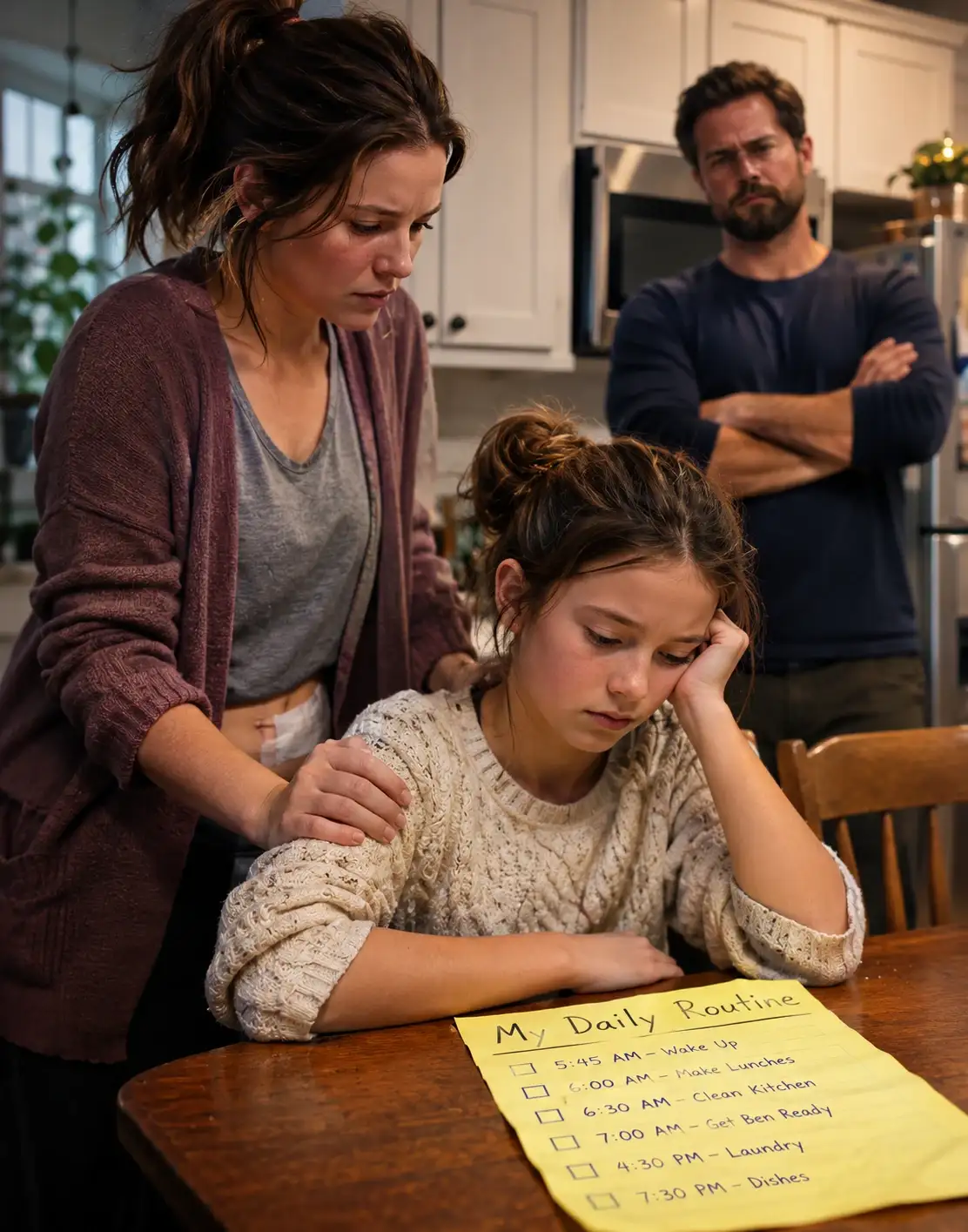
I turned toward the pantry, where a laminated yellow sheet of paper was taped to the inside of the door.
I opened it fully.
At the top, in large printed letters, were the words:
MORNING & EVENING ROUTINE — ANNIE
Below that was a detailed list.
5:45 AM: Wake up. Prepare lunches for Annie and Ben. Pack both backpacks.
6:15 AM: Empty the dishwasher and wipe the kitchen counters.
6:30 AM: Lay out Ben’s clothes. Help him brush his teeth and get dressed.
7:00 AM: Prepare Dad’s coffee and make breakfast for Ben.
4:30 PM: Fold one load of laundry and vacuum the living room.
7:30 PM: Clear dinner dishes and load the dishwasher.
At the bottom, there was one final instruction written in Paul’s familiar handwriting.
Do not wake Mom. This is how we help the family.
I read the entire page twice.
Suddenly, the previous eleven days made sense.
The clean clothes Ben had worn to school. The lunches that appeared in the refrigerator. The kitchen counters that occasionally looked better than I expected. Even the coffee Paul drank every morning.
None of it had been the result of my husband’s efforts.
Our daughter had been doing it.
He hadn’t taken over the household responsibilities. He had simply transferred them to a ten-year-old child and instructed her to keep it secret.
I felt something inside me break.
“Annie,” I whispered, turning toward her. “How long have you been doing all this?”
She lowered her eyes.
“Since the day after you came home from the hospital.”
My throat tightened.
“Every morning?”
She nodded.
“What about after school?”
“I do some things when I get home. Dad said the laundry doesn’t take very long, and Ben needs help because he’s still little.”
I crouched beside her, although the movement pulled painfully at my healing incision.
“Sweetheart, who told you that you had to do all of this?”
“Dad.”
“Did he say why?”
She hesitated.
“He said you were sick and couldn’t do much. He said if the house got too messy, you would become upset and your stitches might open again. Then it would be our fault because we hadn’t helped enough.”
I couldn’t speak.
Annie continued in a small voice.
“He said I was the oldest, so I had to be responsible. He also said I shouldn’t tell you because you might try to do everything yourself.”
I reached for her hands.
“Have you been getting enough sleep?”
She shrugged.
“Sometimes I’m tired at school.”
“Annie, you’re ten. You should be sleeping, eating breakfast, and getting ready for school. You shouldn’t be responsible for running this household.”
Her eyes filled with tears.
“I was just trying to help, Mom.”
That sentence hurt more than anything else.
I pulled her into my arms as carefully as I could. She leaned against me, and I felt her small shoulders begin to shake.
“You have nothing to apologize for,” I whispered. “You haven’t done anything wrong.”
She held onto me for a long moment.
Then she asked the question I will never forget.
“Is Dad going to be angry because I told you?”
I pulled back and looked directly into her eyes.
“No. You are never in trouble for telling me the truth. And you are not responsible for protecting grown-ups from the consequences of their choices.”
I stood slowly and reached for the yellow sheet.
With one firm movement, I peeled it away from the pantry door.
I folded it once and placed it on the kitchen table.
My husband had spent eleven days telling me that I needed to start contributing again.
Meanwhile, he had been teaching our daughter that her childhood responsibilities included keeping her mother quiet, her brother prepared, and her father comfortable.
The house cleaner’s insults suddenly seemed like the smallest problem in our home.
Because the person who had been treating me unfairly wasn’t a stranger who had walked through our front door.
It was the man I had trusted to protect our family.
Discover More: My Best Friend and I Chose the Same Sperm Donor for Our Babies later Then the Doctor Asked If We Were Secretly Related
Chapter 3 — The Morning Everything Changed
At 7:05 the following morning, Paul walked into the kitchen wearing his usual button-down shirt and dark trousers. He reached automatically for the coffee pot, then stopped when he noticed that it was empty.
The kitchen was unusually quiet.
There were no lunchboxes waiting on the counter, no breakfast dishes, and no backpack standing beside the door. Ben was still upstairs watching cartoons, and Annie was sleeping in her bedroom.
I was sitting at the dining table.
The yellow schedule lay directly in front of me.
Paul looked at it, then at my face.
“Nat? What are you doing up so early?”
“I’m waiting for you.”
He frowned.
“Where are the kids?”
“Annie is sleeping. Ben is upstairs.”
Paul glanced toward the staircase before looking back at me.
“Why is Annie still asleep? She needs to get ready.”
“She’s not getting up at five-forty-five anymore.”
His expression changed.
I tapped the yellow paper.
“Would you like to explain this?”
He stared at it for several seconds.
Then he pulled out the chair opposite me.
“Look, Natalie. Before you get upset, I can explain.”
“Please do.”
He sighed.
“It’s a chore chart. I thought it would make things easier while you were recovering.”
“Did you write it?”
“Yes.”
“Did you tell her to wake up before six every morning?”
“She volunteered to help.”
I looked at him.
“She is ten years old, Paul. Did you seriously expect me to believe that she volunteered to prepare breakfast, pack lunches, clean the kitchen, help her brother get dressed, fold laundry, and vacuum the house every single day?”
He rubbed his forehead.
“You’re making it sound worse than it was.”
I slowly pushed the paper toward him.
“Read it.”
He glanced down.
“I know what’s written there.”
“Then perhaps you should explain why our daughter has been doing your coffee, your children’s lunches, and your household chores while you sleep.”
His jaw tightened.
“I have a demanding job, Natalie. I can’t do everything.”
I stared at him.
“Neither can I. Yet for years, I’ve worked full-time and managed this household without asking our daughter to sacrifice her sleep.”
“I never said you had to do everything.”
“You didn’t have to say it. You simply expected it.”
He leaned back in his chair.
“I was overwhelmed. I was trying to keep things together.”
“And when you couldn’t manage the responsibilities, you gave them to Annie and told her not to tell me.”
“I didn’t want you worrying.”
“You told her that my recovery depended on her keeping the house clean. You made a ten-year-old believe that if she failed to finish her chores, my stitches might open.”
Paul looked down.
For the first time that morning, he didn’t immediately have an answer.
I continued.
“Do you know what she asked me when I found her in the kitchen? She wanted to know whether you would be angry because she had told me.”
His expression shifted.
“She said that?”
“Yes. Your daughter was afraid of disappointing you because she couldn’t keep a secret from her own mother.”
Paul rubbed his hands together.
“I didn’t realize she was taking it so seriously.”
“That’s because you never bothered to ask how she was doing.”
The silence between us grew.
I looked at the schedule again.
“Paul, chores are normal. Children can make their beds, put away toys, and help with age-appropriate tasks. But this isn’t a chore chart. This is a household management schedule. You assigned her responsibilities that belong to the adults in this family.”
He finally looked up.
“What do you want me to do?”
I had thought about that question all night.
“First, you’re going to call your office and tell them you’ll be late this morning.”
He looked surprised.
“Why?”
“Because you’re going upstairs to get Ben ready. You’re going to prepare breakfast, pack his lunch, and make sure Annie has time to sleep. Then you’re going to apologize to her.”
“I can do that.”
“And I don’t want to hear that you were stressed or that you were only trying to help. She deserves a real apology. You need to tell her that what you asked her to do was inappropriate and that she was never responsible for my recovery.”
Paul looked down at the paper.
“Okay.”
“Second, this schedule is finished. Annie will not be doing household work before school, and she will not be responsible for Ben’s daily care.”
He nodded slowly.
“And third,” I continued, “when you come home tonight, we’re going to divide the household responsibilities between the two adults who actually live here. Not based on who earns more money, not based on who is a man or a woman, and certainly not based on who happens to be home recovering from surgery.”
He remained silent.
“I am your wife, Paul. I’m not your employee. And our daughter is not a replacement for me.”
His eyes finally met mine.
“I understand.”
“I hope you do. Because I won’t allow Annie to grow up believing that being a good woman means sacrificing her sleep, education, and happiness to make everyone else comfortable.”
Paul picked up the yellow sheet and folded it carefully.
Then he stood.
“I’ll talk to her.”
“Good.”
He started toward the stairs but stopped halfway across the kitchen.
“Natalie?”
I looked up.
“I’m sorry.”
It was the first apology I had heard from him since the entire situation began.
I didn’t rush to accept it.
“Then show me that you’re sorry by changing what happens next.”
He nodded and walked upstairs.
A few minutes later, I heard his voice coming from Annie’s bedroom. I couldn’t make out every word, but I heard him tell her that she didn’t need to get up early anymore.
Then came a long silence.
When Annie finally came downstairs, she looked at me with cautious eyes.
“Mom, am I still supposed to make the lunches?”
I smiled and opened my arms.
“No, sweetheart. Your dad is making them today.”
She looked toward the kitchen.
“Dad is making lunch?”
“Yes.”
A small smile appeared on her face.
“Can I go back to sleep for a little longer?”
“Absolutely.”
She hugged me before returning upstairs.
I sat at the table, listening to the ordinary sounds of the morning. Paul opened the refrigerator, searched through the cupboards, and asked where we kept the sandwich bags. Ben came downstairs asking for cereal, and his father helped him find a clean bowl.
It wasn’t a perfect morning.
The toast was slightly burned, the kitchen became messy again, and Paul struggled to remember where we kept the children’s lunch containers.
But for the first time in nearly two weeks, those responsibilities belonged to the person who had agreed to take them on.
That evening, we sat down with a blank sheet of paper and divided the household tasks. We discussed school preparations, laundry, meals, cleaning, grocery shopping, and the countless small responsibilities that had previously fallen almost entirely on me.
It wasn’t a magical solution to years of imbalance. One conversation couldn’t erase the way Paul had behaved or restore the trust he had damaged.
But it was a beginning.
Over the following weeks, I continued recovering from surgery. Paul took on more responsibilities, and Annie returned to her normal routine of school, homework, friends, and playtime. Her only regular chores were age-appropriate tasks, such as putting away her toys and keeping her bedroom reasonably tidy.
I also made sure she understood something I wished every child could hear.
Helping your family is an act of love. It should never become a burden that steals your childhood.
A few days later, while we were having breakfast, Annie looked at me and said, “Mom, I like it better when mornings aren’t so busy.”
I smiled.
“So do I.”
She took another bite of her pancakes and began telling me about a book she wanted to borrow from the school library.
Watching her talk excitedly about something so ordinary, I realized how much I had missed during those eleven days.
I had been so focused on recovering physically that I hadn’t noticed how exhausted my daughter had become.
And that was something I would never allow to happen again.
I still think about Linda Collins occasionally. Her judgmental comments were unpleasant, but she had no idea what was happening behind our front door.
The bigger problem wasn’t the woman who walked into my kitchen and criticized the mess.
It was the husband who looked at that same mess, decided his daughter should clean it, and convinced himself that he was doing everyone a favor.
Our kitchen didn’t need a perfect cleaning schedule.
Our family needed something much more important: adults willing to act like adults.
And our daughter needed the freedom to be ten years old.
The most important lesson I learned wasn’t about keeping a clean house. It was about recognizing when the people who are supposed to protect a child are quietly asking that child to carry burdens that were never hers to bear.
Editor’s Note: This story explores the importance of shared family responsibilities, mutual respect, and protecting children from adult burdens. No child should feel responsible for managing a household or sacrificing their childhood to keep the family running. A healthy home is built on understanding, teamwork, and care—not criticism or unrealistic expectations.This story is presented for entertainment and reflection. Names and identifying details have been changed, and some elements may be fictionalized.
Related Posts
- My Pregnancy With Seven Babies Was Already Unbelievable, but the Delivery Took an Unexpected Turn

- At 80, My Stomach Started Growing, Then Doctors Discovered Something Nobody Expected

- On My Wedding Day, My Brother Sank My Grandfather’s Vintage Mustang Into a Lake—Then I Asked One Question That Wiped the Smiles Off Their Faces

- I Pretended I Was Dying to Find Out If My Struggling Girlfriend Loved Me or My Money—Then She Disappeared for Five Days and Returned With Something That Made Me Break Down in Tears
- My Son’s Best Friend Wore a Bright Red Dress to His Funeral, The Reason Left Us all in Tears
- My Brother Destroyed My $78000 SUV Because I Refused to Give It to His Wife—Then the Police Asked One Question That Silenced My Entire Family








About the Author
Hassan is the founder and editor of MidnightReads, a publication featuring thoughtful stories, human-interest articles, history, relationships, and entertaining reads.
He is involved in researching, writing, and editing content for the site, with a focus on creating original, clear, and useful articles that give readers something meaningful to take away.
Hassan believes good content should inform, entertain, and encourage curiosity.
— Hassan, Founder & Editor, MidnightReads