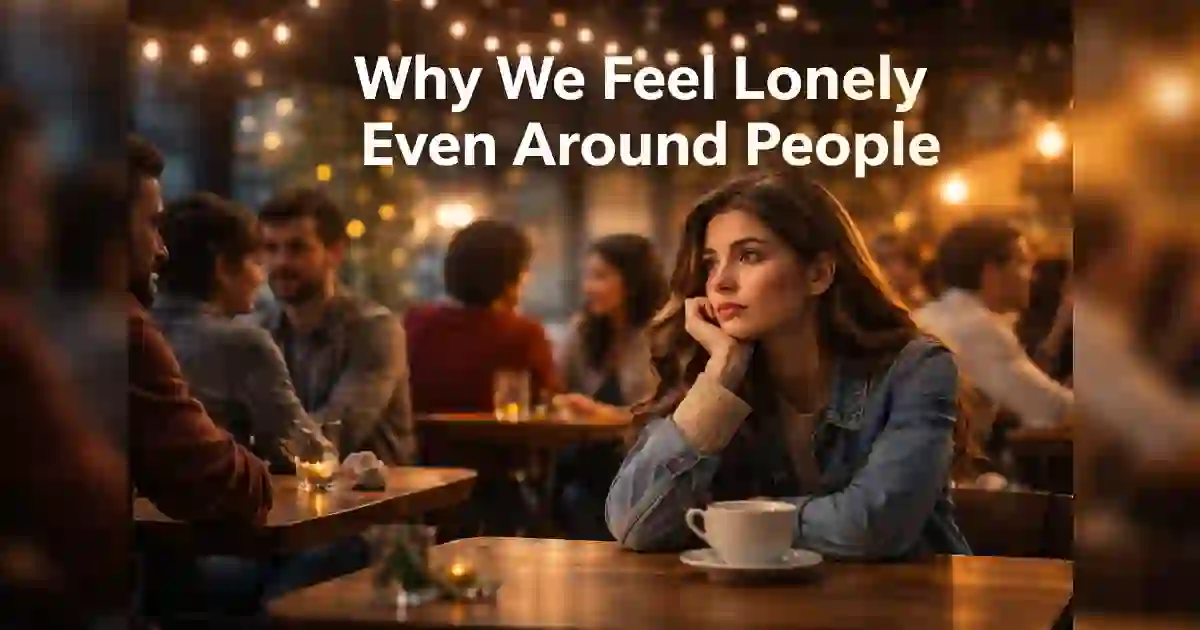
You can be sitting in a room full of people and still feel completely alone.
Everyone is talking. Laughing. Scrolling and Sharing stories.
And somehow, you feel disconnected from all of it.
It’s a strange kind of loneliness. Not the kind that comes from being physically alone — but the kind that comes from feeling unseen.
And if you have ever felt this way, you are not dramatic. You are not ungrateful. You are not broken.
You are human.
Let’s talk about why this happens.
Loneliness Is not About the Number of People Around You

Most people think loneliness means isolation.
But loneliness is not about physical presence.
It is about emotional connection.
You can have friends, coworkers, family members, instead of all these you still feel like no one truly understands you.
When conversations stay surface-level… When no one asks how you are really doing… When you do not feel safe enough to open up…
That is when loneliness shows up.
It is not the absence of people.
It’s the absence of connection.
You are Present, But Not Fully Yourself
Sometimes we feel lonely because we are not actually being ourselves around others.
Maybe you filter your thoughts. Maybe you tone down your personality. Maybe you avoid talking about what truly matters to you.
When you constantly adjust who you are to fit into a group, you slowly disconnect from your own identity.
And when you are not being real, the connection does not feel real either.
You may be surrounded by people — but if they only know the edited version of you, it will not feel fulfilling.
Real connection requires authenticity.
And authenticity requires safety.
You may also like The Hidden Reason We Overthink Conversations
Surface Conversations Create Deep Emptiness

There is nothing wrong with small talk.
But if every interaction stays at “How is work?” and “What’s new?” — it can start to feel hollow.
We crave depth.
We crave someone asking, “How are you really feeling?”
When conversations never go deeper than daily updates, something inside us stays untouched.
And that untouched part becomes lonely.
We do not just want to be heard.
We want to be understood.
Social Media Makes It Worse
You can spend hours online interacting with people and still feel disconnected.
Why?
Because most online interactions are curated.
You see highlight reels. You see perfect photos. You see filtered happiness.
And even when you comment, react, or message then it rarely replaces genuine emotional presence.
Scrolling creates stimulation.
But stimulation is not connection.
The more we replace meaningful interaction with digital engagement, the easier it becomes to feel lonely in crowded digital spaces.
You are Carrying Things You Have not Shared

Sometimes loneliness comes from unspoken emotions.
Maybe you are stressed. Maybe you are overwhelmed. Maybe you are struggling silently.
But you have not told anyone.
When you carry heavy thoughts alone, even friendly environments can feel distant.
You laugh. You nod. You participate.
But inside, there is a quiet weight no one sees.
And that creates emotional separation.
It’s hard to feel connected when the deepest parts of you stay hidden.
You Do not Feel Truly Seen
Being around people does not automatically mean being seen.
Feeling seen means:
Someone notices your mood shifts.
Someone remembers small details about you.
Someone asks about the thing you mentioned weeks ago.
When interactions feel transactional or routine, connection feels shallow.
We do not just want company.
We want recognition.
And when that’s missing, loneliness grows quietly.
You have Outgrown Certain Spaces

Sometimes loneliness is not about people being bad.
It is about growth.
You may have changed.
Your interests may have shifted. Your mindset may have matured. Your priorities may have evolved.
But your environment stayed the same.
When you outgrow certain conversations or values, you start feeling disconnected and even if the people around you have not changed.
And that does not mean you are better than them.
It just means you are on a different path now.
You are Not Comfortable Being Vulnerable
Vulnerability is uncomfortable.
Opening up feels risky.
You might think: “What if they do not understand?” “What if they judge me?” “What if I look weak?”
So you stay quiet.
But without vulnerability, connection stays shallow.
And shallow connection cannot fill emotional needs.
Sometimes loneliness is not about others not reaching in.
It’s about us not letting them.
You may also like Things We Secretly Enjoy When No One Is Watching
The Fear of Being Misunderstood

Maybe you have tried opening up before.
Maybe someone dismissed your feelings. Maybe someone changed the subject. Maybe someone gave advice instead of listening.
That can make you withdraw.
When you feel misunderstood repeatedly, you stop trying.
And when you stop trying, emotional distance grows.
Loneliness becomes a defense mechanism.
So What Can You Do?
Loneliness does not disappear overnight.
But small shifts can help.
Start with one person.
Not everyone.
Just one.
Share something slightly deeper than usual.
Ask one meaningful question.
Put your phone away during conversations.
Be present.
Connection grows slowly but not instantly.
And sometimes, you may realize that the environment is not right for you.
That is okay too.
You are allowed to seek spaces where you feel more understood.
Final Thoughts
Feeling lonely around people does not mean you are ungrateful.
It does not mean you do not appreciate your friends.
It does not mean something is wrong with you.
It means you crave depth.
You crave authenticity.
You crave emotional safety.
And that is not weakness.
That is awareness.
True connection is not built on proximity.
It is built on presence.
It is built on honesty.
It is built on feeling safe enough to be real.
And when you find even one space , one person, where you can be fully yourself…
That quiet loneliness begins to fade.