
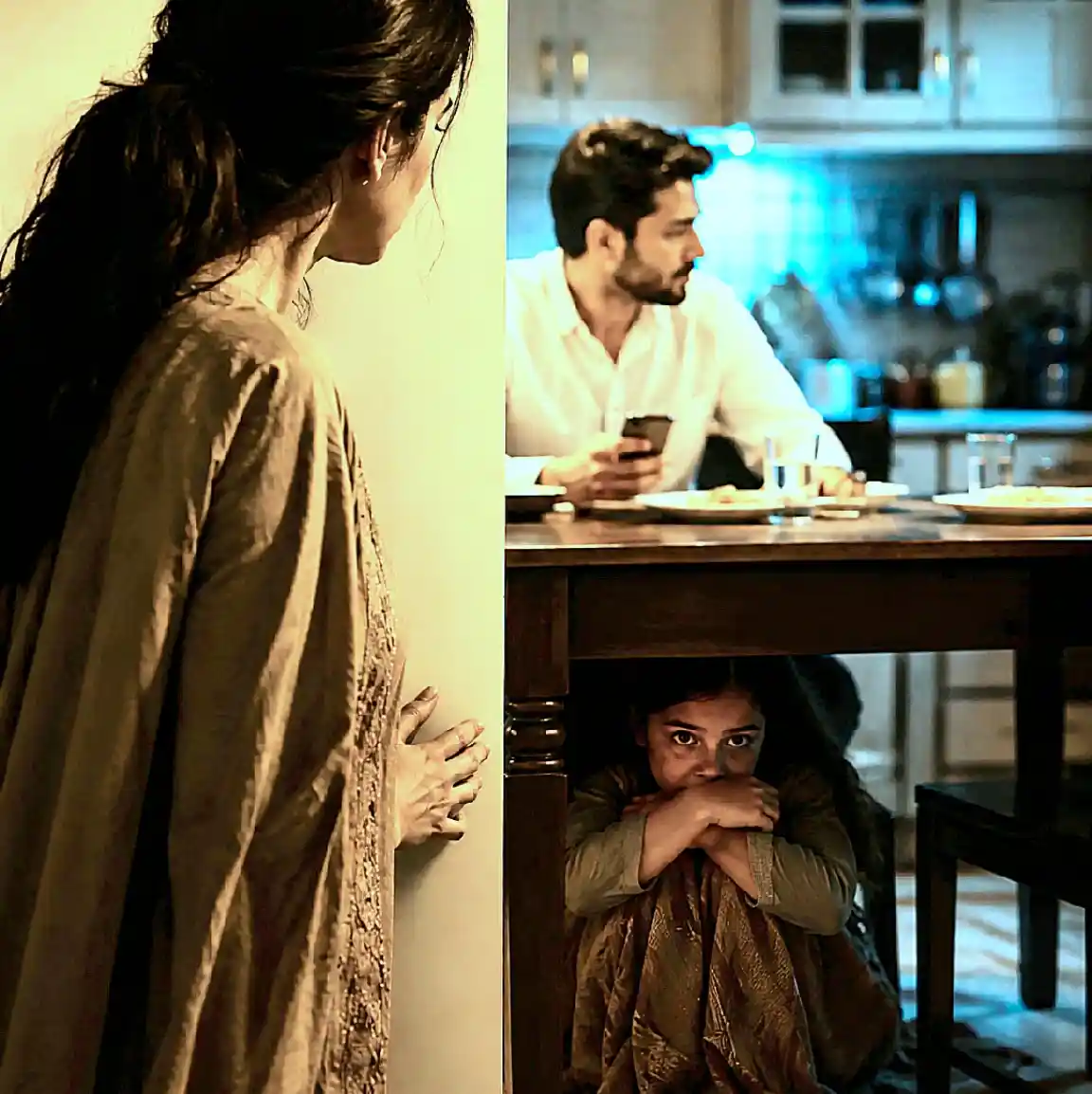
My Nine-Year-Old Daughter Started Sleeping Under the Kitchen Table… And I Was Terrified When I Finally Learned Why
The first time I noticed something was wrong, I ignored it.
That is the part that still haunts me the most.
Not the police.
Not the phone.
Not even the look on my daughter’s face the night everything finally came apart when my 9-Year-Old Daughter Refused to Sleep in Her Room alone.
What destroys me even now is the memory of all those tiny moments I explained away because accepting the truth felt impossible.
My daughter’s name was Maryam.
She was nine years old. And quiet by nature.
Gentle in a way that made people instantly protective of her.
After losing her father at six years old, she had become even softer. Grief changed her slowly, like rain wearing down stone. She stopped laughing loudly. She stopped making friends easily. Sometimes she would stare out the apartment window for long stretches of time without speaking at all.
I used to think she was still waiting for her father to come home.
Maybe part of her always was.
We lived in a small apartment in Lahore above a noisy electronics repair shop. During the day, the sounds of traffic never stopped. Rickshaws rattled past our windows from morning until midnight. Vendors shouted from the street below. Somewhere nearby, somebody was always frying onions or boiling tea.
Life in our building was crowded and loud.
But inside our apartment, silence slowly started growing.
After my husband died, everyone treated me differently.
Neighbors pitied me.
Relatives advised me.
Women spoke to me in lowered voices, as if widowhood were contagious sadness.
“You are still young, Ayesha.”
“A child needs stability.”
“You cannot spend your whole life alone.”
At first I refused every suggestion of remarriage.
I was exhausted.
Trying to survive already felt difficult enough.
Then I met Faraz.
And for the first time in years, life seemed less heavy.
He was calm, respectful, dependable.
The type of man mothers trusted immediately.
He helped elderly neighbors carry groceries upstairs. He remembered birthdays. He never used foul language. Even the watchman downstairs used to praise him.
Most importantly, he appeared patient with Maryam.
He bought her books.
Helped with homework.
Brought small chocolates home after work.
Whenever someone praised him for caring about another man’s child, he would smile modestly and say:
“She is my daughter now too.”
And every single time he said it, I felt grateful.
Looking back now, that gratitude feels like betrayal.
The first few months after our marriage seemed normal.
Not perfect.
But peaceful enough.
Then Maryam began changing.
At first the changes were subtle.
She stopped sitting close to Faraz during dinner.
Whenever he entered a room unexpectedly, she startled visibly before pretending everything was fine.
She began locking the bathroom door even during daytime.
One afternoon I walked into her room without knocking and found her hurriedly changing clothes inside her blanket.
“Why are you doing that?” I asked with a small laugh.
Her face immediately turned red.
“I just want privacy.”
She was only nine.
I remember feeling surprised.
Faraz overheard us and chuckled from the hallway.
“She is growing up.”
That explanation satisfied me.
Or maybe I wanted it to satisfy me.
Because once a terrible thought enters your mind, it changes everything forever.
And I was not ready for that.
Weeks passed.
Maryam started waking up in the middle of the night.
Sometimes I would find her sitting awake in bed, sweating despite the fan spinning overhead.
“Another nightmare?” I would ask.
She always nodded.
Never more than that.
Then she stopped sleeping properly altogether.
Dark circles appeared beneath her eyes.
Her teacher called one afternoon saying Maryam seemed distracted in class and had become unusually withdrawn.
I blamed grief again.
Or school pressure.
Or hormones.
Anything except the truth.
One evening we were all eating dinner together when Faraz reached over and touched Maryam’s shoulder casually while speaking.
My daughter physically flinched.
Not slightly.
Violently.
The spoon fell from her hand onto the plate with a loud metallic sound.
For a second nobody spoke.
Then Faraz laughed awkwardly.
“Why are you so jumpy these days?”
Maryam immediately apologized.
“I am really sorry.”
Sorry.
That word crushed me later.
Children apologize when they are scared adults will become angry.
I should have noticed that.
But instead, I forced myself to smile and continued eating.
That night I lay awake much longer than usual.
Something deep inside me felt uneasy.
Not enough to face directly.
But enough to disturb my sleep.
The next few days became stranger.
Maryam started carrying her school bag everywhere around the apartment.
Even to the kitchen.
Even to the bathroom.
Whenever I asked why, she simply said:
“I don’t want anyone touching my things.”
Faraz joked about it constantly.
“She guards that bag like treasure.”
Maryam never laughed.
Then came the night I stopped being blind.
Dinner ended quietly.
Faraz was watching television while scrolling through his phone.
I was washing dishes when I noticed Maryam gathering strange things from her room.
Her blanket.
A pillow.
Her water bottle.
Her school bag.
Without saying anything, she walked into the kitchen, crawled beneath the dining table, and pushed herself tightly against the wall.
At first I stared in confusion.
“Maryam?”
She pulled the blanket around herself.
“I’m sleeping here tonight.”
I almost smiled.
“Why?”
She kept her eyes fixed downward.
“It feels safer.”
My stomach tightened instantly.
Before I could respond, Faraz laughed from the living room.
“Kids watch one horror movie and suddenly become dramatic.”
Maryam’s body stiffened at the sound of his voice.
I slowly crouched beside the table.
“Sweetheart, what do you mean safer?”
For several seconds she stayed silent.
Then very quietly she whispered:
“Here he cannot open me.”
The plate slipped from my hands.
The sound exploded through the apartment.
Faraz immediately looked toward us.
“What happened?”
But I could not answer.
Because every nerve in my body had gone cold.
👉You would love this also:: She Was Given Away at 6 Months Old — The Hidden Pain She Carried for Years
I looked at my daughter beneath that table and suddenly months of strange moments connected together inside my head all at once.
The nightmares.
The flinching.
The locked doors.
The fear.
The silence.
My breathing became uneven.
“What did you say?” I whispered.
Maryam immediately shook her head.
“Nothing.”
Faraz stood up from the sofa.
“You’re scaring her now.”
He walked toward us casually.
The moment he stepped closer, Maryam pushed herself farther back beneath the table so fast her shoulder hit the wall.
That movement shattered something inside me.
Children move away from danger instinctively.
Even when they cannot explain why.
Faraz stopped walking.
For one brief second, irritation flashed across his face before disappearing behind another calm smile.
“You are both overreacting.”
I barely slept that night.
Every sound inside the apartment felt wrong.
Every movement felt suspicious.
Faraz acted completely normal beside me in bed. He even joked before sleeping.
“She is becoming too emotional lately.”
I said nothing.
Around two in the morning, I suddenly woke up.
The space beside me was empty.
At first I assumed he had gone to the bathroom.
Then I noticed the apartment was completely silent.
Too silent.
I stepped into the hallway.
And froze.
Faraz was standing outside Maryam’s bedroom door.
One hand rested on the handle.
The hallway light cast shadows across half his face.
“Faraz?”
He turned calmly.
“She was coughing.”
“I did not hear anything.”
For a moment, his eyes stayed fixed on mine.
Cold.
Careful.
Watching.
Then came the familiar smile again.
The polite one.
The harmless one.
“You worry too much.”
I wanted to believe him.
God help me, part of me still wanted to believe him.
Because the alternative was unbearable.
The next morning Maryam refused school completely.
She sat curled on the sofa hugging her school bag tightly against her chest.
Faraz left for work after breakfast.
The second the apartment door closed behind him, the air itself felt lighter.
I sat beside my daughter carefully.
Neither of us spoke for a long time.
Then finally I whispered:
“Did Faraz hurt you?”
Maryam stared at the floor.
Tears gathered slowly in her eyes.
I felt my chest tightening painfully.
“Please tell me the truth.”
Without speaking, she opened her school bag.
Inside was my old mobile phone.
I stared at it in confusion.
I had lost that phone months ago during our move.
“Where did you get this?”
Maryam’s hands started shaking.
“I hid it.”
Fear crawled slowly through my body.
I turned the phone on.
There was only one folder.
VIDEOS.
Nothing else.
No photos.
No contacts.
No apps.
Just VIDEOS.
Maryam suddenly began crying so hard she could barely breathe.
Not loudly.
Not dramatically.
Quietly.
Like someone exhausted from carrying terror alone for too long.
Then she asked the question that broke me completely.
“Will you believe me?”
No child should ever need to ask her mother that.
I pulled her into my arms immediately.
“I will always believe you.”
She buried her face against my chest and sobbed until my clothes were wet with tears.
I never opened the videos because I could not be able to do it.
I already knew enough.
My entire body screamed one thing:
Get her somewhere safe.
Immediately.
I called my older sister within minutes.
That evening Maryam packed a small bag and left with her aunt.
The entire time she held my hand tightly like she feared I might suddenly change my mind.
Before leaving, she looked at me nervously and whispered:
“You are not angry?”
That question destroyed something inside me forever.
Because it meant she had been carrying fear and guilt at the same time.
“No,” I told her. “Never.”
That night I waited alone inside the apartment for Faraz to come home.
When he entered carrying sweets and samosas like every ordinary evening, I looked at him differently for the first time.
Not as my husband.
Not as Maryam’s stepfather.
But as a stranger wearing a human face.
He smiled casually.
“Where’s Maryam?”
“At my sister’s house.”
His expression changed slightly.
Only slightly.
“Why?”
I stared directly at him.
“She needed space.”
For several seconds neither of us spoke.
Then the doorbell rang.
Faraz frowned.
I walked to the door and opened it.
My sister stood outside beside a female police officer and Maryam’s school counselor.
Faraz immediately stepped backward.
“What is this?”
The police officer spoke calmly.
“We need to ask you some questions.”
He laughed suddenly.
Sharp.
Cold.
Disbelieving.
“You’re serious?”
I looked at him carefully.
And for the first time since meeting him, I saw anger beneath the performance.
“You still have not watched the videos, have you?” he asked quietly.
Fear moved through my body like ice water.
“What did you do?”
His smile slowly returned.
But now it looked ugly.
“You really thought the phone was only about the child?”
My throat went dry instantly.
He stepped closer.
“Did you never wonder why your bedroom door opened at night sometimes? Why objects moved? Why your phone angles changed?”
The room began spinning around me.
Memories crashed into place violently.
The half-open closet.
The strange sounds outside the bathroom.
The uneasy feeling of being watched.
And Maryam…
My little girl had found that phone.
Hidden it.
Protected it.
Protected me.
Even while terrified herself.
Tears filled my eyes instantly.
Not weakness.
Shame.
Because my child had been braver than me.
The police took him away that night.
Neighbors gathered outside whispering among themselves.
Some looked shocked.
Others looked doubtful.
Because charming men rarely look dangerous to outsiders.
For weeks afterward, Maryam barely spoke.
Trauma changes children quietly.
She stopped drawing.
Stopped singing.
Stopped sleeping peacefully.
Sometimes I caught her checking door locks repeatedly before bed.
One afternoon I found her sitting beneath the kitchen table again.
I sat beside her silently.
After several minutes, I finally asked:
“Why here?”
She touched the wooden edge softly.
“Because there’s only one opening.”
I swallowed hard.
“If someone came,” she whispered, “I could see them first.”
My heart broke so completely in that moment that I thought I might physically collapse.
A nine-year-old child had built herself a hiding place inside her own home.
And her mother never noticed.
Months later, things slowly improved.

Therapy helped.
Time helped.
Love helped.
One night Maryam finally decided to sleep in her bedroom again.
But before entering, she stopped at the doorway and looked back at me nervously.
“Will you leave the door open?”
I smiled despite the tears burning in my eyes.
“Yes.”
That night I sat outside her bedroom until morning.
Just listening to her breathe peacefully.
And sometime before sunrise, I realized something I will carry for the rest of my life:
Children are not always afraid of darkness.
Sometimes they are afraid nobody will believe them when they finally speak about what is hiding inside it.
If this story moved you, share it with others. 💔
Thank you for reading—your support means a lot. Stay connected for more real and emotional stories.
Latest Posts
- I Found a Six-Year-Old Girl Cleaning My Study at 2 A.M. With a Baby on Her Back, Then She Pointed to My Library Wall and Asked Why Someone Was Knocking Behind It

- Poor Girl Was Mocked for Her Cheap Yellow Dress at a Luxury Wedding—Minutes Later, She Stopped to Help an Elderly Woman Who Changed Her Life
- Two Traffic Officers Pulled a Young Woman From Her Car and Handcuffed Her, Then One Thing in Her Pocket Changed the Entire Stop

- The Billionaire Saw His Fiancée Push the Maid Off the Building, What He Did Next Left the Entire City in Shock





About the Author
Hassan is the founder and editor of MidnightReads, a publication featuring thoughtful stories, human-interest articles, history, relationships, and entertaining reads.
He is involved in researching, writing, and editing content for the site, with a focus on creating original, clear, and useful articles that give readers something meaningful to take away.
Hassan believes good content should inform, entertain, and encourage curiosity.
— Hassan, Founder & Editor, MidnightReads