
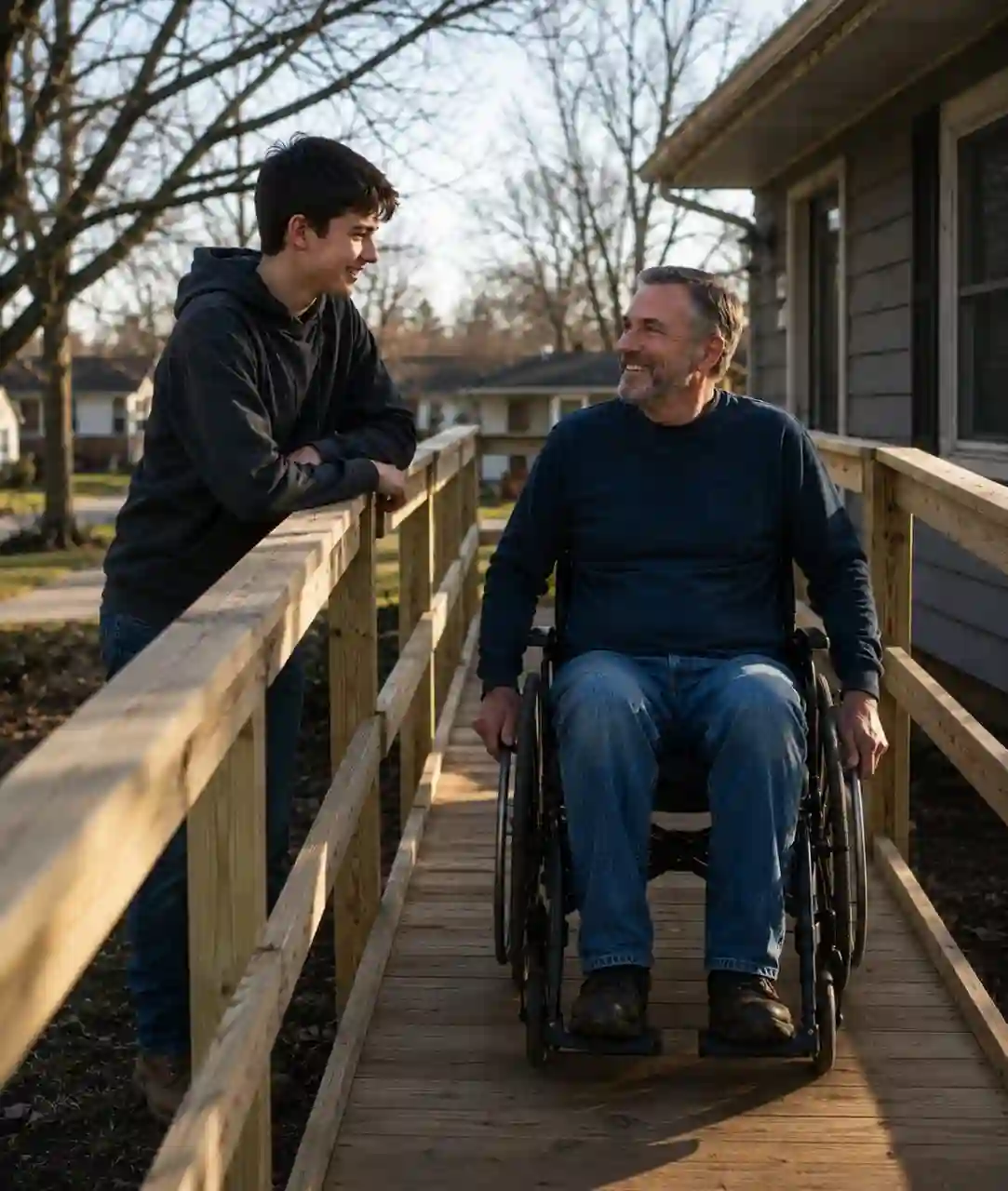
The first time my fourteen-year-old son Mason knocked on Hank Rourke’s door, he was carrying the ugliest birdhouse I had ever seen.
The roof leaned to one side, three nails were sticking out at odd angles, and one wall looked as though it had been measured by someone who had never heard of a ruler. Mason knew it was bad. He also knew exactly where he wanted to take it.
Across the street lived Hank, a fifty-eight-year-old carpenter who had spent most of his life making broken things useful again.
Before his accident, Hank was the kind of man people called when they had given up on a repair. A loose stair, a damaged cabinet, a table with a broken leg—somehow, Hank could usually find a way to fix it. He had worked with wood for more than thirty years, and his garage was packed with tools he knew as well as most people knew the rooms in their own homes.
Then, one afternoon at a construction site, a steel beam shifted.
The accident happened quickly. Hank survived, but he lost his left leg below the knee.
When he finally returned home, everything that had once seemed ordinary had become complicated. The three steps leading to his front door were now an obstacle. His workshop was difficult to reach. His pickup truck sat untouched in the driveway.
The doctors and physical therapists recommended a wheelchair ramp.
Hank refused.
Several neighbors offered to build one. A local contractor offered to do the work at a reduced price. I even told him that my husband and I would help pay for the materials.
Every offer received the same answer.
“No.”
It wasn’t that Hank didn’t understand what the ramp would do for him. He understood perfectly.
That was exactly why he did not want it.
I have built ramps for other people,” he told me one afternoon. “I don’t need somebody building one for me.”
I tried to explain that accepting help wasn’t the same as giving up.
Hank looked toward the garage.
“Maybe not to you.”
After that, I stopped bringing it up.
Hank became quieter.
He stopped going to the diner where he had eaten breakfast every Sunday morning. He stopped visiting the hardware store. He rarely sat outside anymore, even when the weather was beautiful.
Most heartbreaking was what happened to his workshop.
The garage door stayed closed.
Through the window, I could see his tools sitting exactly where he had left them. His workbench was covered with a thin layer of dust. A half-finished wooden cabinet stood against one wall, waiting for someone who no longer seemed interested in finishing it.
Hank hadn’t just lost a leg.
He seemed to believe he had lost the person he used to be.
My son Mason had never been particularly interested in woodworking.
That changed when he enrolled in a high school shop class.
His first assignment was supposed to be a simple birdhouse.
Instead, Mason created what looked like a small wooden disaster.
When he brought it home, I tried very hard not to laugh.
“Don’t,” he warned.
“I didn’t say anything.”
“You were thinking it.”
“I was thinking it needs character.”
Mason sighed and looked at the birdhouse.
“My teacher says I rush everything.”
“He might have a point.”
Mason stared at me.
Then his eyes moved toward Hank’s house.
“Do you think Mr. Rourke would help me?”
I knew exactly who he meant.
“You could ask.”
Mason picked up the birdhouse.
A few minutes later, he was walking across the street.
I watched from the kitchen window as he climbed Hank’s three porch steps and knocked.
Hank didn’t answer immediately.
Mason knocked again.
Eventually, the door opened.
Hank was standing there on his crutches.
“What do you need, kid?”
Mason held out the birdhouse.
“My teacher says I have no business holding a hammer.”
Hank glanced at it.
His face remained serious for about three seconds.
Then one corner of his mouth lifted.
“Your teacher may be onto something.”
Mason nodded.
“My mom says you’re the best carpenter around.”
“She exaggerates.”
“I need you to teach me how to fix this.”
Hank looked at the birdhouse again.
“That’s not a repair.”
Mason waited.
“That’s a rescue.”
For the first time in weeks, Hank laughed.
It wasn’t loud, but I heard it through the open kitchen window.
“Bring it around to the garage,” he said.
That afternoon, Hank didn’t build the birdhouse for Mason.
He made Mason do everything.
“Measure it.”
Mason measured.
“Again.”
“I already measured it.”
“Then you should have no problem doing it twice.”
Mason measured again.
Hank showed him how to remove a bent nail without splitting the wood. He explained why the grain mattered and why rushing a cut usually created more work.
When Mason sanded the wrong direction, Hank stopped him.
“Feel the wood.”
Mason ran his hand over the board.
“See that?”
“The grain?”
“Exactly.”
Hank nodded.
“Wood tells you how it wants to be worked. You just have to pay attention.”
By the end of the afternoon, the birdhouse was still imperfect.
But it was standing.
Mason carried it home proudly.
The following Saturday, he went back.
Then the Saturday after that.
Soon, the visits became routine.
Mason and Hank built a planter box, a small bookshelf, and eventually a wooden storage chest for Mason’s room.
Hank taught him how to use a square, how to sharpen a pencil before making a mark, and why a good carpenter measured twice before making a cut.
He also taught him things that had nothing to do with woodworking.
When Mason complained about a difficult assignment, Hank listened.
When Mason talked about feeling behind the other students in his class, Hank told him about the first cabinet he had ever built.
“It was terrible,” Hank admitted.
“You kept it?”
“Absolutely not.”
Mason laughed.
Hank smiled.
“I learned more from that bad cabinet than from the ten good ones that came after it.”
Something was changing in Hank.
The garage wasn’t silent anymore.
There was the sound of sandpaper moving across wood, drills turning, drawers opening, and two people arguing over whether a measurement was correct.
Hank began spending longer hours in the workshop.
He started cleaning his tools.
He shaved again.
He even began sitting outside with his morning coffee.
It seemed that Mason hadn’t simply found a carpenter to teach him.
He had found someone who needed a student.
But there was still one thing Hank refused to discuss.
The three steps.
Every Saturday, when they finished working, Hank had to struggle back into the house.
Mason never watched.
At least, he never made it obvious.
Hank would position his crutches, brace himself, and climb one step at a time.
Sometimes he had to stop halfway.
Sometimes his hands shook.
Mason would quietly gather the tools and wait.
He never said, “Let me help.”
That was important.
Then, one October morning, Mason arrived at Hank’s garage carrying a clipboard.
Hank looked up from his workbench.
“No birdhouse?”
“No.”
“Another bookshelf?”
“No.”
“Then what is it?”
Mason put the clipboard on the workbench.
“My final shop project.”
Hank picked it up.
The first thing he noticed was the detailed drawing.
The second thing he noticed was the measurements.
The third thing was what Mason had drawn.
A wheelchair ramp.
Hank’s expression changed.
“Where did you get these measurements?”
“I measured the porch.”
“You measured my porch?”
Mason nodded.
“Without asking me?”
“You were sleeping.”
Hank stared at him.
Mason swallowed.
“I know I shouldn’t have.”
Hank looked back at the drawing.
It wasn’t a random sketch.
Mason had measured the porch carefully. He had drawn the support structure and calculated the slope. He had even made notes about where the existing steps could be incorporated.
Hank slowly put down the clipboard.
“No.”
Mason didn’t argue.
“I just need you to check my design.”
“I said no.”
“You don’t have to build it.”
Hank looked at him.
Mason pointed to the drawing.
“I just need my carpenter.”
That stopped him.
Not my injured neighbor.
Not the man who needs a ramp.
Not someone who can’t do things anymore.
“My carpenter.”
Hank picked up the pencil.
He studied the drawing for another minute.
Then he circled one corner.
“This support is wrong.”
Mason leaned closer.
“Why?”
“Because you’re calculating the load incorrectly.”
Mason looked disappointed.
“So I have to start over?”
Hank shook his head.
“No.”
He pulled the clipboard closer.
“We fix it.”
That was how the ramp began.
For the next two weekends, Hank became a carpenter again.
He couldn’t carry the lumber.
He couldn’t climb ladders.
He couldn’t do the physical work the way he had before.
But he could design.
He could calculate.
He could inspect.
He could teach.
Mason carried the boards and handled most of the heavy work. Hank checked every measurement.
“Too far.”
Mason moved the board.
“Level it.”
Mason adjusted it.
“Check again.”
“It’s level.”
“Check again.”
Mason sighed.
Hank smiled.
“You’ll thank me someday.”
“I doubt it.”
“You’ll remember me when you’re fixing somebody else’s crooked cabinet.”
Mason laughed.
On the second Saturday, the weather turned cold.
Mason’s hands were red from the chilly air, and sawdust had worked its way into the sleeves of his sweatshirt.
He dropped his drill on the ground.
“I thought this was supposed to be a school project.”
Hank looked at the half-finished ramp.
“It is.”
“It feels like a construction job.”
“That’s because you’re building something.”
Mason sat down.
After a moment, Hank said quietly, “I appreciate what you’re doing.”
Mason looked up.
“You don’t have to.”
“I know.”
Hank looked toward the house.
“When I came home, I thought the accident had taken everything that made me useful.”
Mason didn’t say anything.
“I thought if I needed help, then I wasn’t really myself anymore.”
He rubbed his hand across the arm of his wheelchair.
“But you didn’t treat me like I was broken.”
Mason shrugged.
“You know how to build stuff.”
Hank smiled.
“Exactly.”
They finished the ramp the following Sunday.
It wasn’t enormous.
It didn’t look like a hospital entrance or some temporary structure attached to the house.
It looked like it belonged there.
The cedar matched the porch. The handrails were smooth. Every joint was secure. The surface was carefully sanded so there were no rough edges.
Hank had insisted on getting every detail right.
When the last screw went in, Mason stepped back.
“We did it.”
Hank nodded.
“We did.”
For a moment, neither spoke.
Then Hank rolled his wheelchair to the bottom of the ramp.
He stopped.
His hands rested on the wheels.
Mason stood several feet away.
Hank pushed.
The wheelchair moved forward.
Up the first section.
Then the second.
Then the final stretch.
He reached the top.
For months, those three steps had represented everything Hank believed he had lost.
Now he simply rolled past them.
He stopped outside his front door and looked back at Mason.
Mason was holding the drill.
Hank wiped his eyes quickly.
“Dust,” he said.
Mason nodded.
“Of course.”
Hank laughed.
The next morning, he drove to the diner.
The waitress nearly dropped her coffee when she saw him walk—or rather, roll—through the door.
“Look who’s finally decided to show up,” she said.
Hank smiled.
“Miss me?”
“Not even a little.”
He ordered his usual breakfast.
A few days later, he visited the hardware store.
Then he went back to work in his garage.
At first, the jobs were small.
A repaired chair.
A coffee table.
A set of shelves.
Eventually, word spread.
People didn’t hire Hank because they felt sorry for him.
They hired him because he was still good.
Maybe not in exactly the same way as before.
But good.
One afternoon, Mason was sweeping sawdust from the garage floor when he noticed the old birdhouse sitting on a shelf.
“You still have that?”
Hank looked over.
“Of course.”
“Why?”
Hank picked it up.
The roof was still slightly crooked.
One corner still had a small crack.
“It reminds me of something.”
“Of how terrible my woodworking was?”
“That too.”
Mason laughed.
Hank placed the birdhouse back on the shelf.
“It reminds me that sometimes the thing that looks useless at first just needs somebody to see what it could become.”
Mason was quiet.
Hank looked at him.
“Don’t get sentimental on me.”
“I wasn’t.”
“You were.”
“I wasn’t.”
Hank smiled.
Years later, Mason would still remember that garage.
He would remember the smell of cedar and coffee.
He would remember Hank tapping a piece of wood with his knuckles and telling him to listen before cutting.
But most of all, he would remember the lesson hidden inside that crooked little birdhouse.
Hank had believed that accepting help meant losing his independence.
Mason showed him something different.
Sometimes independence isn’t about refusing every helping hand.
Sometimes it’s about choosing how you want to move forward and allowing other people to stand beside you while you do it.
Mason went to Hank because he needed a teacher.
Hank thought he was teaching a boy how to work with wood.
Neither of them realized that they were building something much more important.
They were building a friendship based not on pity, but on respect.
And perhaps that was why the ramp mattered so much.
It didn’t erase what Hank had lost.
It didn’t pretend his life would return to the way it had been before the accident.
It simply gave him a way to move forward.
Sometimes, that is what good people do for one another.
They don’t carry you through the whole journey.
They help you build a path you can travel yourself.
Author’s Note
Stories like this remind us that meaningful help does not always come in the form of doing everything for someone. Sometimes, it means respecting their independence while helping them find a new way forward. The relationship between Hank and Mason highlights the value of patience, mentorship, dignity, and the simple act of showing up when someone needs a reason to keep going.
Stay Connected
- I Found a Six-Year-Old Girl Cleaning My Study at 2 A.M. With a Baby on Her Back, Then She Pointed to My Library Wall and Asked Why Someone Was Knocking Behind It

- Poor Girl Was Mocked for Her Cheap Yellow Dress at a Luxury Wedding—Minutes Later, She Stopped to Help an Elderly Woman Who Changed Her Life
- Two Traffic Officers Pulled a Young Woman From Her Car and Handcuffed Her, Then One Thing in Her Pocket Changed the Entire Stop

- The Billionaire Saw His Fiancée Push the Maid Off the Building, What He Did Next Left the Entire City in Shock
- My Husband Told Me to Leave His Company Party for His Mistress, Then the Chairman Announced the New Majority Owner and He Realized He Had No Idea Who His Wife Really Was
- I Married a Man 41 Years Older for His Fortune but After His Funeral, His Lawyer Handed Me a Box and Said, “He Made Sure You Got Exactly What You Deserved”





Hammad Ali
Co-Owner & Author
Hammad Ali is a co-owner and author at MidnightReads, contributing thoughtful and engaging articles across human-interest, life, history, relationships, and entertainment topics.
They help develop and create original, useful content designed to inform, entertain, and give readers something meaningful to take away.