The Vet Created a Senior Pet Assistance Fund to Save an Old Man’s Dog—Years Later, the Town Discovered Who Was really Paying
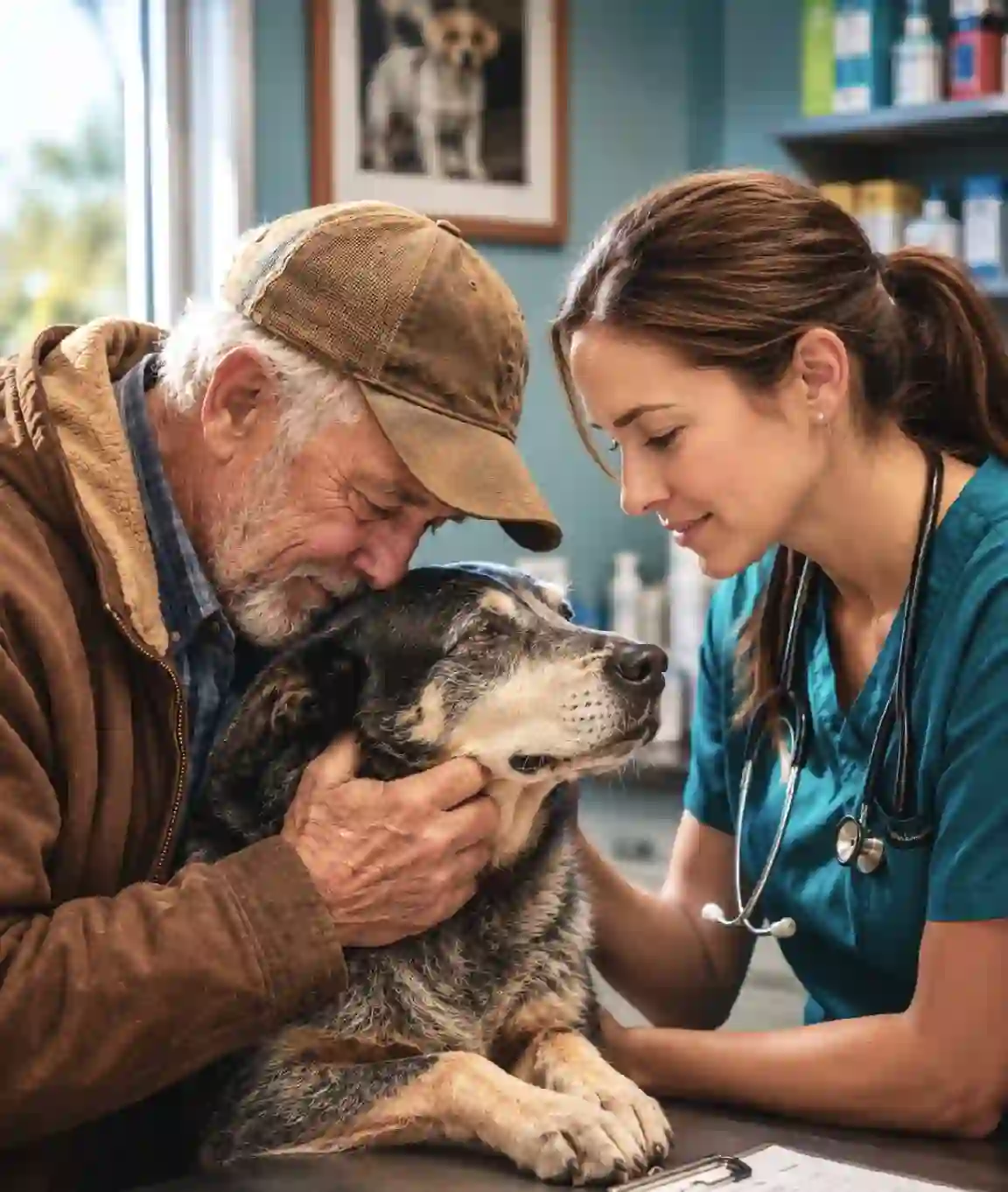
Walter Briggs had already made his decision before he walked into the veterinary clinic that winter morning. He was going to take his dog home, even though the thought of what that meant was almost more than he could bear.
Blue, his sixteen-year-old cattle dog, was sick. He needed treatment, and Walter had just been given an estimate he couldn’t afford. The old dog still had enough energy to follow him around the house, but the years were catching up with him.
Walter stood at the reception counter with one weathered hand resting on Blue’s head. He glanced at the estimate one more time before folding it carefully and putting it into his coat pocket.
“I’m sorry, Doc. I can’t do it,” he said quietly. “I’ve got enough for groceries and propane, but not both him and me.”
Dr. Elaine Harper looked at the old dog, then at Walter. She had been a veterinarian for more than three decades, and she had heard every possible explanation from people who couldn’t afford their pets’ medical care. But Walter wasn’t angry or demanding. He simply looked heartbroken.
“I’ll take him home,” Walter said.
Blue leaned against his leg, as if he had no idea that the conversation was about him. Elaine watched the dog’s tail move slowly across the floor and thought about how many times she had seen money stand between an animal and a reasonable chance at a few more comfortable years.
Before she had time to reconsider, Elaine said something that wasn’t true.
“Don’t worry. We have a senior pet assistance fund.”
Walter looked up.
“A what?”
“A senior pet assistance fund,” Elaine repeated. “It helps older residents with unexpected veterinary expenses.”
Behind her, receptionist Hannah stopped typing. She knew there was no fund. Elaine knew it too. The fund had been created approximately ten seconds earlier.
But Walter didn’t know that.
“You’re sure?” he asked.
“I’m sure,” Elaine said.
Walter looked down at Blue and rubbed the white patch between the dog’s ears. His shoulders finally relaxed.
“Looks like you got lucky, old boy.”
Blue’s tail tapped softly against the floor.
That was how the town’s mysterious senior pet fund began.
Except there was no fund.
There was only Elaine.
Blue Was More Than a Dog
Walter had spent most of his life working outdoors in Wyoming. He repaired fences, fixed equipment, worked cattle, and became known as the kind of man people could call when something needed fixing.
His hands carried the evidence of that life. They were rough, scarred, and permanently weathered, but Walter rarely complained about the work. He had always believed that if something needed doing, you simply did it.
Then his wife, Margaret, died two winters earlier.
Neighbors brought food to the house and friends stopped by to check on him. For a while, people made sure Walter wasn’t spending too much time alone. Eventually, though, life returned to normal for everyone except him.
Blue remained.
The dog had belonged to both Walter and Margaret. She used to joke that Blue was her “four-legged shadow” because he followed her from room to room.
After she died, Blue became Walter’s shadow instead. He slept beside Walter’s recliner, waited outside the bathroom, and sat near the kitchen whenever Walter cooked.
Most importantly, Blue gave Walter a reason to get out of bed every morning.
Elaine understood that kind of bond. She had seen it countless times during her career, especially among older pet owners who lived alone.
For some people, an animal isn’t simply a pet. It’s companionship, routine, comfort, and sometimes the last living connection to someone they have lost.
So Elaine picked up the estimate and looked at Walter.
“Let’s take care of Blue.”
Walter shook his head. “I don’t want special treatment.”
“It’s not special treatment,” Elaine replied.
“It’s the fund.”
Walter finally nodded. He paid the thirty dollars he could afford, and the clinic covered the rest.
Blue received his treatment, and Walter took him home.
“You Just Invented a Charity”
Hannah waited until the clinic closed before confronting Elaine. She walked into the office, folded her arms, and stared at her boss.
“You just invented a charity.”
Elaine leaned back in her chair. “I invented a solution.”
“With your own money?”
Elaine didn’t answer.
Hannah shook her head. “You realize you can’t keep doing that.”
“I know.”
“Then why start?”
Elaine looked toward the examination room. “Because he was going to lose his dog for the wrong reason.”
She expected it to happen once, maybe twice. Instead, the requests slowly started coming.
A few weeks later, an elderly woman arrived carrying a small terrier wrapped in a faded blue blanket. The dog needed medication, but the woman had barely enough money for groceries.
When she quietly asked whether the senior pet fund could help, Elaine simply nodded.
“Of course.”
Then came a retired teacher with an aging cat, a rancher with an old border collie, and a widow whose Labrador developed an infection.
Each situation was different, and Elaine didn’t automatically approve every request. She considered the animal’s condition, the recommended treatment, and whether financial hardship was genuinely preventing the owner from getting necessary care.
Sometimes the answer was treatment.
Sometimes it wasn’t.
Elaine never believed that keeping an animal alive at any cost was always the kindest choice. But she also refused to let a manageable medical problem become a death sentence simply because an elderly owner lived on a fixed income.
So she kept helping.
Quietly.
The “Fund” Had Only One Donor
At first, Elaine paid the bills from her own savings. A few dollars here, a hundred dollars there, and she barely noticed the difference.
Eventually, however, the requests became more frequent.
Elaine stopped replacing things she could still use. She kept driving her old pickup, postponed renovations at the clinic, and wore the same winter coat year after year.
Whenever Hannah noticed, she complained.
“You can’t keep paying everyone’s veterinary bills.”
Elaine would give her a tired smile. “I’ll figure it out.”
“That’s what you always say.”
“I know.”
The strange thing was that Elaine wasn’t doing any of it because she wanted recognition. She wanted the opposite.
She didn’t want Walter to feel like a poor old man being rescued. She didn’t want Mrs. Duffy to feel embarrassed. She didn’t want anyone leaving the clinic believing they owed a stranger something.
Most of the people who needed help had spent their lives helping other people. They had raised families, worked long hours, paid taxes, helped neighbors, and brought meals to friends after difficult times.
Then retirement came, their income became fixed, and suddenly a veterinary bill of a few hundred dollars could become a crisis.
Elaine believed they deserved help without humiliation.
So the secret continued.
For years.
Elaine Wasn’t Exactly in a Position to Be Giving Money Away
There was one detail almost nobody in town knew. Six months before she helped Walter, Elaine had suffered a stroke.
She had recovered enough to return to work, but her left hand never completely regained its old strength. Most people didn’t notice, but Elaine noticed every time she struggled with a button, couldn’t open a jar, or felt her fingers tremble around a coffee cup.
Her staff encouraged her to slow down, but Elaine wasn’t very good at it. The clinic was her life’s work, and the people who brought their animals through her doors trusted her.
So she continued working.
She also continued paying into the imaginary fund.
It became a strange habit. Elaine would tell herself she was finished, and then another person would walk through the clinic doors needing help.
She would sigh and think, “Just this once.”
Then she would do it again.
Blue Got Older
Blue survived his treatment and made it through another winter. Then another.
Walter continued bringing him in for checkups, and although the old dog moved more slowly, he remained Walter’s constant companion.
One Christmas, Elaine received a card from Walter. Inside was a photograph of him sitting on his porch with Blue’s head resting on his knee.
On the back, Walter had written, “Still here. Both of us.”
Elaine kept the photograph in her desk.
A few years later, Blue died peacefully at almost sixteen. Walter called the clinic the following morning, and Elaine could hear the grief in his voice.
“He went in his sleep,” Walter said.
“I’m sorry,” Elaine replied.
There was a long pause before Walter finally spoke.
“Those extra years were worth everything.”
Walter died a few years later.
His daughter sent Elaine a Christmas card after the funeral. Inside was another photograph of Walter and Blue sitting together on the porch.
She had written, “Those extra years mattered more than you knew.”
Elaine placed the photograph inside her desk and kept it there.
Then the Numbers Caught Up With Her
Nearly seven years after that first conversation with Walter, the clinic’s finances became impossible to ignore.
The roof needed repairs, medical equipment was aging, operating costs had increased, and heating bills were climbing. On top of everything else, Elaine had spent years quietly paying veterinary expenses that were never supposed to come out of her own pocket.
One afternoon, her accountant sat across from her and delivered the news.
“You may have to close.”
Elaine stared at him.
The words seemed heavier than they should have been. She had spent years helping other people keep their pets healthy and their lives a little less lonely, and now she wasn’t sure she could keep her own clinic open.
After he left, Elaine sat alone in Exam Room Two.
She looked at the photograph of Walter and Blue sitting together on the porch. She picked it up, held it for a moment, and then carefully placed it back on the desk.
Hannah Found the Records
A few days later, Hannah walked into Elaine’s office carrying a thick folder.
Elaine looked up. “What’s that?”
“The fund.”
Elaine gave her a tired smile. “There is no fund.”
Hannah placed the folder on the desk.
“There is now.”
Elaine opened it and found years of invoices, receipts, payments, and handwritten notes. Hannah had gone through the clinic’s financial records and finally realized how much Elaine had personally contributed.
“You paid all of this?”
Elaine said nothing.
“And these?”
Still nothing.
Hannah looked at her with tears in her eyes. “Why didn’t you tell anybody?”
Elaine closed the folder.
“Because it was supposed to help them.”
“It did help them.”
“Not if they felt like charity.”
Hannah stared at her for a moment.
“You’ve spent years worrying about everyone’s dignity.”
Elaine looked down at her weakened hand.
“I just didn’t want anyone to feel small.”
Hannah’s voice softened.
“The clinic is going under.”
“I know.”
“And you’re still worried about how everyone else feels?”
Elaine gave her a faint smile.
“I guess that’s my problem.”
Hannah shook her head.
“No. Maybe it’s the town’s turn.”
Three Days Later, the Parking Lot Was Full
Elaine was driving toward the clinic one cold morning when she noticed cars parked along both sides of the street.
Pickup trucks.
Sedans.
Old station wagons.
The clinic parking lot was completely full.
People stood outside the entrance in winter coats and work boots. Some were retirees she had treated for years. Others were families she recognized from around town.
Elaine parked farther down the street and walked toward the building.
Nobody immediately explained what was happening.
A retired rancher simply stepped forward and handed her an envelope.
“For the fund.”
Elaine stared at it.
“You don’t have to do this.”
“I know,” he said with a smile. “That’s why we’re doing it.”
Another person stepped forward.
Then another.
A widow handed Elaine twelve dollars and apologized that it wasn’t more.
Elaine closed her fingers around the envelope.
“It’s plenty.”
A family brought a glass jar filled with folded bills. Someone else handed her a check that made her sit down when she saw the amount.
Then the photographs began appearing.
There was an old beagle sleeping beneath a Christmas tree. A gray cat curled in an elderly woman’s lap. A three-legged ranch dog sitting in the passenger seat of a pickup.
And then Elaine saw Blue.
His gray muzzle rested on Walter’s knee as they sat together on the porch.
It was the photograph she had kept in her desk.
Each photograph had a handwritten note attached.
“You gave us another Christmas.”
“She stayed with Mom until the end.”
“Dad never knew you paid.”
“He was my husband’s best friend after the funeral.”
“You gave us another summer.”
Elaine stood in the hallway, unable to speak.
By noon, the clinic walls were covered with photographs.
She had spent seven years trying to keep her kindness invisible.
Now the entire town knew.
And instead of judging her, they had come to help.
Hannah stood beside her.
“You spent seven years telling everyone there was a fund.”
Elaine laughed through her tears.
Hannah pointed toward the crowd outside.
“Looks like there really is one now.”
The Fund Finally Became Real
The clinic stayed open, but something much bigger happened.
The imaginary fund became a real community program.
People contributed whenever they could. Some gave five dollars, some gave fifty, and others donated much more.
A local business offered to match donations for a month. A retired teacher organized a fundraiser, and local children began bringing coins from lemonade stands.
One little boy told his grandmother that he wanted to save enough money so “old dogs don’t have to leave their people.”
Elaine kept the rules simple. The fund would help older residents with appropriate veterinary care when cost was the barrier.
Nobody receiving assistance had to publicly thank a donor. Nobody received a plaque, and nobody had to explain their financial situation to the entire town.
Whenever possible, the people receiving help were never told exactly who had paid their bill.
Elaine insisted on that last part because she had learned something important.
Sometimes preserving someone’s dignity is just as valuable as paying their bill.
What Elaine Finally Understood
Years earlier, Elaine thought she had created a way to save old pets.
Eventually, she realized she had been helping save something else.
Connection.
She was helping the widower who still had a reason to come home, the widow who still had a warm body waiting beside her chair, and the retired rancher who still had a companion riding beside him in his pickup.
Animals don’t understand retirement accounts or medical bills. They don’t know whether their owners have savings or debt.
They simply know who feeds them, who walks them, who comforts them, and who comes home.
For some older people, that relationship becomes one of the most important parts of everyday life.
Elaine’s story began with a sentence that wasn’t true.
“There is a senior pet assistance fund.”
At the time, there wasn’t.
There was only one veterinarian who couldn’t bear to watch an old man lose his dog because he couldn’t afford a veterinary bill.
But the idea grew.
One quiet act became another, and then another, until the entire community decided to make the imaginary fund real.
Today, senior pet owners in the community can receive help when they need it. Elaine no longer carries the entire burden herself.
She doesn’t have to.
The town carries it with her.
And the photograph of Walter and Blue still hangs inside the clinic.
Elaine keeps it there because it reminds her where everything started—not with a fundraiser or a wealthy donor, but with a man standing at a veterinary counter trying to decide whether he could afford to save his best friend.
Sometimes kindness begins with something incredibly small. A paid prescription, a few extra months, a ride home, or a stranger quietly saying, “I’ve got this.”
And sometimes, the kindness you give when nobody is watching doesn’t disappear. It travels through people, changes lives, and eventually finds its way back to the person who started it.
Years after Elaine invented a fund that didn’t exist, she discovered something she had never expected.
The town had been watching.
And when she finally needed help herself, they were ready to prove that kindness had never been a one-way street.
Author’s Note
Stories like this remind us that kindness does not always have to be grand or public. Sometimes it means helping someone through a difficult moment while allowing them to keep their dignity.
Whether it is an elderly neighbor, a struggling family, or a beloved pet, small acts of compassion can make a lasting difference. The greatest kindness is often the kind given without expecting recognition in return.
Related Posts
- On My Wedding Day, My Brother Sank My Grandfather’s Vintage Mustang Into a Lake—Then I Asked One Question That Wiped the Smiles Off Their Faces

- Tyler Cameron and Tate Madden Are Expecting a Baby Girl, but His Emotional Tribute to His Late Mother Made the Announcement Even More Meaningful
- I Pretended I Was Dying to Find Out If My Struggling Girlfriend Loved Me or My Money—Then She Disappeared for Five Days and Returned With Something That Made Me Break Down in Tears
- My Son’s Best Friend Wore a Bright Red Dress to His Funeral, The Reason Left Us all in Tears
- My Daughter Abandoned Me at My Wife’s Grave, 190 Miles From Home—Four Days Later, Her Husband Saw Me in the Chairman’s Seat

- 20 Funny Comics That Turn Everyday Moments Into Unexpected Laughs



About the Author
Hassan is the founder and editor of MidnightReads, a publication featuring thoughtful stories, human-interest articles, history, relationships, and entertaining reads.
He is involved in researching, writing, and editing content for the site, with a focus on creating original, clear, and useful articles that give readers something meaningful to take away.
Hassan believes good content should inform, entertain, and encourage curiosity.
— Hassan, Founder & Editor, MidnightReads