
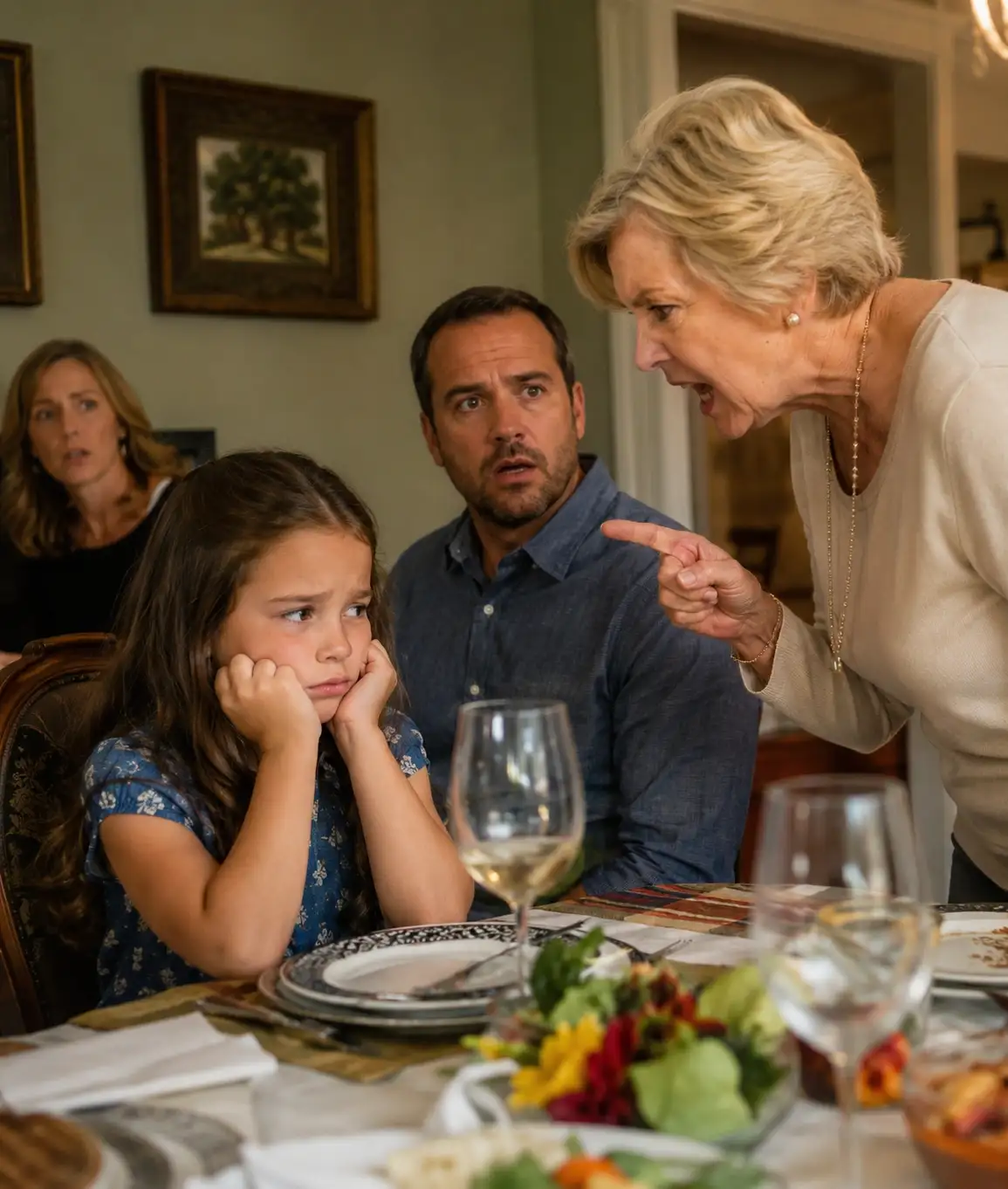
At our Sunday family dinner, my mother-in-law, Barbara, stared directly at my eight-year-old daughter, Ellie, and said coldly,
“She’s not as pretty as her cousins. Some kids are simply disappointments.”
For a moment, Ellie seemed frozen.
Her fork stopped halfway to her mouth.
She didn’t cry.
That somehow made it worse.
My wife had died three years earlier.
Before Leah passed away, she made me promise something I never wanted to carry alone.
“Take care of my mother,” she whispered from her hospital bed.
So I did.
I paid Barbara’s car payments, insurance, medical bills, property repairs, and every unexpected “emergency” that somehow appeared whenever she needed money.
I never complained.
I never reminded her.
I simply kept the promise.
Until that night.
I looked across the table at Barbara.
Then I looked at Ellie.
And something inside me finally broke.
I forced a small smile.
“Keep talking, Barbara.”
She raised an eyebrow.
“You’ve got about three hours left to run your mouth.”
Tom, my younger brother-in-law, shifted uncomfortably.
“Derek, man—”
I ignored him.
Barbara stared at me.
“What is that supposed to mean?”
I gently put my hand on Ellie’s shoulder.
“Finish your dinner, sweetheart.”
Ellie looked at me.
“We’re going home soon.”
She immediately put her fork down.
Barbara scoffed.
“Don’t be dramatic. I was only telling her the truth.”
“No,” I said.
“You were hurting a child.”
“She needs to learn that the world isn’t going to flatter her.”
I stood.
The chair scraped against the floor.
“Come on, Ellie.”
We walked toward the front door.
Behind us, Barbara called out.
“You’re really going to throw away everything I’ve done for this family because of one comment?”
I stopped.
I turned around.
“You’ve done something for this family?”
Her expression changed.
“You’re standing in a house whose mortgage I’ve helped pay.”
Her face went pale.
“Your car is insured because of me.”
She said nothing.
“Your medical bills are paid because of me.”
Tom looked at his mother.
“What is he talking about?”
Barbara glared at him.
I opened the door.
“Three hours.”
Then Ellie and I left.
On the drive home, she barely spoke.
I kept looking at her in the passenger seat.
Finally, she whispered,
“Dad?”
“Yeah?”
“Am I ugly?”
My hands tightened around the steering wheel.
“No.”
“But Grandma said—”
“Grandma was cruel.”
She looked out the window.
“Maybe she was telling the truth.”
I pulled into a quiet parking lot and turned off the engine.
Then I turned toward my daughter.
“Ellie, listen to me.”
She looked at me.
“Your value has nothing to do with how pretty you are.”
She wiped her cheek.
“Then why did she say it?”
I didn’t have an answer.
Not yet.
But I was about to find one.
That night, after Ellie went upstairs, I opened the spreadsheet where I’d recorded every payment I’d made for Barbara.
The total was over $86,000.
I stared at the number.
Then I remembered something.
Leah’s final months.
Her hospital room.
Her weak voice.
“Take care of my mother.”
At the time, I never questioned it.
But suddenly, I wondered why Leah had been so insistent.
I’d always assumed it was because Barbara was her mother.
Now I wasn’t sure.
At 10:17 p.m., I called Barbara.
She answered immediately.
“What do you want?”
“I want to understand something.”
“What?”
“Why do you treat Ellie like you don’t want her around?”
Silence.
Then Barbara said,
“Because she reminds me of Leah.”
My chest tightened.
“What does that mean?”
“You wouldn’t understand.”
“Try me.”
She hung up.
I sat there for several minutes.
Then my phone buzzed.
It was Tom.
“Derek,” he said, “you need to come over.”
“Why?”
“I found something.”
“What?”
“Mom’s old filing cabinet.”
I drove there.
Tom met me outside.
He looked nervous.
“What did you find?”
He lowered his voice.
“Letters.”
“From who?”
“Leah.”
My heart stopped.
He handed me an envelope.
My name was written on the front.
I opened it with shaking hands.
Inside was a letter dated two months before Leah died.
My dearest Derek,
If you’re reading this, something happened that I couldn’t explain to you while I was sick.
Please don’t hate my mother.
But please don’t trust everything she tells you either.
I read the sentence twice.
Tom looked over my shoulder.
“What does it say?”
I continued.
Mom knows about the trust.
She knows Ellie is the beneficiary.
I stopped.
“What trust?”
Tom’s face changed.
“What?”
I read the next paragraph.
Dad left something for Ellie.
Mom has always believed she should have received it.
She thinks because Ellie is only a child, I won’t let her have it.
But I will.
And if I’m not here, you must protect it for her.
I looked at Tom.
“What trust is she talking about?”
“I don’t know.”
I kept reading.
The money isn’t the important part.
It’s what it represents.
Dad wanted Ellie to have something that belonged to our family before Mom could take control of it.
I folded the letter.
“Who was Leah’s father?”
“Your father-in-law, obviously.”
“No. I mean his estate.”
Tom stared at me.
Then he slowly shook his head.
“I thought everything went to Mom.”
Apparently, so did I.
We searched through the cabinet.
We found old tax documents.
Insurance paperwork.
Bank statements.
And finally, a legal document.
It was a trust agreement.
Established by Leah’s father.
The beneficiary was Ellie.
The amount wasn’t enormous by wealthy-family standards.
But it was substantial.
Nearly $240,000.
And there was something else.
The trust was protected from Barbara.
She had no authority over it.
The trustee was an attorney named Michael Harris.
I immediately called him.
He answered the next morning.
After verifying my identity, I asked about the trust.
There was a long pause.
Then he said,
“I’ve been waiting for you to contact me.”
“Why?”
“Because your wife asked me to contact you if she ever became unable to manage the matter herself.”
I sat down.
“What matter?”
“Your mother-in-law has been trying to access the trust for years.”
My stomach tightened.
“Why?”
“She believes your daughter shouldn’t receive it.”
“Why would she believe that?”
“Because she believes Leah promised her the money.”
I looked at Tom.
Then the attorney said something that made everything suddenly make sense.
“Your wife disagreed.”
“What happened?”
“Leah changed the trust instructions shortly before her death.”
“To protect Ellie?”
“Yes.”
I leaned back.
“And Barbara knew?”
“She knew the trust existed.”
“But she didn’t know about the final changes.”
I closed my eyes.
Suddenly, Barbara’s behavior over the last three years looked completely different.
The constant requests for money.
The questions about Ellie’s future.
The strange comments about Ellie being irresponsible.
The way Barbara had repeatedly told me that children didn’t understand money.
The way she kept asking whether I’d made a will.
The way she had once casually asked me,
“If something happened to you, who would control Ellie’s finances?”
At the time, I hadn’t thought anything of it.
Now every conversation felt different.
She wasn’t simply trying to control me.
She was trying to control what belonged to Ellie.
I called Barbara.
She answered angrily.
“I don’t have anything else to say to you.”
“I know about the trust.”
Silence.
Complete silence.
Then she whispered,
“Who told you?”
“Leah.”
“You have no idea what you’re talking about.”
“I have the documents.”
Barbara’s voice became defensive.
“That money should have come to me.”
“No.”
“I’m her mother!”
“And Ellie is Leah’s daughter.”
“She was going to give it to me!”
“Leah specifically protected it from you.”
Barbara started crying.
For the first time, I heard something other than anger in her voice.
Fear.
“She didn’t understand.”
“She understood enough to protect her daughter.”
“She was sick!”
“She was sick,” I said quietly.
“But she was still thinking about Ellie.”
Barbara began sobbing.
I didn’t feel victorious.
I felt sick.
All those years.
All that money.
All those Sundays.
And the woman I thought I was helping had been looking at my daughter as an obstacle.
Then Barbara said something I will never forget.
“That’s why I wanted you to send Ellie to live with her cousins.”
My blood ran cold.
“What?”
“She would have been better off there.”
“Why?”
“Because if you ever remarried, another woman might take control of everything.”
I stared at the phone.
“So you wanted Ellie away from me?”
“No.”
“You wanted her away from the trust.”
She said nothing.
That silence told me everything.
I hung up.
I immediately contacted the attorney.
The trust was secured.
Barbara couldn’t touch it.
Neither could I—not for myself.
It belonged to Ellie.
And for the first time since Leah died, I felt like I’d finally done something my wife had asked me to do.
Not by paying Barbara’s bills.
By protecting our daughter.
But there was still one thing bothering me.
Why had Leah asked me to take care of Barbara?
The answer came three days later.
The attorney sent me another letter.
This one was addressed to me personally.
I opened it alone.
Derek,
If you found out the truth, please understand something.
I didn’t ask you to take care of Mom because I thought she deserved everything.
I asked because I was afraid.
I knew what would happen after I was gone.
Mom would feel abandoned.
She would blame you.
She would blame Ellie.
And I didn’t want my last days to be filled with fighting.
I thought if you helped her financially, she’d leave you and Ellie alone.
I was wrong.
I’m sorry.
Please forgive me.
I put the letter down.
For three years, I’d carried guilt because I thought I wasn’t doing enough.
Now I realized something heartbreaking.
Leah had been trying to protect us even while she was dying.
She simply hadn’t known how much Barbara would eventually demand.
The following Sunday, I didn’t take Ellie to Barbara’s house.
Instead, we went to the park.
We ate sandwiches beneath a tree.
Ellie ran through the grass.
Then she came back carrying a tiny yellow flower.
“Dad?”
“Yeah?”
“Can I keep this?”
“Of course.”
She smiled.
Then she asked,
“Are we going to see Grandma again?”
“Maybe.”
“Do you hate her?”
I thought about it.
“No.”
“Are you angry?”
“Yes.”
She nodded.
“Me too.”
I looked at her.
She squeezed the little flower in her hand.
“But I’m not going to let what she said make me feel ugly.”
I smiled.
“That sounds like my girl.”
A few weeks later, Barbara asked to see us.
I agreed.
Not because I trusted her.
Because Ellie deserved to decide for herself whether she wanted a relationship with her grandmother.
We met at the same café.
Barbara looked older.
Tired.
She stared at Ellie for several seconds.
Then she said,
“I owe you an apology.”
Ellie didn’t answer.
Barbara swallowed.
“What I said at dinner was cruel.”
“You said I was a disappointment.”
“I know.”
“Why?”
Barbara looked at me.
Then at Ellie.
“Because I was angry about something that had nothing to do with you.”
Ellie thought about that.
Then she asked,
“Do you think I’m pretty now?”
Barbara’s eyes filled with tears.
“Yes.”
Ellie nodded.
“But Dad says being pretty isn’t the most important thing.”
Barbara looked at me.
For once, she didn’t argue.
She simply whispered,
“He’s right.”
We left a few minutes later.
There was no dramatic forgiveness.
No sudden transformation.
No perfect family reunion.
Some wounds don’t disappear because someone says sorry.
But Ellie walked beside me with her head up.
And that was enough.
That night, I returned home and looked at Leah’s photograph.
“I understand now,” I whispered.
I had spent three years thinking taking care of someone meant never saying no.
It doesn’t.
Sometimes love means paying a bill.
Sometimes it means keeping a promise.
And sometimes keeping a promise means saying enough.
Barbara had spent years believing I was the man standing between her and what she wanted.
She was wrong.
I wasn’t standing between her and anything.
I was standing beside my daughter.
And I wasn’t moving.
Because Leah had left me one final responsibility.
Not to protect her mother’s comfort.
To protect our little girl.
And this time, I wasn’t going to misunderstand the promise.
Ellie didn’t need to be the prettiest child in the room. She only needed to know she was loved.
Sometimes, protecting your family means finally saying, “Enough.”
Thanks for reading. Visit Midnight Reads for more emotional stories.
Editor’s Note:
This story is a fictionalized family drama created for entertainment. The characters, dialogue, and events are presented as a narrative and are not intended to describe real people or actual events.
Trending Posts
- My Mother-in-Law Called My 8-Year-Old Daughter a Disappointment at Dinner—Then I Discovered Why She Had Always Treated Her Differently

- My Family Forced Me to Cook Thanksgiving Dinner Alone—Then a Man in a Black Suit Walked In, Kissed My Hand, and Called Me “Darling”
- At My Wedding, I Caught My Brother Putting Something in My Champagne—So I Switched Our Glasses, and Thirty Minutes Later, His Secret Came Out
- My Husband Threw Me Out After Inheriting $75 Million, Calling Me Dead Weight—Then His Father’s Lawyer Revealed the One Thing He Never Knew
- My Mom Called Me “Chemical Sludge,” Locked Me Out of the House I Paid For, and Sent Me to Eat in the Garage—So I Finally Made a Decision Nobody Expected
- An Old Family Photo Revealed a Mystery No One Expected

Hammad Ali
Co-Owner & Author
Hammad Ali is a co-owner and author at MidnightReads, contributing thoughtful and engaging articles across human-interest, life, history, relationships, and entertainment topics.
They help develop and create original, useful content designed to inform, entertain, and give readers something meaningful to take away.