
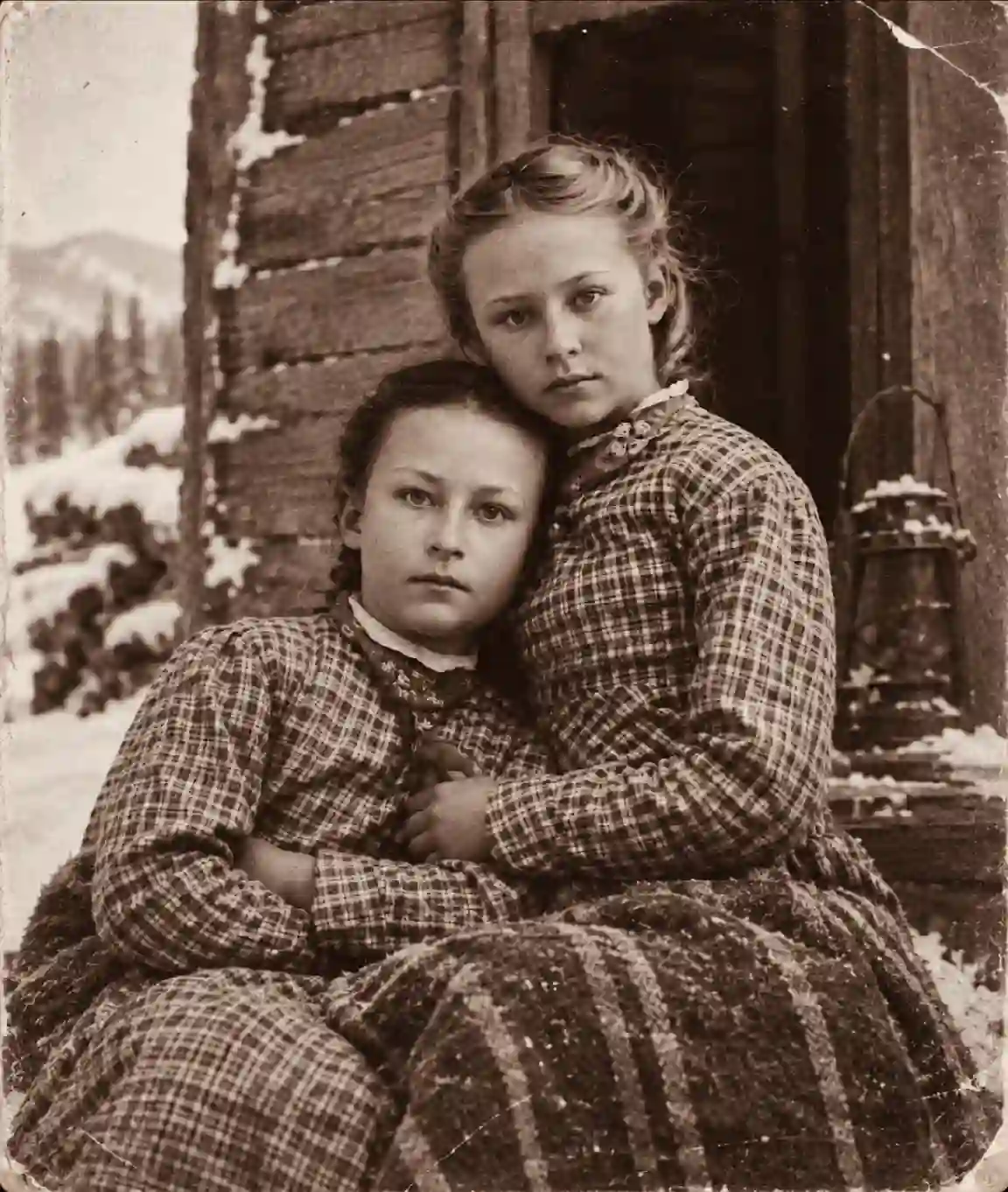
In the winter of 1883, two sisters stood at the doorway of a small Wyoming homestead and faced a future neither of them was prepared to understand.
Sarah was thirteen.
Emma was eleven.
Their father was gone, taken by illness after days of fever. The nearest neighbor was many miles away and the world beyond their property seemed impossibly distant.
This survival story of two sisters explores courage, resilience, and the powerful bond between two young girls facing an unforgiving winter.
They were children in a place where winter did not care how old you were.
There was no modern heating system, no telephone, no easy way to call for help, and no guarantee that food would last until spring.
There was, however, one thing they still had.
Each other.
The story of Sarah and Emma is best understood as a historical-style survival narrative rather than a verified account with independently established details. Yet the circumstances it portrays reflect the genuine hardships faced by many isolated families on the American frontier: severe winters, limited medical care, long distances between neighbors, and children who sometimes had to grow up far too quickly.
And at the heart of the story is a simple idea that remains meaningful today:
Courage is not always about being fearless. Sometimes it is simply refusing to abandon someone you love.
A Home That Suddenly Became Their Responsibility
Before their father’s death, the homestead had been a home.
Afterward, it became a responsibility.
The girls had to think about things children normally never had to consider.
How much food remained?
How much firewood was available?
Could the roof withstand another storm?
What would happen if one of them became sick?
And perhaps most frightening of all:
Who would come for them?
In nineteenth-century America, children who lost their parents could face difficult and uncertain futures. Depending on their circumstances, relatives, neighbors, churches, charitable organizations, or institutions might become involved.
For two sisters who had already lost their father, the possibility of being separated from each other would have been especially frightening.
So they made a decision.
They would stay together for as long as they could.
It was not a heroic speech.
It was simply two frightened children deciding that neither would face the unknown alone.
They Did Not Know How to Survive
The romantic image of frontier life often makes survival look simple.
Chop wood.
Start a fire.
Grow food.
Hunt.
Build a shelter.
In reality, each of those tasks required knowledge, physical strength, practice, and sometimes years of experience.
Sarah knew some household skills. She could sew and preserve food.
Emma could read and handle numbers.
But neither girl had been trained to become a hunter, carpenter, or wilderness survival expert.
Their first attempts were imperfect.
They used their firewood too quickly.
They struggled to keep the stove burning through the night.
Food became more important with every passing day.
Fear became part of the routine.
There were moments when the sisters could do little except sit together and hope that morning would come.
That is an important part of the story that should not be forgotten.
Courage does not mean knowing exactly what to do.
Sometimes courage begins with admitting that you do not know—and learning anyway.
The Winter Became Their Teacher
With no one else immediately available to teach them, the girls had to learn from whatever information they could find.
An old book became a source of knowledge.
The landscape became a classroom.
The snow became a record of what had passed during the night.
They began paying attention to tracks.
They learned which supplies needed to be protected.
They became more careful with firewood.
They learned that wasting one resource today could create a crisis tomorrow.
Most importantly, they developed a routine.
One sister could rest while the other watched the fire.
They divided tasks.
They encouraged each other when one became frightened.
Their survival was not the result of one dramatic act.
It was built through hundreds of small decisions.
A little more wood saved.
A little more food preserved.
A little more knowledge gained.
A little more confidence earned.
That is how difficult situations are often survived in real life—not through one extraordinary moment, but through ordinary decisions repeated again and again.
When the Blizzard Came
Then the weather became even more dangerous.
A severe blizzard buried parts of the homestead beneath snow.
The entrance became difficult to use, and the girls had to work their way through the accumulation.
They had no sophisticated equipment.
They used whatever they could.
A household skillet could become a digging tool.
Their hands could become the last available option.
Their fingers became painfully cold.
Their clothing became wet.
Their supply of firewood seemed to disappear faster than they could collect it.
But they continued.
For Sarah, there was another responsibility.
Emma was younger.
If Sarah panicked, Emma would see it.
So Sarah learned to hide some of her fear.
That does not mean she was fearless.
It means she understood that sometimes another person’s hope depends partly on your ability to keep going.
The Moment Emma Fell Through the Ice
One of the most frightening moments in the story came when Emma fell through thin ice while trying to collect water.
Cold water can become dangerous extraordinarily quickly, particularly in an isolated environment where medical help is far away.
Sarah pulled her sister out.
She removed the wet clothing, wrapped Emma in whatever dry coverings were available, and stayed beside her.
The scene captures something deeper than physical survival.
Sarah could not control the weather.
She could not summon a doctor.
She could not make the winter disappear.
But she could control what she did next.
She stayed.
She warmed her sister.
She refused to leave her alone.
And that is sometimes what love looks like when there are no easy solutions.
Not fixing everything.
Just refusing to walk away.
“We Are Our People”
Eventually, the season changed.
The snow began to disappear.
The land that had looked lifeless slowly became visible again.
When a traveling minister came across the homestead, he expected to find children who had been abandoned or rescued.
Instead, he found two girls working in a garden.
They had survived.
Not because the winter had been kind.
It had not.
Not because they suddenly became adults.
They were still children.
They survived because they adapted, learned, shared responsibility, and remained committed to one another.
The story’s most memorable exchange comes when the minister asks where their people are.
The answer is simple:
“We are our people.”
Whether or not this exact conversation ever happened, the sentiment captures the emotional center of the narrative.
The girls had lost their father.
They had lost their sense of security.
But they had not lost their family completely.
They still had each other.
The Note in the Bible
Years later, the story imagines Sarah returning to the old homestead after she had built a life of her own.
Inside their father’s Bible, she discovers a note Emma had written during that terrible winter.
Its message is essentially a promise:
If one sister fell, the other would help her rise.
If one became weak, the other would carry the burden.
They would keep going together.
The note matters because it shows how children sometimes understand love in its simplest form.
Not through complicated explanations.
Not through grand promises about the future.
But through presence.
“I am here.”
“You are not alone.”
“We will get through this together.”
Those are small words.
But in a frightening moment, they can mean everything.
What This Story Can Teach Us About Strength
The most valuable lesson in this story is not that people should try to become hardened or independent enough to survive everything alone.
It is almost the opposite.
The sisters survived because they depended on each other.
That is an important distinction.
Modern culture sometimes presents strength as complete independence.
Never asking for help.
Never showing weakness.
Always handling everything alone.
But genuine strength can look very different.
1. Strength can mean asking what needs to be done
The girls could not control their circumstances.
They could control their response.
Instead of spending all their energy asking why something had happened, they had to ask a more practical question:
What needs to happen next?
That mindset can help people through difficult situations even today.
2. Small actions can become survival
A single piece of firewood does not seem important.
A single meal does not seem like much.
One small task rarely feels heroic.
But difficult situations are often overcome through hundreds of small actions.
Progress does not always look dramatic.
Sometimes it looks like getting up tomorrow and doing the next necessary thing.
3. Love is demonstrated through actions
The sisters did not prove their bond through speeches.
They proved it by sharing food.
Keeping watch.
Working together.
Protecting one another.
Staying when leaving would have been easier.
That remains true in ordinary life.
People often remember what we did for them more than what we promised to do.
4. Being afraid does not make you weak
The girls cried.
They were frightened.
They made mistakes.
None of those things erased their courage.
This is perhaps one of the most important lessons.
Fear and courage can exist at the same time.
You do not have to feel brave before doing something difficult.
Sometimes you become brave by doing it while you are afraid.
The Real Meaning of “Home”
At the beginning of the story, home is a physical place.
A small homestead.
A house.
A stove.
A garden.
But by the end, the meaning has changed.
Home has become a person.
Or, more accurately, a relationship.
The sisters become each other’s sense of safety when everything else disappears.
That idea reaches far beyond a nineteenth-century frontier story.
A person can have a beautiful house and still feel alone.
Another person can have very little and still feel deeply loved.
Home is not always the place where we sleep.
Sometimes it is the person who makes us feel that we do not have to face the world by ourselves.
Why Stories Like This Still Matter
Stories about survival are rarely only about survival.
They are about identity.
They ask questions such as:
What do we become when life becomes difficult?
Who do we protect?
What are we willing to sacrifice?
And how much stronger can we become when someone else is depending on us?
The story of two young sisters facing a brutal winter reminds us that courage is not reserved for soldiers, explorers, or famous historical figures.
Sometimes courage belongs to ordinary people whose names never appear in history books.
Sometimes it belongs to a child carrying firewood.
Sometimes it belongs to a sister staying awake beside another sister.
Sometimes it belongs to someone quietly deciding:
I will not give up today.
A Final Lesson From the Two Sisters
The winter eventually ended.
The snow melted.
The garden returned.
Life continued.
But the experience changed the sisters forever.
They had learned something that cannot easily be taught in a classroom:
People can endure extraordinary hardship when they do not have to endure it alone.
Their story is a reminder that strength is not measured by age, size, wealth, or power.
It can be found in patience.
In loyalty.
In responsibility.
In kindness.
And sometimes, in the simple decision to stay beside someone when the night feels impossibly long.
We often imagine that courage arrives with a dramatic moment—a rescue, a victory, a heroic act.
But real courage is frequently quieter.
It looks like getting out of bed after a terrible day.
It looks like sharing your last piece of food.
It looks like protecting someone who is weaker than you.
It looks like learning a skill because someone depends on you.
And it looks like keeping a promise long after the moment that created it has passed.
The sisters’ greatest achievement was not defeating the winter.
It was refusing to let the winter defeat their bond.
Because sometimes the strongest shelter a person can have is not a roof overhead.
It is another human being saying:
“I’m still here.”
Author’s Note
This article was written to share a meaningful story about courage, family, resilience, and human connection. It is presented for educational and inspirational purposes, with the goal of giving readers more than entertainment by highlighting the lessons we can take from difficult circumstances. We aim to provide original, thoughtfully written content that is useful, respectful, and enjoyable to read.
What This Survival Story of Two Sisters Teaches Us
- Courage does not require the absence of fear.
- Small, consistent actions can help us overcome enormous difficulties.
- Asking for or accepting help is not a sign of weakness.
- Love is often demonstrated through actions rather than words.
- Strong relationships can give people resilience during difficult times.
- When life cannot be controlled, we can still choose how we respond.
Related Posts
- The White Cloth hanging From a Car Window: What This Little-Known Road Signal Really Means
- Joke of the Day: Johnny Asked His Teacher One Question, and Her Hilarious Answer Made the Whole Class Laugh!
- 25 Funny Comics That Turn Everyday Moments Into Unexpected Laughs
- My Ex-Husband’s Mother Arrived With Two Moving Trucks Minutes After Our Divorce—She Demanded My Mansion, but She Had No Idea What My Attorney Had Discovered2.
- My Mommy Has Been Sleeping for Three Days”—A Six-Year-Old Girl Pushed Her Newborn Twins to the Hospital in a Wheelbarrow

Hammad Ali
Co-Owner & Author
Hammad Ali is a co-owner and author at MidnightReads, contributing thoughtful and engaging articles across human-interest, life, history, relationships, and entertainment topics.
They help develop and create original, useful content designed to inform, entertain, and give readers something meaningful to take away.