I Found a Newborn Baby Beneath a Metal Colander in the Kitchen Sink, Covered in Flour With One Sock Missing, Then I Found a Hospital Bracelet With Another Name Inside It
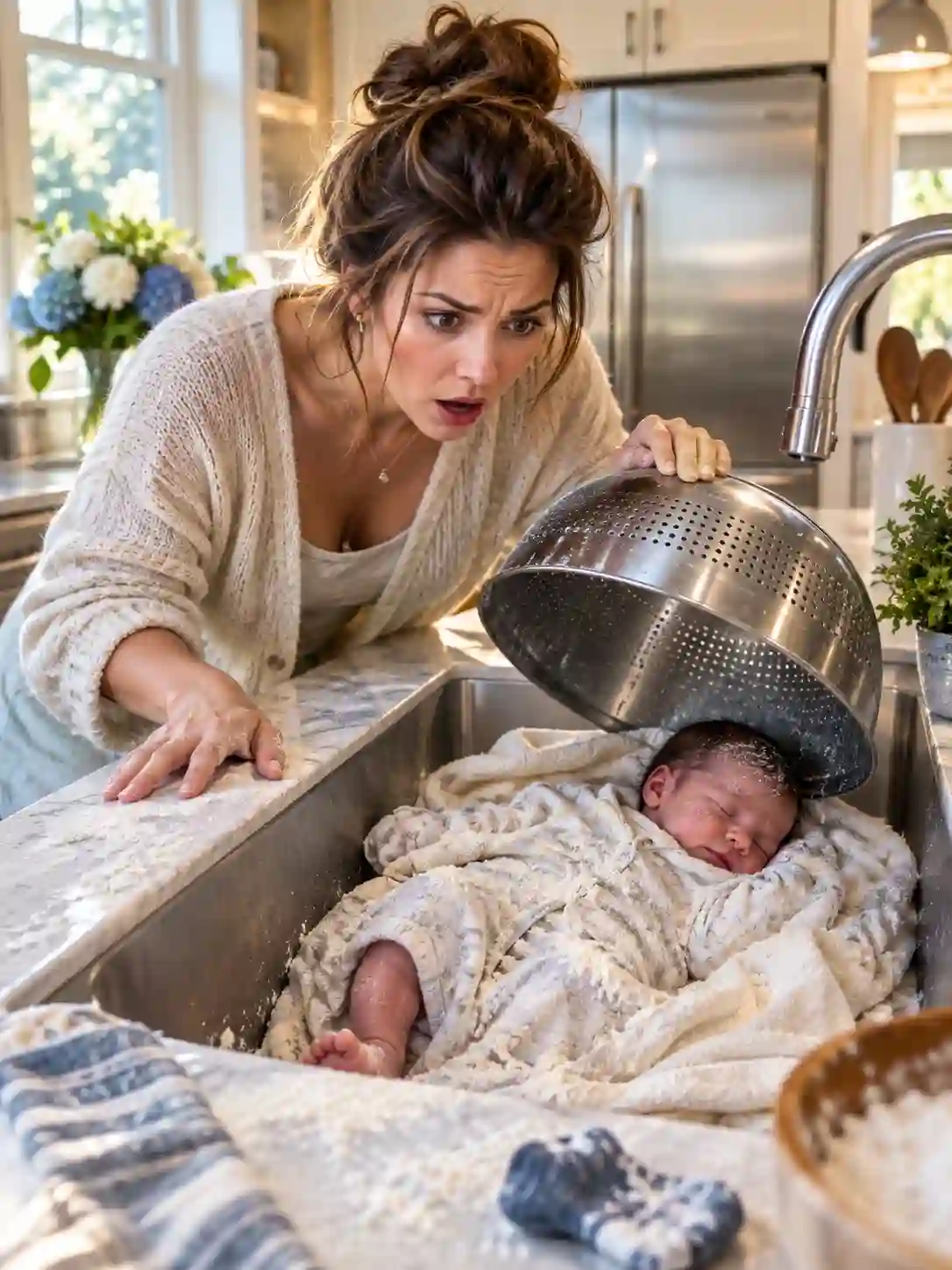
I had cared for newborns long enough to know that a baby could turn an ordinary morning into chaos within seconds. But nothing prepared me for what I found in the Whitakers’ kitchen that gray Tuesday morning—a four-day-old foster newborn baby lying on a folded blanket inside the kitchen sink, covered in flour, with a metal colander placed over him and one tiny sock missing.
At first, I thought I had walked into some bizarre accident. Then I noticed the red mark around his bare ankle, and the moment I picked up the missing sock from the floor, I found a hospital bracelet hidden inside it with a name that didn’t belong to him.
That was when I realized the strange scene in the kitchen wasn’t an accident at all.
I just didn’t know yet that the bracelet would lead police to a locked basement room, expose a secret the Whitaker family had been hiding for years, and uncover the truth about a child whose real identity had been deliberately erased.
My name is Claire Bennett, and until that morning, I thought the hardest part of my job was helping exhausted families survive those first few weeks with a newborn.
I had been working for the Whitakers for nearly six months as a postpartum care aide, helping with meals, laundry, nursery routines, grocery shopping, and the endless little tasks that become overwhelming when an infant enters a household. The Whitakers were financially comfortable, well known in town, and, from the outside, seemed like the sort of family that had everything under control.
Four days earlier, they had welcomed a newborn boy into their home as a foster placement.
They called him Noah.
I had met him that first afternoon.
He was tiny, quiet, and surprisingly alert for a newborn. He had a little patch of dark hair and a habit of curling his fingers around mine whenever I held him. Mallory told me that his placement was temporary while the state worked through his case.
I didn’t question it.
Foster placements came with complicated paperwork, and I wasn’t part of that process. My job was to care for the baby and help the household function.
That Tuesday morning, I arrived a little before seven.
The house was unusually quiet.
Mallory had told me the night before that she hadn’t slept much and planned to stay upstairs until later in the morning. I let myself in through the back door, put my bag down, washed my hands, and headed toward the kitchen to make coffee.
That’s when I saw him.
Noah was lying on a cream-colored blanket inside the dry kitchen sink. A thin layer of white flour covered his sleeper and part of the blanket, and a large stainless-steel colander had been placed upside down over his body.
One foot was bare.
I stopped in the doorway because my mind couldn’t immediately process what I was seeing.
There was no baking scheduled that morning. The counters were clean, the oven was cold, and the sink was completely dry.
Whoever had put the baby there had done it deliberately.
I rushed toward him and lifted the colander.
“Noah?”
He stirred.
I checked his breathing, touched his cheek, and watched his chest rise and fall. He was alive and responsive, although he began to whimper when I moved the blanket.
Relief came first.
Then I noticed his ankle.
A dark red mark circled it.
I carefully lifted his leg.
The mark was too even to be caused by a loose piece of clothing. Something narrow had pressed against his skin hard enough to leave an impression.
I looked around the sink.
The missing sock was lying on the floor near the pantry.
I picked it up.
Something was inside.
At first, I thought it was a piece of lint or folded paper. I turned the sock upside down, and a small plastic hospital bracelet dropped into my palm.
I read the name.
Eli Mercer.
I stared at it.
Noah’s name was Noah Whitaker.
I knew that because I had seen his placement paperwork and because Mallory had written his name on the card beside his bassinet.
I turned the bracelet over.
The hospital date was four days earlier.
The same day Noah had arrived.
My stomach tightened.
I was still staring at it when I heard footsteps behind me.
I turned.
Mallory stood in the kitchen doorway.
She was wearing a gray robe, and a loose strand of hair hung across her face. She looked as though she’d just gotten out of bed.
But she wasn’t looking at the baby.
She was staring at the bracelet.
Her face lost all its color.
“Where did you get that?” she asked.
“It was inside his sock.”
She walked toward me.
“Give it to me.”
“Who is Eli Mercer?”
She stopped.
For several seconds, she said nothing.
Then she glanced at the kitchen door.
I followed her gaze.
The door was locked.
I hadn’t noticed her locking it when she came in.
“Mallory,” I said quietly, “why is there another child’s hospital bracelet inside this baby’s sock?”
“It isn’t another child’s.”
“Then whose is it?”
She didn’t answer.
Noah began crying.
I moved toward him.
Mallory grabbed my arm.
“Don’t.”
I pulled away.
“Get your hands off me.”
“You don’t understand what you’re holding.”
“I understand that a four-day-old baby was put in a kitchen sink.”
“He wasn’t hurt.”
I pointed at his ankle.
“He has a mark.”
“That doesn’t mean anything.”
“Then explain it.”
She stared at me.
For the first time since I’d known her, I couldn’t read her expression.
Then she reached into the sink and picked up Noah.
“I’m taking him upstairs.”
“No.”
She turned.
“Claire.”
“Put him down somewhere safe.”
“I know how to handle a baby.”
“Then you should have left him in his bassinet.”
Her eyes hardened.
“You’re making a mistake.”
“I think the mistake was trusting you.”
I reached for my phone.
Mallory’s expression changed immediately.
“Don’t call anyone.”
“Why?”
“Because you don’t know what you’re getting involved in.”
“I know enough.”
I dialed 911.
Mallory stood perfectly still while I told the dispatcher that there was a newborn in the house whose identification didn’t appear to match his placement records.
Then she did something that frightened me more than anything else that morning.
She looked toward the basement door.
It was only a glance.
But it was enough.
The police arrived within minutes.
Two officers entered the house while I explained what had happened. One immediately checked Noah while the other asked Mallory questions.
When I handed him the hospital bracelet, his expression became serious.
“Where did you find this?”
“Inside the baby’s sock.”
“Did you put it there?”
“No.”
Mallory said nothing.
The officer examined the baby’s ankle.
“What happened here?”
“I don’t know,” Mallory said.
“Who put the baby in the sink?”
“I don’t know that either.”
I looked at her.
“You’re lying.”
The officer asked me to explain why I believed that.
I told him about the basement.
I told him I’d seen Mallory unlock it late one night several weeks earlier.
Her reaction was immediate.
“You have no right to search my home.”
The officer looked at her.
“What’s in the basement?”
“Storage.”
“Then why is it locked?”
“Because some things are private.”
He asked for the key.
Mallory said she didn’t have it.
I told him where I’d seen her keep it.
He searched the drawer.
A few minutes later, he found a small key taped underneath it.
Mallory started crying.
“Please don’t open that door.”
The officer looked at her.
“Why?”
She shook her head.
“I can’t explain.”
“Then we’ll start by looking.”
He unlocked the basement.
The door opened slowly.
The officer went down the stairs.
I remained upstairs with the other officer and the baby.
A few minutes passed.
Then we heard a drawer being opened.
Another.
Then footsteps.
The officer returned carrying a cardboard box.
He placed it on the kitchen table.
Inside were hospital records.
Birth certificates.
Adoption paperwork.
Photographs.
Medical forms.
And dozens of infant identification bracelets.
My hands went cold.
There were names I didn’t recognize.
Different hospitals.
Different dates.
Some records were several years old.
Others were recent.
The officer picked up a photograph.
It showed a newborn sleeping in a hospital bassinet.
On the back someone had written:
Eli Mercer — transfer pending.
I looked at Mallory.
“Who is Eli Mercer?”
She began crying.
“I don’t know.”
The officer’s voice became firm.
“You’re going to have to do better than that.”
Mallory covered her face.
“My husband started it.”
“What did he start?”
“The adoptions.”
She lowered her hands.
“He worked with a private adoption agency. He handled placements for families who couldn’t have children.”
“That sounds legal.”
“It was supposed to be.”
“What happened?”
Mallory looked toward the basement.
“Some of the paperwork wasn’t real.”
Nobody spoke.
She continued.
“Names were changed. Dates were changed. Hospital records were altered. Babies were sometimes moved from one family to another without the proper paperwork.”
I felt sick.
“Why?”
“Money.”
She said the word so quietly that I almost didn’t hear it.
“Families were desperate. Some paid huge amounts. My husband knew people who could make children appear to have been legally placed.”
“And the biological parents?”
“Some were lied to.”
My throat tightened.
“About what?”
“About where their children went.”
The officer stared at her.
“How many children?”
“I don’t know.”
“You expect us to believe that?”
“I stopped keeping track.”
The second officer returned from the living room.
“The baby is stable. We’re taking him to the hospital.”
Then his radio crackled.
He listened.
His face changed.
“What?”
The older officer looked at him.
The younger officer lowered the radio.
“They ran the baby’s fingerprints.”
I looked at Noah.
“What did they find?”
He hesitated.
“The baby isn’t Noah Whitaker.”
“I know.”
“And he isn’t Eli Mercer.”
Mallory stared at him.
“Then who is he?”
The officer answered.
“Daniel Reyes.”
I felt my stomach drop.
The name meant nothing to me.
But Mallory reacted immediately.
She whispered, “Oh God.”
The officer noticed.
“You know that name?”
She didn’t answer.
“Mrs. Whitaker?”
Mallory began shaking.
The officer repeated the question.
“Do you know Daniel Reyes?”
She finally nodded.
“He’s the baby.”
“What do you mean?”
“I didn’t know his name.”
“Then how did you know it?”
Mallory looked at me.
“I saw it on one of the papers.”
The officer picked up the documents.
“Where?”
She pointed toward the box.
He searched through the papers.
Then he found a missing-child report.
Daniel Reyes had been reported missing four days earlier.
Four days.
The exact day the baby had arrived at the Whitaker house.
His parents had been told that their newborn son had disappeared from a temporary care arrangement.
They had been searching for him ever since.
The baby everyone called Noah had never been Noah.
Someone had brought Daniel into the Whitaker house under a false name.
And the hospital bracelet hidden inside his sock had been the first piece of evidence that exposed it.
Mallory was taken into custody that morning.
Before she was led outside, she stopped beside me.
“I didn’t kidnap him.”
I didn’t respond.
“I swear.”
“Then who did?”
She looked toward the basement.
“My husband.”
“Where is he?”
“I don’t know.”
The police later discovered that Mallory’s husband had been living under another name in a neighboring state.
He had not disappeared.
He had been hiding.
His arrest opened an investigation far larger than anyone initially expected.
The basement records weren’t simply evidence of one illegal adoption.
They pointed to a network of forged documents, dishonest intermediaries, and people who had been exploiting desperate families for years.
Several children were eventually identified.
Some families received answers they had been waiting for years to hear.
Others discovered that the stories they’d been told about their children’s births and adoptions weren’t true.
Daniel’s case was different.
His parents knew exactly who he was.
They had never stopped looking for him.
I saw his mother three weeks later at the hospital.
She was sitting beside his bed, holding his tiny hand.
When she saw me, she stood.
“You’re Claire?”
I nodded.
She hugged me before I could say anything.
For a moment, neither of us spoke.
Then she whispered, “Thank you for looking.”
I didn’t know what to say.
“I just found him.”
“No,” she said. “You noticed him.”
I thought about that distinction for a long time afterward.
Because she was right.
I could have walked into that kitchen and ignored the strange scene.
I could have assumed the flour was an accident.
I could have put the missing sock back on the baby’s foot and gone about my morning.
I could have believed Mallory when she told me everything was fine.
But something had felt wrong.
And sometimes that’s all you get—a feeling that something doesn’t fit.
Months passed.
The investigation continued.
Mallory cooperated with prosecutors and provided information about her husband’s activities.
Her husband faced multiple charges.
The adoption agency connected to the case was investigated.
And Daniel eventually went home with his parents.
I left postpartum care shortly afterward.
Not because I was afraid of babies.
I still loved them.
I simply realized that I couldn’t walk into another family’s kitchen without remembering that morning.
The sink.
The flour.
The colander.
The tiny bare foot.
And the hospital bracelet hidden inside a sock.
I kept a photograph from that day.
It wasn’t a photograph of the baby.
It wasn’t a photograph of the basement.
It was simply a picture of that little sock sitting on my kitchen counter after the police had taken Daniel to the hospital.
I don’t know why I took it.
Maybe because at the time, I understood that it was the smallest clue in a story I hadn’t even begun to understand.
A year later, Daniel’s mother sent me another photograph.
Daniel was standing in their backyard, holding a red toy truck.
He was smiling.
On the back she had written:
“He knows his name now.”
I cried when I read it.
Because that was what had been stolen from him first.
Not just his home.
Not just his family.
His name.
Someone had taken a newborn who couldn’t speak for himself and replaced the truth with a different identity.
But a tiny hospital bracelet had survived.
It had been hidden inside a sock.
The sock had been left on a kitchen floor.
And somehow, that little mistake had brought the truth to light.
People sometimes ask me what I remember most about that morning.
It isn’t Mallory’s face.
It isn’t the police arriving.
It isn’t even the locked basement.
It’s the moment I lifted the colander and saw that tiny face looking back at me.
He didn’t know where he was.
He didn’t know what had happened.
He only knew that he was hungry, cold, and alone.
And for a few terrifying minutes, nobody knew who he really was.
But I know one thing now.
When something feels wrong, especially when a child is involved, you don’t need to know the whole story before you act.
You just need to be willing to look closely.
Because sometimes the truth isn’t hidden behind a locked door.
Sometimes it’s sitting quietly inside a missing sock.
And sometimes, the smallest clue in the room is the one that finally brings a child home.
Author’s Note: This story is a work of fiction created for entertainment. The characters, events, locations, and circumstances are fictional. It was written to explore how one small detail can uncover a much larger truth, and how paying attention when something feels wrong can sometimes make all the difference.
Trending Posts
- My Daughter Abandoned Me at My Wife’s Grave, 190 Miles From Home—Four Days Later, Her Husband Saw Me in the Chairman’s Seat

- My Father-in-Law Lived Under My Roof for 20 Years, and I Called Him a Burden, Until His Lawyer Opened a Blue Ledger at His Funeral and Revealed What He’d Been Hiding All Along

- My Ex-Husband’s Mother Arrived With Two Moving Trucks Minutes After Our Divorce—She Demanded My Mansion, but She Had No Idea What My Attorney Had Discovered2.

- My Mother-in-Law Pushed Me Down the Stairs at Nine Months Pregnant—She Never Expected Her “Unemployed” Son to Arrive With the Entire Board of Directors




Hammad Ali
Co-Owner & Author
Hammad Ali is a co-owner and author at MidnightReads, contributing thoughtful and engaging articles across human-interest, life, history, relationships, and entertainment topics.
They help develop and create original, useful content designed to inform, entertain, and give readers something meaningful to take away.