
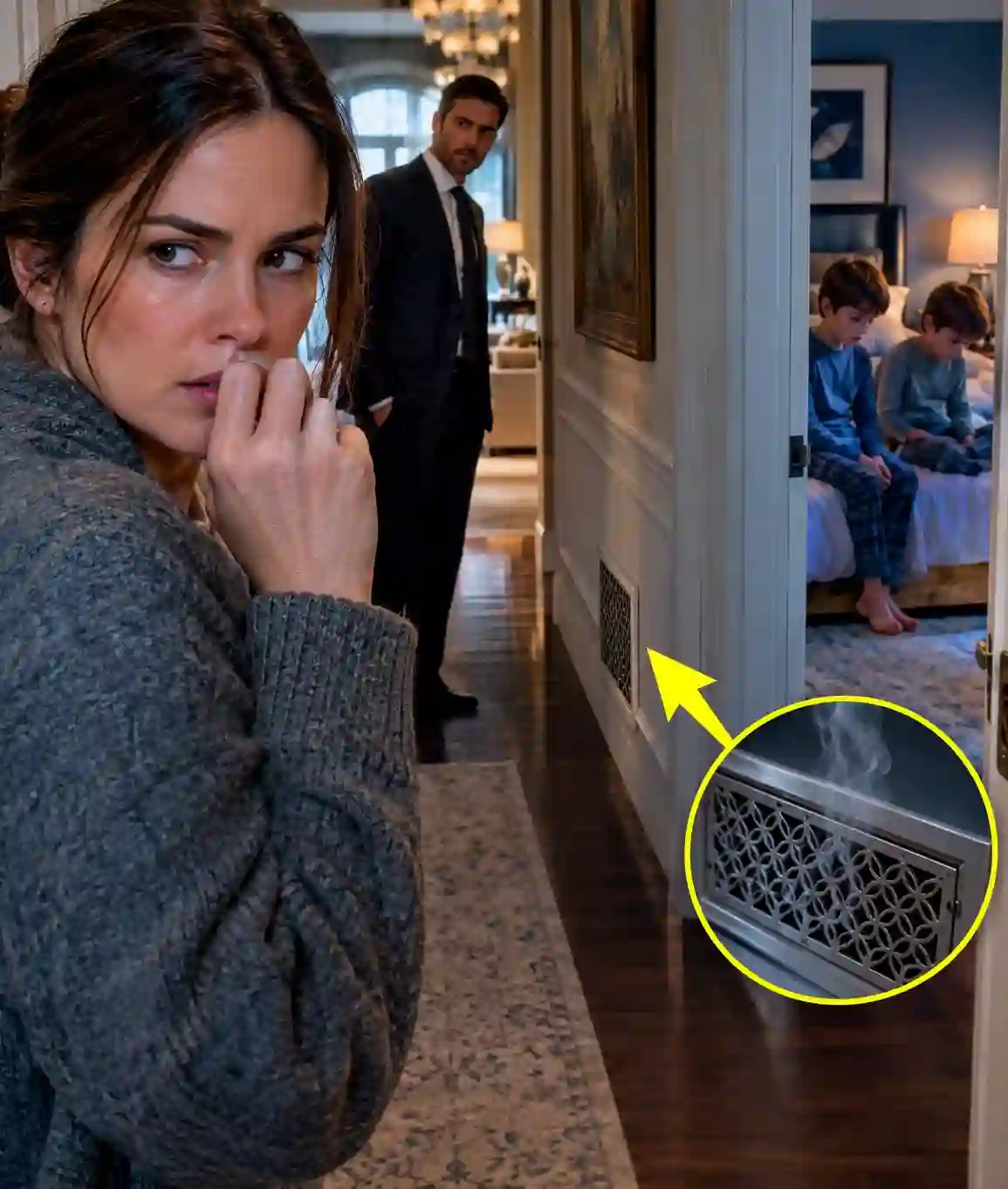
A 40-year-old billionaire had spent more than $3 million trying to understand why his twin sons kept getting weaker.
He had taken them to leading hospitals in Boston and New York, hired specialists, paid for every test their doctors recommended, and brought some of the country’s most respected physicians into his Connecticut home. Every specialist left with another theory, another possibility, and another expensive plan. Still, nobody could explain why seven-year-old Lucas and Leo were slowly losing their strength.
The boys weren’t dying. At least, no doctor had been able to say that they were. They were simply changing. They tired easily, complained of headaches and stomach discomfort, struggled to concentrate at school, and had lost their enthusiasm for the sports and games they once loved.
Their father couldn’t accept that there might never be an answer.
Then Claire Morgan arrived as their new live-in nanny.
At thirty-four, Claire had no medical degree and no experience working for billionaires. What she did have was eight years of caring for children with complicated health problems, and she had learned something that expensive specialists sometimes overlooked: caregivers see the ordinary details that happen between appointments.
When Claire arrived at the Moretti estate in Connecticut, she immediately felt out of place. The property looked more like a private resort than a family home, with a long gated driveway, manicured gardens, walls of glass, marble floors, and security cameras discreetly positioned around the grounds.
She carried one suitcase through the enormous front entrance and became painfully aware of her secondhand cardigan.
The nanny agency had called her less than twenty-four hours earlier. The position offered an unusually generous salary and a private room, but the agency had warned her that the family was under enormous pressure because the two boys had been ill for more than a year.
A woman named Mrs. Harper met Claire in the foyer and led her to Vincent Moretti’s office.
Claire had seen photographs of Vincent online. Publicly, he was known as a successful investor with restaurants, commercial properties, and businesses throughout the Northeast. At forty, he was already worth billions. In person, however, he looked less like a powerful businessman and more like a father who hadn’t slept properly in months.
Medical reports covered his desk.
“You’re Claire Morgan?” he asked.
“Yes.”
“You’ve cared for medically complicated children?”
“For eight years.”
“Children without clear diagnoses?”
“Some of them.”
Vincent studied her for a moment. “What makes you think you can help my sons?”
Claire considered the question before answering. “I don’t know that I can. But I can promise I’ll pay attention.”
That answer seemed to interest him.
He pushed a thick folder across the desk. “My sons are Lucas and Leo. They’re seven. Identical twins. Eighteen months ago, they started getting weaker.”
Claire opened the folder.
The reports contained page after page of test results and consultations. Fatigue, headaches, nausea, weight loss, muscle weakness, concentration problems, sleep disturbances. There were records from pediatric specialists, neurologists, nutritionists, geneticists, and other physicians.
“How many doctors have seen them?” she asked.
“Twenty-three, if you count everyone we’ve consulted.”
“And you’ve spent more than three million dollars?”
Vincent’s expression tightened. “More than three million.”
Claire turned another page. “Do they ever feel better?”
“Sometimes.”
“When?”
He hesitated.
“When they’re away from the house.”
Claire looked up.
“Where do they go?”
“My mother’s home in Westchester. They’ve stayed there during school breaks.”
“And how are they there?”
“They seem more energetic.”
“How much more?”
Vincent leaned back. “Enough that I’ve noticed.”
Claire closed the folder. “Has anyone compared their symptoms when they’re at your house with how they are when they’re somewhere else?”
Vincent frowned. “Their doctors know they’ve spent time away.”
“That’s not what I asked.”
Before he could answer, the office door opened.
A silver-haired man entered carrying a leather medical bag. He didn’t bother knocking.
“Vincent, we need to discuss the next round of testing.”
His eyes settled on Claire.
“Who’s this?”
“Claire Morgan. She’s starting today.”
The doctor’s expression changed slightly.
“A nanny?”
“Yes.”
He gave a restrained laugh. “I hope we’re not replacing medical care with babysitting.”
Claire kept her voice calm. “I hope not either.”
The man introduced himself as Dr. Harrison Blake, the physician who had treated the twins for almost a year. He was clearly accustomed to being listened to, and his tone suggested that he considered the matter settled.
“These boys have a complicated medical history,” he said. “It’s important that everyone follows the treatment plan.”
“I agree.”
“You’ll follow the medical instructions exactly.”
“Of course.”
Claire glanced at the reports on the desk. “Can I ask one question?”
Dr. Blake looked at her with mild impatience.
“If the boys consistently feel better when they’re away from the house, has anyone investigated the house itself?”
His expression changed.
“Children behave differently when they’re on vacation.”
“Sometimes.”
“That doesn’t mean they have an environmental illness.”
“I didn’t say they did. I asked whether anyone had investigated it.”
Silence settled over the office.
Vincent looked at the doctor, then at Claire.
Finally, he said, “She’s right.”
Dr. Blake didn’t appear pleased.
“I’ll see you later,” he told Vincent before leaving.
Once the door closed, Vincent looked at Claire.
“You don’t seem intimidated by him.”
“I don’t enjoy arguing with people.”
“You just challenged one of the doctors I pay a fortune to listen to.”
“I asked him a question.”
That earned the faintest smile.
Vincent then took Claire upstairs to meet the boys.
Lucas and Leo had adjoining bedrooms at the end of a long hallway. Between them was a playroom filled with books, toys, gaming equipment, sports gear, and enough expensive electronics to occupy an entire school.
Vincent opened Lucas’s door.
Claire took two steps inside and stopped.
There was a smell.
It was faint, almost sweet, with something artificial underneath it. Most people might have ignored it, but Claire had spent years working around children with allergies and respiratory problems. She had learned to notice changes in smells, rooms, cleaning products, and ventilation.
“Do you smell that?” she asked.
Vincent inhaled.
“Smell what?”
Claire stepped back into the hallway. The scent seemed stronger there.
A decorative ventilation grate sat between the two bedrooms.
“When was this ventilation system last inspected?” she asked.
Vincent frowned. “I don’t know.”
“Who maintains it?”
“The house has an automated system.”
“That isn’t what I asked.”
Vincent looked at her.
Before he could answer, something hit the floor behind them.
Mrs. Harper had dropped the towels she was carrying.
Claire turned.
The house manager was staring at the ventilation grate.
Her face had gone pale.
“Mrs. Harper?”
“I’m sorry,” she said quickly as she bent to collect the towels.
But Claire noticed that Mrs. Harper wasn’t looking at the towels.
She was looking at Vincent.
And in that moment, Claire realized there was something about that vent that someone in the house already knew.
That evening, Vincent arranged for the boys to stay with their grandmother for a few nights. He told them it was simply a change of scenery, but Claire noticed the concern in his face when they left.
Once the boys were gone, she went upstairs again.
The strange smell was still there.
She didn’t touch the vent. Instead, she called an independent environmental testing company and asked them to inspect the house the following morning.
The technicians arrived early.
They tested the twins’ bedrooms, the playroom, carpets, water, cleaning products, and air quality. For several hours, nothing appeared unusual.
Then one technician removed a panel from the ventilation system.
He paused.
“Mr. Moretti, could you come here?”
Vincent approached.
“What is it?”
The technician pointed inside. “This filter isn’t part of the original system.”
Vincent frowned. “What does it do?”
“I don’t know yet. I’d like to send it to the lab.”
He carefully removed the filter and sealed it inside a sample bag.
Claire glanced toward the doorway.
Mrs. Harper was standing there.
She looked frightened.
That afternoon, Vincent asked her to come into his office.
Claire happened to be nearby when she heard Mrs. Harper say, “I tried to tell you.”
Vincent looked confused. “Tell me what?”
“That something was wrong upstairs.”
“How long have you thought that?”
“Almost a year.”
“Why didn’t you tell me?”
“I did.”
Vincent stared at her.
“I told you the upstairs smelled strange. I told you the boys were complaining about headaches at night.”
“I thought you meant the cleaning products.”
“So did I at first.”
Mrs. Harper’s voice became quieter. “But the smell kept getting stronger.”
Claire stepped into the office.
“Did you tell Dr. Blake?”
Mrs. Harper looked down.
“Yes.”
That changed everything.
Vincent immediately ordered his security department to pull every maintenance record associated with the house.
The ventilation system had been modified eighteen months earlier, just weeks before the boys’ symptoms began.
There was an authorization document bearing Vincent’s digital signature.
He stared at it.
“I didn’t approve this.”
“Are you sure?” Claire asked.
“I was overseas when this was submitted.”
The security director checked the records.
The authorization had been processed through Vincent’s private account.
Someone had apparently used his credentials.
Then the environmental laboratory called.
The filter contained a chemical compound capable of causing fatigue, headaches, nausea, and concentration problems with prolonged exposure.
It wasn’t enough by itself to prove what had happened to the boys, but it was serious enough to warrant immediate action.
Vincent’s face went pale.
“Could this have contributed to their symptoms?”
The laboratory specialist was careful with his answer.
“It’s certainly possible.”
Vincent ended the call and looked at Claire.
“Find out who installed it.”
The records led back to a contractor working through Vincent’s private security department.
They also revealed that Dr. Harrison Blake had personally approved the modification.
Vincent called the doctor.
“Come to the house.”
Dr. Blake arrived less than an hour later.
He looked annoyed rather than concerned.
“What happened?”
Vincent placed the authorization document on his desk.
“Did you approve this?”
Blake looked at it.
“Yes.”
“Why?”
“To investigate whether environmental factors were aggravating the boys’ symptoms.”
“You installed something in their bedrooms without telling me?”
“I was investigating a medical possibility.”
“You were experimenting on my children.”
“I did not poison them.”
“I didn’t accuse you of poisoning them.”
The doctor fell silent.
Claire watched him carefully.
“Then tell us what you did.”
Blake sighed.
“I suspected the boys had a mild inherited metabolic condition. Their symptoms were unusual, and I believed an environmental factor might be making them worse. I wanted to determine whether there was a connection.”
“By altering the ventilation?”
“I believed the exposure would be insignificant.”
Vincent stared at him.
“You believed.”
Blake didn’t answer.
Before the confrontation could continue, the security director entered the room with a tablet.
“Mr. Moretti, there’s something else.”
He showed Vincent the ventilation access records.
The system had been remotely accessed dozens of times.
The account used was connected to Dr. Blake’s office.
Blake immediately shook his head.
“I didn’t authorize all those changes.”
“Then who did?” Vincent asked.
No one answered.
Then Mrs. Harper entered carrying an envelope.
“I think I know.”
She placed it on Vincent’s desk.
Inside were bank transfers to the security supervisor responsible for the home’s ventilation system.
The payments had come from a company connected to Vincent’s older half-brother, Adrian.
Vincent stared at the documents.
Adrian had spent years competing with him for control of the family’s business interests. But Vincent couldn’t understand why his brother would involve his own nephews.
The security supervisor eventually confessed.
Adrian had wanted Vincent distracted and financially vulnerable. Vincent had been preparing to place a large portion of his fortune into a trust for Lucas and Leo, while also restructuring his ownership of one of the family’s biggest companies.
Adrian believed that if Vincent became convinced his sons were seriously ill, he would stop focusing on business and begin making emotional financial decisions.
The plan had been to make the boys appear progressively worse without causing permanent harm.
But it had gone further than anyone expected.
The security supervisor had manipulated the ventilation system.
Dr. Blake had discovered enough to suspect an environmental problem, but instead of reporting it, he had used the situation to conduct his own unauthorized experiment.
Meanwhile, every doctor who examined the boys had been searching for an extraordinary medical explanation.
The twins spent the next several weeks away from the mansion while the entire ventilation system was removed and replaced.
The changes were almost immediate.
Their appetites improved.
They slept better.
Their headaches became less frequent.
Within weeks, they were running around their grandmother’s yard again.
Further medical testing confirmed that the boys did have a mild inherited condition, but it was manageable. It wasn’t the devastating illness everyone had feared.
The environmental exposure had been aggravating their symptoms and making the underlying condition appear far more mysterious and severe than it really was.
Months later, Claire returned to the Moretti estate.
The house had been professionally cleaned, the ventilation system had been replaced, and the boys’ rooms had been completely renovated.
But the biggest difference wasn’t in the house.
It was in the children.
Lucas came racing down the hallway to greet her, with Leo close behind.
“You’re back!”
Claire laughed. “I am. But aren’t you supposed to be walking?”
The boys exchanged mischievous looks before disappearing toward the kitchen.
Vincent watched them go.
He looked healthier too.
Not because his fortune had increased, but because he finally seemed to believe his children were going to be okay.
“I owe you an apology,” he said.
“For what?”
“For not listening sooner.”
Claire shook her head. “You were trying to save your sons.”
“I spent three million dollars trying to find the answer.”
“You weren’t wrong to look for medical help.”
He looked toward the boys.
“You found the question I should have asked.”
Claire smiled. “Which was?”
“Why did they always feel better when they left the house?”
She nodded.
That had been the clue.
Not a rare disease.
Not an exotic diagnosis.
Not another million-dollar test.
Just a simple difference in the boys’ everyday lives.
Claire stayed with the family for another year. Lucas and Leo gradually returned to school activities and sports, and their personalities came back with their strength. The investigation into Adrian and the people who had helped him continued, while Dr. Blake faced serious professional consequences for his unauthorized experiment.
But Claire never forgot the ventilation grate between those two bedrooms.
She often thought about how many people had walked past it.
Doctors.
Specialists.
Technicians.
Security personnel.
The family itself.
Everyone had been looking for something complicated because they assumed the answer had to be complicated.
Claire had simply noticed that the boys were different when they weren’t breathing the same air.
Sometimes the most important clue isn’t buried in a medical report or hidden inside an expensive machine. Sometimes it is sitting quietly in the background of everyday life, waiting for someone to notice a pattern that everyone else has dismissed.
And sometimes the person who finally sees it isn’t the expert with the most impressive credentials.
It’s the person who walks into a room, notices that something feels wrong, and has the courage to ask one simple question:
What changed?
For Lucas and Leo, the answer had been inside their home the entire time.
Editor’s Note: This is a fictional suspense story created for entertainment. The characters, events, medical circumstances, and family conflict are fictional. The story highlights how paying attention to small everyday details can sometimes reveal what complicated investigations overlook.
Popular Posts
- On My Wedding Day, My Brother Sank My Grandfather’s Vintage Mustang Into a Lake—Then I Asked One Question That Wiped the Smiles Off Their Faces

- I Pretended I Was Dying to Find Out If My Struggling Girlfriend Loved Me or My Money—Then She Disappeared for Five Days and Returned With Something That Made Me Break Down in Tears
- My Son’s Best Friend Wore a Bright Red Dress to His Funeral, The Reason Left Us all in Tears
- My Daughter Abandoned Me at My Wife’s Grave, 190 Miles From Home—Four Days Later, Her Husband Saw Me in the Chairman’s Seat

- My Brother Destroyed My $78000 SUV Because I Refused to Give It to His Wife—Then the Police Asked One Question That Silenced My Entire Family

- My Father-in-Law Lived Under My Roof for 20 Years, and I Called Him a Burden, Until His Lawyer Opened a Blue Ledger at His Funeral and Revealed What He’d Been Hiding All Along







About the Author
Hassan is the founder and editor of MidnightReads, a publication featuring thoughtful stories, human-interest articles, history, relationships, and entertaining reads.
He is involved in researching, writing, and editing content for the site, with a focus on creating original, clear, and useful articles that give readers something meaningful to take away.
Hassan believes good content should inform, entertain, and encourage curiosity.
— Hassan, Founder & Editor, MidnightReads