
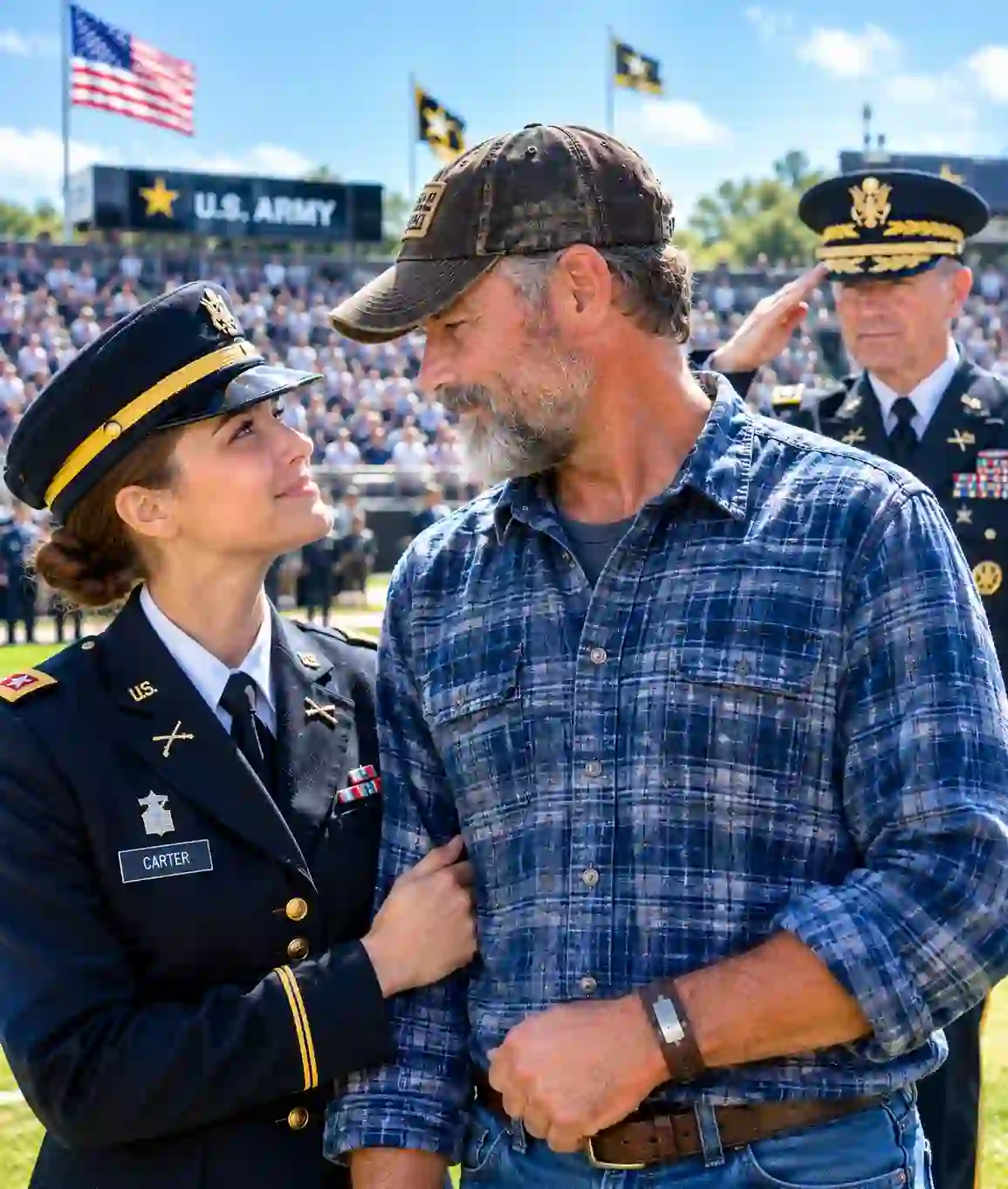
I drove eighteen hours in an aging Freightliner because my daughter had spent four years earning the right to stand on that field.
I had missed birthdays because of freight schedules, arrived late to family dinners, and once watched one of her school plays through a shaky video her mother sent me from the audience. I had spent most of her childhood measuring time by state lines, fuel stops, loading docks, and the glow of truck-stop signs at two in the morning.
But I had promised Emma that when the day came for her Army commissioning, I would be there.
So I drove.
By the time I reached the Tennessee military installation just after sunrise, my shoulders were stiff, my right knee was throbbing, and the old Freightliner sounded like it had developed several new opinions about retirement.
I shut off the engine and sat behind the wheel for a moment.
The cab went strangely quiet.
I could smell diesel, coffee, worn upholstery, and the industrial-strength soap I had used at a truck stop somewhere outside Nashville. My blue flannel shirt was clean, although I had ironed it with a tiny travel iron in the sleeper. I had shaved in a bathroom with a broken mirror and managed to nick my chin twice.
It wasn’t exactly the appearance I would have chosen for an important military ceremony.
But Emma wasn’t going to care.
She never had.
I climbed down from the truck, straightened my shirt, and looked toward the stadium.
Families were already making their way inside. Some fathers wore dark suits and polished shoes. Mothers carried flowers. A few families had arrived together in expensive SUVs with out-of-state plates. Nearly everyone seemed to have a phone in hand.
I looked at my own clothes.
Work boots.
Blue flannel.
Faded jeans.
Hands that still had a thin layer of grease beneath the fingernails no matter how hard I scrubbed.
Then I looked at the leather band around my right wrist.
It had once been black.
Years of sunlight, sweat, rain, and work had turned it a deep brown. The stitching had faded, and one corner had been repaired with thread after it nearly came apart.
Most people would have thrown it away years ago.
I couldn’t.
I touched the small metal plate sewn into the leather and felt the familiar raised letters beneath my thumb.
CARTER.
I had worn that band for more than sixteen years.
“Dad!”
I looked up.
Emma was running toward me.
She was wearing her Army dress uniform, and for a second I couldn’t reconcile the woman coming toward me with the little girl who used to climb into my truck carrying a pink backpack and a box of crayons.
Her hair was pulled back neatly. Her uniform was perfect. The expression on her face, however, was exactly the same.
She reached me and wrapped both arms around my shoulders.
“You actually came.”
I laughed.
“I told you I would.”
“You drove all night.”
“Most of it.”
She pulled away and looked at my face.
“You didn’t sleep, did you?”
“I slept.”
She narrowed her eyes.
“How long?”
I considered lying.
“Forty-five minutes.”
“Dad!”
“I was parked safely.”
She shook her head, but she was smiling.
Then she touched my sleeve.
“You look nice.”
“I wore my good flannel.”
“That is not a good flannel.”
“It has buttons.”
She laughed.
For a few seconds, everything felt simple.
Then Emma noticed the leather band on my wrist.
“You still wear that thing?”
“Every day.”
“You’ve had it forever.”
“Pretty much.”
She had asked about it before. I had always given her the same answer.
“It belonged to someone important.”
She had never pushed.
Today, she looked at it a little longer.
“Who?”
I smiled.
“I’ll tell you someday.”
She rolled her eyes.
“You’ve been saying that since I was twelve.”
“Then I guess someday hasn’t arrived yet.”
She laughed and linked her arm through mine.
As we walked toward the stadium, I noticed people looking at me.
They weren’t openly rude.
Most weren’t even staring.
It was subtler than that.
A glance at my boots.
A quick look at my truck parked among rows of newer vehicles.
A second glance at my clothes.
Then people would turn back toward their families.
I knew that look.
I’d spent most of my adult life around people who measured success by what was parked in your driveway, what kind of watch you wore, or what job title appeared beneath your name.
Truck drivers learned early not to take those judgments personally.
We carried other people’s products for them.
We slept in parking lots.
We ate dinner beside loading docks.
We kept moving while most of the country slept.
People depended on us without necessarily noticing us.
I had become comfortable with that.
I wasn’t at the ceremony to impress anyone.
I was there because my daughter was about to become an Army officer.
That was enough.
The commissioning ceremony began at ten.
The cadets stood in formation beneath a bright Tennessee sky while families filled the stadium seats behind them. The band played. Officers moved across the field. Cameras were raised throughout the crowd.
I found Emma immediately.
She stood perfectly still with the other cadets.
I remembered her at eight years old, standing beside my truck in a winter coat and pretending to command an imaginary platoon.
“Attention!” she used to shout.
I would salute her from the driver’s seat.
She thought it was hilarious.
She didn’t know that I had once worn a uniform too.
She didn’t know how much of my life had been spent overseas.
She knew only that her father drove trucks.
And I had preferred it that way.
The guest speaker took the stage.
Lieutenant General Daniel Mercer was a decorated senior Army officer who had served for decades. His uniform was covered with ribbons and insignia, and when he began speaking, the stadium settled into complete attention.
He talked about leadership.
He talked about responsibility.
He talked about the people soldiers rarely see standing behind them—the spouses who wait at home, the parents who worry, the children who grow up counting deployments, and the ordinary people who make extraordinary sacrifices without ever receiving recognition.
I listened quietly.
Then General Mercer stopped.
It was so sudden that I initially thought there had been a technical problem.
His eyes had moved across the crowd.
Then they stopped on me.
I looked behind myself.
There was nobody directly behind me.
I turned back.
Mercer was still looking at me.
His expression had changed.
Not confusion.
Not curiosity.
Recognition.
His speech had ended in the middle of a sentence.
An officer standing near the podium leaned toward him and said something.
Mercer didn’t respond.
Instead, he stepped away from the microphone.
He walked down the stairs.
Then he started across the field.
People began turning in their seats.
I felt uncomfortable.
I looked at Emma.
She had noticed him too.
“Dad,” she whispered, “why is he coming over here?”
“I don’t know.”
The general continued walking.
He didn’t hurry.
He didn’t bring an aide.
He didn’t appear to care that thousands of people were watching.
When he reached the family seating area, he stopped directly in front of me.
For several seconds, neither of us said anything.
Then his eyes dropped to my wrist.
The color seemed to drain from his face.
“Where did you get that?”
I instinctively covered the leather with my other hand.
“My old Army unit gave it to me.”
Mercer stared at me.
“What did you say your name was?”
I hadn’t said it.
“Thomas Carter.”
His expression changed again.
“Thomas Carter?”
I nodded.
He looked at my face as if he were comparing it with an image stored somewhere in his memory.
Then he said something I hadn’t heard in sixteen years.
“Sergeant Carter?”
My heart seemed to stop.
Nobody had called me that in a very long time.
I looked at him carefully.
“You know me?”
Mercer took a slow breath.
“I knew a Sergeant Carter.”
He pointed toward the leather band.
“He wore one of those.”
I looked down.
The small metal plate was still visible beneath my fingers.
“That’s me.”
The general didn’t answer immediately.
Instead, he turned toward the field.
“Give me a minute.”
Then he looked at Emma.
“Lieutenant?”
Emma straightened.
“Sir?”
“Is this your father?”
“Yes, sir.”
Mercer looked at her with an expression that was difficult to read.
Then he looked back at me.
“I had no idea.”
“Neither did I.”
He almost smiled.
“That sounds about right.”
He asked if he could sit beside me.
I moved over.
The general sat in the family section beside a truck driver wearing a blue flannel shirt while thousands of people watched.
Then he began telling my daughter a story.
Sixteen years earlier, Mercer had been a battalion commander serving overseas.
At the time, I had been Sergeant Carter, one of the noncommissioned officers assigned to his unit.
Emma listened without blinking.
I had never told her what happened.
I had spent years trying not to remember.
Mercer explained that during a convoy mission, several vehicles came under attack. One vehicle was disabled, and soldiers were trapped inside.
“The order was to move the remaining vehicles out of the danger area,” he said.
Emma looked at me.
“But Dad went back?”
Mercer nodded.
“He went back.”
I stared at the field.
I could still remember the heat.
The smoke.
The shouting over the radio.
The feeling that every second had become longer than the one before it.
I remembered reaching the damaged vehicle.
I remembered getting one soldier out.
Then another.
I remembered finding Mercer injured near the roadside.
“I wasn’t thinking about medals,” I said quietly.
Mercer looked at me.
“I know.”
“You would have done the same thing.”
He smiled faintly.
“That is the part you never understood.”
“What?”
“I couldn’t.”
The words landed heavily.
Mercer explained that he had been injured badly enough that he couldn’t move without help.
I had carried him to a safer position.
Then I went back again.
And again.
By the time the evacuation team arrived, I was injured myself.
I had never considered it heroic.
I had simply been the senior enlisted man who was still standing.
After the mission, I spent weeks recovering.
Then I went home.
My wife was pregnant with Emma.
We had a mortgage we could barely afford, and I had decided that whatever came next, I wanted my daughter to know her father as someone who came home every night.
I left the Army.
I never talked about what happened.
Mercer looked at my daughter.
“Your father saved lives that day.”
Emma’s eyes were filled with tears.
She looked at me.
“Why didn’t you tell me?”
I shrugged.
“Because I didn’t want you growing up thinking your dad was some kind of hero.”
“You were.”
“No.”
I smiled.
“I was your dad.”
Mercer looked down at the leather band.
Then he asked me a question.
“Do you remember what was engraved on the inside?”
I shook my head.
He carefully took the band from my wrist.
He turned it over.
The inside was worn almost smooth.
But the letters were still there.
Mercer read them aloud.
“Bring them home.”
Emma covered her mouth.
I had forgotten the words were there.
That band had been given to me by the soldiers in my unit after the mission. They had joked that I was the one person who refused to leave anyone behind.
I had worn it ever since.
Mercer held it for another second before returning it to me.
Then he stood.
“I owe you something.”
I shook my head.
“You don’t owe me anything.”
“Yes, I do.”
He turned toward the audience.
His voice carried across the stadium.
“Before this young officer receives her commission, I want everyone here to understand something.”
The crowd had gone completely quiet.
“There are people whose service continues long after they remove the uniform. Some become police officers. Some become firefighters. Some teach. Some raise families. Some drive trucks across this country while everyone else is asleep.”
He looked directly at me.
“And some never tell anyone what they once did.”
Then General Mercer stepped in front of me.
He stood straight.
He raised his hand.
And he saluted.
I froze.
For a moment, I didn’t know what to do.
Then old instinct took over.
I stood.
My back straightened despite my aching knee.
I returned the salute.
The stadium erupted.
People applauded.
Some stood.
Others wiped tears from their faces.
But I barely heard any of it.
I was looking at my daughter.
Emma was crying openly.
Mercer lowered his hand and turned to her.
“Lieutenant Carter, you have inherited something far more important than a uniform.”
Emma stood at attention.
“Yes, sir.”
“You have inherited an example.”
She nodded.
Mercer smiled.
“Don’t spend your career trying to become your father.”
Emma glanced at me.
“Why not, sir?”
“Because,” he said, “you’ll have enough work becoming yourself.”
That made her laugh through her tears.
The ceremony continued.
When Emma’s name was called, she walked across the field and received her commission.
I watched her take the oath.
I watched her pin on her rank.
I watched the little girl who once saluted my truck become a United States Army officer.
When it was over, she came straight to me.
She hugged me so tightly that my knee nearly gave out.
“I can’t believe you never told me.”
“There wasn’t much to tell.”
“There was an entire Army.”
I laughed.
“Maybe a little.”
She pulled back.
“Are you proud of me?”
I looked at the uniform.
Then at her face.
“More than you know.”
She smiled.
“I think I’m proud of you too.”
I glanced toward General Mercer.
He was speaking with another officer, but when he saw us, he gave me a small nod.
I nodded back.
There were no more words needed.
Later that afternoon, Emma walked with me toward the parking lot.
My old Freightliner was still sitting where I’d left it, covered in road dust and looking painfully out of place among the newer vehicles.
Emma stopped beside it.
“You’re really driving this thing home?”
“Unless you want to buy me a new one.”
She laughed.
“I’ll think about it.”
I opened the driver’s door.
Before climbing in, I looked at the leather band around my wrist.
Emma noticed.
“You’re still going to wear it?”
“Until it falls apart.”
She reached out and touched it.
“Then we’ll get it repaired.”
I smiled.
“Deal.”
She stepped back.
I climbed into the cab.
The old engine coughed twice before starting.
Emma stood beside the truck, still wearing her new lieutenant’s uniform, and raised her hand in salute.
I looked at her through the open window.
Then I returned the salute.
For sixteen years, I had believed the most important thing I had ever done was survive that convoy.
I was wrong.
The best thing I had ever done was come home.
And the proudest thing I had ever done was drive eighteen hours through the night so I could watch my daughter become the person she was always meant to be.
Editor’s Note: This story is a fictionalized, original work created for entertainment and inspiration. The characters, events, and circumstances are presented as storytelling rather than as a verified real-life account. The story highlights the quiet sacrifices of parents, the lasting impact of military service, and the pride that comes when a child achieves something extraordinary.
Related Posts
- On My Wedding Day, My Brother Sank My Grandfather’s Vintage Mustang Into a Lake—Then I Asked One Question That Wiped the Smiles Off Their Faces

- I Pretended I Was Dying to Find Out If My Struggling Girlfriend Loved Me or My Money—Then She Disappeared for Five Days and Returned With Something That Made Me Break Down in Tears
- My Son’s Best Friend Wore a Bright Red Dress to His Funeral, The Reason Left Us all in Tears
- My Brother Destroyed My $78000 SUV Because I Refused to Give It to His Wife—Then the Police Asked One Question That Silenced My Entire Family

- Every Ride Home Left Me With Missing Memories And I Thought My Husband Was Worried About My Blackouts Until I Heard His Voice on the Recording

- My Mother Banned Me From My Brother’s Wedding, Then One Phone Call Revealed Who I Really Was

About the Author
Hassan is the founder and editor of MidnightReads, a publication featuring thoughtful stories, human-interest articles, history, relationships, and entertaining reads.
He is involved in researching, writing, and editing content for the site, with a focus on creating original, clear, and useful articles that give readers something meaningful to take away.
Hassan believes good content should inform, entertain, and encourage curiosity.
— Hassan, Founder & Editor, MidnightReads