
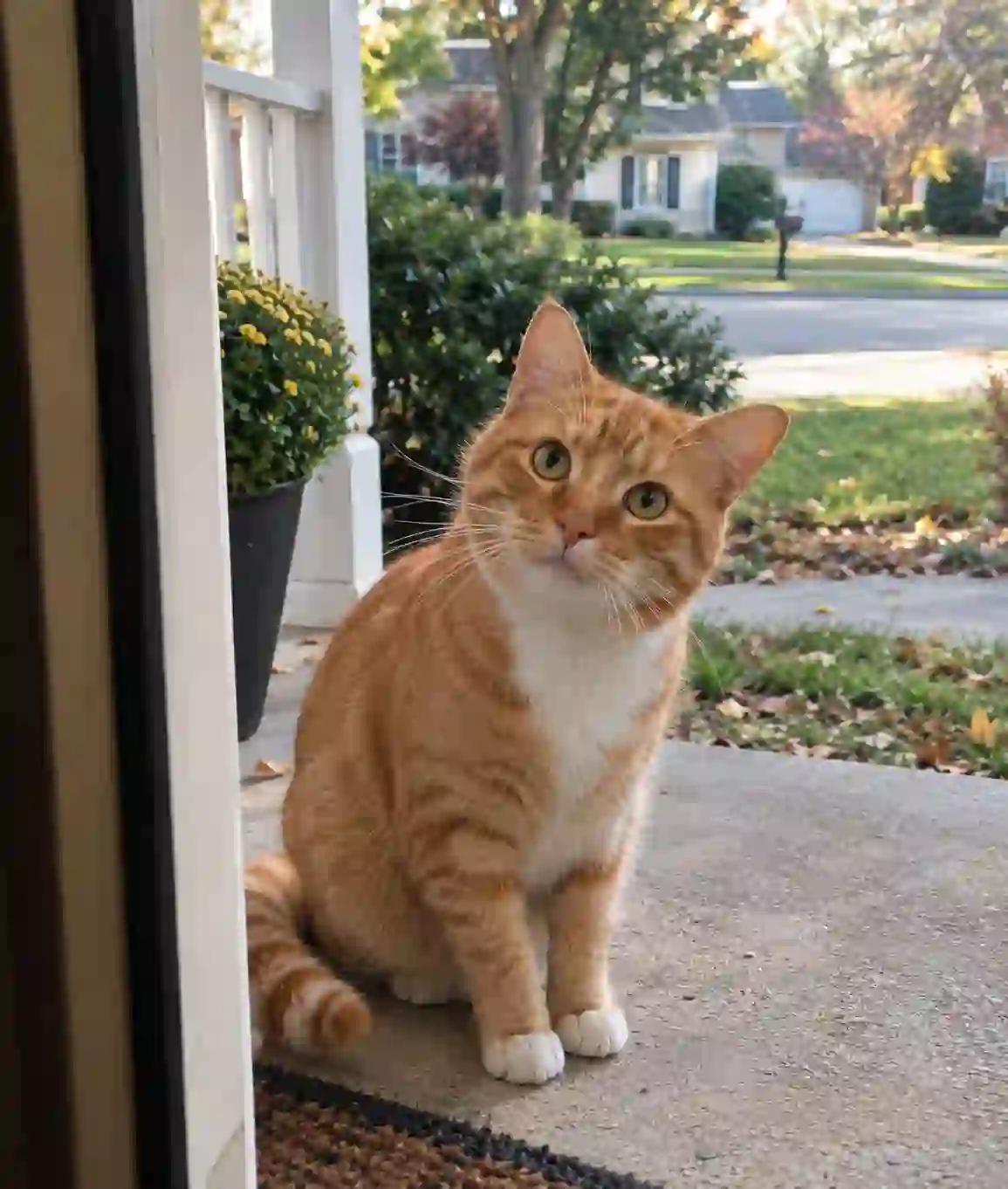
For three weeks, the orange cat appeared at Rachel Turner’s back door at exactly the same time every evening.
He never meowed for food. He never scratched at the door. He simply sat on the porch and stared toward the house for several minutes before leaving the same way he had come.
Rachel initially assumed he belonged to someone nearby, so she ignored him. But when the temperature dropped below freezing and the stray cat still returned that evening, she began wondering why he kept choosing her house.
She put out a bowl of water and some food, but the cat barely touched either one. What he seemed to want was stranger: he wanted to be near the house.
Rachel eventually took a photograph and posted it in her neighborhood’s community group, asking if anyone recognized him.
She expected someone to reply, “That’s my cat.”
Instead, one message sent several days later would explain why the animal had been returning to her porch—and reveal a connection to the house across the street that Rachel had never noticed.
Rachel lived in a quiet suburban neighborhood outside Columbus, Ohio, where most of the houses had been built around the same time. The streets were lined with mature trees, and people generally knew which dogs belonged to which families. Cats were different. Several residents allowed their cats to spend time outdoors, so seeing one crossing a driveway wasn’t unusual.
The orange tabby first caught Rachel’s attention in late October.
She had just returned from work when she noticed him sitting near the steps. He was clean, healthy-looking, and comfortable around people, so she assumed he had wandered over from another house.
Rachel went inside and forgot about him.
The following evening, he was there again.
Then he returned the next evening.
By the end of the first week, Rachel had noticed a pattern. The cat usually arrived between 5:30 and 6:00 p.m., sat near the back door, watched the house for a while, and eventually disappeared toward the same row of houses.
She started calling him the orange cat.
Her neighbor, Linda, suggested that someone probably owned him.
“He’s probably just making his rounds,” Linda said.
That sounded reasonable, but Rachel couldn’t explain why he spent so much time at her house.
She decided to leave a small bowl of water outside. The cat drank some of it but showed little interest in the food she placed beside it.
The next evening, she tried again.
He sniffed the food and walked away.
Rachel found that unusual. Most of the neighborhood cats she had encountered were quick to investigate anything edible.
This cat seemed to have another reason for being there.
As the weather became colder, Rachel began paying closer attention. She noticed that the cat wasn’t wandering randomly. He arrived from the same direction each evening and left along the same route.
She took a photograph and posted it in the neighborhood’s Facebook group.
“Does anyone recognize this cat?” she wrote. “He’s been coming to my house every evening for several weeks.”
Several neighbors commented, but nobody claimed him.
One person suggested checking with a local animal shelter. Another recommended having him scanned for a microchip if he continued coming around.
Rachel decided to do both.
The following weekend, she managed to get close enough to put him safely into a carrier.
The veterinarian found no microchip.
The cat was examined and appeared to be in reasonably good health. He wasn’t feral, and he was comfortable around people, which suggested that he had once lived with someone.
Rachel asked whether she should keep looking for an owner.
“Definitely,” the veterinarian told her. “A friendly cat outdoors may be lost rather than homeless.”
That advice changed the way Rachel approached the situation.
Instead of assuming the cat needed a new home, she started trying to find his old one.
She contacted nearby shelters, checked local lost-pet listings, and posted his photograph again.
Still, nobody came forward.
Then winter arrived.
One evening, the temperature fell below freezing. Rachel looked through her kitchen window and saw the cat sitting on the porch exactly where he always sat.
She opened the back door.
The cat stayed where he was.
Rachel stepped outside and sat on the porch several feet away.
“You’re going to freeze out here,” she said.
The cat looked at her but didn’t move.
Rachel waited.
After several minutes, he walked toward the open door, stopped at the threshold, and looked inside.
She moved aside.
The cat entered.
He didn’t explore the kitchen or search for food. He walked directly toward the mudroom, curled up on a small rug near the heating vent, and settled down.
Rachel closed the door.
For the first time, she wondered whether the cat wasn’t looking for food at all.
Maybe he was looking for something familiar.
She still needed to know where he had come from.
Over the next few days, Rachel noticed that he seemed particularly interested in the house across the street.
That house had been empty for months.
The previous owners had moved away, and the property had been on the market for some time.
The cat frequently sat near Rachel’s porch facing that direction.
One Saturday morning, Rachel saw him leave and decided to follow him from a distance.
He crossed two driveways, passed beneath a hedge, and stopped beside the empty house.
He sat there for several minutes.
Rachel stood across the street and watched.
Then she understood why his route had always seemed so deliberate.
He wasn’t simply visiting her house.
He was staying close to the place he had known before.
Rachel called the real-estate agent listed on the property.
She asked whether the previous owners had owned an orange cat.
The agent didn’t know, but she offered to contact the former owners.
A few days passed.
Then Rachel received a message from a woman named Karen.
Karen had seen Rachel’s neighborhood post.
She asked for another photograph.
Rachel sent several.
Karen called almost immediately.
She said the cat looked exactly like a cat named Oliver who had belonged to her father.
Her father had lived in the empty house across the street.
Rachel was surprised.
Karen explained that her father had died earlier that year. After his death, the family had tried to find a permanent home for Oliver. A relative had taken him temporarily, but Oliver escaped before the family could settle him into the new house.
They searched for him but eventually assumed someone else had taken him in.
Karen had no idea that he had remained in the neighborhood.
Rachel asked whether she wanted to come and see him.
Karen came the next afternoon.
She brought an old photograph of Oliver sitting on her father’s porch.
There was no doubt.
It was the same cat.
But Karen noticed something Rachel hadn’t expected.
Oliver’s original name wasn’t Oliver.
His family had called him Rusty.
“That’s him,” Karen said. “Dad adopted him from a shelter about five years ago.”
Rachel listened as Karen explained that her father had developed a very close routine with the cat.
Every evening, he would sit outside after dinner. Rusty would sit beside him or somewhere nearby.
The porch had been their regular place.
That explained the cat’s behavior better than Rachel’s theory about food ever had.
Rusty had been returning to the place where he had spent years with his owner.
After his owner died and the house was sold, the routine disappeared. The cat had been left without the person and place that had structured much of his daily life.
Rachel suddenly understood why he had been sitting on her porch at almost the same time every evening.
He had been repeating an old routine in the closest place he could find.
Karen asked Rachel whether she wanted to let her take Rusty home.
Rachel hesitated.
She had grown attached to him, but she didn’t want to keep someone else’s pet simply because he had become comfortable with her.
Karen explained that her home already had two cats and that she worked long hours. She also admitted that her father’s old cat seemed happier staying in the neighborhood he knew.
After talking with her family, Karen suggested that Rusty remain with Rachel.
They could visit him, and Rachel could continue caring for him.
Rachel agreed.
She officially adopted him a few weeks later.
There was no dramatic transformation afterward. Rusty remained much the same cat.
He still liked his routine.
He still appeared near the back door around dinner time.
He still preferred sitting near people rather than constantly demanding attention.
But now he had a safe indoor place to sleep and someone who knew his history.
Karen continued visiting.
She brought photographs of her father and occasionally told Rachel stories about the years he had spent with Rusty.
Rachel eventually learned that the orange cat had been part of the family for much longer than she had realized.
He had moved with her father from one apartment to the house across the street and had spent years following the same daily pattern.
The porch, the evening, and the person sitting there had all been familiar parts of his life.
Rachel also learned something practical from the experience.
Before taking in an unfamiliar cat, she should have checked for a microchip and searched for an owner. A cat that spends time outdoors isn’t necessarily abandoned. Some have homes nearby, some have been lost, and others are cared for by more than one household.
She now tells friends not to assume that a cat needs to be rescued simply because it spends time outside.
A photograph in a local lost-pet group, a call to nearby shelters, and a microchip scan can sometimes reunite an animal with its family.
She also discovered that cats can have remarkably consistent routines.
Rusty’s repeated visits had initially seemed mysterious, but once she knew his history, his behavior became easier to understand. He had been returning to a familiar area and following patterns he had learned over years.
Today, Rusty still sits on Rachel’s porch in the early evening.
The difference is that he no longer has to wait outside.
When Rachel opens the door, he walks inside and settles on the rug in the mudroom before eventually finding his favorite place near the living room window.
Karen visits every few weeks.
Sometimes they sit outside and talk about her father while Rusty moves between them.
Rachel says she still thinks about how easily she could have misunderstood the situation.
She had assumed the cat was hungry.
Then she thought he might be homeless.
Later, she wondered whether he simply liked her porch.
The real explanation was more ordinary and more meaningful: he had lost his person and was trying to stay close to the home and routine he remembered.
For Rachel, the experience became a reminder that animals can carry their own histories, even when the people who encounter them know nothing about those histories.
The orange cat who appeared at her door wasn’t looking for a random place to spend the evening.
He was looking for something familiar.
And, in the process, he found a new home without having to give up the memories of his old one.
Editor’s Note
This is an original fictional human-interest story. The characters and events are fictional. The practical information about encountering an unfamiliar cat is included for general awareness and should not replace advice from a veterinarian, animal shelter, or local animal-control agency.
Trending Posts
- 10 Female Mind Games That Can Keep a Man Hooked , And What They May Really Mean

- I Took a Job Bathing a Paralyzed Billionaire Because My Children Were Starving, Then I Unbuttoned His Shirt and Discovered the Shocking Secret That Connected Him to My Son

- The Billionaire Spent $3 Million Trying to Save His Twin Sons, Then Their New Nanny Noticed Something Strange Above Their Bedrooms
- My Mother Invited 20 Guests Into My Home and Forced My Wife and 5-Year-Old Daughter to Serve Them, But When I Came Home Early, My Daughter Revealed What Was Hidden in a Locked Drawer
- I Married a 74-Year-Old Wealthy Man to Give My Daughter a Better Life but Then I Heard Him Whispering to Her at Midnight
- Kiersten Was 29 Weeks Pregnant and Preparing for Her Second Son, Then One Diagnosis Forced Her to Begin a Fight She Never Expected





Hammad Ali
Co-Owner & Author
Hammad Ali is a co-owner and author at MidnightReads, contributing thoughtful and engaging articles across human-interest, life, history, relationships, and entertainment topics.
They help develop and create original, useful content designed to inform, entertain, and give readers something meaningful to take away.