
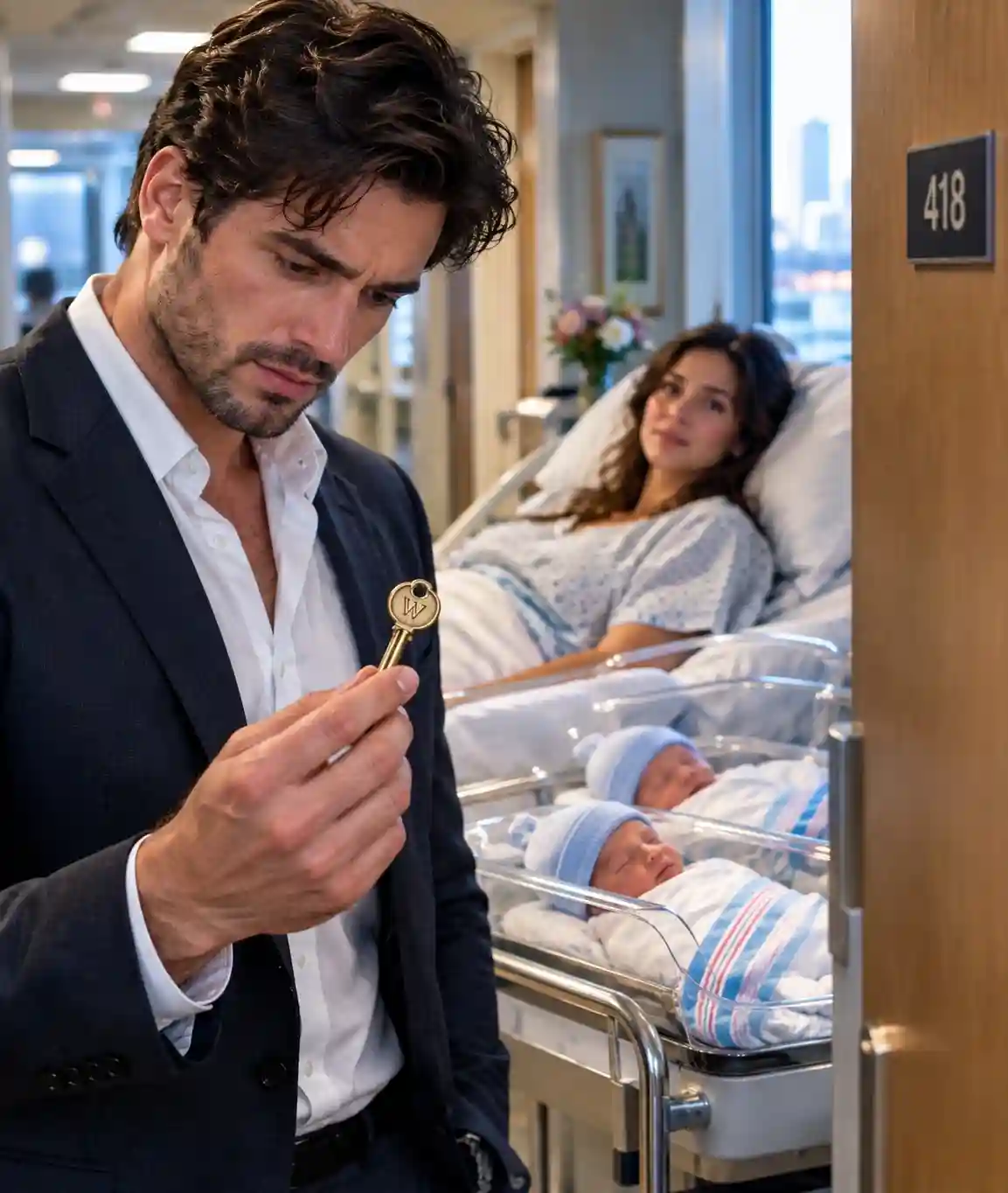
Seven months after our divorce, I was sitting alone in my office when my phone rang just before midnight. An unfamiliar woman told me my ex-wife, Mara Bennett Waverly, had been admitted to St. Catherine’s Women’s Hospital and had just given birth. I was about to ask why she was calling me when she added, “The babies are yours.”
I drove to the hospital without calling anyone. The entire way there, I kept trying to understand how Mara could have been pregnant during our divorce without me knowing. We had spent months fighting over accusations involving my family’s business, and I had walked away believing she had betrayed me.
When I reached the maternity floor, an older nurse was waiting near the elevators. She introduced herself as June Harper and told me Mara had given her my private number months earlier. Then she placed a small brass key in my hand and said Mara wanted me to have it before my family arrived.
I stared at the key and asked what it opened. June wouldn’t tell me, but she warned me that my parents and my brother already knew about the babies. Before I could ask how, my phone vibrated with a message from my mother asking where I was and telling me not to make another mistake.
I entered Room 418 and found Mara sitting upright in a hospital bed, pale and exhausted. Two tiny boys were sleeping in bassinets beside the window, and for several seconds I could do nothing but stare at them. I had spent seven months believing my marriage was over, only to discover that I had become a father before I even knew my children existed.
Mara watched me carefully as I asked whether the boys were mine. She nodded and said she had never doubted it, but she had been afraid to tell me because someone had made sure I would never hear the truth. When she handed me copies of letters she had tried to send through her attorney, I recognized the dates from the period when my father had told me Mara was only trying to reopen our divorce settlement.
There was a handwritten note across one of those letters, and I recognized the handwriting immediately. It belonged to my father. The note warned Mara not to contact me again unless she wanted to make the situation worse for herself.
I looked at Mara and demanded to know what my father had to do with her pregnancy. She told me she had discovered she was pregnant shortly before our divorce was finalized, but my father found out before she could tell me. According to Mara, he threatened to use his influence to challenge her ability to raise the children if she contacted me.
I wanted to believe she was exaggerating, but she explained that she had tried to reach me through her attorney several times. My father had told me those messages were simply attempts to manipulate me and reopen the divorce. At the time, I never questioned him because I had already convinced myself that Mara was guilty.
Before I could ask another question, my father walked into the room with my mother and my older brother, Daniel. None of them looked surprised to see me. My father immediately told me that we needed to leave and discuss the situation privately.
I refused and asked why they had known about the babies. My mother said they were concerned about the children’s future, while Daniel explained that they had prepared a temporary guardianship agreement because Mara was supposedly not in a position to make decisions. I stared at him in disbelief because the boys had been born only hours earlier.
Mara quietly told me that my family had been pressuring her to sign the agreement for months. She said they wanted control over the boys because they were Waverly heirs. My father told her to stop manipulating me, but his reaction only made me more suspicious.
I remembered the brass key in my pocket and asked Mara what it opened. She looked at June, who was standing near the doorway, and then told me that the key would lead me to something my grandfather had left behind. She said that whatever I found there would explain why my family had been so desperate to keep me away from her.
June led me downstairs to an old storage area in the hospital basement. We stopped in front of a steel door with a small brass lock, and the key fit perfectly. Inside were three boxes, several folders, and an old digital recorder that had been carefully placed on a shelf.
The first box contained bank records and copies of transactions from the Waverly Foundation. The second contained photographs of my father and Daniel meeting executives from an investment company that had received millions of dollars from one of our family accounts. The third box contained a DNA test confirming that I was the biological father of Mara’s unborn children.
The test had been performed six months earlier, which meant someone had known about my sons long before I did. Beneath it was a folder with my name on it, filled with emails between my father and Daniel. One message said I had to remain convinced that Mara had betrayed the company because a reconciliation between us could expose everything they had been hiding.
I read the messages again, hoping there was some other explanation. Instead, I found another email discussing the pregnancy and saying the children could not become public until a matter involving my grandfather’s trust had been settled. At that point, I knew the divorce had been manipulated, but I still didn’t understand why.
Then I found the recorder.
When I pressed play, my grandfather’s voice filled the room. He explained that he had discovered irregular transfers from the Waverly Foundation and believed my father and Daniel were involved. He said he had gathered evidence but feared that confronting them directly would put the family business at risk.
For that reason, he had created a separate trust in my name that would become active if I ever separated legally from the family business. The trust was designed to give me independence if my family ever tried to control my decisions or prevent me from accessing information that belonged to me.
Then his voice became more personal as he warned me that there was someone my family would try very hard to make me distrust. That person was Mara.
I stood in the basement for several minutes after the recording ended. The woman I had spent seven months blaming had apparently been trying to protect me, while the people I had trusted had been working to keep us apart. The brass key suddenly felt much heavier in my hand.
When I returned upstairs, my father was waiting outside Room 418. He looked at me and immediately knew I had found something. I asked him why he had hidden my children from me, and for the first time, he stopped pretending there was a simple explanation.
He admitted that he believed I would return to Mara if I knew she was pregnant. He said he had been trying to protect the Waverly family and the company from what he considered a disastrous decision. I asked whether destroying my marriage and hiding my children was part of that protection, but he couldn’t give me an answer.
Daniel tried to defend the financial transactions by saying they had been necessary to keep the company stable. I showed him the records proving that Mara’s credentials had been used to authorize transactions she had never made. When I told him copies of the evidence were already being sent to my attorney, he finally stopped arguing.
The investigation that followed lasted for months. Independent investigators reviewed the Waverly Foundation’s finances and found numerous irregular transfers involving companies connected to my father and Daniel. The evidence used against Mara during our divorce was also examined, and serious inconsistencies were found in the records that had been used to accuse her.
The guardianship agreement my family had tried to make Mara sign was abandoned. Parts of our divorce settlement were reopened, and the accusations against Mara were formally challenged. My grandfather’s trust also became active, separating my personal interests from the family business and giving me the freedom to walk away.
Mara never asked me to punish my family. She didn’t ask me to destroy the company or seek revenge against my father. Her only request was that the false accusations against her be corrected so that our children would never grow up believing their mother had betrayed their father.
I agreed.
When the boys were finally discharged from the hospital, I helped carry them home. I moved into a nearby apartment instead of immediately trying to rebuild my marriage with Mara. We had too much history and too much hurt between us to pretend that one night of revelations could fix everything.
Instead, we started learning how to raise our sons together. There were disagreements about feeding schedules, doctor’s appointments, sleep routines, and which stroller was worth buying. Somehow, those ordinary problems felt better than the secrets and accusations that had defined our marriage.
Slowly, Mara and I began talking honestly about what had happened. She admitted that she should have found another way to reach me, while I admitted that I had trusted my family so completely that I stopped listening to her. Neither of us could change those decisions, but we could decide not to repeat them.
A year after the night at St. Catherine’s, I returned to the hospital for the first time. I wasn’t there because of an emergency this time. Mara and I had brought the boys for a routine appointment, and Noah and Caleb were now old enough to turn every quiet hallway into a race track.
While Mara checked them in, I found myself standing outside Room 418. The door was closed, just as it had been that night, but I no longer felt the same fear when I looked at it. I reached into my pocket and felt the small brass key I still carried.
Mara noticed it when she joined me. She smiled and asked whether I was still carrying it around. I told her I probably always would, not because I needed it anymore, but because it reminded me of the one night when I finally stopped accepting other people’s explanations for my own life.
She looked toward the boys, who were arguing over a toy in the waiting area. Then she said, “You know what I think? That key didn’t save us.”
I looked at her, surprised.
“You did,” she continued. “The moment you decided to find out what was really happening instead of deciding what you wanted to believe.”
For months, I had thought the worst thing my family had done was separate Mara and me. I eventually realized it was something more complicated. They had convinced me that I was protecting myself when, in reality, I was surrendering every important decision to people who benefited from my ignorance.
The legal case eventually ended with my father and Daniel losing control of several family assets and facing financial penalties. I chose not to take over the company. Instead, I used the trust my grandfather had created to establish an independent foundation in his name, with strict outside oversight so no member of my family could quietly control it again.
Mara and I never pretended the divorce had never happened. We didn’t rush into another marriage simply because we had children together. We rebuilt our relationship slowly, with separate homes at first, honest conversations, and the understanding that trust could not be demanded just because two people once loved each other.
Eventually, we became a family again, but it looked different from the one I had grown up in. There were no secret meetings behind closed doors, no decisions made for someone “for their own good,” and no one was allowed to confuse loyalty with obedience.
One evening, several years later, Caleb asked me why I kept an old key in the wooden box on my desk. I looked at Mara, who was standing in the doorway, and then at Noah, who was waiting for my answer.
I picked up the key and placed it in Caleb’s palm. “It opened a door once,” I told him. “But that’s not why I kept it.”
“Then why?” he asked.
I smiled. “Because it taught me never to be afraid of what might be behind a locked door.”
Caleb handed the key back, apparently satisfied with the answer, and ran outside after his brother. Mara walked over and slipped her hand into mine.
I looked at the brass key one last time before placing it back in the box. Seven months after my divorce, I had walked into a hospital believing I was there to deal with my past. Instead, I discovered my future waiting for me in two tiny bassinets.
The key had opened a hidden room, but the real door it opened was inside me. It forced me to question the people I trusted, confront the choices I had made, and finally understand that protecting a family doesn’t mean keeping secrets for it.
Sometimes, protecting a family means being brave enough to uncover them.
Editor’s Note: This is a fictional human-interest story created for entertainment. The characters, events, organizations, and circumstances are fictionalized, and any resemblance to real people or events is coincidental. The story explores trust, family secrets, forgiveness, and the consequences of allowing others to make important decisions on our behalf.
Latest Posts
- The Millionaire Suddenly Told His Maid “Don’t Move” as He Sat Alone in His Wheelchair, What He Confessed That Rainy Night Was Something She Never Expected

- My Husband Gave Me Three Weeks to Leave Our Home, Then My Lawyer Asked About a Document I Signed Three Years Earlier

- I Was Hiding in a Brooklyn Restaurant From the Men My Stepmother Sent After Me When a Six-Year-Old Boy quietly Asked Me to Marry Him, Then His Father Walked In
- My 11-years-old Daughter Was Locked Out of the House on a Freezing Afternoon after school then Three Days Later, My Mother Received a Letter She Never Expected

- My Sister Slammed a Spiked Tiara Onto My Head at Her Wedding later Then Doctors Found Something was Hidden Inside It

- My Mother-in-Law Told Me to Wait Until Morning While I Was in Labor, Then the Emergency Dispatcher Heard Her Locking the Bathroom Door






About the Author
Hassan is the founder and editor of MidnightReads, a publication featuring thoughtful stories, human-interest articles, history, relationships, and entertaining reads.
He is involved in researching, writing, and editing content for the site, with a focus on creating original, clear, and useful articles that give readers something meaningful to take away.
Hassan believes good content should inform, entertain, and encourage curiosity.
— Hassan, Founder & Editor, MidnightReads