
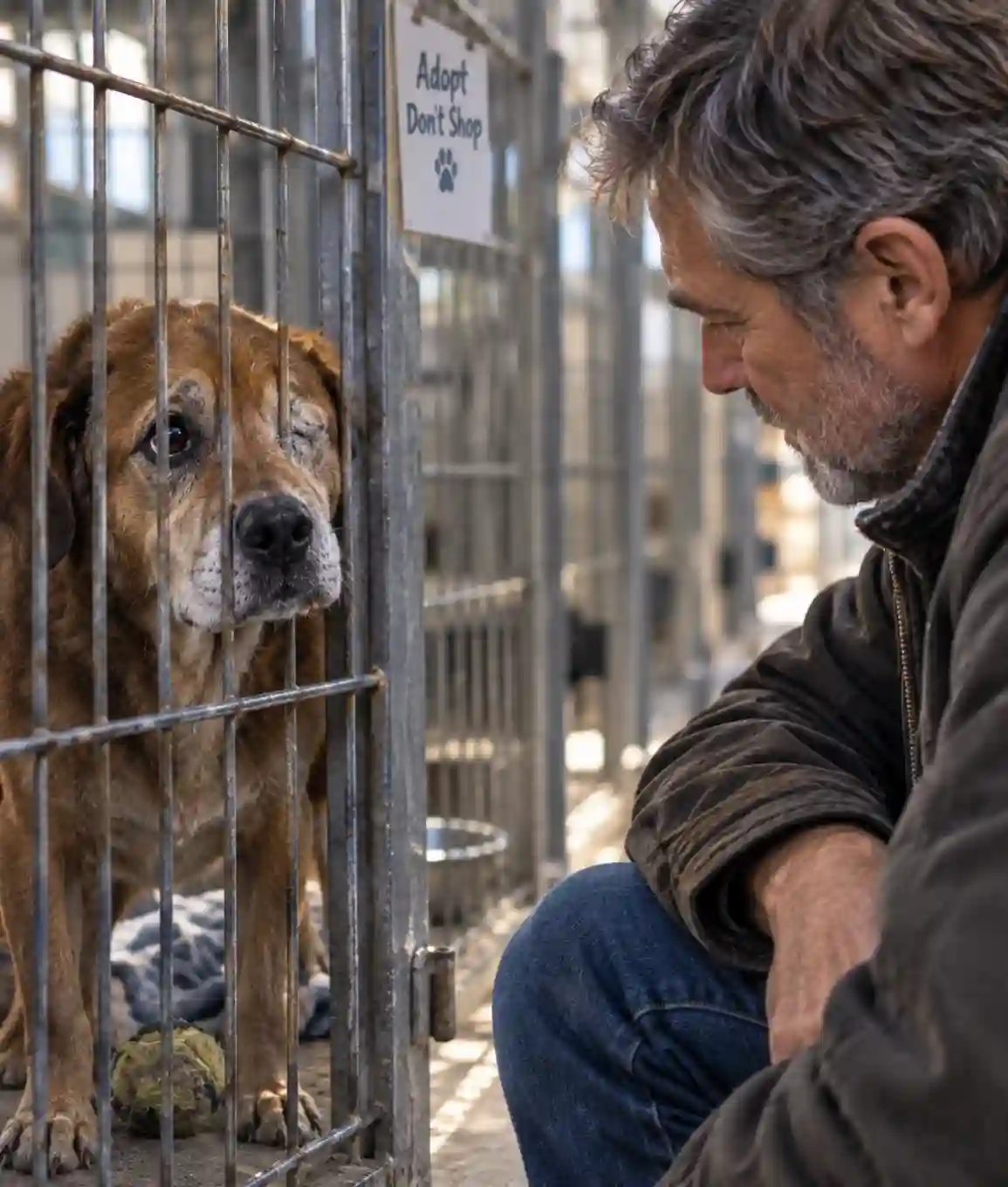
I watched a one-eyed dog get passed over eleven times in less than two minutes. What broke me wasn’t his missing eye. It was watching him pick up the same battered tennis ball and carry it toward person number twelve as if he still believed that this time someone might stay.
His name was Neron.
I was fifty-eight years old when I first saw him on my phone, sitting at my kitchen table with a cup of coffee I’d already reheated twice. The video had been posted by a woman who worked at a local animal shelter, and it showed different families walking past Neron’s kennel.
Every time someone stopped, Neron did the same thing. He hurried to the back, picked up an old tennis ball, and carried it toward them. The ball was almost gray, with one side split open and pieces of faded fuzz hanging from it.
A little boy scratched Neron behind the ears, and Neron’s tail slapped happily against the kennel wall. For a moment, it looked as if the boy had chosen him. Then the family walked three doors down and left with a younger dog.
The next clip showed an older couple.
Neron brought them the ball.
They smiled at him.
Then they left with a small white dog.
Another family came.
Same ball.
Same hopeful greeting.
Different dog leaving with them.
I watched the video three times.
It wasn’t his missing eye that bothered me. It was the way he kept believing the next person might stay.
I knew something about that.
I repair appliances for a living. Washers, dryers, refrigerators, dishwashers—whatever people are tired of replacing. My whole life, I’ve been the man people call when something breaks.
My older brother was the one Dad took fishing first. He was better at sports, better at talking, and better at being the person everybody noticed when he walked into a room.
I was useful.
There’s a difference.
After my marriage ended, that feeling followed me. People called when they needed a truck, when a dryer stopped heating, when a garage door got stuck, or when they needed someone to help move something heavy.
Nobody was cruel to me.
That almost made it harder.
I was simply rarely the first person anybody thought of when nothing was wrong.
After enough years, you get good at pretending that doesn’t bother you.
I told myself I liked living alone. Most nights, I ate dinner in front of the television and fell asleep in my recliner. There was something comfortable about having nobody to disappoint and nobody expecting anything from me.
Then I saw Neron carrying that ball.
The next afternoon, I drove to the shelter.
I told myself I was only going to look.
A woman named Erin led me toward the kennels.
“There he is,” she said.
Neron was lying on a blanket with his head between his paws. His right eye followed me. His left eye was gone, leaving a small patch of fur and an old scar.
I waited for him to run for the ball.
He didn’t.
For some reason, I felt disappointed.
“He used to do it for everybody,” Erin said quietly. “Lately, not as much.”
“How long has he been here?”
She hesitated.
“Long enough.”
I sat down on the concrete floor outside his kennel. I didn’t call him. I didn’t snap my fingers or make the usual noises people make when they want a dog to perform happiness for them.
I just sat there.
After a while, Neron stood.
He stretched and slowly walked toward the back corner.
There was the ball.
He picked it up and came toward me, but stopped about three feet away. He didn’t drop it. He simply stood there holding it, watching me as if he wasn’t sure what I wanted from him.
“I get it,” I said.
Erin looked at me, but I wasn’t talking to her.
She told me something then that I still think about.
Sometimes, after a family chose another dog and left, Neron would sit near the shelter door. If they came back inside because they had forgotten a jacket or needed another paper signed, he would immediately run for his ball.
He always thought they had come back for him.
I looked at Neron again.
Then I stood up to leave.
He followed me to the kennel door.
The ball was still in his mouth.
When I reached for my jacket, he slowly dropped it. The ball rolled beneath the gate and stopped beside my shoe.
I bent down and picked it up.
I expected him to reach for it.
Instead, he simply watched me.
I held the ball through the bars.
“You really keep giving this away, don’t you?”
Neron stepped closer.
He took the ball gently from my hand and walked back toward his blanket.
I don’t know why that affected me so much. Maybe because I suddenly understood that he wasn’t trying to impress anyone. He had simply found one thing he could offer, and he kept offering it even after people had disappointed him.
I went home that evening, but I couldn’t stop thinking about him.
The next morning, I was back at the shelter before Erin had finished her coffee.
She looked at me through the office doorway and smiled.
“I was wondering how long you’d last.”
“I didn’t sleep much.”
“Neron?”
I nodded.
She led me to his kennel. He was lying quietly in the corner, and for a moment he didn’t seem to notice me. Then he lifted his head, recognized me, and got to his feet.
I expected him to grab the ball.
He didn’t.
Instead, he walked over and rested his chin against my knee.
I sat down beside him.
That was the first time I realized I wasn’t coming to the shelter because I felt sorry for him anymore. I was coming because I liked being around him.
There was something uncomplicated about Neron. He didn’t care what job I had, how much money I made, whether I was married, or why I lived alone. He didn’t know that my brother had always been the favorite. He didn’t know that my marriage had ended years earlier. He didn’t know how many evenings I’d spent eating dinner in a quiet house while pretending I preferred it that way.
He just knew that when I sat beside him, I stayed.
Over the next few weeks, I became part of his routine. I would arrive after work, sit outside his kennel, and tell him about my day while he listened with the patience of someone who had nowhere else to be. Sometimes we’d play with the ball. Other times, he’d simply lie beside me while I read the newspaper.
People continued coming to the shelter looking for dogs.
Neron continued being overlooked.
But something had changed.
He no longer seemed desperate whenever someone walked past his kennel. If a family stopped, he’d get up and greet them, but if they moved on, he’d return to his blanket instead of staring after them.
I wasn’t sure whether he had stopped expecting everyone to choose him or whether he had simply learned that someone was coming back.
Then one Friday afternoon, Erin called me into her office.
“Neron has an adoption application.”
I froze.
For some reason, the news felt like a punch in the stomach.
“What kind of application?”
“A family. They’ve met him twice. They have a fenced yard and another older dog.”
I forced a smile.
“That’s good.”
Erin studied my face.
“You know you don’t have to say anything.”
“I know.”
I went home that evening without visiting him.
The next morning, I sat at my kitchen table with a cup of coffee that went cold in front of me. I told myself I was being ridiculous. Neron deserved a family. He deserved a yard and people who could give him more attention than I could.
But around noon, I found myself driving back to the shelter.
When I reached his kennel, the family was there.
A man, a woman, and a teenage boy were sitting on the floor with Neron. The boy had the old tennis ball in his hand.
Neron was watching him.
The boy rolled it across the floor.
Neron chased it, picked it up, and brought it back.
Everyone laughed.
I stood there quietly.
Then the woman noticed me.
“Are you his owner?”
I almost laughed.
“No. Not yet.”
She looked at Erin.
Erin looked at me.
The man stood up.
“Actually, we were just talking about that.”
I didn’t understand.
Erin walked over and handed me a piece of paper.
It was an adoption application.
My name was written across the top.
“You left this here last week,” she said.
I stared at it.
I had completely forgotten.
The family had come to meet Neron again, but after talking with Erin, they realized someone else had already fallen in love with him.
The teenage boy walked over and handed me the ball.
“He likes you better,” he said.
I looked at Neron.
For once, he wasn’t carrying the ball.
He was sitting beside me.
I took it from the boy and smiled.
“I think we’re going home.”
Neron’s tail started moving.
That afternoon, I drove home with him sitting in the passenger seat. He was nervous at first, keeping his head turned toward the window as if he couldn’t quite believe the scenery was changing.
When we pulled into my driveway, he didn’t jump out immediately.
He looked at me.
I opened the door.
“Come on, Neron.”
He stepped onto the driveway.
Then he walked inside.
The house looked exactly the same as it had that morning. The furniture hadn’t changed. The walls hadn’t changed. Nothing about the place was different.
Except now there was a dog walking through it.
Within ten minutes, Neron had inspected the living room, sniffed every corner, found the kitchen, and carried his old tennis ball onto the rug.
That night, I sat in my recliner with the television on.
Neron lay on the floor beside me.
I looked down at him and realized something I’d never been able to put into words before.
For years, I’d thought loneliness was simply what happened when people stopped needing you.
Neron showed me another possibility.
Maybe loneliness sometimes begins when you stop believing you’re worth being chosen.
The next morning, I woke to the sound of something bumping against my bedroom door.
Neron was standing there with his ball.
I laughed.
“You’re kidding.”
He dropped it and waited.
I picked it up and threw it down the hallway.
He ran after it.
A minute later, he brought it back.
I threw it again.
Then again.
Soon I was laughing at seven in the morning while an old one-eyed dog raced through my house carrying a nearly destroyed tennis ball.
It wasn’t some grand moment. There was no music playing and nobody was watching. It was just an ordinary morning that somehow felt completely different from every morning that had come before it.
Months passed.
Neron learned my routines. He knew when I was leaving for work and when I was coming home. He knew exactly where I kept the treats, and he developed a habit of waiting beside the front window around the time I usually returned.
He also learned something I had never taught him.
I always came back.
One Saturday, I took him to a nearby lake. I hadn’t been fishing in years, partly because it reminded me of my father and my brother, and partly because I had convinced myself that there was no reason to go anymore.
I brought an old fishing rod from the garage.
Neron sat beside me while I cast the line. Every so often, he nudged the tennis ball against my shoe.
“You really don’t know when to quit, do you?” I said.
He looked up at me.
I smiled.
“No. I guess I don’t either.”
We stayed until the sun began dropping behind the trees.
For years, I had thought about all the things I had missed. The fishing trips I hadn’t taken, the marriage that hadn’t worked, the friendships that had faded, and the years I had spent convincing myself that being needed was close enough to being loved.
Sitting beside Neron, I realized I didn’t want to spend the rest of my life counting what had already gone wrong.
I wanted to notice what was still there.
A few months later, I returned to the shelter to volunteer. There was a nervous little brown dog hiding behind a blanket in one of the kennels. He wouldn’t come near the people passing by, so I sat on the floor outside his kennel and simply stayed there.
I didn’t call him or try to force him to trust me. After a while, he slowly came forward and sniffed my hand.
Behind me, Neron was lying near the reception desk with his old tennis ball between his paws.
Then Neron nudged the ball across the floor.
It rolled until it stopped beside the nervous dog’s kennel.
The little dog looked at it, then looked at Neron.
Neron didn’t move.
After a few seconds, the dog stepped forward and sniffed the ball.
I smiled.
That small moment made me understand Neron differently. I had spent months thinking his greatest lesson was about never giving up, but that wasn’t quite right.
Sometimes persistence means continuing to hope. Other times, it means learning when to stop chasing people who have already decided to walk away.
Neron had learned both.
He still welcomed people. He still enjoyed being noticed. He still carried his battered ball whenever someone showed him kindness. But he no longer needed every stranger to choose him.
He already knew where he belonged.
So did I.
Today, the old tennis ball sits in a small basket beside Neron’s bed. He has better toys now, including several that I bought because I couldn’t resist them, but every once in a while he still pulls that battered ball from the basket and carries it into the living room.
He doesn’t play with it for long anymore. Usually, he drops it beside my chair and settles down at my feet.
I keep the ball because throwing it away would feel like throwing away a piece of the story that brought us together.
But I also keep it for another reason.
Before Neron came into my life, I thought being needed was the same thing as being valued. If someone needed a repair, a favor, a ride, or a strong pair of hands, I knew exactly what my purpose was. When nobody needed anything, I wasn’t always sure where I fit.
Neron never needed me to repair him.
He needed food, patience, a safe home, and someone willing to give him time. In return, he gave me something I hadn’t realized I was missing: a reason to open the front door and expect someone to be there.
I went to the shelter because I couldn’t stop thinking about a dog who had been overlooked.
I came home with a dog who taught me that being overlooked is not the same as being without value.
And maybe that is why I still think about person number twelve.
Eleven people had walked past Neron in that short video. He couldn’t control any of their decisions. All he could do was decide what he would do when the next person arrived.
He picked up the ball.
He walked forward.
He offered what he had.
The twelfth person didn’t give him a perfect life.
Neron didn’t give me one either.
What we gave each other was something much more ordinary and, in the end, much more important: a place to belong.
Sometimes, that is enough to change everything.
Editor’s Note: Neron’s story reminds us that an animal’s age, appearance, or past injuries should not determine its worth. Every shelter animal deserves patience, care, and a fair chance to find a loving home.
Related Posts
- I Found a Six-Year-Old Girl Cleaning My Study at 2 A.M. With a Baby on Her Back, Then She Pointed to My Library Wall and Asked Why Someone Was Knocking Behind It

- Poor Girl Was Mocked for Her Cheap Yellow Dress at a Luxury Wedding—Minutes Later, She Stopped to Help an Elderly Woman Who Changed Her Life

- Two Traffic Officers Pulled a Young Woman From Her Car and Handcuffed Her, Then One Thing in Her Pocket Changed the Entire Stop

- The Billionaire Saw His Fiancée Push the Maid Off the Building, What He Did Next Left the Entire City in Shock



Hammad Ali
Co-Owner & Author
Hammad Ali is a co-owner and author at MidnightReads, contributing thoughtful and engaging articles across human-interest, life, history, relationships, and entertainment topics.
They help develop and create original, useful content designed to inform, entertain, and give readers something meaningful to take away.