
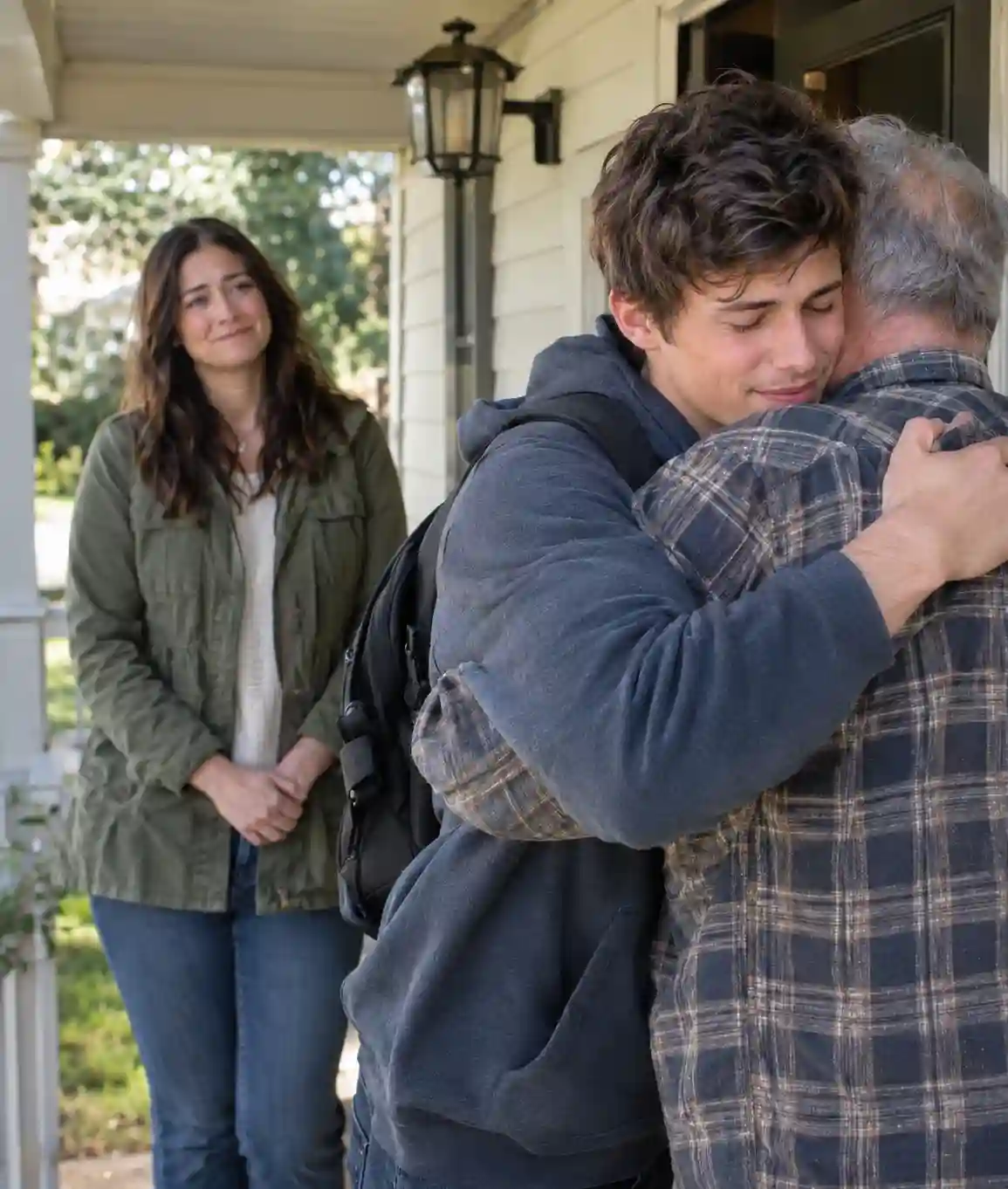
When I was eighteen, my father put my suitcase on the front porch and told me I had made my choice. I was pregnant, unmarried, and still trying to understand how quickly my entire life had changed. The father of my baby had already disappeared, and the one person I thought would stand beside me was the man now telling me I couldn’t stay in his house.
“You’ve thrown your future away,” Dad said. “And that boy isn’t going to give you anything. He’s worthless.”
I wanted to argue with him, but I couldn’t. I was too frightened, too embarrassed, and too young to know what my life would look like after that moment. I picked up my suitcase, walked down the steps, and left without knowing that it would be eighteen years before I would sit across from my father again.
The boy who had promised he would always be there disappeared completely before my son was born. I never heard from him again, so I stopped waiting for an apology and concentrated on raising my child. It wasn’t easy. I worked whatever jobs I could find, studied when I had the energy, and learned how to stretch a small paycheck far enough to cover rent, groceries, daycare, and everything else a child needed.
There were nights when I fell asleep sitting at the kitchen table because I had been working late. There were mornings when my son climbed into my bed before sunrise because he was afraid of a thunderstorm. We didn’t have much, but we had each other, and somewhere along the way, I stopped thinking of our life as something I had failed to build.
My son grew into a thoughtful, funny young man. He knew his father had left before he was born, and he knew there was another part of his family he had never met. Whenever he asked about my parents, I told him the truth without filling his head with bitterness.
“My father and I had a serious disagreement a long time ago,” I would say. “Someday, if you want to know more, I’ll tell you.”
He never pushed me.
That changed on his eighteenth birthday.
After dinner, he stayed at the table while I cleared the plates. When I came back into the room, he was looking at an old photograph he had found in a box of my childhood things. It showed me at about six years old, sitting on my father’s shoulders and laughing at the camera.
“Mom,” he said, “I want to meet Grandpa.”
I stopped beside the table.
I had imagined that conversation many times, but imagining it was different from actually hearing it. I sat across from him and asked what had changed.
“Nothing changed,” he said. “I’m eighteen now. I’ve spent my whole life knowing there was somebody out there who was supposed to be my grandfather. I don’t need him to give me anything. I just want to know who he is.”
I couldn’t tell him not to go.
He was old enough to make his own decisions, and if I stopped him, I would only be repeating the mistake my father had made years earlier—deciding what was best for another person without asking what they wanted.
The next Saturday, we drove to my hometown.
I hadn’t seen my childhood house in eighteen years. From the car, it looked smaller than I remembered. The porch needed paint, the bushes had grown wild, and the oak tree beside the driveway was much larger than it had been when I was a teenager.
My son looked at me before opening the car door.
“Are you coming?”
I shook my head.
“This is something you should do yourself.”
He nodded and walked toward the house.
I watched him climb the steps and knock.
A few seconds later, the door opened.
My father appeared.
Even from across the street, I recognized him immediately. His hair had turned almost completely gray, and he moved more slowly than the man I remembered, but there was no mistaking him.
My son said something.
My father stared at him.
Then he looked past him toward the street.
For one frightening second, I thought he had seen me.
Instead, he stepped outside and closed the door behind him.
They talked for several minutes. My son eventually sat on the porch beside him, and my father disappeared inside the house. When he returned, he was carrying a small wooden box.
My son opened it while they were sitting together.
I couldn’t see what was inside.
About half an hour later, my son came back to the car.
He didn’t speak immediately.
“What happened?” I asked.
“He knew who I was.”
I looked at him.
“He knew?”
“He knew my name. He knew what year I was born. He even knew the hospital.”
I felt a strange mixture of anger and confusion.
“How could he know all that?”
My son looked down at the wooden box sitting on his lap.
“Because he kept records.”
I frowned.
“What kind of records?”
He opened the box.
Inside were birthday cards.
Not one or two.
There were eighteen of them.
Each envelope had my son’s name written across the front, followed by a year.
I picked up the first one.
It was dated the year he was born.
“Did he give these to you?”
My son nodded.
“He said he wrote one every year.”
I stared at the envelopes.
“Why didn’t he send them?”
“He said he didn’t think you would forgive him.”
That answer made me angry.
Not because it was impossible to understand, but because it was too easy.
He had been afraid of rejection while I had spent eighteen years wondering whether my father had forgotten I existed.
I put the cards back into the box.
“What else did he say?”
My son hesitated.
“He asked about you.”
“What did you tell him?”
“I told him you were okay.”
I smiled sadly.
“That was kind of you.”
“He also said something else.”
I waited.
“He said he had been wrong.”
Those four words were more difficult to hear than I expected.
For years, I had imagined my father eventually realizing his mistake. But I had never allowed myself to believe I would actually hear him admit it.
My son reached into the box and pulled out one more envelope.
“This one isn’t for me.”
He handed it to me.
My name was written on the front.
I recognized my father’s handwriting immediately.
I didn’t open it until we were home.
The letter was several pages long, and for the first time, my father told me the truth without trying to defend himself. He admitted that he had been terrified when I became pregnant. He had believed that forcing me out would make me understand how serious my situation was, and he convinced himself that I would eventually return after I had learned to manage on my own.
But when I didn’t return, his pride prevented him from coming after me.
He wrote that he had driven past my first apartment once and sat in his car for nearly an hour.
He had found out when my son started school.
He had learned when I got my first promotion.
He even knew when my son graduated from high school.
He had been watching my life from a distance without ever having the courage to step back into it.
At the end of the letter, he wrote something that made me put the page down.
He said the wooden box wasn’t the only thing he had kept.
There was something in the garage that belonged to my son.
The next morning, I drove back to my father’s house.
This time, I didn’t stay in the car.
My father opened the door before I could knock twice.
For several seconds, we simply looked at each other.
“You came,” he said.
“I did.”
He stepped aside.
I walked into the house where I had grown up. Nothing felt familiar anymore, yet everything did. The kitchen clock was still on the wall. The cabinets were the same. Even the small scratch on the floor near the dining table was still there.
We sat across from each other.
“I read your letter,” I said.
He nodded.
“I meant every word.”
“You knew where we were.”
“Yes.”
“You knew about him.”
“Yes.”
“Why didn’t you come?”
My father looked down at his hands.
“Because every year I waited, it became harder. At first, I told myself you needed time. Then I told myself you were better without me. Eventually, I was ashamed that so much time had passed, and I didn’t know how to face you.”
I stared at him.
“You could have called.”
“I know.”
“You could have written.”
“I know.”
“You could have come to my door.”
He swallowed.
“I know.”
For once, he didn’t make an excuse.
That mattered more than I expected.
After a long silence, he said, “I’m not asking you to forgive me.”
“Good.”
He looked surprised.
“I can’t erase eighteen years,” I continued. “And I don’t want to pretend nothing happened. But I also don’t want to spend the rest of my life being angry about something that happened when I was eighteen.”
His eyes became wet.
“I understand.”
Then he told me about the garage.
My son was already waiting outside when we walked through the back door.
Inside was an old blue sedan covered with a dusty sheet.
I recognized it immediately.
It had belonged to my father when I was a child.
“What does this have to do with me?” my son asked.
My father looked at him.
“I bought this car when your mother was sixteen. She used to sit behind the wheel and pretend she was driving. When you were born, I thought someday I’d teach you how to drive it.”
My son looked at the old car.
“It doesn’t run.”
“I know.”
He smiled slightly.
“Then why keep it?”
My father looked toward me.
“Because I couldn’t bring myself to get rid of the last thing that reminded me of both of you.”
My son walked over and lifted the hood.
“What do you think?”
My father smiled.
“I think the battery is dead.”
My son laughed.
“That I can fix.”
I stood there watching the two of them bend over the engine together.
It wasn’t the reunion I had imagined.
There were no dramatic embraces. Nobody suddenly forgot the past. My father hadn’t magically become the man I needed when I was eighteen, and I wasn’t going to pretend that eighteen missing years could be recovered in a single afternoon.
But something had changed.
My son had given my father something I never could have given him myself: a second chance to become a grandfather.
And my father had finally given me something I had stopped waiting for years ago—not money, not an explanation, and not even an apology.
He had finally admitted that what happened to me had never been my punishment to carry.
A few months later, my son called me from my father’s garage.
“Mom, Grandpa got the car running.”
I laughed.
“Already?”
“Not exactly. We had some help.”
I could hear my father shouting something in the background.
“What did he say?”
My son laughed.
“He said you’re still terrible at fixing cars.”
I smiled.
For the first time in eighteen years, hearing my father’s voice in the background didn’t hurt.
It sounded ordinary.
And maybe that was the real ending I had been waiting for—not a perfect family, not a rewritten past, but an ordinary afternoon that would have been impossible when I was eighteen.
My father had once believed that throwing me out would teach me how to survive.
Instead, I learned how to build a life without him.
Eighteen years later, my son walked through that same door and gave us both something neither of us knew how to ask for.
A chance to stop letting one terrible decision define the rest of our lives.
Editor’s Note: This is a fictional story created for entertainment and reflection. The characters and events are fictional, but the emotions and lessons are inspired by real-life family experiences.
Related Posts
- I Found a Six-Year-Old Girl Cleaning My Study at 2 A.M. With a Baby on Her Back, Then She Pointed to My Library Wall and Asked Why Someone Was Knocking Behind It

- Poor Girl Was Mocked for Her Cheap Yellow Dress at a Luxury Wedding—Minutes Later, She Stopped to Help an Elderly Woman Who Changed Her Life

- Two Traffic Officers Pulled a Young Woman From Her Car and Handcuffed Her, Then One Thing in Her Pocket Changed the Entire Stop

- The Billionaire Saw His Fiancée Push the Maid Off the Building, What He Did Next Left the Entire City in Shock
- I Came Home From the Military Early and Found My Wife Unconscious in the Snow while My Mother Said, “She Finally Learned Where She Belongs”
- My Divorce Had Been Final for Seven Months When a Midnight Hospital Call Revealed My Ex-Wife Had Given Birth to My Twin Sons, then a Brass Key Exposed Why She Hid Them


Hammad Ali
Co-Owner & Author
Hammad Ali is a co-owner and author at MidnightReads, contributing thoughtful and engaging articles across human-interest, life, history, relationships, and entertainment topics.
They help develop and create original, useful content designed to inform, entertain, and give readers something meaningful to take away.