
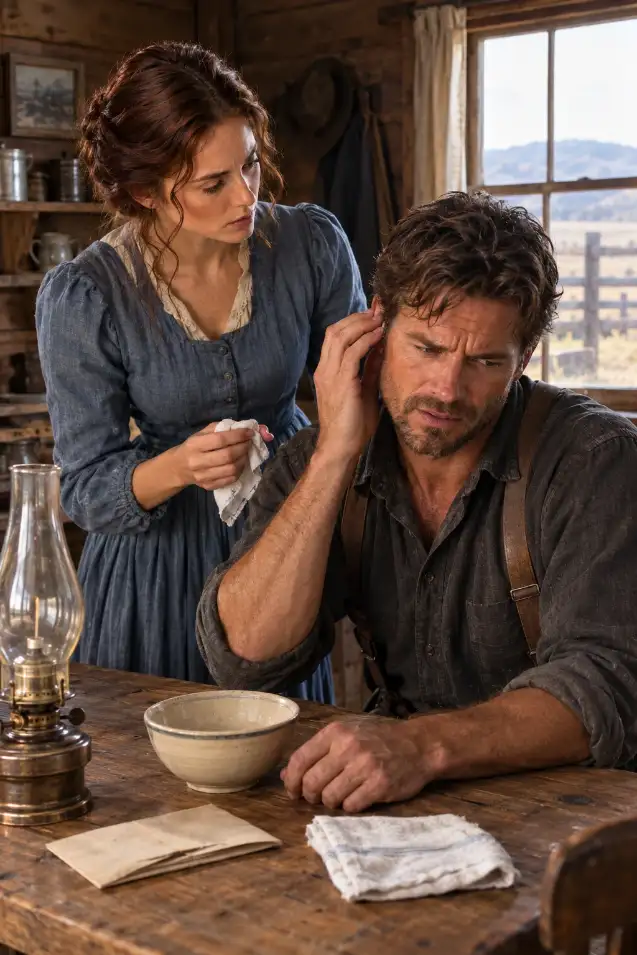
The black thing inside her husband’s ear moved just as Rosalie Ashford raised the oil lamp.
She froze.
Gideon Rook, the man she had married only eight days earlier, was gripping the edge of the kitchen table so tightly that his knuckles had turned white. Sweat ran down his face despite the freezing weather, and a thin line of blood trickled from his swollen right ear. He looked at Rosalie with desperate eyes, unable to hear the frightened questions spilling from her lips.
Then he shoved his worn notebook toward her.
DON’T LET ANYONE IN TOWN KNOW.
Rosalie stared at the words, then at the strange movement inside his ear. Why would a man suffering such terrible pain be more frightened of the townspeople than of whatever was happening to him? And why had he endured similar problems since childhood?
Eight days earlier, Rosalie had known almost nothing about Gideon except the rumors circulating around Coldwater, a small frontier town surrounded by snow-covered hills and cattle ranches. At thirty-eight, he owned a sprawling property beyond the northern ridge, lived mostly alone, and could barely hear a word spoken to him. Some townspeople called him dangerous. Others whispered that his deafness had made him strange and unpredictable.
Rosalie had never believed that a person’s disability made him dangerous. But she had learned that people were often willing to invent stories about anyone who was different.
Unfortunately, she had little choice about marrying him.
Her father, Thomas Ashford, had accumulated gambling debts that threatened to take the family farm. Rather than accept responsibility for his mistakes, he had decided to exchange his daughter’s future for fifty dollars. Rosalie’s older brother, Merrick, laughed when she protested, telling her she should be grateful that a wealthy rancher had agreed to take her.
On the morning of the wedding, Rosalie had stood before a cracked mirror wearing her late mother’s faded ivory gown. She was twenty-three years old, frightened, and furious that neither her father nor her brother had asked what she wanted.
Then Gideon arrived.
He was tall and broad-shouldered, with dark hair, a weather-beaten face, and a quiet manner that made people mistake his silence for hostility. During the ceremony, he barely touched Rosalie’s cheek when the minister instructed him to kiss his bride.
The journey to his ranch was almost entirely silent. Rosalie sat beside him beneath a wool blanket, wondering whether she had escaped one miserable home only to enter another.
But when they arrived, she found a clean cabin, a warm fire, fresh bread, and a neatly made bed in a separate bedroom.
Gideon handed her his notebook.
This room is yours. I’ll sleep beside the fire. You owe me nothing except honesty. If you decide to leave, I’ll arrange a safe journey.
Rosalie read the message twice.
She had expected demands, resentment, and perhaps violence. Instead, the man her father had accepted money from was offering her something her own family had denied her: a choice.
That first night, she locked her bedroom door out of habit. Gideon never tried to open it.
Over the following days, they developed a quiet routine. Gideon rose before dawn to feed cattle, repair fences, and split firewood. Rosalie prepared meals, washed clothes, and learned how to manage a household in the wilderness. Their conversations took place mostly through short handwritten notes.
Storm tonight.
Flour is above the stove.
North fence needs repairing.
Their marriage was not romantic, and Rosalie did not pretend to love a man she barely knew. Yet she began to feel safe around him. Gideon never mocked her questions or treated her as though she belonged to him. When she accidentally ruined a batch of bread, he smiled and wrote that even his first attempts at cooking had been worse.
She laughed so unexpectedly that she surprised herself.
It was the first time she had laughed freely in months.
But she soon noticed something troubling.
Gideon repeatedly pressed two fingers behind his right ear. Sometimes he stopped working and stood perfectly still, his face tightening as though he were fighting a wave of pain. When Rosalie changed the bedding, she noticed faint rusty stains on his pillowcase.
One evening, she placed his notebook on the table and wrote, Does your ear hurt?
He hesitated before answering.
Sometimes.
How long has this been happening?
Gideon stared at the page for several seconds.
Since I was seven.
Rosalie wanted to ask more, but his expression told her that the subject was painful in ways that had little to do with his body. She decided to wait until he was ready to explain.
The next few days brought a bitter cold spell. Snow covered the fences, and Gideon worked longer hours to protect the cattle. Each evening, he returned to the cabin looking more exhausted than before.
On the seventh night, Rosalie found him sitting beside the fire with his hand pressed against his ear. His face was pale, and his shirt was damp with sweat.
She brought him a warm cloth and a glass of water.
Gideon accepted them but avoided her eyes.
Rosalie opened the notebook again.
You don’t have to hide the pain from me.
For a long moment, he looked at her. Then he wrote a sentence that troubled her more than anything he had said before.
Doctors told me nothing could be done.
Rosalie wanted to tell him that doctors could be wrong, that he deserved another examination, and that no one should have to suffer alone. But she could see how many years of disappointment had taught him not to expect help.
She placed her hand over his and remained beside him until he relaxed.
The following evening, everything changed.
They were eating supper when Gideon suddenly dropped his spoon. His face tightened, and he gripped the table. A moment later, his chair crashed backward as he doubled over, both hands pressed against his head.
Rosalie rushed to him.
His right ear was swollen and red, and a thin line of blood had appeared near the opening. She helped him sit upright and fetched the oil lamp to examine the injury.
Then she saw it.
Deep inside the ear canal, something black shifted.
Rosalie stopped breathing for a moment. Whatever it was, it appeared to be alive.
She wanted to rush Gideon to a doctor, but the nearest clinic was miles away, and snow was already falling heavily outside. She fetched a clean cloth and tried to keep him still while she considered what to do.
Gideon caught her wrist and pushed his notebook toward her.
DANGEROUS.
Rosalie looked at him, then wrote back.
I won’t hurt you. But we need help.
He shook his head and pointed toward the door. Whether he feared the journey, the doctors, or something connected to his past, she could not tell.
Then he reached inside his coat and pulled out a yellowed envelope.
The paper was creased and stained, and the name on the front belonged to Dr. Elias Mercer, the physician who had treated Gideon as a child.
Rosalie opened the envelope beneath the trembling lamplight.
The letter described a serious injury and an infection that had threatened the boy’s hearing. The doctor had recommended further examination, warning that the damage might become permanent without proper treatment.
But the final lines contained something unexpected.
A handwritten note referred to a man who had been present near the creek on the day of Gideon’s accident.
Thomas Ashford.
Rosalie’s father.
She read the name again, unable to believe what she was seeing. Her father had never mentioned Gideon’s family, the accident, or the doctor. She had never even known that they were connected.
Then Gideon took the letter from her and pointed to a sentence near the bottom.
If the truth about that afternoon ever comes to light, the Ashford family must answer for what happened to the boy.
Rosalie’s hands began to tremble.
Had her father caused Gideon’s injury? Had he delayed seeking help? Or was the letter describing something more complicated than she could understand?
Before she could ask, Gideon caught her hand and reached for his notebook. His pencil moved slowly, as though every word required an effort.
YOUR FATHER WASN’T THE ONLY PERSON WHO KNEW WHAT HAPPENED TO ME.
Rosalie looked up sharply.
Gideon turned the letter over. On the back was another name, written in faded ink—a name belonging to someone who was still alive in Coldwater.
Someone who might know why Gideon had lost his hearing.
Someone who might also know why Thomas Ashford had spent nearly three decades avoiding the truth.
Outside, the wind rattled the cabin windows. Gideon looked at Rosalie with an expression she had never seen before: not anger, but fear that the past had finally caught up with him.
She had come to the ranch believing her father had sold her future for fifty dollars.
Now she wondered whether that bargain had been connected to a secret far older than their marriage.
Who was the second person named in the letter? What really happened to Gideon when he was seven? And why had Rosalie’s father never told her the truth?
To discover what Rosalie learned when she returned to her father’s house—and the secret that would change her marriage forever—continue to Part 2 on Midnight Reads.
PART 2:
Rosalie did not sleep that night.
Gideon’s words kept returning to her mind: Your father wasn’t the only person who knew what happened to me.
At dawn, she placed the old letter inside her coat and prepared to leave for Coldwater. Before she stepped outside, Gideon handed her his notebook.
Ask him what happened at the creek. Don’t let him change the subject.
Rosalie folded the note and slipped it into her pocket. She was frightened of what she might discover, but she was more frightened of returning to a life in which other people decided what she was allowed to know.
The journey to her father’s farm took nearly an hour. As the familiar buildings appeared beyond the snowy fields, she remembered the fifty dollars, her father’s careless smile, and the way Merrick had laughed when she left for her wedding.
She had once believed that the worst thing her father had done was sell her into a marriage she had never wanted.
Now she wondered whether that bargain had been connected to a much older secret.
When she entered the kitchen, Thomas was counting coins at the table. He looked up, saw the letter in her hand, and immediately stopped.
“Where did you get that?” he demanded.
Rosalie placed it in front of him.
“I want you to tell me what happened to Gideon Rook when he was seven years old.”
Her father’s face lost its color.
For several seconds, he said nothing. Then his eyes moved toward the back door, as though he were considering leaving rather than answering.
Rosalie pulled out a chair and sat down.
“I’m not leaving until I hear the truth.”
Thomas stared at the letter, and when he finally spoke, his first sentence was not a denial.
“I knew that boy was in trouble,” he admitted. “And I made a terrible mistake.”
Rosalie’s heart began to pound.
Thomas explained that nearly thirty years earlier, he had been working near the creek when he heard a commotion. He found young Gideon in the water close to the bank and pulled him out. The child was frightened and barely responsive.
Instead of immediately seeking medical help, Thomas had spent precious minutes trying to determine whether the boy could stand and breathe normally. He was young, inexperienced, and afraid of being blamed for an accident that had happened while he was nearby.
By the time he reached the Rook property and summoned help, Gideon was seriously ill.
“I thought he’d recover,” Thomas said. “I didn’t understand how bad it was.”
Rosalie stared at him.
“But you told his family you called for help immediately.”
Thomas rubbed his forehead.
“I was afraid they’d blame me.”
“And you let them believe you had done everything possible.”
He lowered his eyes.
Rosalie felt anger rising inside her, but she forced herself to remain calm. The letter did not establish that her father had caused the accident or that his delay was the sole reason Gideon lost his hearing. Even so, he had concealed what happened instead of allowing the family to understand the full circumstances.
“Did you cause the accident?” she asked.
“No. I found him in the creek. I didn’t push him.”
“Did you deliberately delay getting help?”
Thomas hesitated.
“I panicked.”
It was not a complete explanation, but it was the first honest admission Rosalie had ever heard him make about the incident.
She looked down at her hands.
For years, she had watched her father gamble away money, ignore debts, and blame other people for the consequences. She had assumed his selfishness was limited to the family he lived with. Now she understood that his fear of responsibility had affected another family decades before she was born.
But one question remained.
“Why did you accept fifty dollars to marry me to Gideon?”
Thomas’s expression hardened.
“Because we needed the money.”
“You needed money, so you sold your daughter’s future to a stranger?”
“He owns a ranch. You have a home and food. What more do you want?”
Rosalie stared at him in disbelief.
She thought about the day she had stood before her cracked mirror in her mother’s wedding gown, terrified of what awaited her. She remembered Gideon offering her a separate room and the freedom to leave, even though he had every reason to believe she might never grow to care for him.
“I wanted you to treat me like a person,” she said. “Not like something you could exchange to settle a debt.”
Thomas opened his mouth, but she continued before he could interrupt.
“I don’t know whether you can change what happened to Gideon. I don’t know whether your delay made his condition worse. But you had a responsibility to tell the truth, and you chose to protect yourself instead.”
Her father looked away.
Rosalie rose from the table.
“You will never decide my future for me again.”
She walked out without waiting for an answer.
For the first time in her life, she did not turn back to see whether her father was watching.
When Rosalie returned to the ranch, Gideon was sitting beside the fire with his notebook open. He looked up immediately and searched her face for news.
She sat beside him and explained everything: what her father had admitted, what he had denied, and what remained uncertain about the accident.
Gideon listened through her written notes without interrupting. When she finished, he wrote a question.
Do you believe him?
Rosalie considered it carefully.
I believe he was frightened. I don’t know whether that explains everything.
Gideon nodded.
He did not demand revenge, nor did he insist that Rosalie reject her family forever. He simply reached across the table and held her hand.
That quiet gesture moved her more than any grand declaration could have.
For most of her life, Rosalie had believed that love meant enduring whatever the people closest to her chose to do. Her father had used that belief to control her, and her brother had used it to excuse his cruelty.
Gideon was teaching her something different.
Love could offer support without demanding obedience. It could make room for questions, disagreement, and boundaries. It could acknowledge pain without pretending that forgiveness erased the past.
That evening, Rosalie took the fifty dollars from her travel bag and placed the bills on the table.
Gideon looked at the money, confused.
“I don’t want our marriage to be something my father bought and sold,” she explained.
Gideon picked up the bills and returned them to her palm. Then he opened his notebook.
You were never mine to buy.
Rosalie read the sentence twice.
Tears filled her eyes, and she leaned forward to kiss him. It was their first kiss that came entirely from her own choice.
Gideon looked surprised, then smiled. After a moment, he opened his notebook again.
Does this mean you’re staying?
Rosalie thought carefully before answering. She did not want to promise a lifetime simply because he had treated her kindly. Trust took time, and neither of them needed to pretend otherwise.
She wrote:
It means I want the chance to know you.
Gideon folded the notebook closed and held her hand.
For the first time since the wedding, the cabin felt less like a place where two strangers had been forced together and more like a home they might build together willingly.
PART 3:
The winter slowly gave way to spring.
Gideon’s infection cleared with treatment, and the persistent pain that had tormented him during the eighth night gradually subsided. The specialist confirmed that his hearing loss was consistent with permanent damage from the serious illness and injury he had suffered as a child.
There was no miracle cure.
At first, Rosalie worried that the news would crush him. For years, Gideon had lived with the hope that someone might eventually discover the reason for his deafness and restore what he had lost. Now he had a clearer medical explanation, but no promise that his hearing would return.
One afternoon, she found him sitting on the porch, looking across the pasture.
She brought him his notebook and sat beside him.
How are you feeling? she wrote.
He considered the question before answering.
Disappointed. But relieved to understand more than I did before.
Rosalie nodded.
She understood that feeling. The truth about her father had not made her childhood easier, but it had helped her see that his choices were his responsibility, not evidence that she was somehow unworthy of love.
They began building a new routine around what they had learned about each other. Rosalie practiced communicating clearly with Gideon, making sure she faced him when speaking and writing down important information. Gideon showed her how he organized the ranch accounts, repaired equipment, and managed the cattle through changing weather.
He also taught her to ride confidently across the northern pasture.
Rosalie discovered that he was not the cold, mysterious man the townspeople described. He had a dry sense of humor and a patient manner with animals. He remembered the smallest details about people and expressed affection through practical gestures, such as leaving a warm shawl by her chair or repairing a loose button on her coat.
Gideon, in turn, discovered that Rosalie had a gift for teaching. She could explain difficult ideas in simple words, and she never treated children as foolish for asking questions.
One day, a neighboring rancher asked whether she might help his daughter learn to read.
That conversation gave Rosalie an idea.
Many families lived too far from Coldwater for their children to attend school regularly, especially during winter. Rosalie proposed opening a small schoolroom in an unused building on the Rook property. She could teach reading, writing, arithmetic, and basic history to children from the surrounding ranches.
Gideon immediately offered to repair the building and provide the necessary supplies.
But he made one thing clear: the school would be Rosalie’s project. She would decide how it was run, whom it served, and how the money was spent.
For the first time, Rosalie had a future that belonged entirely to her.
As spring turned into summer, the schoolroom filled with children carrying worn books and slate boards. Their parents brought flour, vegetables, and firewood in exchange for lessons, and several families contributed small amounts of money whenever they could afford it.
Rosalie did not become wealthy, but she found satisfaction in work that helped others.
She also began to understand why Gideon had valued independence so deeply. His deafness had forced him to develop ways of navigating a world that often refused to accommodate him. He had learned to read expressions, observe carefully, and solve problems without waiting for someone else to decide what he could accomplish.
His life had not been easy, but it had not made him helpless.
The discovery in his ear had frightened them both, yet it had brought them to a doctor who could treat the immediate problem and investigate his long-standing condition. It had also opened a door to a family history that neither of them could ignore.
Thomas eventually wrote to Gideon.
In the letter, he acknowledged that he had been afraid on the day of the accident and that he had failed to seek help as quickly as he should have. He insisted that he had never intended to hurt the boy, but he admitted that he had hidden the truth because he feared the consequences.
Gideon read the letter several times.
He did not respond immediately.
Rosalie never pressured him to forgive her father. She knew that an apology could be a beginning, but it could not erase the years Gideon had spent suffering without understanding what had happened.
Eventually, Gideon sent a short reply acknowledging the letter. He made no promise of friendship and demanded no punishment. He simply wrote that the truth should have been told years earlier.
For Rosalie, that was enough for the moment.
She allowed herself to visit her father occasionally, but she established clear boundaries. She would not lend him money for gambling, conceal his behavior from creditors, or allow him to decide where she lived. Merrick eventually left Coldwater to seek work elsewhere, and the farm became Thomas’s responsibility alone.
Their family was not suddenly healed.
But Rosalie had stopped believing that she had to sacrifice her own well-being to keep it together.
Months later, on a warm evening in early summer, Rosalie and Gideon sat outside their cabin watching the cattle move slowly across the pasture. The sky was streaked with orange and gold, and a gentle wind moved through the tall grass.
Gideon opened his notebook.
Do you ever wish you had refused the marriage?
Rosalie considered the question carefully.
She thought of the girl who had stood before a cracked mirror in her mother’s faded ivory gown, convinced that her future belonged to whoever held the money. She remembered the fear of arriving at an unfamiliar ranch, the frightening discovery on the eighth night, and the letter that had changed everything she believed about her father.
Then she wrote:
I wish I had been given a real choice from the beginning. But I’m grateful for the choice I have now.
Gideon read her answer and rested his hand over hers.
Rosalie could hear the wind moving through the grass, the horses shifting in the corral, and the distant creak of the barn door. Gideon could not hear those sounds, but he felt her fingers close around his and turned toward her with a familiar smile.
She had come to the ranch believing that a fifty-dollar bargain had determined the rest of her life.
Instead, she had found a man who respected her freedom, a community she could serve, and the courage to confront the people who had treated her as though her wishes did not matter.
Their love did not erase the past, restore Gideon’s hearing, or make every problem disappear. It gave them something more realistic and lasting: the chance to face the future as equal partners.
And Rosalie finally understood the lesson that had eluded her for years.
The price someone places on you can never determine your worth. The people who truly love you do not claim ownership of your life. They give you the freedom to choose—and the dignity to decide whether you want to stay. In
Author’s Note
This story is an original work of fiction written for Midnight Reads. The characters, events, and locations are fictional, and the story explores themes of dignity, trust, personal freedom, forgiveness, and the importance of treating others with kindness and respect.
Through Rosalie and Gideon’s journey, we hope readers will reflect on the value of personal choice, the meaning of genuine love, and the understanding that no person’s worth can be measured by money or social status.
At Midnight Reads, we aim to publish original, engaging stories that entertain readers, encourage thoughtful reflection, and offer meaningful perspectives on human relationships and everyday life.
Related Posts
- My Mommy Has Been Sleeping for Three Days”—A Six-Year-Old Girl Pushed Her Newborn Twins to the Hospital in a Wheelbarrow

- My 5-Year-Old Son Screamed “Stop the Car!” When He Saw Two Boys Sleeping Beside the Trash — Then I Realized They Had His Face and My Dead Wife’s Eyes

- My 60-Year-Old Boyfriend Came to Meet My Son for the First Time but When He Saw Him, He Went Pale ,and Whispered, “I Need to Leave”
- An Elderly Stranger Looked Me Dead in the Eye Across a Small-Town Diner and Said, “I’m Not Here for the Pie. I’m Here to Ask You to Marry My Son”—and My Whole Life Split Open Right There
- I Came Home From New York Three Days Early—and Found My Husband Holding a Newborn Baby Who Looked Exactly Like Me
- My New Neighbor Kept Hanging Her Underwear Outside My 8-Year-Old Son’s Window—Then I Found Out Why


About the Author
Hassan is the founder and editor of MidnightReads, a publication featuring thoughtful stories, human-interest articles, history, relationships, and entertaining reads.
He is involved in researching, writing, and editing content for the site, with a focus on creating original, clear, and useful articles that give readers something meaningful to take away.
Hassan believes good content should inform, entertain, and encourage curiosity.
— Hassan, Founder & Editor, MidnightReads