
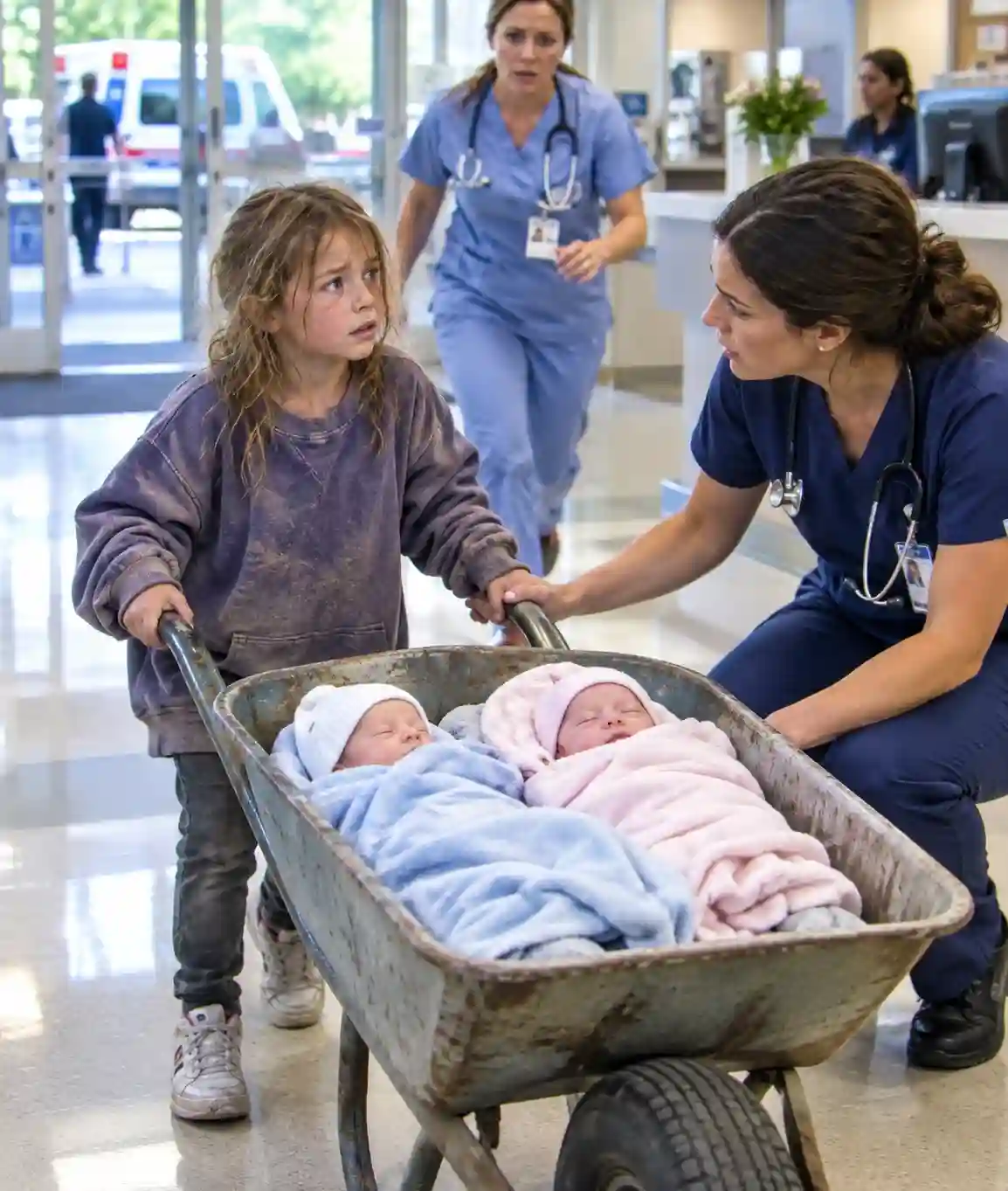
When the emergency room receptionist heard the squeaking wheels approaching the hospital entrance, she looked up, expecting to see a child playing with a toy.
Instead, she saw a six-year-old girl struggling to push an old metal wheelbarrow through the automatic doors. Two tiny babies lay inside, wrapped in mismatched towels. One was whimpering weakly, while the other remained unusually still.
The girl wore oversized sneakers and a sweatshirt that nearly swallowed her hands. Her cheeks were red from the cold, and her small fingers trembled from gripping the heavy handles. Despite her exhaustion, she kept pushing until the wheelbarrow reached the reception desk.
“Please help my brothers,” she whispered. “They need a doctor.”
The receptionist immediately stood up and called for a nurse. Within seconds, hospital staff hurried toward the child, carefully lifting the Newborn Twins from the wheelbarrow and carrying them into the treatment area.
A nurse wrapped a warm blanket around the little girl’s shoulders.
“Sweetheart, where is your mommy?”
“At home.”
“Is she coming to the hospital?”
The girl looked down at her shoes.
“She won’t wake up.”
The nurse knelt beside her. “How long has she been sleeping?”
The little girl held up three fingers.
“Three days.”
For a moment, the nurse couldn’t find the right words. She asked another staff member to stay with the child while the medical team assessed the babies. Both newborns needed urgent attention, and no one wanted to waste a second.
The receptionist brought the girl a chair, but she refused to sit.
“Can I see my brothers?”
“The doctors are helping them right now,” the nurse explained. “You did the right thing bringing them here.”
The girl swallowed hard.
“I tried to wake Mommy first.”
Her name was Lily Carter, and she had just walked several miles with her newborn twin brothers because she believed the hospital was the only place left where someone could help her family.
Lily explained that her mother, Emily, had been feeling sick since giving birth. At first, Emily told her she needed rest. She spent most of the day in bed, occasionally asking Lily to bring her water or check on the babies.
But the next morning, something changed.
Emily stopped answering when Lily called her name. She barely moved when Lily touched her shoulder. Frightened, the child brought her a glass of water and placed it beside the bed. She tried making cereal for herself and the twins, although she had never prepared a proper meal alone.
When her mother still didn’t wake up, Lily began to understand that something was terribly wrong.
She didn’t know what an emergency was. She had never called an ambulance and didn’t know how to find a telephone number for one. All she understood was that her mother had been asleep far longer than anyone should be.
For two days, Lily stayed close to her brothers and did whatever she could to comfort them. She wrapped them in blankets, tried to feed them with the bottles she could reach, and kept returning to her mother’s bedroom to check whether she had opened her eyes.
On the third morning, one of the twins became so quiet that Lily began to cry.
She remembered something her mother had told her months earlier: when people were very sick, doctors knew how to help them.
That was when Lily decided to leave.
She found an old metal wheelbarrow in the shed behind the house and lined it with folded blankets. Then she carefully placed the twins inside, wrapped their little bodies in towels, and began pushing.
The hospital seemed impossibly far away.
The wheelbarrow rattled along the uneven road, and its handles were heavy against Lily’s small hands. Several times, she had to stop because her arms hurt too much to continue. Whenever she rested, she leaned over the babies to make sure they were still breathing.
A passing car slowed down once, but the driver continued down the road before Lily could ask for help. She didn’t know how to explain where she was going, and she was afraid that stopping for too long might make her brothers sicker.
So she pushed onward.
By the time she reached the hospital, her legs were aching, her throat was dry, and she had almost no strength left. Yet she had not abandoned the wheelbarrow for a single moment.
Now, sitting in the emergency room, Lily finally began to cry.
A nurse held her hand while a social worker came to ask a few gentle questions. Lily could not provide a street address, but she remembered a red mailbox, a leaning tree, and a gas station near the road leading to her home.
An emergency team was dispatched to find Emily.
Then Lily suddenly reached beneath her sweatshirt and pulled out a small brass key hanging from a piece of string.
“Mommy says I must never lose this,” she explained.
A paramedic crouched in front of her.
“May I borrow it, sweetheart? We might need it to get inside and help your mommy.”
Lily stared at the key. It was the one thing she had carried throughout her frightening journey without letting go.
“Will you bring her back?”
The paramedic didn’t make a promise he couldn’t guarantee.
“We’re going to do everything we can.”
Lily slowly pulled the string over her head and placed the key in his hand.
“Please don’t leave her alone.”
The paramedic closed his fingers around it and hurried toward the ambulance.
Within minutes, the team found the red mailbox and the leaning tree. At the end of a long driveway stood a small house with a bicycle lying in the grass and a front door that had not been opened for days.
They knocked.
Nobody answered.
Using Lily’s key, one paramedic opened the door while another called Emily’s name. The house was silent except for the faint hum of a refrigerator.
They moved quickly through the hallway, checking the rooms until they reached the bedroom.
Emily was lying unconscious on the bed, pale and barely responsive. An empty baby bassinet stood nearby, and a glass of water sat untouched on the bedside table.
The paramedics immediately began assessing her condition and called for additional medical support.
As they prepared to move Emily, one of them noticed something beside the bed that made him stop for a moment.
It was a small notebook, opened to a page covered with hurried handwriting.
At the top, Emily had written Lily’s name.
Below it were several short sentences, followed by a final line that appeared to have been written with a trembling hand.
The paramedic glanced at his colleague.
Neither man knew what the note meant, but they understood that Emily’s medical emergency was only part of the story.
They carefully placed her on a stretcher and rushed her toward the waiting ambulance.
Back at the hospital, Lily sat outside the treatment area, holding a paper cup of water in both hands.
She had already asked three times whether her brothers were alive.
Now she looked up at the nurse approaching her.
“Did you find Mommy?”
The nurse sat beside her and took a breath.
“Yes, sweetheart. They found her.”
Lily’s eyes filled with tears.
“Is she awake?”
“Not yet. The doctors are helping her.”
The little girl nodded, then asked the question that had frightened her throughout the journey.
“Did she know I went to get help?”
The nurse gently squeezed her hand.
“We don’t know yet, Lily. But we’re going to do everything we can to help her.”
Lily looked down at the empty space beside her chair, where the wheelbarrow would have stood.
She had brought her brothers to the hospital.
The paramedics had found her mother.
But she still didn’t know whether the three people she loved most in the world would ever be together again.
And then the emergency room doors opened.
A doctor walked toward her, carrying a small piece of paper.
“Lily Carter?” he asked.
She jumped to her feet.
“Is that my mommy’s?”
The doctor looked at the note before answering.
“Yes, sweetheart. And there’s something important we need to tell you.”
PART 2: The Note Her Mother Left Behind Revealed Why the Little Girl Had to Save Her Family
Lily stood beside the chair, her hands clasped tightly in front of her.
The doctor crouched so that they were at the same height.
“Your mommy is very sick,” he explained gently. “But she’s here with us now, and our team is treating her.”
“Will she wake up?”
“We hope so. We need to give her time and make sure the medicine is working.”
Lily nodded, although she didn’t fully understand what he meant. She had spent three days waiting for her mother to open her eyes. Hearing that she might have to wait longer made her chest feel tight.
The doctor glanced at the note in his hand.
“This was found beside your mother’s bed. We think it may help us understand what happened.”
He didn’t read it aloud to Lily. Instead, he explained that Emily had written down some of her symptoms and the difficulties she had been experiencing since the twins were born. The note suggested that she had been getting progressively worse but had struggled to find help.
The medical team suspected a serious infection following childbirth, along with dehydration and other complications. Emily needed urgent treatment, and the doctors were still assessing the full extent of her condition.
The note wasn’t a miraculous explanation, nor did it answer every question. But it helped the medical staff understand that Emily had been unwell before she became unconscious.
While Emily received treatment, the twins remained under close observation. They were dehydrated and needed help with feeding and maintaining their body temperature. The doctors and nurses worked carefully to stabilize them.
Lily was taken to a quiet family room, where a social worker stayed with her. A few minutes later, a woman entered carrying a coat and a small bag of food.
It was Mrs. Brooks, the neighbor who lived two houses away from the Carter family.
The moment she saw Lily, she hurried forward and knelt to hug her.
“Oh, sweetheart. What happened?”
Lily began explaining everything at once. She told her about her mother’s long sleep, the babies who wouldn’t stop crying, the wheelbarrow in the shed, and the road that had seemed to go on forever.
Mrs. Brooks listened in disbelief.
She had seen Emily occasionally over the previous weeks but had assumed that she was recovering from childbirth and spending time with the babies. She hadn’t realized how serious the situation had become.
“I wish I’d known,” she whispered, holding Lily close.
Lily buried her face in the woman’s coat.
“I didn’t know who else could help.”
Mrs. Brooks closed her eyes for a moment.
That sentence hurt more than anything else the little girl had said.
Lily should have been playing, learning, and asking adults for help when she was frightened. Instead, she had spent days trying to care for her mother and newborn brothers without understanding how dangerous the situation had become.
The hospital arranged for Lily to remain with a trusted adult while the appropriate child and family support services were contacted. Mrs. Brooks stayed beside her, helping her eat and answering the same questions whenever Lily needed reassurance.
Late that evening, a doctor came to update them.
Emily had responded to the initial treatment and was showing signs of improvement, although she remained seriously ill. The twins were also stabilizing, but the doctors wanted to keep them under observation.
Lily listened closely.
“Can I see them?”
A nurse led her to the neonatal unit, where she stood beside the glass, looking at her brothers resting in their hospital beds.
One wore a small identification band around his wrist. The other had a soft blanket tucked around his shoulders.
“They look smaller than they did at home,” Lily whispered.
“They’re receiving the care they need,” the nurse replied.
Lily pressed her hands against the glass.
“I told them we were going to find a doctor.”
The nurse smiled gently.
“And you did.”
For the first time since entering the hospital, Lily looked relieved.
The next morning, Emily’s condition improved enough for the medical team to begin discussing her recovery with her. She was still weak and needed ongoing treatment, but she was conscious.
When the doctor told her that Lily had brought the twins to the hospital, Emily began to cry.
She could barely remember the days before her collapse. She had been feeling increasingly unwell, and her strength had faded faster than she had understood. She remembered worrying about the babies and trying to rest, but the details had become confused.
The doctor explained how seriously ill she had been and how important it was that she had received treatment when she did.
Then he told her what Lily had done.
Emily covered her face with both hands.
“My little girl walked all that way?”
“Yes,” the doctor answered. “She brought both babies here herself.”
Emily began sobbing.
She was grateful that her children were alive, but the knowledge of what Lily had endured filled her with a different kind of pain. Her daughter had been frightened, exhausted, and alone when she should have been protected.
When Emily was finally allowed to see Lily, the little girl entered the room holding a folded piece of paper.
She had drawn four people beneath a bright yellow sun: a woman, a little girl, and two tiny babies. Their hands were joined, and above them she had written four names in uneven letters.
MOMMY. LILY. BABY ONE. BABY TWO.
Emily reached for her daughter’s hand.
“I’m so sorry, sweetheart.”
Lily climbed onto the chair beside her.
“I tried to wake you.”
“I know.”
“I brought the babies to the doctor because one of them stopped crying.”
Emily’s eyes filled with tears.
“You were so brave.”
Lily shook her head.
“I just pushed the wheelbarrow.”
Emily gently brushed the hair away from her daughter’s forehead.
“Sometimes, sweetheart, doing what needs to be done is the bravest thing anyone can do. But you should never have had to do it all by yourself.”
Lily looked at her mother for a long moment.
Then she asked the question she had been carrying since the day she left home.
“Are you going to sleep for three days again?”
Emily’s face crumpled.
“I can’t promise that I’ll never get sick,” she said softly. “But I promise we’re going to make sure there are grown-ups who can help us. You won’t have to handle something like this alone again.”
Lily leaned forward and hugged her.
For several minutes, neither of them spoke.
Emily held her daughter as tightly as her weakened arms allowed, wishing she could erase the fear Lily had experienced. She knew that saying sorry would not undo what had happened, and she would need time to recover physically and emotionally.
But she could begin by accepting help.
Over the following days, the doctors continued treating Emily while the twins gained strength. Hospital staff arranged follow-up care and helped the family connect with practical support. Mrs. Brooks offered to check in regularly, and Emily began making plans with trusted adults so that someone would be available if she became ill again.
The family did not return to normal overnight. There were appointments, difficult conversations, and moments when Emily struggled with guilt. But she no longer tried to hide her difficulties or assume she could manage everything alone.
When the twins were ready to leave the hospital, Emily held them against her chest, one in each arm. Lily stood beside her, watching their tiny faces.
“Can I hold one?”
“With an adult helping you,” Emily replied.
Lily smiled.
This time, she didn’t have to be the person responsible for everything. She could simply be their big sister.
Several weeks later, on a sunny afternoon, Emily found Lily sitting on the porch with the twins resting safely in their stroller. The old wheelbarrow remained in the shed, its rusty handles untouched.
“What are you thinking about?” Emily asked as she sat beside her daughter.
Lily looked down the road.
“I was thinking about how far I pushed them.”
Emily slipped an arm around her shoulders.
“It must have felt like a very long way.”
“It was.” Lily paused. “But I knew doctors helped sick people.”
Emily kissed the top of her head.
“You saved your brothers, Lily. And you helped us find a way to get help for me, too.”
Lily considered that for a moment.
Then she pointed toward the sleeping twins.
“When they’re bigger, can I teach them how to ride bikes?”
“Of course.”
“Can I teach them everything?”
Emily smiled.
“Not everything. Some things they’ll have to learn themselves.”
Lily giggled, then glanced toward the shed.
“But I’m not teaching them to push that wheelbarrow. It’s too heavy.”
Emily laughed, and for the first time in weeks, the sound came without the weight of fear behind it.
She drew Lily close and watched the twins sleeping peacefully in the afternoon light.
The family still had challenges ahead, but they had learned something important. Love did not mean one person had to carry every burden. Sometimes love meant asking for help, accepting support, and allowing other people to stand beside you when life became too difficult.
Lily would probably never understand how extraordinary her journey had been. To her, she had simply done what she believed a big sister should do.
But the adults who heard her story understood what she could not yet put into words.
A six-year-old child should never have to carry the weight of an entire family on her small shoulders.
And when a child does something extraordinary to protect the people she loves, the answer should not be to expect her to keep being brave.
It should be to make sure she is finally safe enough to be a child.
Because Lily’s greatest act of courage wasn’t pushing that wheelbarrow for miles. It was refusing to give up when she didn’t know what else to do—and finding help before it was too late.
Editor’s Note: This fictional story reminds us that courage can come from the smallest hearts, but no child should ever have to face a crisis alone. Asking for help and supporting one another can make a life-changing difference.
Trending Post
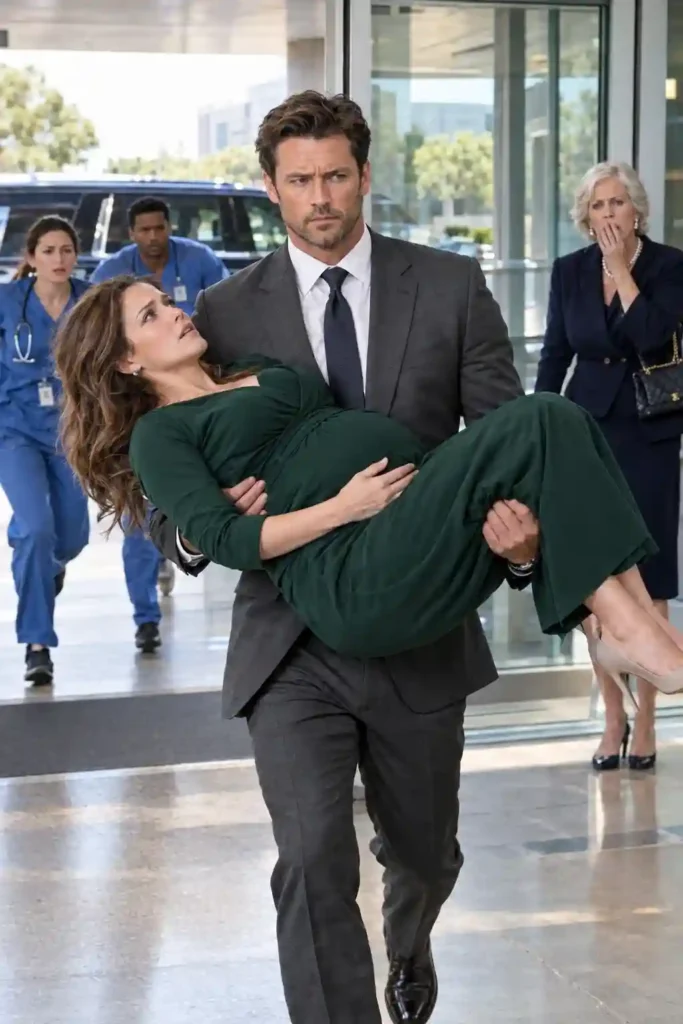
- My Mother-in-Law Pushed Me Down the Stairs at Nine Months Pregnant—She Never Expected Her “Unemployed” Son to Arrive With the Entire Board of Directors

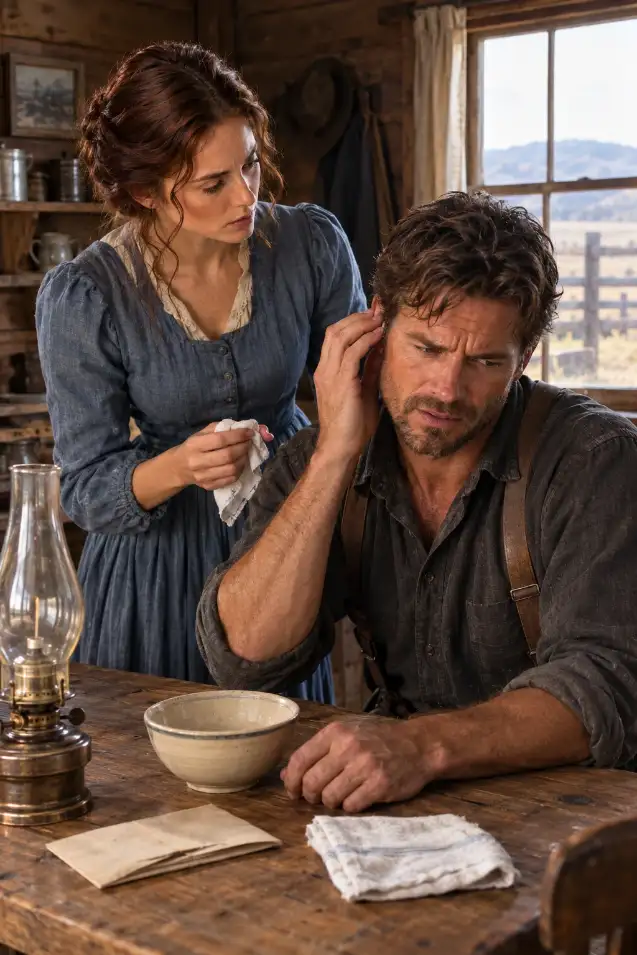
- Her Father Sold Her to a Deaf Rancher for $50—But on Their Eighth Night, She Discovered Something Moving Inside His Ear and Uncovered a Secret Buried for 29 Years

- I Found the Black Lace Gift My Husband Bought for Another Woman, Then a Hotel Key Fell From His Jacket and Revealed Something Much Bigger

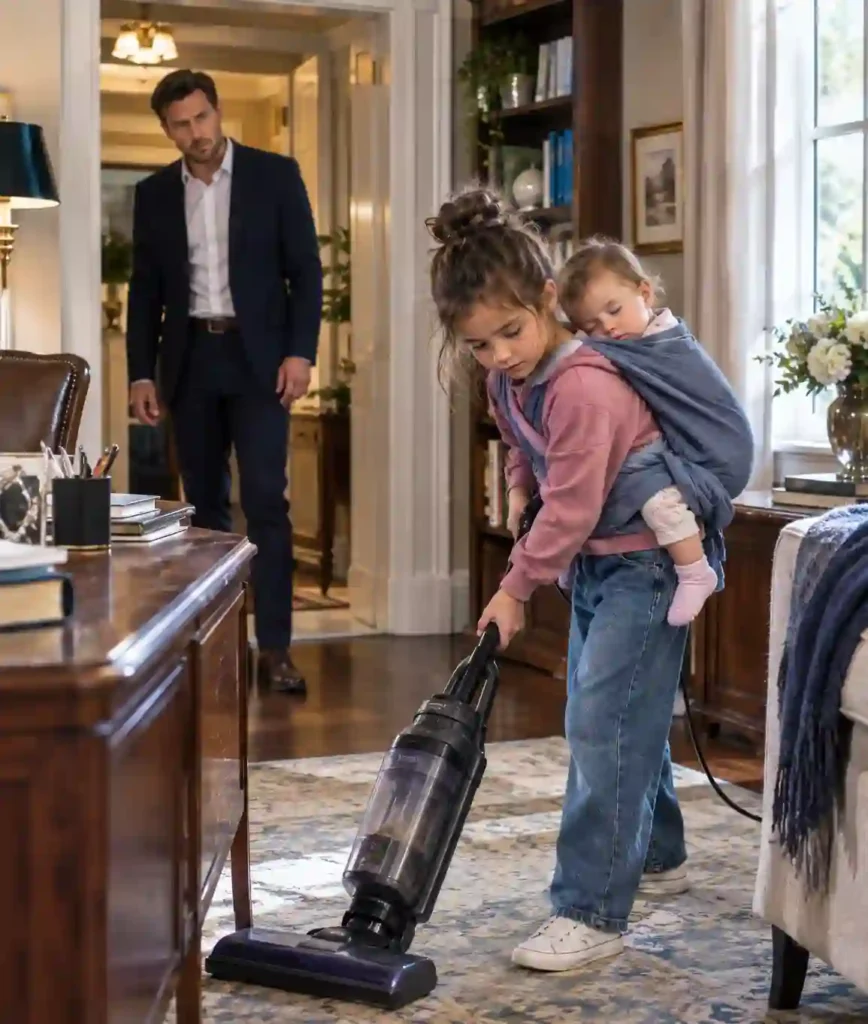
- I Found a Six-Year-Old Girl Cleaning My Study at 2 A.M. With a Baby on Her Back, Then She Pointed to My Library Wall and Asked Why Someone Was Knocking Behind It



Hammad Ali
Co-Owner & Author
Hammad Ali is a co-owner and author at MidnightReads, contributing thoughtful and engaging articles across human-interest, life, history, relationships, and entertainment topics.
They help develop and create original, useful content designed to inform, entertain, and give readers something meaningful to take away.