
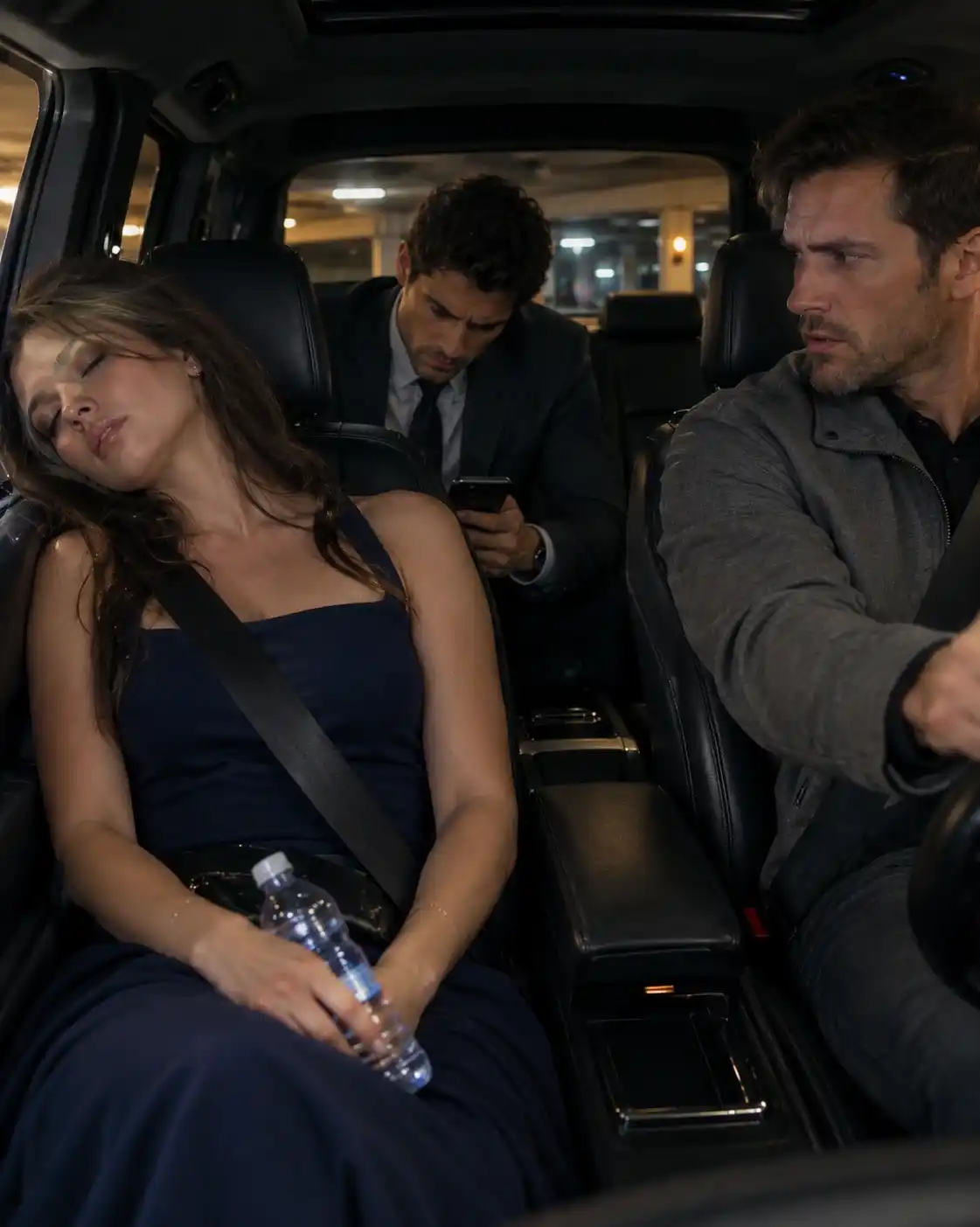
Every time my brother-in-law drove me home from work, I lost hours of my memory.
At first, my husband insisted I was simply overworked. After the fourth incident, I secretly recorded the ride—and what I heard made me question everything I believed about my marriage.
“She’s unconscious again,” Marcus whispered.
A few seconds later, my husband’s voice came through the car speakers.
“Good. Take her to the usual location. Vanessa is waiting. And this time, make sure the pictures look believable.”
I sat on the edge of my bed that night, listening to the recording again and again.
My husband wasn’t trying to protect me from my mysterious blackouts.
He was using them.
And I was beginning to understand that whatever he had planned for me was much bigger than an affair.
Four Rides I Couldn’t Remember
My name is Sofia Vance. I was thirty-one, worked as an accountant in downtown Dallas, and lived with my husband, Julian, in a condominium in Southlake, Texas.
From the outside, our life looked comfortable. Julian was a senior executive at his family’s logistics company. We had a beautiful home, dependable incomes, and the kind of marriage our friends often described as fortunate.
I used to agree with them.
Julian could be thoughtful in ways that made me feel understood. He remembered my favorite coffee, sent flowers on difficult workdays, and knew exactly how to make me laugh when I was stressed.
That was why I never questioned his suggestion that his younger brother, Marcus, drive me home when I worked late.
“You’ve been putting in too many hours,” Julian told me one evening. “Let Marcus pick you up. At least I won’t have to worry about you driving tired.”
It sounded reasonable.
My accounting office sometimes kept me until nearly ten at night, especially during busy reporting periods. Marcus lived nearby and frequently visited our condominium, so arranging a ride seemed convenient.
The first time it happened, I barely thought about it.
Marcus pulled up outside my building, greeted me, and handed me a bottle of water.
“Long day?”
“The longest.”
I took a few sips and settled into the passenger seat.
I remembered the glow of traffic lights through the windshield. I remembered Marcus asking whether I wanted the radio turned down.
Then my memory stopped.
When I opened my eyes again, I was in the underground garage of our condominium. The dashboard clock read 11:08 p.m., and Marcus was nowhere in sight.
My head felt heavy. My mouth was dry. I couldn’t remember the final part of the journey.
I blamed exhaustion.
The second incident happened five days later.
The third happened the following week.
Each time, Marcus had offered me water. Each time, I remembered the beginning of the drive but not the end. And each time, I woke up confused, with hours missing from my memory.
I began to dread getting into his SUV.
After the third incident, I finally told Julian what was happening.
“Something isn’t right,” I said while we were eating dinner. “I keep losing track of time when Marcus drives me home.”
Julian didn’t even put down his fork.
“You’re working ten-hour days, Sofia. Your body is telling you to slow down.”
“But I don’t feel this way when I drive myself.”
“Because you’re alert when you’re behind the wheel.”
“That doesn’t explain why I can’t remember arriving home.”
He sighed as though I had asked him to solve an impossible problem.
“Honey, you’ve always worried too much. Get some sleep this weekend. You’ll feel better.”
He reached across the table and squeezed my hand.
Normally, that small gesture would have reassured me.
Instead, I noticed how quickly he had dismissed my concern.
The following morning, I made an appointment with a medical professional. I also decided that I needed to document what was happening.
I bought a small digital recorder and kept it in the inside pocket of my handbag.
I wasn’t trying to prove that anyone had done something wrong. I simply wanted a record of the rides in case I needed to explain the episodes to a doctor.
I had no idea that the recording would reveal something far more disturbing.
The Fourth Ride
On Thursday evening, Julian called to say he had an important business dinner.
“Marcus will pick you up,” he said. “I’ve already arranged it.”
For a moment, I considered refusing.
Then I remembered how Julian had reacted the last time I raised my concerns. If I wanted to understand what was happening, I needed to stop relying on his explanations.
I switched on the recorder before leaving my office.
Marcus was waiting outside in his dark SUV. He smiled when he saw me.
“Ready to escape the spreadsheets?”
“More than ready.”
He handed me a bottle of water.
I held it for a moment before placing it in my bag.
“I’ll drink it later,” I said.
Something flickered across his face. It was brief, but I noticed it.
“No problem.”
The drive began normally. Dallas traffic moved slowly, and the radio played a song I recognized. Marcus asked about work, and I gave him short answers.
Then my thoughts began to feel strangely sluggish.
I tried to focus on the street signs outside. My eyelids felt heavier than they should have, and I struggled to follow the conversation.
My last clear memory was a brightly illuminated intersection.
When I woke, I was alone in the condominium garage.
My handbag was beside me. My phone showed several missed notifications, but I couldn’t account for the time that had passed.
I went upstairs and found Julian on the couch, watching television.
“Hey, sweetheart,” he said without looking away from the screen. “Another exhausting day?”
I studied him.
“Apparently.”
He smiled.
“See? You need to stop pushing yourself so hard.”
I forced myself to smile back.
“Maybe you’re right.”
Then I went into our bedroom, closed the door, and retrieved the recorder.
My fingers were trembling when I pressed play.
At first, there was only the sound of the engine, traffic, and ordinary conversation.
Then Marcus spoke.
“She’s unconscious again.”
A second voice came through the vehicle’s Bluetooth system.
Julian.
“Everything going according to plan?”
“Yeah. She’s completely out.”
My stomach tightened.
Julian didn’t sound alarmed. He didn’t ask whether I was breathing normally or whether Marcus needed medical help.
He sounded satisfied.
“Take her to the usual location,” he said. “Vanessa should already be there.”
Marcus hesitated.
“And the photographs?”
“Make sure they look authentic. We can’t afford another sloppy attempt.”
I stopped breathing for a moment.
Photographs?
What photographs?
Marcus lowered his voice.
“What happens if Sofia starts getting suspicious?”
Julian answered without hesitation.
“She believes she’s exhausted. Keep encouraging that explanation.”
I pressed a hand over my mouth.
For weeks, I had been telling my husband that something was wrong. He had looked me in the eyes and convinced me that I was imagining it.
Now I knew he had been hiding something.
The recording continued.
A vehicle door opened and closed. Footsteps echoed. Then a woman’s voice came through.
“Do you have the documents?”
“Right here,” Marcus replied. “Julian wants everything finished before Friday.”
I heard papers rustling, followed by several camera clicks.
“These aren’t convincing enough,” the woman said. “We need better angles.”
Marcus let out a frustrated breath.
“Fine. Let’s get it over with.”
Then came a sound I couldn’t identify, followed by a few seconds of silence.
The recording ended.
I sat completely still.
Vanessa. Photographs. Documents. A plan that had apparently been repeated several times.
I didn’t know where Marcus had taken me, what the photographs showed, or why my husband needed them to look authentic.
But I knew enough to understand that confronting Julian without evidence would be dangerous.
I saved the recording to two separate locations and wrote down everything I remembered.
Then I went back into the living room.
Julian smiled at me.
“Feeling better?”
“A little.”
He reached for my hand.
“Good. I worry about you, you know.”
I let him hold it for a moment before gently pulling away.
For the first time since our wedding, I wondered whether every reassuring word he had spoken to me was part of a performance.
That night, I barely slept.
By morning, I had made three decisions: I would not confront Julian yet, I would preserve every piece of evidence I could find, and I would get medical help for the unexplained blackouts.
But before I could do any of those things, I needed to understand what he wanted
Julian left for work at eight the following morning.
He kissed my cheek and reminded me not to work late.
“Call me if you need anything.”
“I will.”
The moment his car disappeared, I walked to his private study.
He kept company documents in a locked cabinet, but he also left ordinary paperwork on his desk. I had never searched through his things before. We had always treated privacy as a matter of mutual respect.
Now I wondered whether he had mistaken my trust for blindness.
I began with the documents on the desk.
There were invoices, business statements, and several printed emails. Most looked ordinary until I noticed a series of payments that didn’t match the expenses listed in the company accounts.
One transfer had gone to Marcus.
Another had gone to an account associated with a woman named Vanessa R.
There were also payments for a luxury apartment and several expenses described only as consulting services.
I photographed the pages I could access and returned them to their original positions.
Then I found a folder tucked beneath a stack of financial statements.
Inside was an envelope containing several printed photographs.
In the first, Julian stood outside a medical clinic with a woman I had never seen before. His arm rested around her waist, and her hand was placed protectively over her pregnant stomach.
On the back, someone had written:
Vanessa — March 12.
I sat down slowly.
My husband was having an affair.
And the woman was expecting his child.
For several minutes, I couldn’t think clearly. I wanted to cry, but I felt as though even my tears had been taken away from me.
Then I noticed another photograph.
It showed a woman leaving a hotel with a man whose face was partially hidden. The woman wore a coat similar to one I owned.
I turned it over.
There was no date, no location, and no explanation.
The image might have meant nothing on its own. But after hearing Julian discuss staged photographs, I couldn’t ignore the possibility that someone was trying to create a false story about me.
I opened the next folder.
This one contained draft divorce agreements, property valuations, and documents concerning the ownership interests connected to Julian’s family business.
My name appeared throughout.
Some of the papers referred to shares and financial interests I had acquired during our marriage. Others outlined proposed settlement terms that would leave me with substantially less than I believed I was entitled to.
A handwritten note was clipped to one page.
Get Sofia to sign before Friday.
Suddenly, the pieces began falling into place.
Julian wasn’t simply preparing to leave me for Vanessa.
He might be building a case against me, using photographs designed to make me appear dishonest or unfaithful. If I became frightened of public humiliation, he could pressure me into accepting a settlement without properly reviewing it.
The missing hours would give him an opportunity to create a story I couldn’t disprove.
And if I questioned him, he could point to my unexplained episodes and claim I wasn’t thinking clearly.
I couldn’t know every detail of his plan from those papers alone, but the recording and the documents raised questions I could no longer ignore.
I carefully photographed the relevant pages and secured the copies.
Then I found a final envelope at the bottom of the folder.
Inside was a printed email exchange between Julian and someone whose address began with the name Vanessa.
The first message was brief.
The clinic appointment is confirmed. We need to finish the other matter before Friday.
The reply read:
Understood. But what happens if she remembers something?
Julian’s response was only one sentence.
She won’t remember anything if Marcus follows the plan.
I read it twice.
My hands had gone cold.
I had spent years believing Julian would protect me if anything ever happened.
Now I had evidence suggesting that he might be deliberately placing me in danger while arranging a financial trap.
I closed the envelope and checked the time.
It was almost ten.
I needed professional help, and I needed it before Julian realized I was asking questions.
I called an independent attorney and arranged a confidential consultation. I also contacted my medical provider about the blackouts and explained that I needed urgent advice.
Then I returned to the study to photograph one last page.
It was a draft statement, written as though I had already admitted to a secret relationship.
At the bottom was a space for my signature.
I had never seen the document before.
Yet the statement described private details about my work schedule, the hours I was away from home, and the rides Marcus had given me.
Someone was preparing to make it look as though I had confessed to something I had never done.
I photographed the page and put everything back.
As I walked out of the study, my phone vibrated.
A message from an unknown number appeared on the screen.
Sofia, you need to stop looking through Julian’s files. You don’t understand what he’s capable of.
A second message arrived before I could respond.
If you want to know what really happened during those missing hours, meet me at the coffee shop across from your office tomorrow. Come alone.
There was no name.
No explanation.
Only a photograph attached to the message.
It showed the inside of Marcus’s SUV.
And in the background, barely visible through the open passenger door, was a woman wearing my coat.
I enlarged the image.
The woman wasn’t standing beside the vehicle.
She was lying across the back seat, apparently unconscious.
I recognized the shoes.
They were mine.
But the date printed beneath the photograph was from a night I remembered spending at home with Julian.
My heart began pounding.
If the date was accurate, then the plan had started earlier than I realized.
And someone else had been watching me long before I bought the recorder.
I stared at the message, then at the study door.
Julian believed I was still the trusting wife who accepted every explanation he gave me.
He didn’t know I had saved the recording.
He didn’t know I had copied the documents.
And he certainly didn’t know about the anonymous message.
But the photograph suggested that the blackouts were only one part of a much larger deception.
At the bottom of the message, the sender had added seven words that changed everything:
“Ask Julian what happened to his first wife.”
Part 2 continues below.
I Asked My Husband About His First Wife—His Answer Exposed the Secret He Had Hidden for Years
I read the anonymous message three times.
“Ask Julian what happened to his first wife.”
Julian had never told me he had been married before.
As far as I knew, I was his first wife. We had been together for years, and I had met most of his relatives. Not once had anyone mentioned another marriage.
I took screenshots of the message and the photograph, then sent copies to a secure account.
I wanted answers, but I knew better than to rush into a confrontation. I had already seen how easily Julian dismissed my concerns. If the anonymous sender was telling the truth, I needed to find out who I could trust.
The following morning, I met with an independent attorney.
I brought copies of the recording, the suspicious financial documents, the photographs, and the anonymous messages.
After reviewing everything, the attorney advised me to preserve the original evidence, avoid signing any settlement documents, and keep my communications private. She also explained that the financial paperwork needed closer examination before anyone could determine whether a crime had occurred.
Most importantly, she told me not to put myself at risk trying to obtain more evidence.
I left her office with a plan.
I would cooperate with the appropriate authorities, arrange medical evaluation for my blackouts, and stop pretending that my marriage was normal.
Then I went to the coffee shop.
The Woman Who Knew My Secret
I arrived ten minutes early and chose a table near the front window.
At 10:15, a woman in her late thirties entered. She wore a gray coat, carried a leather handbag, and kept looking over her shoulder.
She approached my table cautiously.
“Sofia?”
“Yes. Who are you?”
“My name is Claire Bennett.”
She sat down but didn’t remove her coat.
“I sent you the messages.”
I studied her face.
“Why?”
“Because I worked for Julian’s company for almost six years. I handled some of the executive records before I left.”
“Did you know about Vanessa?”
Claire nodded.
“I knew about the affair. I also saw payments that didn’t make sense. When I started asking questions, Julian told my supervisor that I was unreliable. Within a month, I had lost my job.”
“What does any of that have to do with me?”
Claire opened her handbag and removed a folded document.
“Everything.”
She placed it on the table.
It was a copy of a marriage record.
Julian’s name appeared at the top, beside the name of a woman called Eleanor Price.
The marriage had taken place eleven years earlier.
I looked up.
“Who was she?”
“His first wife,” Claire replied. “She disappeared from his life after a serious dispute over money. The family said their marriage ended quietly, but the financial records told a different story.”
“Are you saying he hurt her?”
“I’m saying I don’t know what happened to her. I won’t pretend I do. But I found evidence that Julian continued to use accounts connected to her long after he claimed their relationship was over.”
I stared at the document.
“Was she reported missing?”
“Not that I could establish. I searched the records available to me, but I never found a clear answer.”
Claire explained that she had first become suspicious when she noticed payments to a company that appeared to have no active business operations. Some transactions were associated with addresses linked to Julian’s previous marriage.
She had copied a small number of records before leaving the company.
Later, she learned about Vanessa and began to suspect that Julian was using the same financial arrangements again.
“Then I heard about you,” she said. “I saw Marcus picking you up outside your office. A few weeks later, I saw a photograph of you that someone had circulated privately.”
“What kind of photograph?”
“One that made it look as though you were involved with another man.”
My stomach tightened.
“Who circulated it?”
“I don’t know who first created it. I only know that someone was trying to use it to support a story about you.”
I remembered the photograph in Julian’s study.
The woman wearing my coat.
The false statement bearing my name.
The anonymous message.
“Why didn’t you go to the police?” I asked.
“I tried to report the financial irregularities through the channels available to me. I didn’t have enough evidence to prove what was happening beyond my own employment records. And I was afraid of accusing someone powerful without proof.”
She paused.
“But now you have the recording.”
I nodded.
Claire leaned forward.
“Sofia, listen to me. Don’t assume Vanessa is the only person involved. She may know everything, or she may have been told a completely different story. You need to find out what the photographs were meant to accomplish.”
“Do you know where they took me?”
“Not for certain. But I recognized the background in one of the photographs. It looked like the private parking area of a furnished apartment complex near Dallas.”
“Why would they take me there?”
Claire shook her head.
“That is the question I couldn’t answer.”
Before leaving, she gave me the contact details of a former company employee who had handled property records.
I thanked her, but I didn’t promise to trust her.
She had given me useful information. That didn’t mean every claim she made was true.
For the first time, however, I had someone who was willing to acknowledge that my concerns deserved investigation.
After the meeting, I contacted my medical provider.
I explained that I had experienced repeated episodes of lost time and unusual drowsiness, particularly during rides with Marcus. I also told the provider that I had reason to suspect I might have been exposed to something without my knowledge.
The advice was clear: unexplained loss of consciousness required prompt medical evaluation.
I arranged to be assessed and gave the clinician a detailed timeline of the episodes. I kept the remaining bottles and any other potentially relevant items rather than discarding them, and I asked how they should be handled.
I was careful not to assume I knew the cause.
The recording suggested that my blackouts might have been part of Julian’s plan, but it didn’t establish what had happened medically. I needed qualified professionals to investigate that question.
The attorney also helped me contact the appropriate authorities and provide the evidence I had already preserved.
I didn’t tell Julian what I had done.
For the first time in our marriage, keeping something from him felt necessary for my safety.
Two days later, the attorney called.
“There’s something you need to know about the financial documents,” she said.
My heart began racing.
“What is it?”
“The draft settlement you found appears to be based on assumptions that need to be challenged. Some of the supporting records don’t match the transactions we’ve reviewed. We are arranging for a more thorough examination.”
“Does that mean Julian stole money?”
“Not necessarily. We need more evidence before reaching that conclusion. But you were right not to sign anything.”
I closed my eyes.
At least one thing was certain: I had not imagined the irregularities.
Then the attorney added, “The authorities have also agreed to review the recording and the other materials you provided.”
For the first time in days, I felt that the situation was no longer mine to handle alone.
I could not undo what had happened, but I could stop Julian from controlling the story.
The next development came from an unexpected source.
Vanessa contacted my attorney.
She wanted to speak with me, but she agreed to communicate through the attorney first.
I was reluctant. She was the woman carrying my husband’s child. I had seen her name in the records and heard her voice on the recording.
How could I trust her?
My attorney advised me to hear what she had to say without making any promises.
We arranged a meeting at her office.
Vanessa arrived looking exhausted. She was visibly pregnant and held a folder tightly against her chest.
She didn’t look like the confident woman I had imagined from the photographs.
“I know you have every reason to hate me,” she said.
“I don’t know you well enough to hate you. But I know what I heard on that recording.”
She lowered her eyes.
“Julian told me you were already separated emotionally. He said you were planning to leave him and that your marriage was practically over.”
“That doesn’t explain the photographs.”
“No. It doesn’t.”
She opened the folder and placed several printed messages on the desk.
According to Vanessa, Julian had told her that he needed evidence of my supposed infidelity because I intended to claim a large share of the family business during the divorce.
He had described the photographs as part of a private investigation.
“He said you were meeting another man after work,” Vanessa explained. “He told me the photographs would prove it.”
“And you believed him?”
“At first, yes. Then I began asking questions.”
She showed us messages in which Julian had insisted that I was unreliable and that any accusations I made would be dismissed as the product of exhaustion.
I recognized the language immediately.
It was the same explanation he had used with me.
Vanessa admitted that she had attended the parking-area meetings and had taken photographs when Marcus asked her to. She claimed she had not understood that I might be unconscious during those encounters until she saw one of the photographs afterward.
“Why didn’t you stop?” I asked.
She looked at me, tears gathering in her eyes.
“Because I was afraid. Julian told me that if I backed out, he would make sure I lost everything. He said he had lawyers who could destroy me in court, and I was pregnant. I didn’t know who to believe.”
I didn’t know whether every part of her story was true.
But I could see that she had been involved in something serious, and her own messages would need to be examined alongside the other evidence.
“Did you know about Eleanor?” I asked.
Vanessa’s expression changed.
“His first wife?”
I nodded.
“He told me they had divorced years ago. He said she had moved away and wanted nothing to do with his family.”
“Did you ever meet her?”
“No. But I once found an old message from her on his laptop. It said she was afraid of him.”
The room became very quiet.
Vanessa reached into her folder and removed a final sheet of paper.
“This is the reason I contacted your attorney.”
It was a copy of a message Julian had sent Marcus several months earlier.
Once Sofia signs, the problem disappears. No more questions, no more complications.
Below it was Marcus’s reply.
And if she refuses?
Julian’s response was chillingly brief.
Then we make sure nobody believes her.
I looked at Vanessa.
“Why are you giving me this?”
“Because I don’t want my child growing up believing that what Julian did was normal. And because I finally understand that I helped him hurt someone who had done nothing to me.”
Her admission did not erase her choices. But it gave the authorities another potential source of evidence.
I left the meeting with no desire to become her friend.
I also left knowing that the story was larger than an affair.
Julian had been trying to control what everyone believed about me.
Now the people he had tried to keep apart were beginning to compare what they knew.
Over the following days, the attorney and investigators reviewed the material I had provided.
The audio recording was examined. The financial records were checked against available company documents. The photographs were compared with the dates and locations that could be established.
The process was slow.
There were no dramatic confrontations in a courtroom, no instant confession, and no single document that answered every question.
Instead, the picture became clearer through small details.
The timestamps on the photographs did not match Julian’s explanation of where I had been.
Several messages contradicted his claim that the divorce arrangements were voluntary.
And the financial records raised questions about payments made to people connected with the alleged scheme.
The medical investigation was separate. My clinicians evaluated the unexplained episodes, and I followed their advice while the relevant evidence was handled by the appropriate professionals.
I stopped accepting rides from Marcus.
I changed my account passwords, secured my personal documents, and arranged somewhere safe to stay while the situation was assessed.
I also stopped responding to Julian’s questions about where I had been.
He noticed the change.
One evening, he stood in the doorway of our bedroom while I packed a small suitcase.
“What are you doing?”
“I’m staying somewhere else for a few days.”
His expression hardened.
“Why?”
“Because I need some space.”
He gave a short, disbelieving laugh.
“After everything I’ve done for you?”
I looked at him.
“That’s exactly what I’m trying to understand, Julian.”
For a moment, he said nothing.
Then his eyes moved toward my handbag.
“Have you been going through my files?”
I felt my pulse quicken, but I kept my voice steady.
“I’m not discussing this with you.”
His face changed.
The familiar warmth disappeared, replaced by an expression I had never seen so clearly before.
“You have no idea what you’re getting yourself into.”
“Then you shouldn’t have given me a reason to look.”
I picked up my suitcase and walked past him.
He didn’t stop me.
That night, I stayed with a trusted friend and followed my attorney’s advice about all further contact.
I didn’t know what Julian would do next.
But I no longer believed I had to face him alone.
A few weeks later, the attorney contacted me with an update.
The investigation had uncovered additional records connected to Julian’s previous marriage. They did not establish everything that had happened to Eleanor, but they contradicted parts of the account Julian had given me.
The authorities were continuing to investigate the financial transactions and the circumstances surrounding my blackouts.
I learned that Eleanor had left Texas years earlier after a bitter dispute over money. Her current circumstances were not something I could independently confirm, and no one was prepared to make claims about her fate without reliable evidence.
I felt relief that the evidence was being examined carefully.
I also felt anger.
Julian had used the idea of my supposed infidelity to pressure me into accepting a settlement. He had encouraged me to doubt my own memory. He had relied on my trust in him to keep me from asking the right questions.
Whatever the final legal findings would be, I had a right to protect myself.
I refused to sign the proposed divorce agreement.
My attorney helped me challenge the terms and pursue a fair review of the financial records. The process took time, and it required patience, documentation, and professional advice.
There was no magical moment when everything became easy.
There were difficult conversations, sleepless nights, and days when I wondered whether I would ever feel comfortable trusting another person again.
But I had something I hadn’t possessed during those first four rides.
Evidence.
And the freedom to make decisions without asking Julian for permission.
The Last Message
Several months later, I received one final message from an unfamiliar number.
It contained no greeting.
Only a photograph.
This time, it showed a woman standing outside a small house beneath a clear blue sky. Her face was turned slightly away from the camera, but there was something familiar about her posture.
Beneath the image were six words:
“Eleanor wants you to know something.”
I forwarded the message to my attorney rather than responding.
I never learned everything about Eleanor from that photograph alone. There was no reliable way to confirm who had taken it or why it had been sent.
But I no longer felt compelled to chase every mystery at the expense of my safety.
The authorities could follow the evidence. My attorney could protect my interests. My medical providers could continue addressing the blackouts.
And I could begin rebuilding a life that belonged to me.
I had once believed marriage meant trusting someone even when the truth was difficult to hear.
Now I understood that trust was not the same as ignoring warning signs. Love did not require me to dismiss my fears, surrender my judgment, or sign away my future to preserve the appearance of a happy home.
I still didn’t know every detail of Julian’s plan.
But I knew enough to stop participating in it.
And that was where my story truly changed.
Sometimes the most important moment isn’t when you discover someone has betrayed you. It’s when you stop letting that person decide what you’re allowed to believe.
Editor’s Note: This fictional story explores trust, manipulation, and the importance of protecting your personal and financial well-being. Sofia’s experience is a reminder to take unexplained health symptoms seriously, seek qualified medical guidance, and obtain independent legal advice when facing complicated relationship or financial concerns.
Related Posts for you
- My Father-in-Law Lived Under My Roof for 20 Years, and I Called Him a Burden, Until His Lawyer Opened a Blue Ledger at His Funeral and Revealed What He’d Been Hiding All Along

- My Ex-Husband’s Mother Arrived With Two Moving Trucks Minutes After Our Divorce—She Demanded My Mansion, but She Had No Idea What My Attorney Had Discovered2.


Hammad Ali
Co-Owner & Author
Hammad Ali is a co-owner and author at MidnightReads, contributing thoughtful and engaging articles across human-interest, life, history, relationships, and entertainment topics.
They help develop and create original, useful content designed to inform, entertain, and give readers something meaningful to take away.