
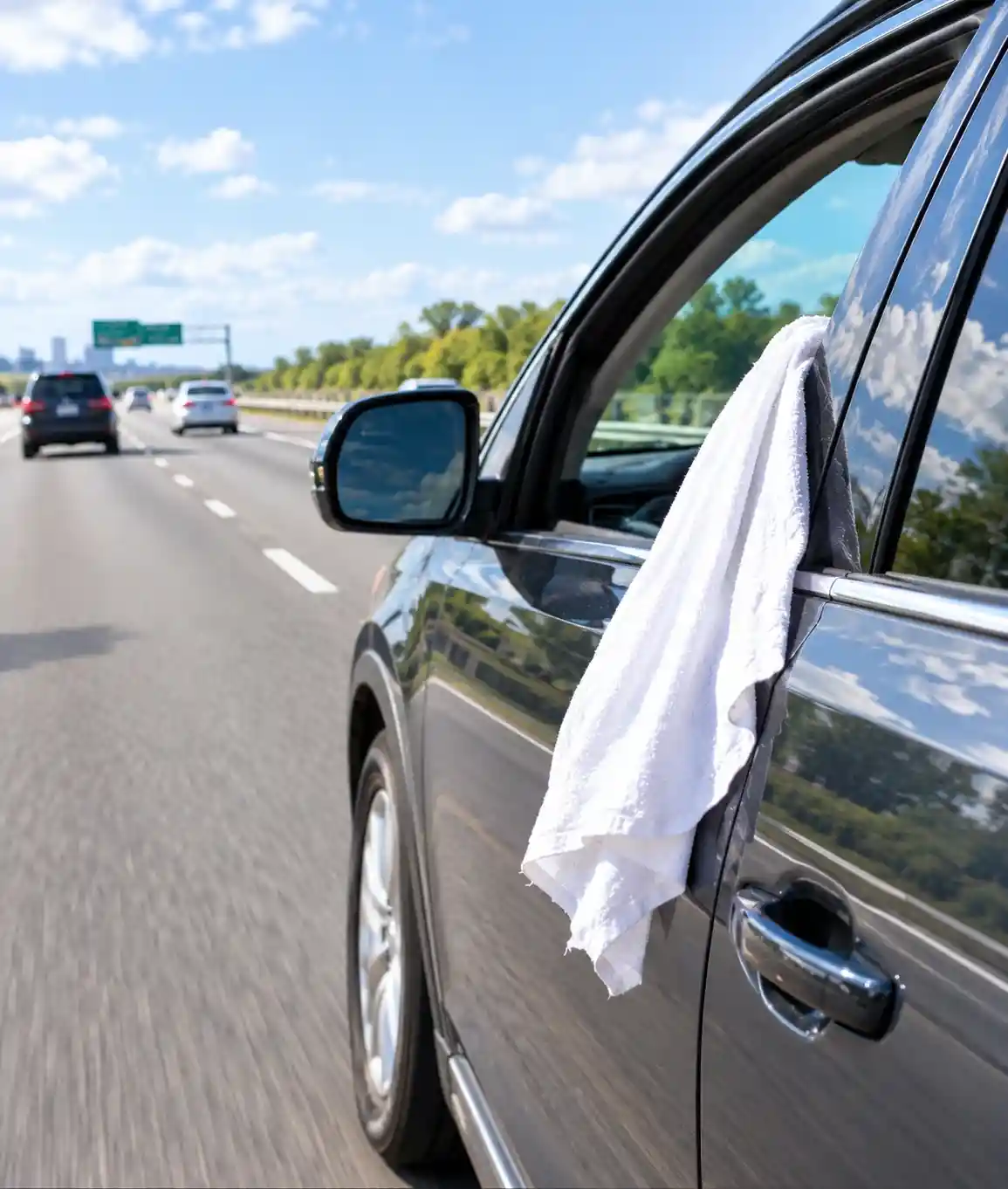
Imagine driving along a busy American highway when you notice a car stopped on the shoulder. Its hood is raised, and a white cloth is hanging from one of its windows.
At first, the detail might seem unimportant. Perhaps someone left a towel there, or maybe the driver is simply trying to dry something. But under certain circumstances, that small piece of fabric could be communicating something important: the driver may need help.
A white cloth displayed on a disabled vehicle has been used as an informal roadside distress signal. It offers a simple way to attract attention when a driver cannot easily communicate with passing motorists. The practice is particularly relevant when a vehicle has broken down or become stranded in a dangerous position.
However, there is an important distinction to understand. A white cloth is not a universal traffic signal, and its meaning is not officially standardized everywhere. Knowing when it might indicate trouble—and how to respond safely—can help you become a more attentive and responsible driver.
What Does a White Cloth Hanging From a Car Window Mean?
In some roadside situations, a white cloth, handkerchief, or light-colored shirt hanging visibly from a vehicle can indicate that the driver needs assistance.
For example, imagine a family traveling several hours from home when their car suddenly develops engine trouble. They manage to pull onto the shoulder, but the engine will not restart. Their phone battery is nearly dead, and they are waiting for roadside assistance.
If they cannot safely leave the vehicle to attract attention, displaying a piece of fabric may help other motorists notice that something is wrong.
The idea is simple: an unusual object placed somewhere visible can make a disabled vehicle stand out from the ordinary traffic around it.
The American Automobile Association (AAA) includes a white cloth among the ways stranded motorists can make their vehicle more noticeable in certain dangerous situations. It is an improvised warning method, not a replacement for official emergency procedures.
The important point is that the cloth may be a request for attention or assistance, but it does not tell you exactly what has happened. The vehicle could have mechanical trouble, a flat tire, or another problem that has left its occupants stranded.
Why Would Someone Use a White Cloth Instead of Calling for Help?
Today, most drivers carry smartphones, and roadside assistance is often only a phone call away. Nevertheless, not every emergency unfolds under convenient circumstances.
A driver might lose cellular service in a remote area, experience a dead phone battery, or find that a vehicle has stopped in a location where getting out is dangerous. In other situations, the driver may simply want to make the vehicle easier for approaching motorists to notice.
A piece of fabric is inexpensive, easy to carry, and readily available. It might be a handkerchief, a white T-shirt, or another light-colored item.
Unlike a phone call, a visible cloth does not depend on a working network connection. Unlike a verbal request, it can potentially attract attention from someone who has not yet stopped.
Still, visibility depends on the circumstances. A small cloth may be difficult to see at high speed, at night, in poor weather, or against a light-colored vehicle. That is why motorists should never rely on a cloth alone when more effective safety measures are available.
How Can You Tell Whether the Cloth Is a Distress Signal?
Context is more useful than the cloth itself.
A white towel hanging from a moving car does not necessarily mean the driver is experiencing an emergency. It might have been left in place accidentally, or it could have another explanation.
However, several details together may suggest that the occupants need help.
1. The vehicle is stopped in an unusual location.
A car sitting on a highway shoulder, near a busy intersection, or in another unsafe location deserves attention, especially if its position suggests a breakdown.
2. The hood is raised.
Drivers sometimes raise the hood to indicate vehicle trouble or while inspecting an engine. Combined with a visible cloth and a stationary vehicle, this can strengthen the possibility that assistance is needed.
3. The hazard lights are flashing.
Hazard lights are designed to warn other road users about a stopped vehicle or a potentially dangerous situation. If they are flashing alongside a raised hood and a white cloth, the driver may be trying several ways to make the vehicle visible.
4. Someone appears to be requesting assistance.
A person signaling toward passing traffic, standing near a disabled vehicle, or visibly seeking help may provide additional evidence that something is wrong.
None of these details proves that an emergency exists. Together, however, they can help you make a more informed decision about whether to report a possible roadside problem.
What Should You Do If You See a White Cloth Hanging From a Car?
Your first responsibility is to keep yourself and other road users safe. Helping someone is important, but stopping suddenly on a busy highway can create another emergency.
Here are practical steps to follow.
1. Stay Alert and Avoid Sudden Braking
If you notice a potentially stranded vehicle, maintain control of your car and watch the traffic around you. Do not slam on the brakes or swerve across lanes simply because you have seen a cloth.
Give the vehicle as much space as traffic conditions safely allow.
2. Look for Signs of Trouble
Notice whether the car is stopped, whether its hazard lights are operating, and whether anyone appears to need urgent assistance. Do not become distracted from the road while trying to investigate.
If the vehicle is moving normally, a cloth alone is not a reliable reason to assume that something is wrong.
3. Report a Potential Emergency
If you believe the occupants are in danger, contact the appropriate emergency service or highway assistance provider when it is safe to do so. In the United States, call 911 when there is an immediate threat to life or safety.
If possible, provide the highway name, direction of travel, nearest exit or mile marker, and a description of the vehicle.
You do not have to put yourself in danger to help someone. Reporting the location may be more useful than attempting an unsafe roadside stop.
4. Do Not Stop in a Dangerous Position
A shoulder may appear wide enough to accommodate another vehicle, but traffic passing at highway speeds can make stopping hazardous.
Never block a travel lane, stop abruptly, or stand in traffic to investigate. If you decide to stop, choose a location where you can do so legally and safely, away from moving vehicles.
If the situation seems suspicious or you are uncomfortable approaching strangers, remain at a safe distance and contact the appropriate authorities.
5. Never Assume You Know the Whole Story
The white cloth may indicate a genuine breakdown, but it is not proof of a medical emergency, a crime, or any particular situation.
Avoid spreading unverified claims about the people involved. Respond to what you can reasonably observe rather than inventing an explanation for the scene.
What If Your Own Car Breaks Down? Can You Use a White Cloth?
Yes, a visible white cloth may be useful as an additional way to attract attention in certain roadside emergencies. However, it should supplement safer, more reliable measures rather than replace them.
If your vehicle develops a problem while driving, follow these general precautions:
- Move out of traffic if possible. If the vehicle is still controllable, pull as far away from moving traffic as you safely can.
- Turn on your hazard lights. They can help alert approaching motorists that your vehicle is stopped or experiencing trouble.
- Call for roadside assistance. Use your phone to contact a trusted roadside service, your insurer’s assistance provider, or the appropriate emergency service.
- Make your location clear. Highway numbers, exit signs, mile markers, and nearby landmarks can help rescuers find you.
- Use appropriate warning equipment. A reflective warning triangle or other approved device may improve visibility where permitted and when it can be placed safely.
- Use a visible cloth only when appropriate. If your vehicle is disabled and you need another way to attract attention, a cloth may help. Do not put yourself in moving traffic or lean dangerously out of a window to attach one.
Whether you should remain inside or leave the vehicle depends on the location and immediate hazards. AAA generally advises stranded motorists to remain inside with seat belts fastened when the vehicle is safely positioned away from traffic. If the car is exposed to an immediate danger, moving to a safer location may be necessary when doing so is possible without entering traffic.
Your circumstances matter, so use judgment and follow instructions from emergency responders.
Does a White Cloth Give a Car Special Permission on the Road?
No. This is an important point that drivers should understand.
A privately owned car does not automatically become an emergency vehicle because a white cloth is hanging from its window. The cloth does not give the driver permission to ignore traffic signals, exceed speed limits, or disregard other road rules.
Nor should other motorists assume that they are legally required to yield to a car displaying a white cloth.
Traffic laws vary by jurisdiction, and any special privileges for emergency vehicles depend on the applicable law and circumstances—not simply on a piece of fabric.
The cloth is best understood as a possible informal request for attention or assistance, rather than an instruction to other drivers.
Is a White Cloth an Official Road Signal Everywhere?
No. This is where many online explanations can become misleading.
A signal that is familiar in one area may be unfamiliar in another. Some roadside practices develop through local custom or safety guidance without becoming part of a standardized traffic-signaling system.
For example, AAA guidance in the United States describes using a white cloth to attract attention when a vehicle is disabled. That does not establish that every driver in every state or country will recognize the signal in the same way.
Other people may use white fabric for entirely unrelated reasons. A cloth might be attached to a vehicle accidentally, used for a practical purpose, or displayed as part of a local custom.
Consequently, drivers should avoid treating every white cloth as proof of an emergency.
If you are traveling in an unfamiliar region, learn the local roadside safety rules and emergency contact procedures. Official traffic guidance is a more dependable source than viral posts that claim a signal has one secret meaning everywhere.
Why This Small Detail Is Worth Knowing
Road safety often depends on noticing things that are easy to overlook.
A raised hood, flashing hazard lights, a vehicle stopped in an unusual location, or someone asking for assistance may each provide a clue that another motorist is experiencing trouble.
A white cloth can be one more visible detail worth noticing. It costs very little, requires no special technology, and may help attract attention when someone is stranded. Yet its usefulness depends on the situation, and it should never replace proper emergency equipment or a call for assistance.
The lesson is not to panic whenever you see white fabric hanging from a vehicle. It is to remain observant, understand the limitations of informal signals, and respond responsibly when the circumstances suggest that someone may need help.
Sometimes, the most useful thing a passing driver can do is simply report a stranded vehicle to the right people.
Final Thoughts: A Simple Cloth Can Carry an Important Message
The next time you notice a white cloth hanging from a car window, take a moment to consider the circumstances.
Is the vehicle stranded? Are the hazard lights flashing? Is the driver visibly requesting help?
Those details may help you recognize a possible roadside emergency. But remember that the cloth alone cannot tell you exactly what is happening, and it is not a universal traffic signal.
The safest response is to stay alert, avoid dangerous stops, and contact the appropriate assistance service if you believe someone may be in trouble.
You do not need to be a mechanic or an emergency responder to help another motorist. Sometimes, making a careful observation and reporting the right information can make a meaningful difference.
Have you ever seen a white cloth hanging from a car window? Did you know it could be used as an informal roadside distress signal, or is this the first time you have heard about it? Share your experience in the comments.
Editor’s Note: This article is intended for general road-safety education. Roadside signals and traffic regulations can vary by location. Always prioritize personal safety and follow local emergency guidance.
You might Also Like
- I Watched a One-Eyed Shelter Dog Get Passed Over by 11 Families, Then I Learned Why He Kept Carrying the Same Old Tennis Ball to Every New Visitor

- After Eight Years Caring for Their Mother Her Brothers Said She Had “No Real Career” , Then the Hospital Records Revealed What She Had Really Done
- I Was Hiding in a Brooklyn Restaurant From the Men My Stepmother Sent After Me When a Six-Year-Old Boy quietly Asked Me to Marry Him, Then His Father Walked In

- A Stray Cat Kept Returning to the Same Porch Every Evening, and the Reason Finally Became Clear






About the Author
Hassan is the founder and editor of MidnightReads, a publication featuring thoughtful stories, human-interest articles, history, relationships, and entertaining reads.
He is involved in researching, writing, and editing content for the site, with a focus on creating original, clear, and useful articles that give readers something meaningful to take away.
Hassan believes good content should inform, entertain, and encourage curiosity.
— Hassan, Founder & Editor, MidnightReads