
For twenty years, I resented the old man who ate at my table, slept under my roof, and never contributed a dollar to our household.
I complained about his medicine, his meals, and the bedroom my children had to share because there was no room for him.
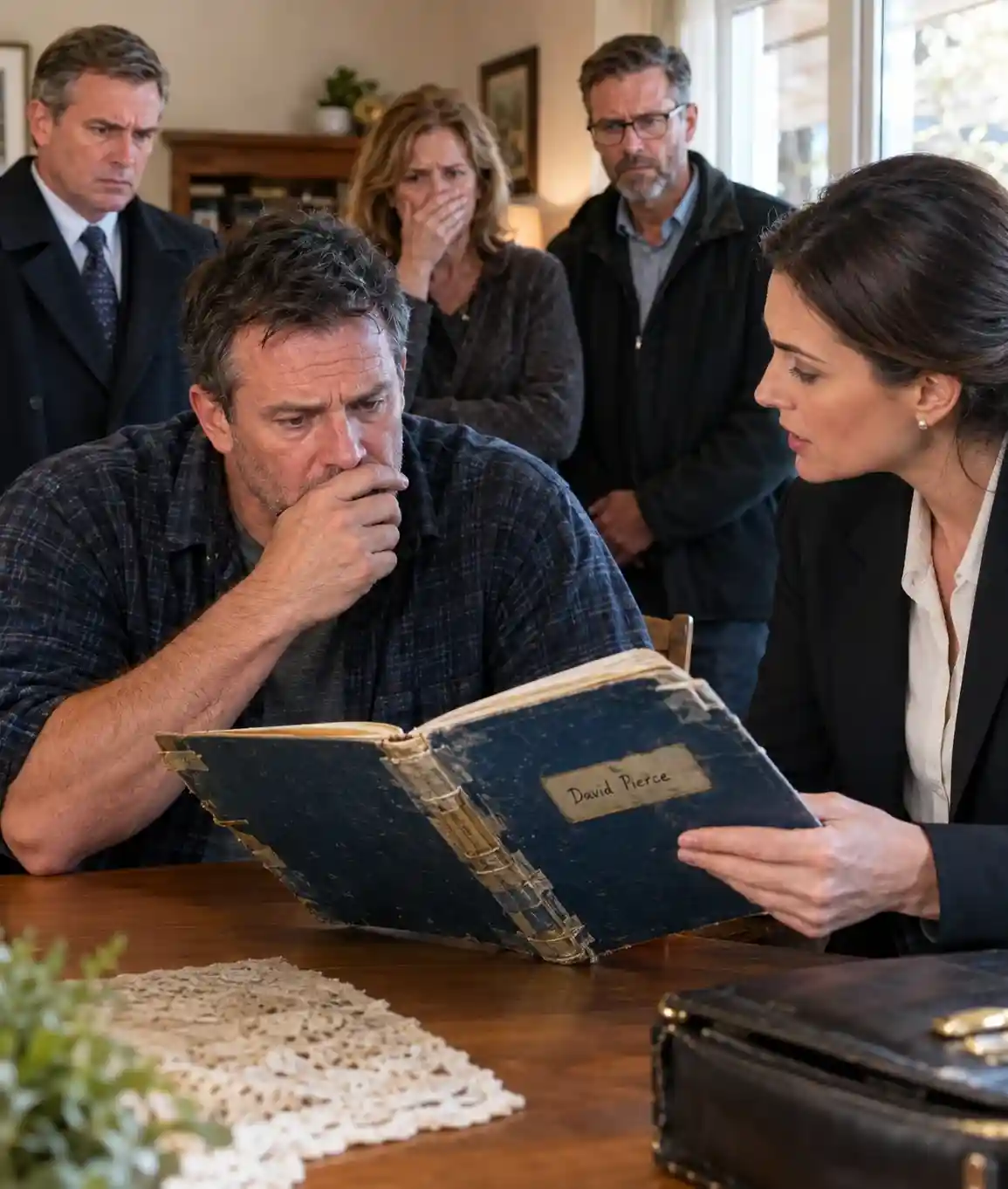
Then, the morning after we buried him, his attorney arrived with a battered blue ledger.
Before she opened it, she looked directly at me.
“David, Arthur left very specific instructions. He wanted you to see what he recorded beside your name before anyone hears the will.”
I had spent twenty years wishing my father-in-law would stop being my responsibility.
By the time I understood what he had actually been doing, I would have given anything to hear his radio playing in the next room again.
My name is David Pierce. I was forty-nine when Arthur Vance died at eighty-nine, and for most of the twenty years we shared a home, I treated him like a bill that never stopped arriving.
He was my wife Claire’s father. That should have meant something to me.
Sometimes, it did.
But when the mortgage was due, the car needed repairs, and my children needed things I couldn’t afford, being a good son-in-law felt like a luxury I had never agreed to purchase.
Arthur moved into our home when he was sixty-nine.
His wife had died that spring, leaving him alone in the modest house where they had raised four children. For a few weeks, he tried managing by himself. Then he fell in the kitchen and spent half a night on the floor before a neighbor found him.
Claire called me at the auto-body shop where I worked outside Denver.
“Dad can’t stay there alone anymore,” she said.
“How long will he be with us?”
“Just until we figure something out. A month, maybe two.”
I remember wiping grease from my hands with a shop rag and looking at the clock. I had already worked nine hours, and all I wanted was to go home.
“Fine,” I told her. “Two months.”
Arthur arrived three days later with two old suitcases, a dented metal coffee thermos, a small transistor radio, and a thick blue ledger wrapped in a grocery bag.
He carried everything himself, although he walked slowly and held the railing whenever he climbed stairs.
Our son, Noah, was eight. Our daughter, Lily, was five. We moved Lily’s bed into Noah’s room and gave Arthur the small bedroom beside the laundry room.
Claire promised the arrangement wouldn’t last long.
Two months became six. Six months became five years. Before I fully understood how it had happened, Arthur had been living with us for a decade.
Then fifteen years passed.
Eventually, twenty.
Arthur never demanded special treatment. He didn’t drink, smoke, shout, or complain about the house. He rose early, made oatmeal, buttered his toast, and poured black coffee into his battered thermos.
Every morning, he thanked me for breakfast.
“Thank you, David.”
I usually answered with a nod.
I told myself I was being practical. Gratitude didn’t pay the electric bill. It didn’t cover blood-pressure medication, dental appointments, or the replacement glasses he needed as his eyesight worsened.
I was a mechanic. My hands were permanently stained with grease, and after ten hours of lifting heavy panels and working beneath damaged vehicles, my back often hurt so badly that I needed a hot shower before I could even remove my work boots comfortably.
When I came home exhausted, Arthur was often sitting in my recliner, listening to baseball on his crackling radio.
He always stood when I entered the room.
“Sorry, son. You want your chair?”
I hated that he called me son.
Not because the word was offensive, but because he said it with such uncomplicated affection that I felt like a worse man every time I heard it.
“You don’t have to move,” I would mutter.
But I never sat down until he had left the room.
Claire noticed everything.
One night, after I complained about another pharmacy receipt, she followed me into the kitchen.
“Dad heard you,” she whispered.
“Then perhaps he’ll understand what it costs to live here.”
“He’s eighty years old, David.”
“And I’m not made of money.”
“Neither is he.”
“Then why am I the only person expected to solve the problem?”
Claire stared at me as if she no longer recognized the man she had married.
“He is my father.”
“And I’m your husband.”
That was how our arguments usually ended. Claire would cry quietly at the sink, and I would leave the room convinced that I had somehow become the villain in a situation I had never wanted.
The worst part was that I genuinely believed I was the only one sacrificing anything.
I remembered every expense. Every extra grocery bag. Every prescription. Every doctor’s visit that forced me to leave work early.
I never counted the things Arthur did without being asked.
When our kitchen tap leaked, he sat beside it with a wrench until he managed to stop the drip. When Claire worked late at the library, he folded laundry and prepared simple meals for the children. When Noah was sick, Arthur sat beside his bed, reading the same baseball stories until the boy finally fell asleep.
I noticed these things.
I simply decided they didn’t count.
They weren’t money.
And money was what I believed our family needed most.
When Noah needed braces, I complained that we were struggling to support everyone on my mechanic’s salary and Claire’s part-time library wages.
When Lily was accepted into a summer music program, I told her we couldn’t afford the tuition.
She cried in her bedroom for an hour.
Two days later, the program director called to say a local charitable fund had covered the full cost.
I assumed someone had heard about our financial difficulties and decided to help.
Arthur never said a word about it.
He simply smiled when Lily showed him her acceptance letter.
“You’ve worked hard for this,” he told her. “Don’t waste a single day.”
She threw her arms around him.
“Thank you, Grandpa!”
I watched from the doorway, embarrassed by the sudden relief I felt. Someone else had paid a bill I couldn’t manage, and for once, I didn’t have to find a way to make the numbers work.
Arthur looked up and caught my eye.
He smiled politely.
I looked away.
By then, he was already in his eighties. His hair had thinned, his steps had become slower, and his hands trembled when he lifted his coffee thermos.
Still, he kept that blue ledger in the bottom drawer of his nightstand.
Occasionally, I saw him writing in it.
“What are you always putting in that old book?” I asked once.
“Things I don’t want to forget.”
“Bills?”
“Something like that.”
He closed the cover before I could see the page.
I thought he was keeping track of his expenses. Perhaps he was trying to prove that he hadn’t completely lost control of his life.
I never asked again.
The worst thing I said to Arthur happened during a winter storm, when I was forty-six.
My old pickup truck had finally given out. The transmission was gone, and the repair estimate exceeded what the truck was worth. I sold it for scrap and started taking two buses to work.
For nearly three months, I woke before sunrise and returned home exhausted. Then, one afternoon, a heavy snowstorm shut down the transit lines before I could reach my stop.
I walked the remaining four miles in freezing wind, carrying my lunchbox and trying to keep the snow from soaking through my boots.
By the time I reached home, my clothes were wet, my fingers were numb, and my back was screaming.
Arthur was sitting on the covered porch beneath a thin blanket. He had his radio beside him and a cup of coffee balanced on the little table.
He struggled to stand when he saw me.
“David, you’re soaked.”
He reached for a towel.
I took one look at his warm blanket, his dry slippers, and the steaming coffee, and something ugly rose inside me.
“Do you know what would make my day better?” I snapped.
Arthur paused.
“What, son?”
“You paying for something around here.”
Claire opened the front door behind him.
“David, don’t.”
But I had carried my resentment for so long that I no longer seemed capable of controlling it.
“Twenty years, Arthur. Twenty years of free meals, heat, medicine, and a roof over your head. Have you ever calculated what you’ve cost this family?”
His expression tightened.
“I think about it every day.”
“Thinking doesn’t pay the bills!”
“I know.”
“You sit around listening to that radio while everyone else works to keep this house running. My kids had to share a bedroom because of you. I lost my truck, and I’m freezing on a bus every morning, while you sit here as if none of this has anything to do with you.”
Arthur lowered the towel.
“David,” Claire said, her voice trembling. “Stop.”
I should have listened.
Instead, I pointed toward the door.
“You’ve been a burden to this family since the day you arrived.”
For several seconds, Arthur didn’t move.
Then his shoulders dropped.
He didn’t argue. He didn’t remind me that he had once raised four children of his own. He didn’t tell me that I was being cruel.
He simply looked down at his slippers.
“I’m sorry, son,” he whispered. “I never wanted to make your life harder.”
Then he added something I would remember for the rest of my life.
“I promise I won’t be in your way forever.”
At the time, I thought he was trying to make me feel guilty.
I turned away and went inside.
Claire stayed on the porch with him. I heard her crying, but I refused to look through the window.
I told myself I had spoken the truth.
That was the lie I carried for the next three years.
Arthur died on a quiet Tuesday morning.
Claire found him in his aluminum folding chair on the back porch. His radio was playing softly beside him, and his coffee had gone cold.
At first, she thought he had fallen asleep.
She touched his shoulder.
Then she screamed.
I ran outside so quickly that I nearly slipped on the kitchen floor. I dropped to my knees beside him, calling his name and searching for a pulse even though something in his still face told me the truth.
The paramedics arrived within minutes.
There was nothing they could do.
He was eighty-nine.
At the funeral, his three other children appeared late.
Mark, the oldest, wore an expensive overcoat and checked his phone throughout the service. Brenda cried loudly whenever someone approached her, while Kevin asked the funeral director whether their father had made arrangements to cover the burial costs.
They had visited Arthur fewer than ten times during the twenty years he lived with us.
Yet, at the graveside, Mark put a hand on my shoulder.
“Well, David,” he said, “I guess you finally get your house back.”
He laughed as if we shared a private joke.
I wanted to punch him.
Instead, I stood there silently, because a small part of me knew that I had once thought the same thing.
That evening, I went out to the back porch.
Arthur’s folding chair was still beside the little table. His thermos sat near the railing, exactly where Claire had left it. The radio was gone, but I could almost hear its faint crackle in the quiet.
For twenty years, I had wanted that chair empty.
Now I couldn’t bear to sit in it.
The following afternoon, someone knocked on our front door.
A woman in a charcoal suit stood outside holding a leather briefcase.
“David Pierce?”
“Yes.”
“My name is Sarah Sterling. I represented Arthur Vance for more than thirty-five years.”
I stared at her.
“Arthur had a lawyer?”
Sarah gave me a measured look.
“Yes. And he left detailed instructions concerning his final affairs.”
Claire appeared behind me, pale and exhausted.
Sarah entered the living room and glanced through the sliding doors toward the porch.
“He spoke about that chair often,” she said quietly.
Claire covered her mouth.
Sarah placed her briefcase on the coffee table.
“Mr. Vance requested that his last will and testament be read in the presence of all four of his children, you, Mr. Pierce, and his grandchildren.”
Mark arrived forty-five minutes later, followed by Brenda and Kevin.
He looked around our modest living room with open disdain.
“What exactly are we expecting to find?” he asked. “Dad never owned a house. He had no business, no investments worth mentioning, and barely enough money for his prescriptions.”
Sarah didn’t answer.
She removed a thick legal folder from her briefcase, followed by a faded yellow envelope.
Then she took out a blue ledger.
My stomach tightened.
I recognized the cracked spine and the strips of brown packing tape. I recognized the frayed corners and the familiar handwriting near the bottom of the cover.
David Pierce.
Sarah placed it directly in front of me.
“Before I read the will,” she said, “Arthur specifically instructed me to show you this book.”
My hands felt cold.
“Why me?”
“Because, according to his written instructions, you deserve to understand what he recorded over the last twenty years.”
She opened the cover.
The first page was dated the week Arthur moved into our home.
Sarah turned it toward me.
I read the first line.
Then I read it again.
Across the room, Mark stopped smiling.
And when Sarah placed her finger beside the final sentence on that page, I realized that the old man I had called a burden had been keeping a secret that could change everything I believed about my family.
Part 2: The Secret My Father-in-Law Recorded in His Blue Ledger Changed Everything I Believed About Him
I stared at the first page of Arthur’s ledger, struggling to make sense of what I was reading.
Sarah Sterling sat beside me, her hands folded over the legal folder.
“Take your time, David,” she said.
The entry was dated twenty years earlier, three days after Arthur had moved into our house.
September 18
Claire has given me a home when I had nowhere safe to go. David agreed to take me in, even though I know this was not the life he planned.
I will never forget what they have given me.
Beneath those words was a list of figures.
My name appeared beside several amounts, followed by dates and short notes. Some entries mentioned groceries. Others referred to electricity, medical appointments, and household repairs.
I frowned.
“So he really was keeping track of what we spent on him?”
Sarah didn’t answer immediately.
“Please read the next page.”
I turned it.
The handwriting was shakier, but the meaning was clear.
David works hard. I see the pain in his back when he comes home. I wish I could do more to help him.
He believes I contribute nothing. I cannot blame him for being tired.
My face grew hot.
I wanted to close the book, but Sarah gently placed her hand on the next page.
“Arthur asked me to make sure you read the entries in order.”
The following pages contained records of events I remembered all too well.
The year Noah needed braces.
The year Lily was accepted into music camp.
The month my pickup truck broke down.
The winter when our heating system needed repairs.
Beside each event, Arthur had written something.
Noah is embarrassed about his teeth. I hope he gets the treatment he needs.
Lily plays the piano beautifully. She should have the opportunity to learn.
David has been walking to the bus stop in the dark. I wish I could find a way to make his mornings easier.
I stopped reading.
The room was silent except for the ticking of the clock above our fireplace.
“How did he know about Lily’s tuition?” I asked.
Claire looked at me through tear-filled eyes.
“I don’t know.”
Sarah opened the yellow envelope.
Inside were copies of receipts, letters, and several bank statements.
She arranged them on the table.
“Arthur established a small charitable fund years ago,” she explained. “He had been contributing to it long before he moved into your home. After he arrived, he continued managing it as best he could.”
Mark leaned forward.
“A charitable fund? With what money?”
“Money he had saved over many years, along with the proceeds from the sale of his former home and other assets,” Sarah replied. “He made careful arrangements for those funds to support specific educational and emergency needs.”
I looked at the receipts.
There was the music camp payment.
There was a payment toward Noah’s orthodontic treatment.
There were other contributions to community programs and assistance funds.
But the documents didn’t say that Arthur had secretly paid all our household bills, and I couldn’t pretend that every financial struggle we had endured had somehow been his doing.
Instead, I began to understand something much harder to accept.
He had seen our struggles.
He had helped when he could.
And I had been so focused on what I believed he owed us that I had never bothered to ask what he was actually capable of giving.
Sarah turned another page.
“This entry is dated the winter your truck broke down.”
I recognized Arthur’s handwriting immediately.
David came home covered in snow today. He was angry, and I understand why. I cannot repair his truck or change the fact that he has to work so hard.
I have offered to pay for repairs, but I know he may refuse. I don’t want him to feel that his home is a place where he must accept charity.
My chest tightened.
I remembered that winter.
I remembered Arthur offering to help with transportation expenses after I complained about the buses.
I had rejected the offer before he could finish explaining.
“I don’t need your money,” I had told him.
At the time, I thought I was defending my dignity.
Now, I wondered whether I had simply made it impossible for him to help me.
Sarah continued reading.
He called me a burden today.
I have no right to demand affection from him. This is his home, too, and I know my presence has changed his family’s life.
I will keep doing what I can. Perhaps one day he will understand that I never wanted to take anything from him.
I pressed my palms against my eyes.
For twenty years, I had treated Arthur’s silence as proof that he didn’t care.
I had never considered that he might have been staying quiet because he didn’t want to make life more difficult for the people who had taken him in.
Then I reached the final entry.
It was dated only six weeks before his death.
The handwriting was unsteady, and several words had been crossed out.
David is not a bad man.
I stopped.
Sarah waited.
I read the sentence again.
He has carried responsibilities he never expected to carry. I have watched him work until his hands shook with exhaustion. I have heard him argue about bills he could barely pay.
Sometimes, he has been cruel to me. I won’t pretend otherwise.
But I have also seen him repair a neighbor’s car without charging a widow who could not afford the work. I have watched him bring home groceries for families who had less than we did. He has a good heart buried beneath his fear of never having enough.
My vision blurred.
Arthur had seen things about me that I had spent years trying to hide from myself.
The final paragraph was shorter.
I hope he learns that a person can cost you money and still give your life something worth more than money.
I lowered the ledger.
No one spoke.
Even Mark, who had spent the afternoon treating the entire gathering like an inconvenience, was staring at the table.
I turned toward Sarah.
“Is that all?”
“No,” she said softly. “There is one more matter.”
She opened the legal folder and removed Arthur’s last will and testament.
“The charitable fund is separate from his estate. His will also addresses his remaining assets and the distribution of his personal property.”
Mark immediately straightened.
“Let’s get to the important part.”
Sarah ignored him.
She explained that Arthur had maintained his finances carefully and had left written instructions for his belongings, savings, and remaining investments. Some provisions supported charities and community organizations he had cared about for years. Others addressed his children and grandchildren.
Then she read a clause that made the room go still.
To my daughter Claire, who opened her home to me without asking what she would receive in return, I leave my personal papers and the small collection of photographs belonging to her mother.
Claire began to cry.
To my grandchildren, Noah and Lily, I leave the funds specified in the attached education trust, to be used according to its terms.
Noah looked at his sister.
Neither of them said anything.
Sarah continued.
Arthur had also left specific gifts to his other children, along with instructions for the charitable fund he had established. He had not divided everything equally, and his reasons were documented in the will.
Mark’s expression darkened.
“And David?” he demanded. “What did Dad leave David?”
Sarah looked directly at me.
“Arthur left you the blue ledger, the letters and records associated with it, and a sealed personal letter. He also directed me to convey a message that he wrote specifically for you.”
She handed me a cream-colored envelope.
My name was written across the front.
I opened it with trembling fingers.
David,
If you’re reading this, I have probably left the porch chair empty for good.
I know you never wanted me in your home for twenty years. I know you felt trapped by a responsibility that arrived without warning. I wish things had been easier for you.
You were not wrong to worry about your family’s future. You were not wrong to feel tired. I never expected you to be happy about every sacrifice.
But I wish you had understood that I was not measuring your worth by how much money you spent on me.
I was measuring it by the way you treated people when you thought nobody was watching.
I saw the kindness you showed strangers. I saw the patience you gave your children. I saw the times you wanted to do the right thing but were too angry or frightened to know how.
I also heard the things you said to me.
I forgive you, David. I hope that one day you will forgive yourself.
Do not spend the rest of your life wishing you had treated me differently. Use the time you have left to treat the people around you better.
That is all I ever wanted.
Arthur.
I couldn’t hold the letter steady.
For years, I had imagined that if Arthur ever left our house, I would feel relief.
Instead, I sat in my own living room, surrounded by my family, and cried for a man who had spent two decades trying not to make me feel guilty.
I cried because he had forgiven me without asking for an apology.
I cried because I had spent so much time calculating what his life cost me that I had never calculated what his absence would cost.
And I cried because the last time I had spoken to him with any real force, I had told him he was a burden.
After Sarah finished explaining the legal documents, Mark asked several questions about the estate. Some concerned the charitable fund, while others concerned the distribution of the remaining assets.
Sarah answered carefully, referring to the will and its supporting records.
There was no dramatic fortune hidden in the blue ledger. No secret mansion. No miraculous inheritance that would erase every hardship we had experienced.
Arthur’s legacy was more complicated than that.
He had planned for the future as carefully as his circumstances allowed. He had helped his grandchildren pursue opportunities, supported causes he believed in, and kept a record of the people who had mattered to him.
Most importantly, he had left me something I couldn’t put a price on.
A chance to recognize the man I had failed to understand.
After everyone left, Claire found me sitting alone on the back porch.
Arthur’s folding chair was still beside the little table.
She sat next to me.
For a long time, neither of us spoke.
Finally, I said, “I thought he was taking something from us.”
Claire wiped her eyes.
“I know.”
“I never asked what he had left behind.”
She reached for my hand.
“He loved you, David. Even when you made it difficult.”
I looked toward the empty chair.
“I don’t know what to do with that.”
“You don’t have to do anything tonight.”
But I knew I couldn’t leave everything unchanged.
The next morning, I took Arthur’s old thermos from the kitchen cupboard and placed it beside the chair. Claire found his transistor radio in the box of belongings Sarah had returned to us, and we put it on the little table.
The radio still worked.
Its speaker crackled as a baseball announcer described a game from the previous evening.
For the first time in years, I sat in the chair beside Arthur’s.
I opened the blue ledger again and read the final entry.
Then I turned to the inside cover and wrote a sentence of my own.
I finally understand that loving someone is not the same as keeping a record of what they cost you.
I closed the book.
I couldn’t change the way I had treated Arthur. I couldn’t return to that snowy evening and take back the words that had made his shoulders slump. I couldn’t sit beside him one more time and tell him that I was sorry.
But I could decide what kind of man I wanted to be while I still had time.
That afternoon, I called Lily and asked whether she would help me find a local program supporting children whose families couldn’t afford music lessons.
She agreed immediately.
Noah offered to help, too.
We decided that, in Arthur’s memory, we would contribute what we could each year. Not because the ledger demanded it. Not because we expected gratitude or recognition.
Because Arthur had taught us something that I had spent twenty years refusing to learn.
A person’s worth cannot be measured by the space they occupy, the food they eat, or the money someone spends on their care.
Sometimes, the people we call burdens are the ones quietly holding our family together.
I still keep Arthur’s blue ledger in my study.
Its pages are worn, and the spine is held together with brown packing tape. Every so often, I open it and read his handwriting.
And whenever life becomes expensive, stressful, or unfair, I remember the old man who sat on my porch with a radio, a cup of cold coffee, and more patience than I deserved.
I once believed my greatest loss would be the money I spent caring for him.
I was wrong.
My greatest loss was the twenty years I spent living beside him without truly seeing him.
If someone you love has become a responsibility you never expected, pause before deciding what their presence has taken from you. You may discover that their value was never something you could calculate.
Editor’s Note: This story explores the complicated emotions that can arise when families take on unexpected caregiving responsibilities. It reminds us that financial pressure and exhaustion can affect relationships, while empathy and honest communication can help us recognize the value of people we may have misunderstood. The characters and events are presented as a fictional narrative for reflection.
Related Posts
- Every Ride Home Left Me With Missing Memories And I Thought My Husband Was Worried About My Blackouts Until I Heard His Voice on the Recording

- My Mother Banned Me From My Brother’s Wedding, Then One Phone Call Revealed Who I Really Was



About the Author
Hassan is the founder and editor of MidnightReads, a publication featuring thoughtful stories, human-interest articles, history, relationships, and entertaining reads.
He is involved in researching, writing, and editing content for the site, with a focus on creating original, clear, and useful articles that give readers something meaningful to take away.
Hassan believes good content should inform, entertain, and encourage curiosity.
— Hassan, Founder & Editor, MidnightReads