
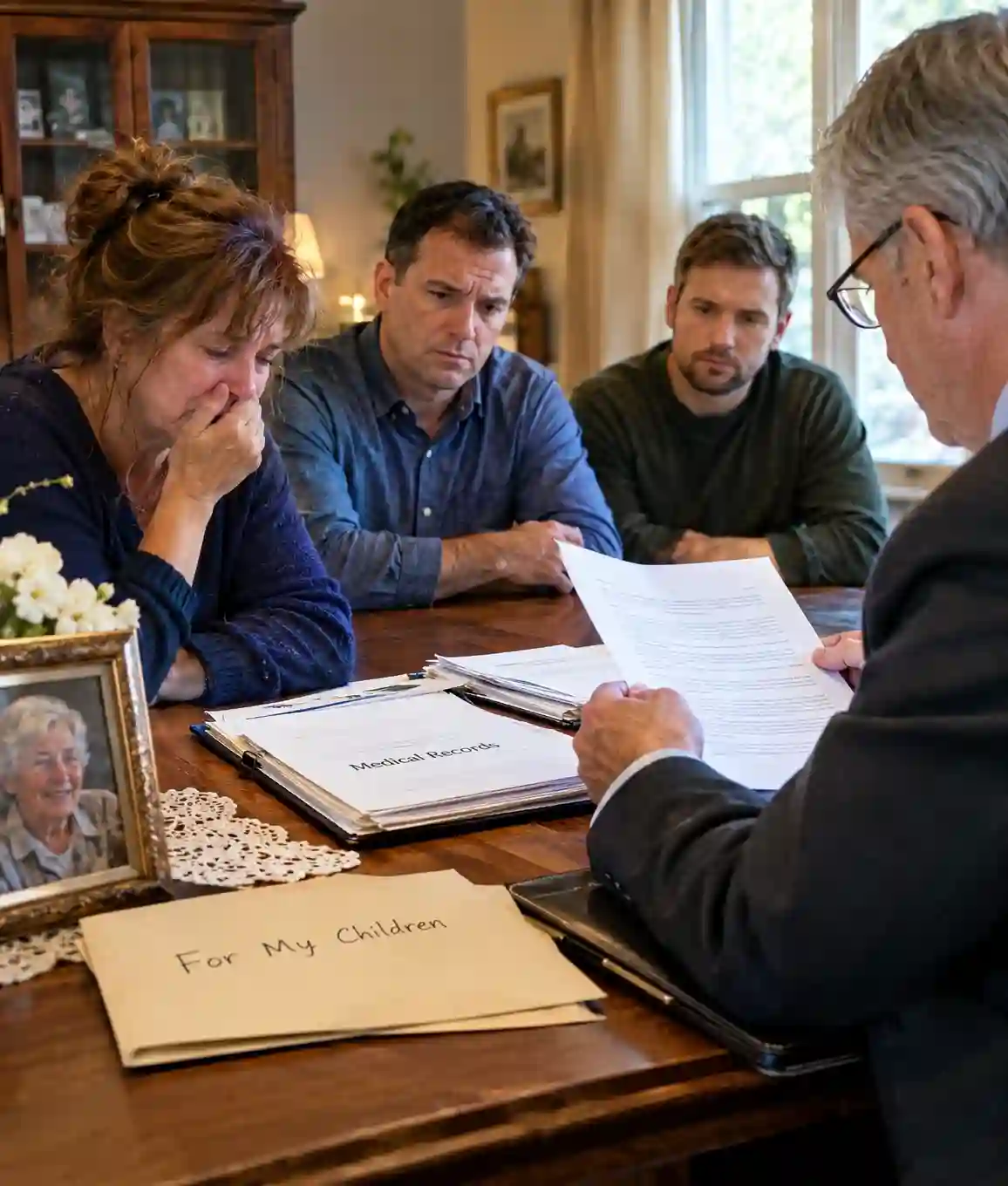
“You lived here for free for eight years, Teresa. The least you can do is pay the estate back.”
My brother Mark said it across our mother’s dining room table less than two weeks after her funeral. He spoke as calmly as if he were discussing an unpaid utility bill, but I could barely process what I was hearing. I looked around the room at the familiar things Mom had left behind: her reading glasses beside the telephone, her favorite coffee mug in the kitchen cabinet, and the small calendar where she had written appointments in her shaky handwriting.
For eight years, that house had been my home and my responsibility. Now, sitting across from my brothers, I was beginning to realize that they had seen those years very differently from the way I had lived them.
I was fifty-seven years old. Before Mom became sick, I had worked as a bookkeeper for a small manufacturing company in Kentucky for nearly twenty years. I had a steady salary, health insurance, retirement savings, coworkers I enjoyed and a routine that gave me a comfortable sense of independence. I wasn’t wealthy, but I had built a life that belonged to me.
Everything changed when Mom was diagnosed with cancer.
At first, none of us expected the illness to completely reshape our lives. Mark lived about six hours away, while Kevin lived in another state. Both had jobs, children, mortgages and responsibilities of their own. When we first discussed Mom’s treatment, all three of us promised to help however we could. I believed them, and I knew they meant it. But because I lived nearby, I naturally became the person who handled most of the daily responsibilities.
It started with doctor’s appointments and prescription pickups. Then Mom needed help after surgery, followed by assistance with meals, bathing and medications. I used my vacation days at first, then took unpaid leave from work. Eventually, I arranged to do some bookkeeping from home so I could remain available.
I kept telling myself it would only be temporary.
It wasn’t.
Some weeks Mom was strong enough to sit on the porch and complain about the weeds growing beside the fence. Other weeks, she struggled to walk from her bedroom to the bathroom. There were hospital admissions, infections, surgeries and emergency room visits that seemed to appear without warning. More than once, I drove through the night because Mom was frightened and needed to be taken to the hospital.
The hardest part wasn’t any single emergency. It was the constant uncertainty. I never knew whether a quiet afternoon would remain quiet or turn into another trip to the emergency room. I learned which medications had to be taken with food, which symptoms meant I should call the doctor and which ones meant I shouldn’t wait at all.
My brothers knew Mom was sick, but they didn’t see most of what happened inside the house.
When they visited, Mom made sure everything looked normal. She would brush her hair, put on a nice sweater and ask me to prepare one of their favorite meals. She didn’t want her sons to worry about her, so she tried to give them the version of herself she wanted them to remember.
After they left, the reality returned.
There were nights when Mom couldn’t sleep because she was afraid she wouldn’t live long enough to see another spring. There were mornings when she needed help getting dressed and evenings when I had to organize her medications for the next day. Sometimes I would sit alone in the laundry room for a few minutes because it was the only place where I could cry without making her feel guilty.
I never told my brothers how exhausted I was.
Part of me didn’t want praise, and another part knew Mom already felt guilty about what her illness had done to my life. I didn’t want her to believe she had become a burden. She was my mother, and I loved her. So I kept doing what needed to be done.
Over the years, however, my own life became smaller. I stopped working full-time and eventually had to give up bookkeeping altogether. My retirement savings no longer grew the way I had planned. I turned down opportunities because I couldn’t make long-term commitments, and there were vacations, weddings and weekends away that I simply couldn’t attend.
I never considered Mom a burden, but that didn’t mean those sacrifices didn’t exist.
When she finally passed away at eighty-four, she was at home. I was holding her hand when she took her last breath. The porch light was still on, and a pot of soup I had made earlier that day was sitting forgotten on the stove.
After the funeral, the three of us met with the attorney handling Mom’s estate.
She hadn’t left behind a fortune. Her biggest asset was the house, along with some savings, an older car and a small piece of land behind the property. I assumed everything would eventually be divided between the three of us. I had never asked Mom about her plans because I didn’t want the years I spent caring for her to feel like some kind of financial transaction.
Before the attorney could explain the estate, Mark leaned back in his chair and said that the house needed to be discussed first.
He placed several sheets of paper on the table.
“I calculated what Teresa would have paid in rent if she hadn’t been living here,” he said.
I stared at the figures. He had estimated eight years of rent and wanted the amount deducted from whatever I received from the estate.
“You think I owe Mom rent?” I asked.
Mark shook his head. “That’s not what I’m saying. You lived here, your expenses were lower, and you weren’t working full-time.”
Kevin nodded quietly.
Then Mark added, “You didn’t exactly have a real career during those years.”
That sentence hurt far more than the amount written on his papers.
I had expected my brothers to disagree with me about the estate. I hadn’t expected them to look at eight years of my life and see them as wasted time.
The attorney had been listening without interrupting. He finally reached across the table and picked up Mark’s calculations.
“I think there are some other records you should see before we discuss this,” he said.
He opened a thick folder.
The first page contained Mom’s medical information and emergency contact details.
“Authorized caregiver,” he read. “Teresa Nolan.”
He turned the page.
“Post-surgery discharge contact. Teresa Nolan.”
Another page.
“Transportation home. Teresa Nolan.”
Another.
“Medication instructions released to caregiver. Teresa Nolan.”
The attorney continued through the records. There were emergency room visits, hospital admissions, surgical procedures, follow-up appointments and specialist visits. My name appeared again and again because I had been the person doctors called when Mom needed someone.
Mark stopped looking at his rental calculations.
Kevin stared at the folder.
The attorney then pointed to two occasions where my brothers were listed as emergency contacts. Their names were there, but so were mine on dozens of other pages, along with notes showing that I had been the person responsible for getting Mom home and helping her follow the instructions after treatment.
The room became quiet.
Then the attorney reached into his briefcase and removed an envelope.
Across the front, written in Mom’s familiar handwriting, were the words: For My Children.
He explained that Mom had written the letter several months before her death and instructed him to read it to all three of us after she was gone.
The letter began with Mom telling us that she loved all three of her children. She said she understood why Mark and Kevin couldn’t be there every day and didn’t want them to carry guilt for living farther away. She knew they had families and responsibilities that prevented them from dropping everything whenever she needed help.
Then she wrote about me.
The attorney explained that Mom knew exactly what I had given up.
She knew I had stopped working full-time because of her care. She knew my retirement plans had changed and that I had turned down opportunities because I couldn’t leave her alone. She also knew that I had never asked her for money or complained about what caregiving had cost me.
Then the attorney read the line that made me look down at the table because I couldn’t hold back my tears.
Mom had written that I had given her eight years of my life at a time when I should have been building the next chapter of my own.
She wrote that she had never wanted me to feel guilty for loving her, but she also didn’t want anyone to pretend that my time had been worthless simply because I wasn’t receiving a paycheck.
Then came the sentence that changed the entire conversation.
“She did not live off me,” Mom had written. “She kept me living.”
Kevin covered his face with his hand.
Mark sat motionless.
Mom’s letter went on to explain that she had decided to leave the house to me, while the remaining savings and land would be divided equally among all three children. She made it clear that the house wasn’t intended as payment for caring for her. It was simply the place where I had spent eight years making sure she was safe and wasn’t facing her illness alone.
The attorney finished the letter and carefully placed it back inside the envelope.
Nobody immediately spoke.
Mark eventually looked at me.
“I didn’t know,” he said.
His voice was quiet, and I believed him.
That was perhaps the saddest part. He hadn’t deliberately ignored everything I had done. He simply hadn’t seen it. He had seen that I stopped working. He had seen that I lived with Mom. He had seen that I had fewer career opportunities than before. What he hadn’t seen were the hospital corridors, medication schedules, sleepless nights and countless small tasks that had filled those eight years.
I didn’t remind him of every sacrifice.
There was no reason to turn the conversation into a list of everything my brothers hadn’t done. Instead, I told him that caregiving was difficult to measure because so much of it happens quietly. There isn’t a paycheck for sitting beside someone during the night, a promotion for remembering their medication schedule or a certificate for driving them to a hospital before sunrise.
Most of the work simply disappears into the ordinary routine of keeping another person’s life going.
A month later, Mark returned to Mom’s house alone. He didn’t bring paperwork or another calculation. He brought a toolbox because the porch railing Mom had complained about for years had finally become loose.
He spent the afternoon fixing it.
Before he left, he stood on the porch for a while and looked through the kitchen window.
“I wish I’d understood sooner,” he said.
“I do too,” I replied.
Kevin began calling every Sunday after that. We didn’t suddenly become a perfect family, and the loss of Mom didn’t disappear simply because we had finally talked honestly about those years. There were still difficult memories and things none of us could change.
But my brothers stopped referring to those years as the period when I had no career.
They finally understood that I hadn’t stopped doing something with my life. I had simply been doing work that didn’t come with a salary or a job title.
I had made sure our mother had someone beside her when she was frightened. I had driven her to appointments, organized her medications, stayed through hospital visits and helped her remain at home for as long as it was safely possible.
For years, I had worried that giving up my career meant I had fallen behind in life.
Mom’s letter made me see those years differently.
A résumé can show where someone worked and what positions they held, but it can’t show every night spent caring for a sick parent or every difficult decision made because someone you love needed you.
Some of the most important work people do never appears on a résumé at all.
Sometimes, it is simply the work of making sure someone you love doesn’t have to face their hardest days alone.
Author’s Note:
Caregiving is often work that happens quietly, without a paycheck, job title, or public recognition. This story is a reminder that the sacrifices made while caring for a loved one can be difficult for others to see—but that does not make them any less meaningful.
Trending Posts
- My Daughter Abandoned Me at My Wife’s Grave, 190 Miles From Home—Four Days Later, Her Husband Saw Me in the Chairman’s Seat

- My Father-in-Law Lived Under My Roof for 20 Years, and I Called Him a Burden, Until His Lawyer Opened a Blue Ledger at His Funeral and Revealed What He’d Been Hiding All Along

- My Ex-Husband’s Mother Arrived With Two Moving Trucks Minutes After Our Divorce—She Demanded My Mansion, but She Had No Idea What My Attorney Had Discovered2.

- My Mother-in-Law Pushed Me Down the Stairs at Nine Months Pregnant—She Never Expected Her “Unemployed” Son to Arrive With the Entire Board of Directors





Hammad Ali
Co-Owner & Author
Hammad Ali is a co-owner and author at MidnightReads, contributing thoughtful and engaging articles across human-interest, life, history, relationships, and entertainment topics.
They help develop and create original, useful content designed to inform, entertain, and give readers something meaningful to take away.