My Son Was Suspended for Pulling the Fire Alarm, Then a Firefighter reveal the truth nobody was expecting
The school called at 9:42 on a Friday morning.
I was sitting at my desk in a dental office, trying to sort out an insurance claim, when Hickory Creek Elementary appeared on my phone. My first thought was that my ten-year-old son, Nate, had gotten sick. Maybe he had a stomachache or needed me to bring something he’d forgotten.
I never imagined the call would turn my entire morning upside down.
“Mrs. Lawson?” a man’s voice said. “This is Principal Conway. I need you to come to the school immediately.”
I pushed my chair back.
“Is Nate okay?”
“He’s physically fine, ma’am, but he’s been involved in a serious incident.”
My stomach tightened.
“What happened?”
“Your son pulled the fire alarm during our school-wide assembly.”
For a moment, I couldn’t process his words.
“He did what?”
“We had more than 300 students and staff members inside the building. The alarm forced everyone to evacuate, interrupted the assembly, and brought the fire department to the school. We consider this extremely serious.”
I glanced at the clock.
9:42.
“Why would he do something like that?”
“That’s what we’re trying to establish. However, I want you to understand that there will be disciplinary consequences.”
I grabbed my purse.
“Did he explain why?”
“He claims he thought there was a fire. At this point, we haven’t confirmed anything.”
“I’ll be there in fifteen minutes.”
I was raising Nate on my own. His father had moved to Arizona three years earlier, and although they spoke regularly, the everyday responsibilities fell on me.
I knew my son better than anyone.
He was curious, sometimes stubborn, and occasionally asked questions that left adults struggling for answers. But he wasn’t a troublemaker. He wasn’t cruel, and he certainly wasn’t the kind of child who would deliberately frighten hundreds of people for entertainment.
Still, pulling a fire alarm wasn’t a small mistake.
I understood how dangerous unnecessary evacuations could be, especially in a crowded school.
As I drove toward Hickory Creek Elementary, I kept asking myself the same question.
What could possibly have made Nate do this?
When I turned onto the school road, two fire trucks were parked near the main entrance.
Children were gathered outside with their teachers. Some parents stood near the sidewalk, talking in concerned voices. A few students were already being escorted back inside.
I heard a woman nearby say, “Apparently, some kid thought it would be funny.”
My face grew hot.
I wanted to defend my son, but I didn’t even know what had happened yet.
Inside the office, the secretary directed me to Principal Conway’s room.
Nate was sitting in a chair beside the window.
His blue hoodie was twisted around his wrists, and one shoelace had come undone. When he saw me, he looked up.
“Mom.”
I expected him to run toward me, but he stayed exactly where he was.
Principal Conway stood behind his desk.
“Mrs. Lawson, thank you for coming. I wish we were meeting under better circumstances.”
I sat beside Nate.
“Can someone please explain what happened?”
The principal folded his hands.
“During this morning’s assembly, Nathan activated a manual fire alarm. The entire building had to be evacuated. We had more than 300 people inside, including students, teachers, and visitors.”
He reached for a sheet of paper and pushed it across the desk.
My eyes immediately went to the bold lettering at the top.
THREE-DAY OUT-OF-SCHOOL SUSPENSION — PROPOSED
I stared at it.
“Three days? He’s ten years old.”
“Mrs. Lawson, we take fire safety very seriously. Pulling an alarm without a valid reason can create unnecessary panic and put people at risk. We cannot ignore that.”
I turned toward Nate.
“Sweetheart, did you pull the alarm?”
He nodded.
“Yes.”
“Did someone tell you to do it?”
“No.”
“Then why?”
His eyes began to fill with tears.
“Because nobody would listen to me.”
Principal Conway sighed.
“Nathan, we’ve already discussed this.”
My son turned toward him.
“But I told them!”
“Nathan.”
“She didn’t even look!”
I leaned closer and gently took his hand.
“Tell me what happened. Start from the beginning.”
He wiped his eyes with his sleeve.
“I smelled something burning.”
The principal shook his head.
“We’ve had no reports of a fire.”
Nate looked at him, then back at me.
“It wasn’t just a smell, Mom. I saw smoke.”
“Where?”
“Near the back of the gym stage. Under the old risers where they keep the theater stuff.”
He took a shaky breath.
“It smelled like burning plastic. I told Mrs. Albright, but she said I needed to sit down because the choir was about to start. Then I tried telling Mr. Henderson, but he said I would lose recess if I kept interrupting.”
I squeezed his hand.
“Then what happened?”
“I saw smoke coming out of the vent near the stage. Just a little bit. And the curtains were really close to it.”
His voice cracked.
“Everybody was watching the singers. Nobody was looking at the vent.”
I felt a chill run down my back.
“So you pulled the alarm?”
He nodded.
“I didn’t know what else to do.”
Principal Conway leaned back in his chair.
“Mrs. Lawson, children sometimes create elaborate explanations when they realize they’ve made a serious mistake. Our custodian checked the gym after the evacuation and found nothing unusual.”
“But what if he really saw something?” I asked.
“The fire department is investigating. However, we cannot allow students to make their own decisions about school safety procedures.”
He slid the suspension notice closer to me.
“We’re asking you to sign this. Nathan will remain out of school for three days and return Wednesday morning.”
I looked at the paper without touching it.
Something about the way Nate was sitting bothered me. He wasn’t arguing anymore. He wasn’t making excuses.
He looked frightened.
And I was beginning to wonder whether he was frightened because he’d done something wrong or because nobody had believed him.
Principal Conway picked up a pen.
“Mrs. Lawson, we need to resolve this.”
Just as I reached toward the paperwork, someone knocked sharply on the office door.
Before anyone could answer, it opened.
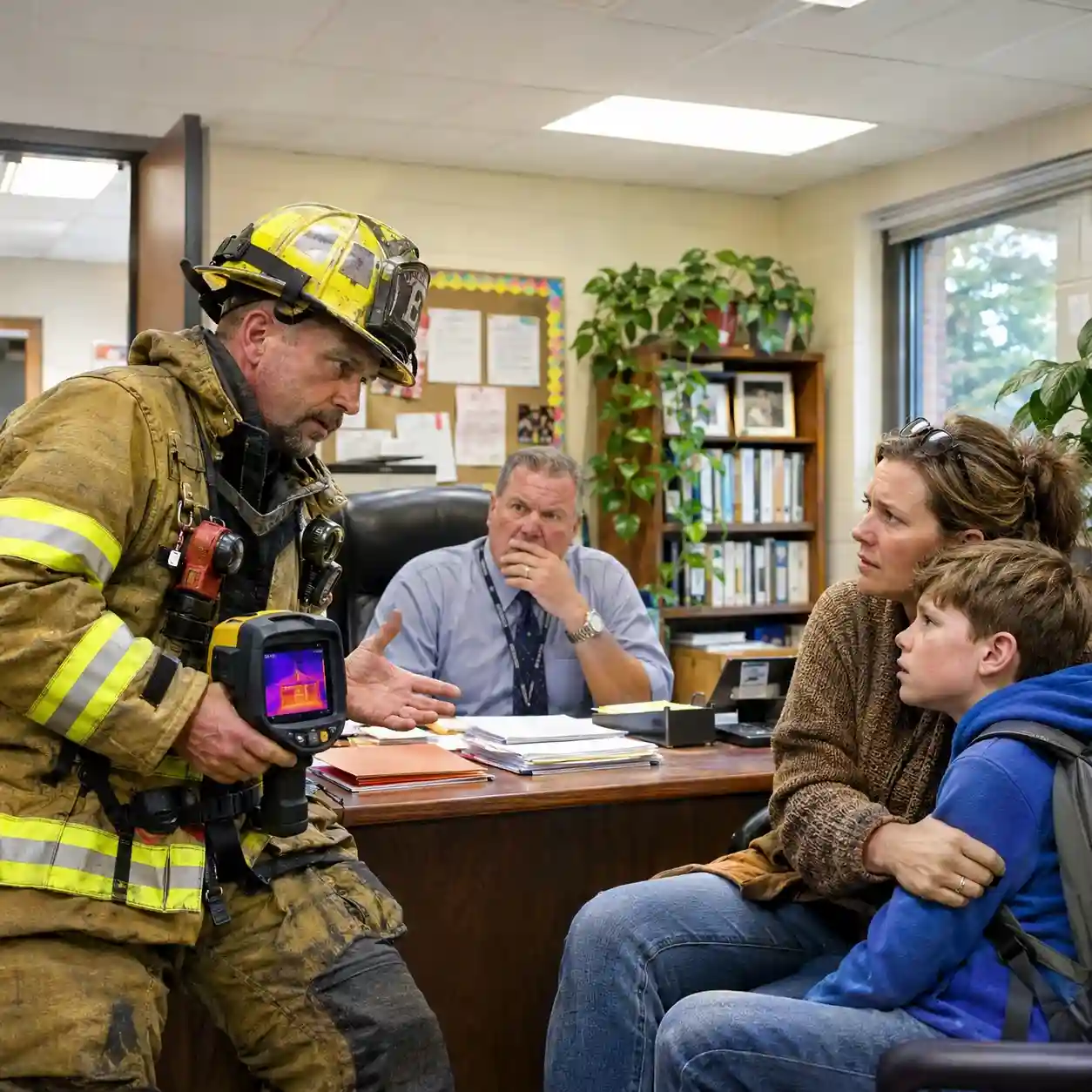
A firefighter walked inside wearing heavy protective gear. His yellow helmet was tucked under one arm, and he was carrying a piece of equipment I couldn’t identify.
Principal Conway immediately stood up.
“Captain Miller. Thank you for responding so quickly. I was just handling the disciplinary situation involving the student who activated the alarm.”
The firefighter didn’t acknowledge the suspension notice.
Instead, he looked directly at the principal.
His expression was unusually serious.
“Before you punish this boy,” he said, “I need to ask you something.”
The room became completely quiet.
Principal Conway frowned.
“Of course. What is it?”
Captain Miller took a step toward the desk.
“Did anyone inspect the ventilation system behind the gym stage?”
Nobody answered.
The firefighter glanced at Nate, then back at the principal.
And what he said next made my blood run cold.
“Because if this boy hadn’t pulled that alarm when he did, we might be talking about something much worse than a school disruption.”
TO BE CONTINUED IN PART 2…
PART 2: The Firefighter’s Question Changed Everything
The principal stared at Captain Miller.
“What exactly are you suggesting?”
The firefighter placed his equipment on the desk.
“My team has been investigating the area Nathan described. We didn’t find an ordinary electrical problem.”
He turned on a handheld thermal imaging camera and showed the screen to the principal.
I couldn’t understand what I was looking at, but the firefighter’s expression told me it wasn’t good.
“There’s a ventilation unit behind the south wall of the stage,” he explained. “The blower motor suffered a serious mechanical failure. It overheated, damaged its wiring, and began melting components inside a sealed ventilation cavity.”
Principal Conway leaned forward.
“Was there actually a fire?”
“Not an open flame in the gym. But the temperature inside that cavity had climbed above 460 degrees Fahrenheit.”
My hand tightened around Nate’s.
Captain Miller continued.
“The surrounding insulation was old, and combustible materials were stored nearby. If the overheating had continued, the situation could have developed into a serious fire.”
He pointed toward the camera.
“We believe the smoke was being drawn through the ventilation system rather than spreading openly into the gym. That’s why the problem wasn’t immediately obvious to people standing in the assembly.”
I looked at Nate.
He had been telling the truth.
All that time, while adults were telling him to sit down, he had been trying to warn them about something genuinely dangerous.
Principal Conway looked uncomfortable.
“But our maintenance employee inspected the area.”
“An ordinary visual inspection isn’t enough to identify a problem inside a sealed ventilation cavity,” Captain Miller replied. “Our thermal equipment detected what wasn’t visible from the outside.”
He paused before adding something that made the entire room even quieter.
“Your student noticed the warning signs before anyone else. He reported them, and when nobody responded, he activated the alarm. That’s exactly why emergency alarms exist.”
I felt tears gathering in my eyes.
Nate was still sitting beside me, staring at the firefighter.
Captain Miller walked over and knelt in front of him.
“Are you Nathan?”
Nate nodded.
“Did you see smoke coming from the vent?”
“Yes, sir.”
“And did you tell your teachers?”
“Twice.”
Captain Miller nodded.
“Then you did the right thing. You should never be afraid to report something that might be dangerous. If you see smoke or smell something burning, tell an adult immediately. And if there’s an emergency and nobody responds, follow the school’s emergency procedures.”
Nate’s eyes filled again, but this time he wasn’t trying to hide them.
“I thought I was going to get in trouble.”
The firefighter gave him a reassuring smile.
“You might have interrupted an assembly, son. But you also helped protect everyone in that building. That’s something you should be proud of.”
I put my arm around my son.
For the first time that morning, his shoulders relaxed.
Captain Miller stood and turned toward Principal Conway.
“We’ve isolated the electrical supply and secured the affected ventilation system. The building will remain closed until the necessary inspections and repairs are completed.”
The principal nodded slowly.
“Of course.”
“And I strongly recommend that the district review its emergency reporting procedures. A child reported a possible fire, and his concerns weren’t properly investigated.”
Conway looked down at the suspension notice.
It was still sitting between us.
He picked it up, stared at it for several seconds, and then slowly tore it in half.
“There’s no suspension,” he said quietly. “Nathan showed exceptional awareness.”
I looked directly at him.
“He showed courage. And he deserved to be listened to the first time.”
For once, the principal didn’t have an answer.
I stood, took Nate’s hand, and helped him gather his things.
As we walked toward the office entrance, Captain Miller called after us.
“Mrs. Lawson?”
I turned.
“Yes?”
He smiled.
“Make sure that young man knows he did something important today.”
I nodded, unable to find the right words.
Outside, the fire trucks were still parked near the entrance. Teachers were talking in small groups, and parents were waiting for updates about the building.
Nate walked beside me, holding my hand.
After a few moments, he finally spoke.
“Mom?”
“Yes, sweetheart?”
“Are you mad at me?”
I stopped walking and knelt in front of him.
“No, Nate. I’m proud of you.”
“But I got everyone out of the assembly.”
“You did. And sometimes doing the right thing means interrupting something important. If you believe someone might be in danger, you should speak up.”
He looked down at his shoes.
“I just didn’t want anyone to get hurt.”
I pulled him into a hug.
“That’s exactly why I’m proud of you.”
That afternoon, I kept thinking about what had happened.
My son hadn’t been trying to cause trouble. He had noticed something unusual, reported it, and tried again when nobody listened.
And when he realized the danger might be getting worse, he made a decision that protected hundreds of people.
The school had initially seen him as a disruptive student.
The firefighter saw something different.
A ten-year-old who understood that safety mattered more than an assembly, a punishment, or the possibility of getting into trouble.
And I learned something I hope I never forget:
Sometimes the smallest voice in the room is the one everyone needs to hear.
Editor’s Note: This is a fictional story inspired by an important reminder: children deserve to be heard, especially when they are trying to warn adults about something that could put others in danger. Sometimes, speaking up can make all the difference.
Related Posts
- At 80, My Stomach Started Growing, Then Doctors Discovered Something Nobody Expected

- On My Wedding Day, My Brother Sank My Grandfather’s Vintage Mustang Into a Lake—Then I Asked One Question That Wiped the Smiles Off Their Faces

- I Pretended I Was Dying to Find Out If My Struggling Girlfriend Loved Me or My Money—Then She Disappeared for Five Days and Returned With Something That Made Me Break Down in Tears



About the Author
Hassan is the founder and editor of MidnightReads, a publication featuring thoughtful stories, human-interest articles, history, relationships, and entertaining reads.
He is involved in researching, writing, and editing content for the site, with a focus on creating original, clear, and useful articles that give readers something meaningful to take away.
Hassan believes good content should inform, entertain, and encourage curiosity.
— Hassan, Founder & Editor, MidnightReads