When people first saw Shazia Begum walking through the crowded streets of old Lahore, they rarely looked at her for more than a second.
Some looked away in discomfort.
Some whispered behind her back.
And some did not even bother lowering their voices.
“Poor children…”
“What a frightening face.”
“She looks cursed.”
Shazia heard it all.
Every single word.
At first, the insults used to pierce her heart like knives. But after years of hearing the same cruel comments, she had learned something painful — the world becomes kinder to broken buildings than broken faces.
Still, every morning before sunrise, she wrapped her faded shawl around herself, stepped out of her tiny rented house, and continued fighting life silently.
Because she had made a promise.
And promises made to dying people have a strange way of becoming stronger than pain itself.
The narrow alley where Shazia lived was always noisy.
Children ran barefoot through puddles, women argued from rooftops, and the smell of tea mixed with smoke from roadside stalls. Her home stood at the very end of the street — a small two-room portion with cracked walls and a roof that leaked during rain.
Inside that tiny home lived her entire world.
Her fourteen-year-old son Hamza.
And her nine-year-old twins, Ahmed and Areeba.
Every morning, before the azaan for Fajr had completely faded, Shazia would quietly wake up. Her knees often hurt from years of hard labor, but she never allowed herself to rest.
She prepared tea first.
Then lunch boxes.
Then uniforms.
By six o’clock, she would gently wake her children.
“Hamza beta… uth jao.”
“Areeba, school nahi jana?”
The twins would complain sleepily while Hamza smiled softly.
“Ammi, let them sleep five more minutes.”
Shazia laughed faintly.
“If I let you all sleep, then who will become doctors and engineers?”
The children giggled.
Those tiny moments were the only times she forgot about the world outside.
Inside her home, nobody cared about her scars.
Nobody stared at her face.
Nobody called her ugly.
To her children, she was simply “Ammi.”
Years earlier, things had been very different.
Before the disease.
Before the scars.
Before the loneliness.
Shazia had once been known for her beauty.
People in the neighborhood used to praise her large expressive eyes and long black hair. At weddings, relatives often whispered to her mother:
“Your daughter looks like a film actress.”
But Shazia never cared much about appearance.
She cared about kindness.
And that was exactly why she fell in love with Rahman.
Rahman worked at a small motorcycle repair shop. He was not rich, handsome, or highly educated. His clothes always smelled of engine oil, and his hands were rough from work.
But he had the gentlest heart she had ever known.
He respected everyone.
He never shouted.
Never lied.
And never allowed Shazia to feel small.
After their marriage, they rented a tiny house and began building a life together from almost nothing.
They were poor, but strangely happy.
On summer nights, electricity cuts forced the entire neighborhood onto rooftops. Shazia and Rahman would sit under the open sky sharing slices of watermelon while talking about their future.
“One day,” Rahman would say, “our children will study in big schools.”
Shazia laughed. “And who will pay those fees?”
“I will.”
“With this tiny mechanic salary?”
Rahman grinned confidently.
“And you will help me.”
She always did.
When money became tight, she stitched clothes for neighbors. Sometimes she stayed awake until midnight finishing embroidery work while Rahman sat beside her fixing old fans or radios for extra income.
Life was difficult.
But they faced every hardship together.
And that made everything easier.
Then tragedy arrived quietly.
At first, Rahman complained about fatigue.
Then swelling in his legs.
Then unbearable pain.
The doctors eventually gave them news that shattered their world.
Kidney failure.
Shazia still remembered the exact moment.
The hospital room smelled strongly of medicine. Rain tapped against the windows while the doctor spoke carefully.
“He needs long-term treatment.”
“How much will it cost?” Shazia asked nervously.
The doctor mentioned an amount so large she felt dizzy.
For a few seconds, neither she nor Rahman spoke.
Because both of them understood the truth.
They could never afford it.
But Shazia refused to give up.
First, she sold her wedding jewelry.
Then her small refrigerator.
Then the gold bangles her mother had gifted her before marriage.
Rahman begged her to stop.
“Shazia… enough.”
But she shook her head stubbornly.
“You would do the same for me.”
Treatment continued for months.
Sometimes Rahman improved slightly.
Sometimes he became so weak he could barely stand.
Still, he always tried smiling in front of the children.
One evening, while Hamza slept beside him in the hospital bed, Rahman whispered softly:
“If something happens to me…”
“Nothing will happen,” Shazia interrupted immediately.
But Rahman continued.
“Listen to me carefully.”
Tears filled her eyes.
He held her trembling hand weakly.
“Promise me our children will study. Promise me they will never beg from relatives. Protect their dignity, even if life becomes difficult.”
Shazia cried uncontrollably.
“Don’t talk like this.”
But Rahman smiled faintly.
“You are stronger than you think.”
Three days later, he died.
And with him, half of Shazia’s world disappeared forever.
The months after Rahman’s death felt endless.
Shazia barely slept.
The children cried themselves to sleep every night.
Bills piled up.
Rent became overdue.
And around the same time, the skin disease she had been ignoring for years suddenly worsened.
Painful infections spread across her face.
Doctors suggested surgery.
“The procedure may help reduce the damage,” one doctor said.
But the surgery failed horribly.
When the bandages finally came off, Shazia could barely recognize herself in the mirror.
One side of her face had become uneven.
Her skin remained scarred and tightened.
Her left eyelid drooped unnaturally.
For several minutes, she simply stared at her reflection silently.
Then she covered the mirror with a cloth.
After that day, the world around her changed completely.
Neighbors who once praised her beauty now avoided eye contact.
Children became frightened.
Some relatives stopped inviting her to family gatherings altogether.
One woman even whispered cruelly:
“She should stay inside the house. People get uncomfortable looking at her.”
Shazia pretended not to hear.
But late at night, when the children slept, she cried quietly into her pillow so nobody would know.
Life became a brutal routine of survival.
At dawn, she cleaned houses.
By afternoon, she washed dishes at a roadside restaurant.
At night, she stitched clothes under dim yellow light until her fingers cramped from exhaustion.
Sometimes she skipped meals to save money for school fees.
Sometimes she drank only water so her children could eat properly.
Yet the hardest burden was not hunger.
It was humiliation.
At one wealthy house where she worked, the owner stopped her near the entrance.
“Use the back gate,” the woman said coldly.
“Why?” Shazia asked softly.
The woman hesitated before answering.
“My daughter gets scared seeing your face.”
Shazia quietly nodded.
And entered through the back gate.
At another house, a little boy burst into tears the moment he saw her.
His mother immediately pulled him away.
“Don’t stare,” she whispered loudly enough for Shazia to hear.
Each insult left invisible wounds inside her.
But every time she thought about giving up, she remembered Rahman’s final words.
Protect their dignity.
So she endured everything silently.
One afternoon, Areeba returned home crying uncontrollably.
Shazia rushed toward her.
“What happened?”
The little girl buried her face into her mother’s chest.
“The girls at school said my mother looks like a monster.”
For a moment, the room became completely silent.
Shazia felt her throat tighten painfully.
Hamza clenched his fists angrily from across the room.
But Shazia gently lifted her daughter’s chin.
“Listen to me carefully,” she said softly.
“People who judge faces usually have very small hearts.”
Areeba sniffed.
“But why do they laugh at you?”
Shazia smiled sadly.
“Because Allah gives beauty differently to everyone. Some people get it on their face. Some get it in their character.”
That night, after the children slept, Hamza approached her quietly.
“Ammi?”
“Yes?”
“When I grow up, I’ll earn so much money that nobody will ever insult you again.”
Shazia kissed his forehead.
“I don’t want revenge, beta.”
“Then what do you want?”
She looked at him lovingly.
“Just become a good human being.”
Years slowly passed.
Hamza studied harder than anyone in his class. The twins also performed brilliantly in school.
Whenever electricity disappeared at night, the three children studied under emergency lights while Shazia stitched clothes nearby.
Sometimes she secretly watched them with tears in her eyes.
This was the dream Rahman had died protecting.
And somehow, despite every humiliation, it was surviving.
Then one winter evening, everything changed.
Hamza came running into the house holding a large envelope.
“Ammi!”
Shazia looked up anxiously.
“What happened?”
His hands trembled violently.
“I got accepted.”
“Accepted where?”
“Medical college.”
For a second, Shazia froze.
Then Hamza continued excitedly:
“And they gave me a full scholarship.”
The sewing machine slipped from Shazia’s hands.
Her lips trembled.
“No fees?” she whispered.
Hamza shook his head emotionally.
“They said I was one of the top students.”
Before he could finish speaking, Shazia burst into tears.
Not quiet tears.
Not hidden tears.
Years of pain, exhaustion, loneliness, and sacrifice exploded out of her all at once.
The twins hugged her tightly while crying too.
That night, for the first time in many years, the house felt full of hope again.
Just three days before Hamza’s college ceremony, posters for a local “Inspiring Women Contest” appeared across the neighborhood.
The competition was being organized by a popular community center in Lahore. Women from different backgrounds were invited to share their life stories on stage. The winner would receive prize money and public recognition.
Most people in the area were excited.
But when Shazia saw the poster outside a tea shop, she immediately lowered her eyes and walked away.
Competitions like that were for beautiful, confident women.
Not someone like her.
That evening, while she stitched clothes near the window, Areeba entered the room excitedly.
“Ammi! You should join!”
Shazia laughed softly without looking up.
“Have you gone mad?”
“I’m serious,” Areeba insisted. “It says inspiring women.”
Hamza looked quietly at his mother.
“You should go.”
Shazia immediately shook her head.
“People already laugh at me in the streets. Now you want them to laugh at me on a stage too?”
Nobody answered.
Because deep down, they knew she was right.
Two days later, Shazia was washing dishes at work when one of the women there suddenly smiled mockingly.
“Did you hear?” she said loudly to another woman. “Even that scar-faced lady from the old alley wants to join the contest.”
The women burst into laughter.
Shazia froze.
Her hands trembled slightly.
She had never even registered.
Then she realized something.
Hamza.
That evening, she returned home angry for the first time in years.
“You registered my name?”
Hamza stood silently.
“Answer me!”
“Yes,” he admitted softly.
“Why would you do this to me?”
Hamza’s eyes filled with emotion.
“Because you spent your whole life hiding from people who never deserved your shame.”
Shazia looked away immediately.
“I cannot stand on a stage while people stare at my face.”
Hamza walked closer.
“They already stare, Ammi. But this time they’ll hear your story too.”
For several long seconds, she said nothing.
Then quietly…
She agreed.
The day of the contest arrived.
The hall was crowded with lights, cameras, judges, and dozens of beautifully dressed contestants.
Women entered wearing elegant clothes and makeup while photographers captured pictures near the stage.
The moment Shazia entered the building with her simple old shawl covering part of her scarred face, whispers immediately spread through the crowd.
Some people stared openly.
A few girls near the entrance giggled.
One man whispered to another:
“Did she come to the right place?”
Shazia’s feet nearly stopped moving.
Every painful memory returned at once.
The insults.
The humiliation.
The back doors.
The laughter.
She wanted to leave immediately.
But then she noticed Hamza standing near the back of the hall watching her proudly.
So she continued walking.
As the contest began, contestants shared emotional stories about poverty, divorce, illness, and struggle.
The audience clapped politely after each speech.
Then the host finally announced:
“Next contestant… Shazia Begum.”
For a second, the hall became unusually quiet.
Shazia slowly walked toward the stage.
The bright lights made her uncomfortable.
She could feel hundreds of eyes fixed on her face.
Some audience members exchanged awkward looks.
A few people even seemed confused about why she was participating at all.
When she reached the microphone, her hands trembled badly.
She tried speaking.
But no words came out.
Then suddenly, a few quiet laughs echoed from somewhere in the audience.
Shazia lowered her eyes immediately.
Her chest tightened painfully.
For one horrible moment, she felt exactly like the broken woman society had always told her she was.
The judges looked uncomfortable.
One of them gently said:
“It’s okay. Take your time.”
Shazia wiped her tears quickly.
Then she looked toward the audience again.
This time, her eyes found her children.
And something inside her changed.
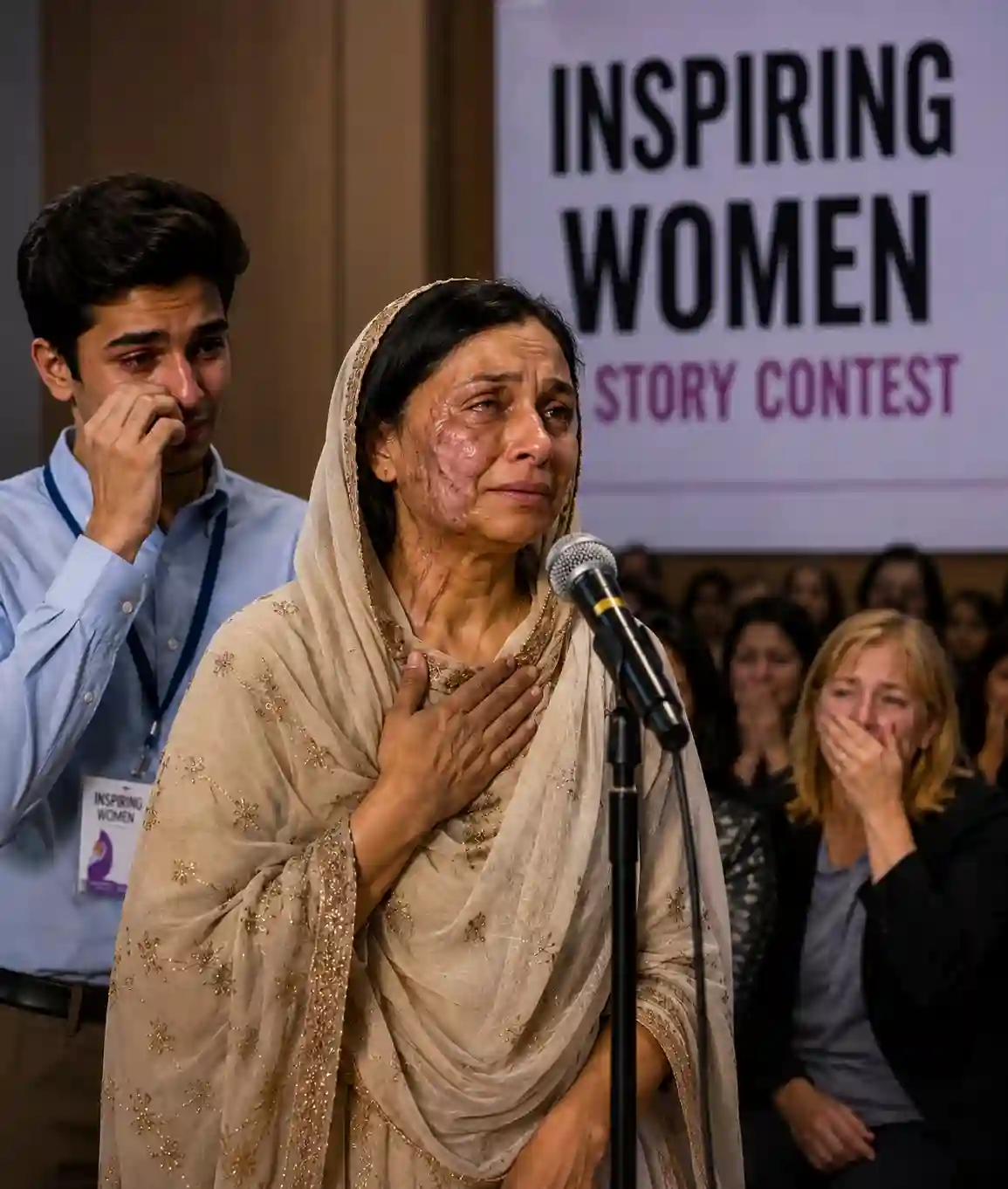
“My name is Shazia,” she began softly.
“I know many of you are wondering why someone who looks like me entered this contest.”
The hall became completely silent.
“Years ago, I was beautiful too.”
Some people lowered their eyes immediately.
“My husband used to tell me I smiled too much,” she continued with a faint laugh.
“But then he became sick. Very sick.”
For the next several minutes, Shazia told them everything.
About Rahman.
About selling her jewelry.
About his kidney failure.
About the failed surgery.
About cleaning houses through back doors.
About people laughing at her face.
About starving so her children could eat.
Some audience members were already crying quietly.
Then Shazia’s voice broke.
“The hardest part was never losing my beauty.”
She paused.
“It was watching my children suffer because of how people treated me.”
The hall remained completely silent.
“But my husband asked me to protect their dignity before he died. So I kept working. Even when people insulted me. Even when I wanted to disappear.”
By now, tears were flowing openly through the audience.
Then she looked directly at the judges.
“I did not come here to win a competition.”
She took a shaky breath.
“I came here because my son wanted me to stop hiding.”
At that moment, Hamza stood up from the audience with tears in his eyes.
And suddenly, the entire hall rose to its feet.
A loud standing ovation exploded across the room.
People who had laughed earlier were now crying the hardest.
Even the judges wiped their tears.
For the first time in years…
Nobody was looking at Shazia’s scars anymore.
They were looking at her strength.
Thank you for reading this emotional story. If it touched your heart, don’t forget to share it with others.