
At 5:02 on Thanksgiving morning, my phone buzzed on the kitchen counter. I was already awake, staring into the dark house, because I hadn’t slept much since David’s funeral the previous afternoon. I thought the worst part of my life had already happened—until my sister’s name lit up the screen.
When I saw Harper’s name, I expected another message about Thanksgiving plans or family logistics. Instead, she wrote something that made no sense at first: “Mom and Dad decided Julian needs your room. Pack your things. You can sleep in the garage.”
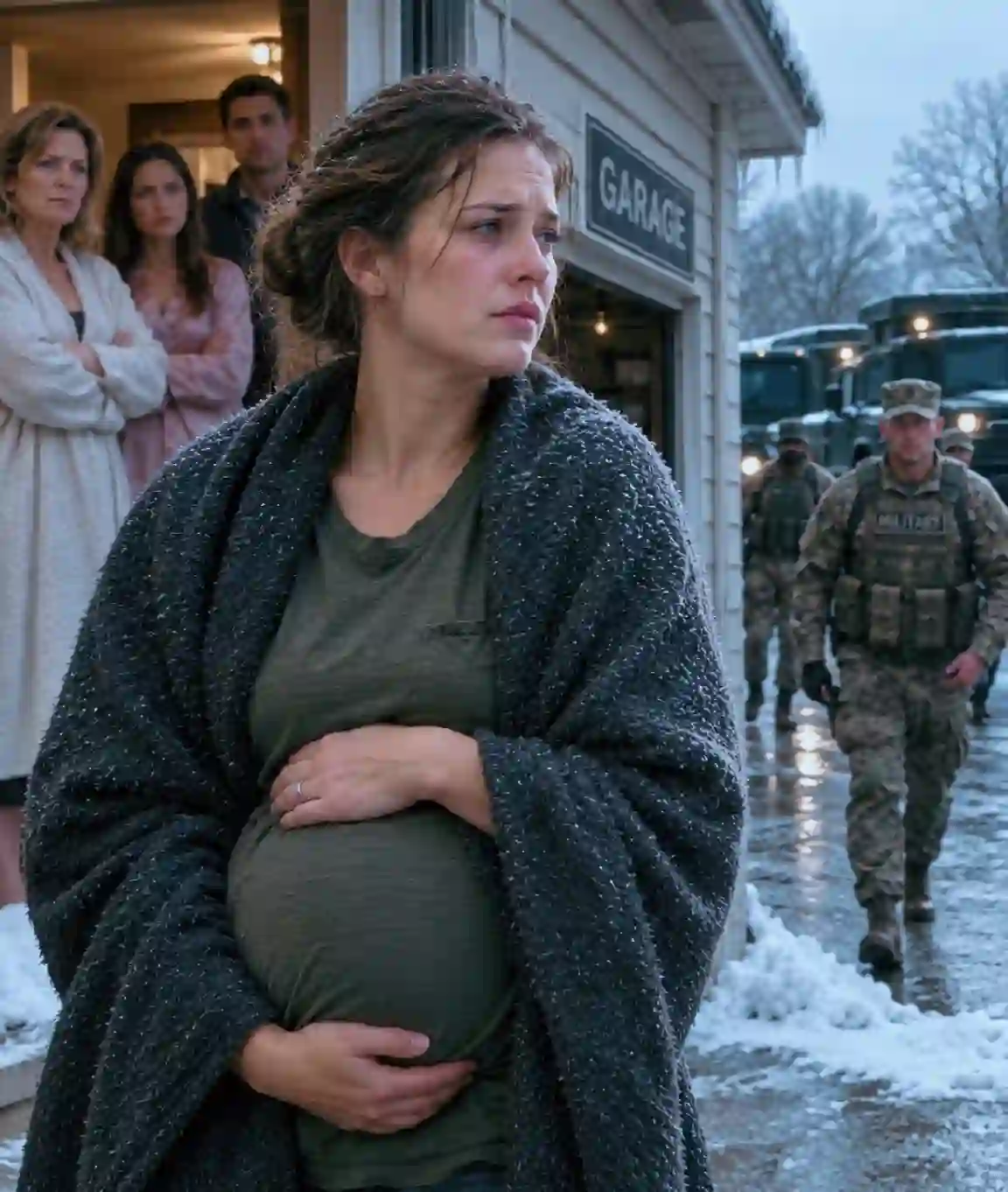
I honestly thought she was joking. I looked toward the frosted kitchen window and could see how cold it was outside. I was five months pregnant, exhausted from months of uncertainty, and still wearing one of David’s old Army T-shirts because I hadn’t been ready to put on anything else after his funeral.
“The garage?” I asked.
“It’s only temporary,” Harper replied. “Julian needs somewhere quiet to work.”
I stared at the coffee in front of me. The garage wasn’t heated properly, and the small electric heater in the corner hadn’t worked since the previous winter. Even if it had worked, I couldn’t understand why anyone thought a pregnant woman who had buried her husband hours earlier should sleep beside a lawn mower and a stack of old boxes.
I walked into the kitchen and found my mother making coffee while my father read the newspaper. They both knew what Harper had told me. Neither looked particularly uncomfortable about it.
“Mom, is this serious?” I asked.
She continued stirring her coffee. “It’s just for a few days, Emma. Julian has clients coming next week, and he needs a proper office.”
I looked at my father. “So where am I supposed to sleep?”
He lowered the newspaper. “Your sister already explained it. Don’t turn this into another argument.”
“Dad, I’m pregnant.”
“We know you’re pregnant.”
“And David was buried yesterday.”
His expression hardened. “We know that too.”
For a moment, I thought he might finally understand how cruel the situation sounded. Instead, he sighed and said, “Emma, everyone is tired. Thanksgiving is today, and your constant crying is making things difficult for everyone.”
I didn’t answer.
That sentence hurt more than I expected.
David had died months earlier, but circumstances surrounding his final assignment had delayed his funeral. During those months, I had lived with unanswered questions and official statements that told me almost nothing. Yesterday was the first time I had stood beside his grave and watched the military honor him properly.
I hadn’t even had twenty-four hours to process it.
Yet my family was already worried about Thanksgiving dinner.
Harper came downstairs a few minutes later wearing a silk robe. Her husband, Julian, followed her while checking something on his phone. He had recently started expanding his investment business and apparently needed a private workspace.
“Don’t look at me like that,” Harper said when she saw my expression. “It’s temporary.”
“Why can’t he use the guest room?”
“Because it’s full of storage.”
“Then I’ll sleep there.”
“No.”
I looked at her. “Why not?”
“Because Julian needs a proper office.”
I glanced at Julian. He looked uncomfortable but didn’t say anything.
Then Harper added, “Besides, you’ve been spending most of your time crying anyway. You’ll probably sleep anywhere.”
Something inside me went very still.
I had spent years trying to keep peace in that family. Whenever Harper wanted something, my parents usually found a reason to give it to her. I had learned not to fight every battle because fighting only made my father angry and my mother upset.
But this was different.
This was David’s house.
He had bought it years before we married with money he’d saved while serving in the Army. He had repaired the roof himself, replaced the kitchen cabinets and spent an entire summer fixing the backyard because he wanted a place where our future children could grow up.
Our child was now growing inside me.
And my family wanted me to sleep in the garage so my sister’s husband could have an office.
I looked at all three of them and realized they were waiting for an argument.
They expected me to cry.
They expected me to beg.
They expected the grieving widow to finally break.
Instead, I simply said, “Okay.”
Harper blinked. “Okay?”
“I’ll move my things.”
My father immediately returned to his newspaper. My mother looked relieved. Julian thanked me quietly before going outside to look at the garage.
Nobody asked if I was all right.
Nobody asked whether I had somewhere else to go.
Nobody even noticed the small military bracelet around my wrist.
They thought they knew what kind of woman I was.
They were wrong.
What My Family Didn’t Know
For almost twelve years, David and I had both served in the United States Army. Our families knew we were military, but they didn’t know much about our assignments. There had been years when we couldn’t explain where we had been, why we had to travel suddenly, or why certain conversations had to remain private.
That wasn’t because we didn’t trust our families.
Some parts of military work simply aren’t yours to discuss.
We had learned to keep our professional lives separate from family gatherings. When relatives asked questions, we gave them simple answers. David joked that his mother could turn a three-minute phone call into an interrogation, so sometimes it was easier to tell everyone we were doing ordinary government work.
They accepted it.
After David died, I remained under military orders. I had been placed on emergency leave, and that leave was coming to an end.
My family knew none of this.
They also didn’t know that David had made arrangements for the house long before his final deployment. He had placed the property into a family trust, with provisions that protected me and our child.
My parents knew David had purchased the house.
They didn’t know how carefully he had planned for our future.
I didn’t tell them.
Not yet.
That morning, I carried a cardboard box into the garage and began moving a few of my belongings. The concrete floor was painfully cold, and the air smelled like dust and gasoline. I tried to ignore it, but after several minutes my hands were numb.
Then the baby moved.
I stopped and placed my hand over my stomach.
“I’m sorry,” I whispered.
I wasn’t sure whether I was talking to my baby or to David.
I picked up another box.
That’s when I heard the engines.
At first, I assumed someone was arriving early for Thanksgiving. Then another vehicle turned onto the road, followed by another.
My father appeared at the front door.
“What is that?”
I stepped outside.
Three dark government vehicles were coming toward the house.
They turned into the driveway and stopped.
The conversation in the house disappeared.
Harper came out behind my father. Julian followed her, still holding his phone.
The door of the first vehicle opened, and a uniformed officer stepped onto the driveway.
He looked around briefly before walking directly toward me.
“Mrs. Carter?”
“Yes.”
He stopped a few feet away.
“I’m sorry about the timing.”
I knew what he meant.
David’s funeral had been yesterday.
Thanksgiving was today.
And there was no good time for what was happening next.
“Are you here because of David?” I asked.
The officer paused.
“Partly.”
He then lowered his voice.
“Your emergency leave has ended. We’re here to take you to the next location.”
My father stepped forward.
“Excuse me. What does that mean?”
The officer looked at me before answering.
I gave him a small shake of my head.
He understood that my family didn’t need details.
My father looked at me instead.
“Emma?”
I couldn’t think of a simple answer.
So I told him the truth.
“I’m still serving.”
Harper stared at me.
“What?”
“I never left.”
“But you told us you were doing administrative work.”
“I was.”
“Then why are these people here?”
“Because my leave is over.”
Julian looked from me to the vehicles.
“You’re actually still active?”
I nodded.
He didn’t say anything after that.
My father looked stunned.
“All these years?”
I nodded again.
“You and David?”
“Yes.”
He stared at me for several seconds.
“Why didn’t you tell us?”
“Because we couldn’t.”
My mother appeared in the doorway. She had tears in her eyes.
“Emma, why didn’t you trust us?”
I looked at her.
“It wasn’t about trust.”
I took a breath.
“Some things were never ours to explain.”
Nobody argued with that.
The officer handed me a sealed envelope and stepped back.
“We can give you a few minutes.”
I looked at the house.
The Thanksgiving table was already prepared. My mother had put out the good plates. There were candles on the table and a turkey waiting in the kitchen.
Explore More Like: She Was Pregnant Before Marriage — His Reaction Shocked Everyone
It was supposed to be a family holiday.
Instead, I was leaving.
My father walked toward me.
“Emma, I’m sorry.”
I looked at him.
He seemed older than he had that morning.
“We didn’t realize…”
“You didn’t ask,” I said quietly.
He looked down.
My mother began crying.
“We thought you were just overwhelmed.”
“I was.”
“Then why didn’t you tell us?”
“Because I was grieving.”
She nodded slowly.
I could see that she finally understood something.
I hadn’t been asking them to solve my grief.
I had only wanted them to stop making it harder.
Harper came closer.
“Emma, I’m sorry about the room.”
I looked at her.
“You wanted it for Julian.”
“I know.”
“And you wanted me in the garage.”
She lowered her eyes.
“I know.”
I didn’t shout at her.
I didn’t threaten her.
I didn’t tell her she would regret it.
I simply said, “I hope you understand why I can’t pretend this morning didn’t happen.”
She nodded.
The officer opened the vehicle door.
I picked up my bag and walked toward it.
Before getting inside, I looked back at my father.
“David loved you,” I said.
My father’s eyes filled with tears.
“I know.”
“He talked about you more than you probably realized.”
My father wiped his face.
“I wish I had spoken to him more.”
“So do I.”
For a few seconds, neither of us said anything.
Then I got into the vehicle.
As we drove away, I watched the house disappear behind us.
I thought about David.
Not his uniform.
Not his medals.
Not the classified assignments I could never discuss.
I thought about the ordinary things.
His coffee mug beside the sink.
The way he complained whenever I left cabinet doors open.
The ridiculous songs he used to make up while cooking.
The way he had put his hand on my stomach when we first heard the baby’s heartbeat.
Those were the memories I wanted to keep.
Not the arguments.
Not the funeral.
Not the garage.
The baby moved again.
I placed my hand over my stomach and smiled.
“Your dad would have loved that,” I whispered.
The road stretched ahead of us.
I didn’t know what the next few weeks would bring. I didn’t know whether my relationship with my family could ever return to what it had been. Maybe it couldn’t.
But I finally understood something.
They had mistaken my silence for weakness.
They had mistaken grief for helplessness.
They had looked at a pregnant widow and assumed she had nothing left.
They were wrong.
I had lost my husband.
I had lost the future I thought we would have.
But I hadn’t lost my ability to stand on my own.
And on Thanksgiving morning, while my family was still preparing a dinner I would never eat, I chose to leave without screaming, without revenge and without giving them the breakdown they had expected.
Sometimes strength doesn’t look dramatic.
Sometimes it looks like picking up your bag, protecting your child, and walking quietly toward the life you still have.
What We Learn
Grief can make people vulnerable, but it does not make them weak. This story also reminds us that we should never assume we know what someone is carrying simply because they are quiet. Family relationships matter, but so do boundaries, respect, and compassion—especially when someone is already going through the hardest moment of their life.
Author’s Note
This is a fictional story created to explore grief, family expectations, resilience, and the importance of treating people with compassion during difficult moments. The military elements are part of the story and are not intended to represent any specific real person, mission, or military operation.
Related Posts
- My Mommy Has Been Sleeping for Three Days”—A Six-Year-Old Girl Pushed Her Newborn Twins to the Hospital in a Wheelbarrow

- My 5-Year-Old Son Screamed “Stop the Car!” When He Saw Two Boys Sleeping Beside the Trash — Then I Realized They Had His Face and My Dead Wife’s Eyes
- My 60-Year-Old Boyfriend Came to Meet My Son for the First Time but When He Saw Him, He Went Pale ,and Whispered, “I Need to Leave”
- An Elderly Stranger Looked Me Dead in the Eye Across a Small-Town Diner and Said, “I’m Not Here for the Pie. I’m Here to Ask You to Marry My Son”—and My Whole Life Split Open Right There
- I Came Home From New York Three Days Early—and Found My Husband Holding a Newborn Baby Who Looked Exactly Like Me
- My New Neighbor Kept Hanging Her Underwear Outside My 8-Year-Old Son’s Window—Then I Found Out Why


About the Author
Hassan is the founder and editor of MidnightReads, a publication featuring thoughtful stories, human-interest articles, history, relationships, and entertaining reads.
He is involved in researching, writing, and editing content for the site, with a focus on creating original, clear, and useful articles that give readers something meaningful to take away.
Hassan believes good content should inform, entertain, and encourage curiosity.
— Hassan, Founder & Editor, MidnightReads