
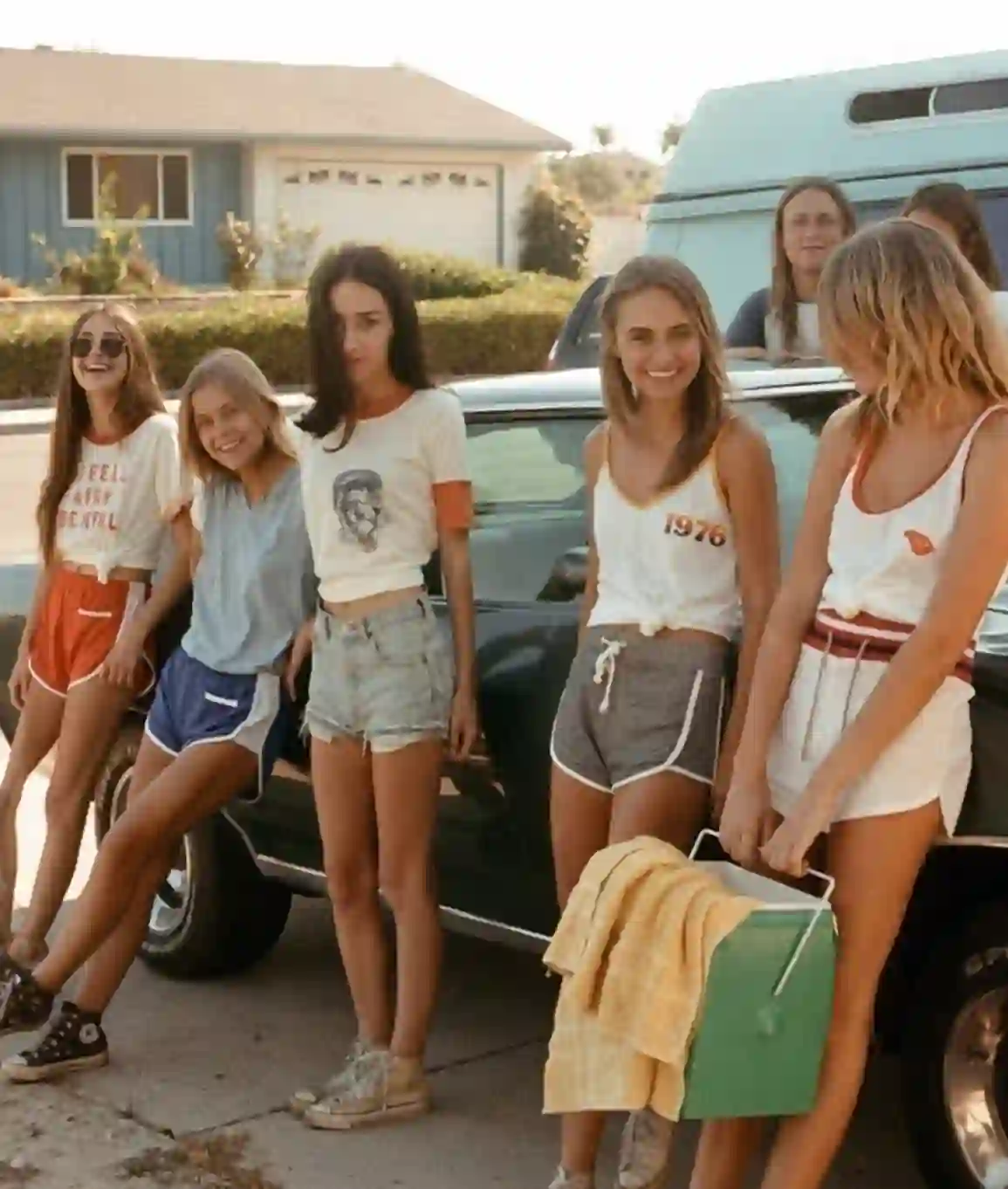
At first glance, this looks like a photograph taken during an ordinary summer day in 1976.
A group of young women are standing beside a classic car. They are dressed casually in shorts, T-shirts and sneakers, while a cooler sits in the foreground. Behind them is a quiet suburban house and several vehicles.
The colors, clothing and old-fashioned car all seem to fit the decade.
Then you notice the question at the top of the image:
“What’s wrong with this 1976 photo?”
That simple question changes the way you see everything.
Suddenly, the shirts become clues. The cars become clues. Even the background deserves a second look.
And there is, in fact, a very good reason this picture could not have been an ordinary photograph from 1976.
The First Clue Is Hiding on a T-Shirt
Look at the woman near the center of the photograph.
Her white shirt features a graphic associated with the Stray Cats, the rockabilly band fronted by Brian Setzer.
There is one major problem with that.
The Stray Cats did not exist in 1976.
According to the band’s official biography, Brian Setzer, Lee Rocker and Slim Jim Phantom formed the group in New York in 1979.
That means a genuine 1976 photograph could not have shown someone wearing a Stray Cats band design that referenced a group which had not yet been formed.
It is a small detail, but it is one of the strongest clues in the entire picture.
The Shirt on the Far Left Gives Another Hint
Now look at the woman standing on the far left.
Her shirt appears to reference Rydell High School, the fictional school associated with Grease.
The original Grease movie was released in 1978, so that reference also points to a period after the supposed 1976 date.
This is where the photograph becomes much easier to understand.
One questionable detail might be dismissed.
But when several details point toward a later period, the 1976 caption becomes increasingly difficult to believe.
Look Beyond the People
The shirts aren’t the only things worth examining.
Take another look at the background.
There are vehicles partially hidden behind the group, and one of them looks considerably newer than the classic cars deliberately placed in the foreground.
That detail is easy to miss because the main subjects naturally attract your attention.
This is a common trick in visual puzzles.
The most obvious objects are often there to establish a particular setting, while the less noticeable objects provide clues that challenge it.
In this case, the classic car helps create the feeling of the 1970s.
The background details make you question it.
The Photograph Was Actually Created Decades Later
The biggest twist is that the image has been traced online to CAMP Collection’s “Block Party – Spring ’16” fashion material. Search results for the original collection identify it as a Spring 2016 lookbook, rather than an authentic photograph from 1976.
That explains almost everything.
The photograph wasn’t trying to document an actual afternoon in 1976.
It was created much later and styled to look like the 1970s.
The clothes, cars, hairstyles and setting were carefully chosen to create that nostalgic appearance.
Once you know that, the photograph stops looking like a mysterious piece of history and starts looking like what it really is: a modern recreation of a particular era.
Why Does It Look So Convincing?
This is probably the most interesting part of the whole picture.
The photographer didn’t simply put people in old clothes and take a photograph.
The entire scene contributes to the illusion.
The classic vehicle immediately gives the viewer a sense of the past.
The casual summer clothing reinforces the same idea.
The hairstyles, suburban setting and muted appearance of the image all work together.
When several visual clues point in the same direction, our brains usually accept the story without questioning it.
That’s why the photograph can feel authentic even though it wasn’t taken in the year printed above it.
The “1976” Shirt Is a Clever Distraction
There is another shirt that seems almost too obvious to ignore.
One of the women is wearing clothing with “1976” printed across it.
At first, that might look like the answer.
After all, why would someone wear a shirt displaying the current year?
But that isn’t necessarily proof of anything.
People have worn dates on clothing for celebrations, events, schools, sports teams and fashion designs.
The more convincing clues are the references that can be connected to things that appeared later.
The Stray Cats are particularly useful because their formation date is documented by the band itself.
The Classic Car Helps Sell the Illusion
The old car in the foreground is another reason so many people initially accept the photograph as authentic.
A classic vehicle can instantly make a modern photograph feel decades older.
But the presence of an old car doesn’t tell you when the photograph was taken.
A vintage automobile can be photographed today just as easily as it could have been photographed fifty years ago.
The same applies to clothing.
Someone wearing 1970s-style shorts and a retro T-shirt doesn’t prove that the photograph was taken in the 1970s.
It may simply mean the photographer wanted the picture to look that way.
So, What Is Actually Wrong With the Photo?
The simplest answer is:
The photograph isn’t really from 1976.
It is a much later image designed to recreate the look and feeling of the 1970s.
The Stray Cats shirt provides a particularly clear clue because the band was formed in 1979. The apparent Rydell High reference points to Grease, which arrived in 1978. The later source attribution to CAMP Collection’s Spring 2016 “Block Party” material explains why these details appear together in a scene that otherwise looks decades older.
What initially appears to be a historical photograph is therefore better understood as a piece of retro-inspired fashion photography.
The Interesting Lesson Behind the Picture
There is a simple lesson hidden inside this viral photo.
A photograph can look old without actually being old.
An old car doesn’t prove the date.
Vintage clothing doesn’t prove the date.
Faded colors don’t prove the date.
Even a convincing-looking setting doesn’t prove the date.
The small details matter.
In this case, the clothing provides clues that are much more useful than the overall appearance of the photograph.
And that is exactly why this picture makes such a good visual puzzle.
Look at the Photo One More Time
Now that you know the answer, go back and look at the image again.
The Stray Cats shirt probably stands out immediately.
The Rydell High reference becomes easier to notice.
The vehicles in the background suddenly seem more important.
And the entire photograph feels different once you realize that it was created to imitate another era.
The next time you see an old-looking photograph online, don’t immediately trust the date written above it.
Take a closer look.
Sometimes the biggest clue isn’t the car, the hairstyle or the faded color.
Sometimes it’s the T-shirt.
Editor’s Note
This article was written to explain the visual clues in a widely circulated photograph. The image is presented as a 1976 photograph online, but details within the image point to a much later creation. We have separated the verifiable historical details from interpretation and have not presented the viral caption itself as proof of the photograph’s date.
The purpose of this article is to provide context and help readers examine the image more carefully.
Related Posts
- The Difference Between You and Your Boss: 6 Funny Workplace Rules Everyone Seems to Know

- He Wanted to Be Buried With His Money—His Wife’s Clever Trick Had Everyone Laughing

- 20 Funny Comics That Will Instantly Brighten Your Day
- Husband and Wife Funny Frames: 20 Marriage Moments That Will Make You Laugh
- Funny Twist Story: He Thought He Was About to Die, Then He Finally Looked Down
- 10 Strange and Funny Signs That Prove People Have a Great Sense of Humor





About the Author
Hassan is the founder and editor of MidnightReads, a publication featuring thoughtful stories, human-interest articles, history, relationships, and entertaining reads.
He is involved in researching, writing, and editing content for the site, with a focus on creating original, clear, and useful articles that give readers something meaningful to take away.
Hassan believes good content should inform, entertain, and encourage curiosity.
— Hassan, Founder & Editor, MidnightReads