
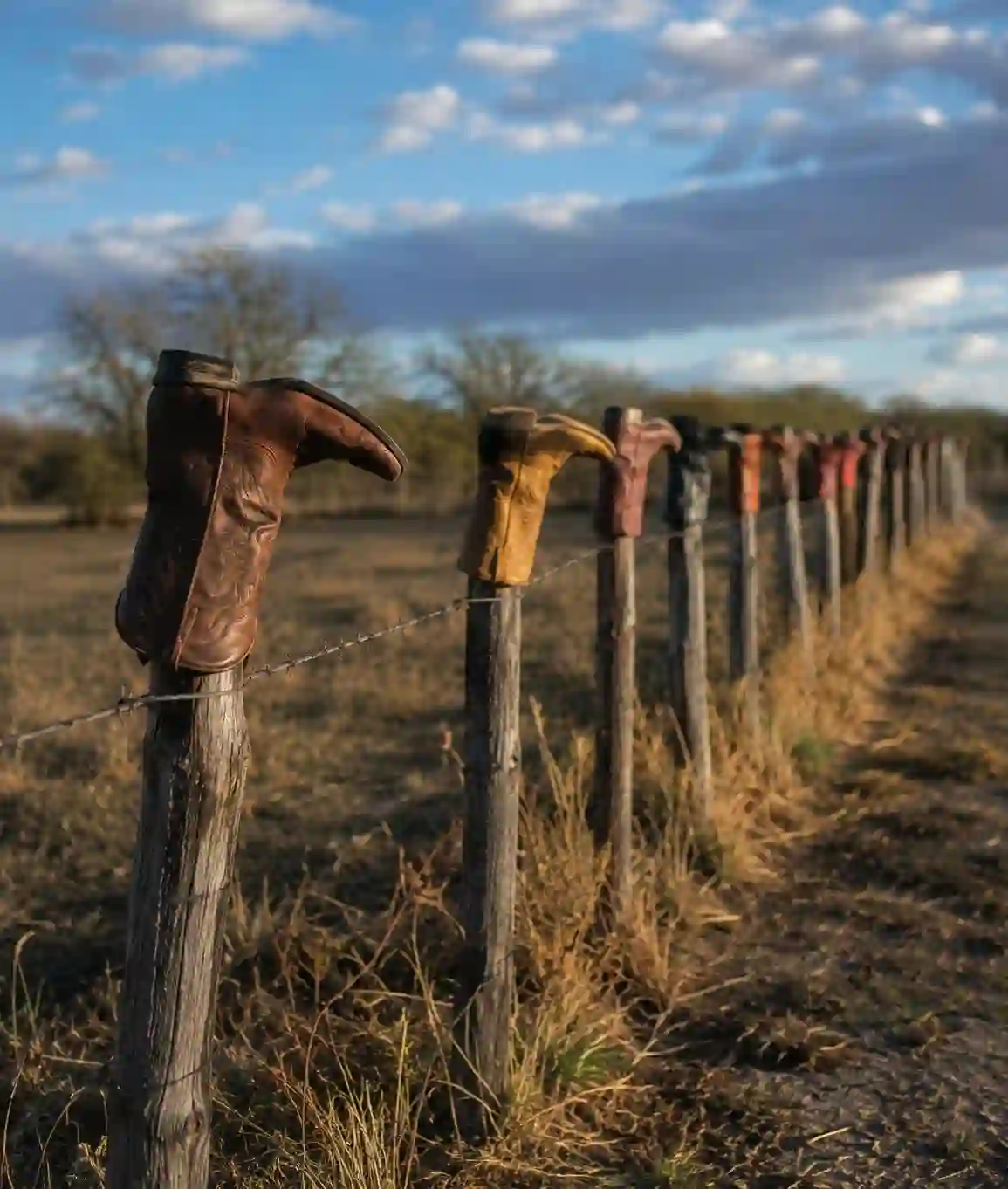
If you have ever driven through the American countryside and spotted an old cowboy boot sitting upside down on a fence post, you may have wondered what you were looking at.
It is such an unusual sight that it almost feels like a message.
Was the rancher trying to tell someone something? Was the boot left there as a memorial? Did someone simply run out of places to put an old pair of boots?
The truth is that there is not one universal answer.
Across ranching communities in the American West, boots on fence posts have been associated with practical uses, personal memories, local customs, and Western folklore. In some cases, the boot may have a story behind it. In others, it may simply be an old piece of footwear that found a second life as part of the landscape.
And that uncertainty is part of what makes the tradition so fascinating.
One of the most meaningful explanations is remembrance.
Ranch life can create unusually strong connections between people, animals, and the land. A ranch hand may spend years working alongside the same family. A cowboy may ride the same horse through countless long days. A well-loved horse can become a trusted working partner rather than simply another animal on the property.
When someone important dies, an old pair of boots can become a quiet symbol of that person’s presence.
The same idea can apply to a horse.
For someone who spends years working with horses, a particular animal may be remembered for its loyalty, temperament, or ability to handle difficult work. An old boot placed on a fence can therefore serve as a simple outdoor memorial.
Not every boot has this meaning, of course. But when one does, what appears to be an abandoned piece of footwear may actually be something deeply personal.
You might drive past it without ever knowing the story.
There is also a much simpler explanation.
Cowboy boots used for ranch work take a beating.
They encounter mud, dust, rain, manure, heat, cold, and rough terrain. After years of work, even a good pair can become too worn, damaged, or uncomfortable to wear.
But ranch culture has long valued making things last.
An old boot doesn’t necessarily have to go straight into the trash. It can become decoration, a marker, or simply another useful object around the property.
Placing it over a fence post gives it a visible place where it can remain useful—or at least avoid becoming another piece of waste.
Some accounts also suggest that an upside-down boot can help cover the exposed top of a wooden fence post and provide some protection from weather. That may make practical sense, but it should not be treated as the universal historical reason for the tradition.
Sometimes an old boot is simply an old boot.
What About the “Rancher Is Home” Story?
This is where the tradition gets particularly interesting.
One popular piece of Western folklore claims that boots placed on or around a fence could serve as a signal indicating whether a rancher was home or away.
Different versions of the story describe different signals. In some tellings, the position or direction of the boot supposedly communicated whether the rancher was at the house or out working.
It sounds like something that could have come straight from an old Western movie.
But there is an important distinction to make.
There is no evidence that this was a universal cowboy communication system used throughout the American West.
It is better understood as a piece of regional folklore or a reported local custom than as an official rule followed by cowboys everywhere.
Ranching traditions have always varied from one community to another. A practice that existed on one ranch may never have been used—or even known about—on another.
That is why claims about a single “cowboy boot code” should be treated cautiously.
There is a very practical reason an upside-down boot makes sense.
Leave a boot facing upward outdoors and rainwater can collect inside it. Over time, that water can damage the leather and create a perfect little container for leaves, dirt, and insects.
Turn the boot upside down, and water can drain away.
It also allows the boot to fit naturally over the top of a fence post.
That doesn’t mean every upside-down boot was placed there for weather protection. A memorial boot may be positioned that way simply because it is the easiest way to display it.
But the position itself is certainly practical.
An old boot that can no longer be worn can still have a place on the fence.
Sometimes the tradition grows beyond a single boot.
One boot becomes two.
Then another pair appears.
Eventually, an ordinary fence can become a collection of weathered cowboy boots.
This has happened in places where boots have been deliberately added as decoration or as part of a local tradition. One well-known example near Hunt, Texas, has been described as a fence decorated with numerous boots, turning an ordinary ranch boundary into an unusual roadside attraction.
The important thing about examples like this is that they show how rural traditions can evolve.
A custom doesn’t always begin with a written rule or a clearly documented origin.
One person does something.
Someone else imitates it.
Another person gives the practice a sentimental meaning.
Eventually, the original reason may be forgotten while the tradition itself survives.
Why Cowboy Boots Carry So Much Meaning
To someone who rarely wears cowboy boots, an old pair may look like nothing more than worn-out footwear.
For a working rancher, it can be very different.
Those boots may have spent years in the saddle. They may have crossed fields before sunrise, walked through mud while checking livestock, stood in the stirrups during long rides, or been worn while repairing fences under a hot summer sun.
They become broken in.
They become familiar.
And over time, they can become connected to memories.
That is why an old pair of boots can have sentimental value long after they have stopped being useful.
Putting them on a fence can be a quiet way of saying:
These boots mattered
There is no universal rule about how many boots should appear.
You may see a single boot sitting alone on a post.
You may see an entire pair.
Or you may find a fence lined with old boots stretching along the property.
The number doesn’t necessarily indicate a particular message.
It may reflect the history of the property.
A family might place boots there to remember someone who died. A ranch might keep the boots of former workers. Someone might simply like the look of weathered leather against an old wooden fence.
Without knowing the story behind the fence, it is impossible to be certain.
And that is something worth remembering the next time you see one.
Is There Really a Secret Cowboy Code?
Probably not—not in the way some stories on the internet suggest.
There is no single nationwide system in which every cowboy boot on every fence has a specific meaning.
Instead, the tradition appears to be a mixture of practicality, remembrance, local custom, and Western folk art.
That may actually make it more interesting.
If every boot had one official meaning, there would be nothing mysterious about seeing one.
But when you don’t know whether the boot represents a person, a horse, a memory, an old ranching habit, or nothing more than a worn-out pair of footwear, the object becomes a little more intriguing.
A simple boot can leave you wondering about the person who wore it.
Imagine the Story Behind One Boot
Picture yourself driving along a quiet country road.
A weathered wooden fence runs beside the highway. Beyond it are open fields, cattle, trees, and long stretches of grassland.
Then you see it.
An old brown cowboy boot is sitting upside down on a fence post.
The leather is cracked.
The color has faded.
The sole is worn almost smooth.
You pass it in a few seconds, but the image stays with you.
Who wore that boot?
How many miles did it travel?
Was it once the favorite pair of a rancher?
Did it belong to someone who spent decades working that land?
Was it placed there to remember a beloved horse?
Or did somebody simply decide that an old boot deserved one final job before being thrown away?
You may never know.
And perhaps that is the best part.
The Meaning Depends on the Story Behind the Fence
The next time you see a cowboy boot sitting on a fence post, don’t automatically assume that it is trash or decoration.
It might be a memorial.
It might be a practical reuse of an old boot.
It might be part of a local custom.
It might be folk art.
Or it might have no special meaning at all.
There is no single universal meaning behind boots on fence posts.
Their significance depends on the people, property, and traditions connected to them.
That is what makes this small Western custom so captivating.
A weathered boot may represent hard work, loyalty, remembrance, resourcefulness, or simply a little rural creativity.
So the next time you spot one standing upside down on a fence post, take another look.
You may not be looking at an abandoned boot.
You may be looking at a small piece of someone’s story.
Author’s Note
Traditions involving boots on fence posts vary by region and individual property. Some explanations are based on local accounts, personal practices, or Western folklore rather than a single documented origin. For that reason, this article distinguishes commonly reported explanations from claims that cannot be treated as universal cowboy customs.
Related Posts
- What Happens When You Stop Chasing Women? 9 Powerful Changes Most Men Don’t Expect

- The White Cloth hanging From a Car Window: What This Little-Known Road Signal Really Means

- 10 Surprising Reasons People Change the Way They Sit on the Toilet — What Toilet Posture Can Really Mean
- I Watched a One-Eyed Shelter Dog Get Passed Over by 11 Families, Then I Learned Why He Kept Carrying the Same Old Tennis Ball to Every New Visitor

- After Eight Years Caring for Their Mother Her Brothers Said She Had “No Real Career” , Then the Hospital Records Revealed What She Had Really Done
- I Was Hiding in a Brooklyn Restaurant From the Men My Stepmother Sent After Me When a Six-Year-Old Boy quietly Asked Me to Marry Him, Then His Father Walked In



Hammad Ali
Co-Owner & Author
Hammad Ali is a co-owner and author at MidnightReads, contributing thoughtful and engaging articles across human-interest, life, history, relationships, and entertainment topics.
They help develop and create original, useful content designed to inform, entertain, and give readers something meaningful to take away.