
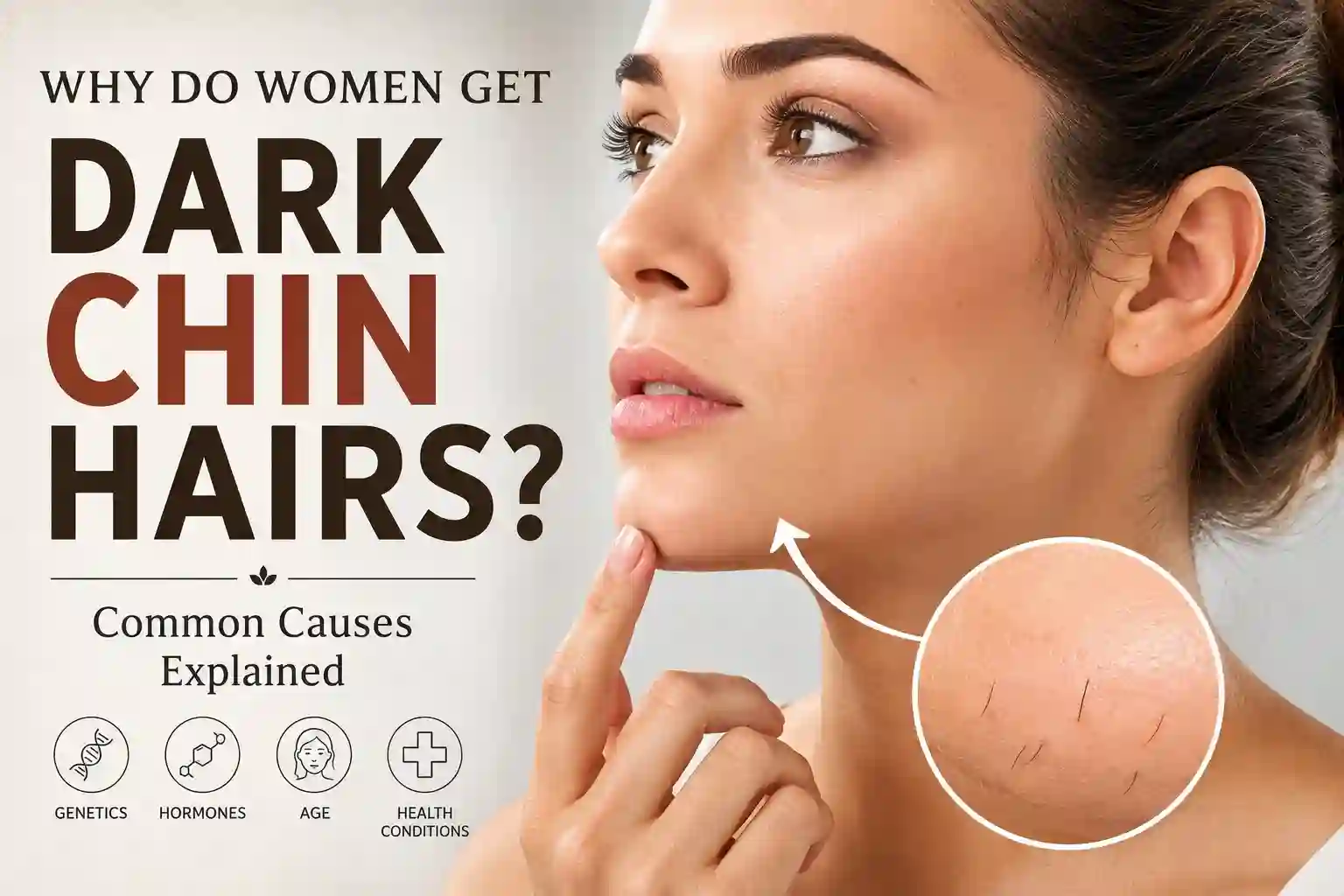
You look in the mirror and notice it: one dark, stubborn hair sitting on your chin.
You pluck it. A few weeks later, another one appears.
For some women, this is simply an occasional cosmetic annoyance. For others, a noticeable increase in coarse facial hair can be connected to changes in hormones or an underlying medical condition.
So what does a dark chin hairs actually mean?
The short answer is: it can mean several different things, and one hair alone usually isn’t enough to tell you why it appeared.
Age, genetics, individual hair growth patterns and hormonal changes can all influence facial hair. When there is a broader pattern of excessive coarse or dark hair growth, doctors may consider a condition called hirsutism.
First, What Counts as Hirsutism?
Hirsutism is the medical term for excessive growth of dark or coarse hair in women in areas where men commonly develop more noticeable terminal hair.
It can affect areas such as the:
- Chin and face
- Upper lip
- Chest
- Lower abdomen
- Back
- Inner thighs
Mayo Clinic explains that hirsutism is often associated with increased activity of hormones called androgens, including testosterone.
That doesn’t mean every woman with a dark chin hair has hirsutism.
Doctors look at the overall pattern and, when appropriate, other symptoms and medical information.
Why Is the Hair Darker Than the Rest?
Not all hair follicles behave in exactly the same way.
Some facial hairs remain fine and barely noticeable, while individual follicles can produce thicker, darker hairs. As people get older, hormonal changes can also affect the way some follicles grow.
This is one reason a woman may notice a few coarse hairs on her chin even if the rest of her facial hair is very fine.
The appearance of a single dark hair therefore doesn’t tell you, by itself, whether your hormones are abnormal.
Can Age Change Facial Hair?
Yes.
Hair growth patterns can change throughout adulthood. Hormonal changes associated with aging, including the transition through menopause, can affect the balance between different types of body and facial hair.
Someone who rarely noticed chin hair when she was younger may therefore notice a few coarse hairs later in life.
That change can be frustrating, but it doesn’t automatically mean that something is medically wrong.
What matters more is how much the hair growth has changed and whether other symptoms appear at the same time.
Could PCOS Be the Reason?
It can be one possible explanation.
Polycystic ovary syndrome (PCOS) is a hormonal and metabolic condition that can cause symptoms including excess facial or body hair, acne, irregular menstrual periods and problems with ovulation.
Mayo Clinic lists PCOS as one of the causes associated with hirsutism.
But there is an important distinction:
One chin hair does not mean you have PCOS.
PCOS is diagnosed by considering a person’s broader medical picture. Facial hair is only one possible feature.
If increased facial hair occurs together with irregular periods, significant acne, scalp hair thinning or other hormonal changes, discussing the symptoms with a healthcare professional can be worthwhile.
What Other Things Can Cause Increased Facial Hair?
PCOS isn’t the only possibility.
Mayo Clinic lists several other potential causes of hirsutism, including certain medications, congenital adrenal hyperplasia, Cushing syndrome and, rarely, hormone-producing tumors. In some women, no specific cause is identified.
Family history can also influence hair growth.
In other words, there isn’t one universal explanation for unwanted facial hair.
That’s why trying to diagnose the cause by looking at a single hair—or by comparing your appearance with someone else’s—isn’t reliable.
When Should You Pay More Attention?
The pattern is more informative than one isolated hair.
For example, it is worth paying closer attention if you notice that coarse facial hair is becoming noticeably heavier over a period of months.
You may also want to speak with a healthcare professional if the change occurs alongside:
- Irregular or absent periods
- New or worsening acne
- Noticeable scalp hair thinning
- Increased coarse hair on other parts of the body
- Other signs of hormonal change
- Rapid changes in facial or body hair
Mayo Clinic specifically recommends medical evaluation when facial or body hair becomes heavy or increases rapidly over a few months.
What If the Changes Happen Very Quickly?
Rapid changes deserve more attention than a few slowly appearing hairs.
Very high androgen activity can sometimes produce additional changes, a process doctors call virilization.
Possible signs can include a deeper voice, increased muscle mass, scalp hair loss or other noticeable changes. These symptoms are not typical of simply finding one occasional chin hair.
If several significant changes appear quickly, don’t try to work out the cause from internet articles alone. A healthcare professional can decide whether an examination or testing is appropriate.
What Might a Doctor Check?
If facial hair growth is significant enough to warrant evaluation, a healthcare professional may ask about your:
- Menstrual cycle
- Medical history
- Family history
- Medications
- Timing of the hair-growth changes
- Other symptoms
Depending on the situation, blood tests may be used to measure certain hormones.
Mayo Clinic notes that testing can help determine whether increased androgen levels are contributing to hirsutism.
Not everyone with unwanted facial hair needs extensive testing. The decision depends on the overall symptoms and clinical situation.
Does Plucking Make the Hair Grow Back Thicker?
This is one of the myths that refuses to disappear.
Plucking removes the hair from the follicle, but it doesn’t change the underlying hormonal reason a follicle may produce hair.
If another dark hair eventually appears in the same area, that doesn’t necessarily mean plucking caused it to become thicker.
The new hair may simply be growing from the same or a nearby follicle.
What Can You Do About Unwanted Chin Hair?
If the issue is mainly cosmetic, there are several ways to remove unwanted facial hair.
Common options include:
- Tweezing
- Shaving
- Threading
- Waxing
- Depilatory products
- Laser hair removal
- Electrolysis
The appropriate choice depends on factors such as hair color, skin type, personal preference and cost.
For women with diagnosed hirsutism, medical treatment can also be considered when appropriate. Mayo Clinic describes both medical and hair-removal approaches, while the Endocrine Society has published clinical guidance on evaluating and treating hirsutism.
If you are considering a professional procedure or prescription treatment, it is best to discuss the options with a qualified healthcare professional.
What About Laser Hair Removal?
Laser hair removal can provide longer-lasting reduction in unwanted hair, but it isn’t the right option for everyone.
The Endocrine Society’s guideline notes that the choice of hair-removal method can depend on hair color and other individual factors. It also highlights that people with darker skin require appropriate laser selection and technique.
That is another reason not to choose a treatment solely because someone online says it worked for them.
Your skin, hair and medical circumstances may be different.
Why Can a Few Chin Hairs Feel Like Such a Big Deal?
There’s also a social side to this subject.
Many women grow up with the idea that visible facial hair is somehow unusual or embarrassing. That can make a single dark hair feel far more significant than it actually is.
But facial hair varies naturally between individuals.
Some women remove every visible hair. Others leave them alone. Neither choice determines whether someone is healthy, feminine or attractive.
The important distinction is between a cosmetic preference and a possible change in health.
If you simply dislike the hair, removing it is a personal choice.
If you notice a significant new pattern of facial hair accompanied by other changes, that’s when medical advice becomes more useful.
The Bottom Line
Finding one dark hair on your chin doesn’t tell you that you have a hormone disorder.
Individual hair follicles can produce different types of hair, and facial hair patterns can change with age and hormonal changes.
However, a new, heavy or rapidly increasing pattern of coarse facial hair can sometimes be associated with hirsutism and conditions such as PCOS. Other causes are possible as well.
So don’t panic over one stubborn hair.
Instead, pay attention to the bigger picture.
If the hair growth becomes noticeably heavier, develops quickly or appears alongside symptoms such as irregular periods, significant acne, scalp hair loss or other rapid physical changes, talk with a healthcare professional.
Sometimes a dark chin hair really is just an annoying hair.
And sometimes, the change in your body around it is the part worth paying attention to.
Medical Disclaimer
This article is provided for general educational and informational purposes. It does not diagnose, treat or prevent any medical condition and should not replace advice from a qualified healthcare professional. If you are concerned about new or rapidly increasing facial hair, hormonal changes or other symptoms, seek individualized medical advice.
Sources
- Mayo Clinic — Hirsutism: Symptoms & Causes
- Mayo Clinic — Hirsutism: Diagnosis & Treatment
- Endocrine Society — Hirsutism Clinical Practice Guideline
Editorial Note
Midnight Reads aims to present health-related topics in clear, accessible language while relying on established medical sources. Health information can change, and individual circumstances differ, so readers should consult an appropriate healthcare professional for personal medical advice.
Related Posts
- My 60-Year-Old Boyfriend Came to Meet My Son for the First Time but When He Saw Him, He Went Pale ,and Whispered, “I Need to Leave”
- An Elderly Stranger Looked Me Dead in the Eye Across a Small-Town Diner and Said, “I’m Not Here for the Pie. I’m Here to Ask You to Marry My Son”—and My Whole Life Split Open Right There
- 10 Surprising Reasons People Change the Way They Sit on the Toilet — What Toilet Posture Can Really Mean
- I Came Home From New York Three Days Early—and Found My Husband Holding a Newborn Baby Who Looked Exactly Like Me
- My New Neighbor Kept Hanging Her Underwear Outside My 8-Year-Old Son’s Window—Then I Found Out Why

About the Author
Hassan is the founder and editor of MidnightReads, a publication featuring thoughtful stories, human-interest articles, history, relationships, and entertaining reads.
He is involved in researching, writing, and editing content for the site, with a focus on creating original, clear, and useful articles that give readers something meaningful to take away.
Hassan believes good content should inform, entertain, and encourage curiosity.
— Hassan, Founder & Editor, MidnightReads