
On August 5, 2010, an ordinary workday at Chile’s San José copper and gold mine suddenly turned into a fight for survival. Deep beneath the Atacama Desert near the city of Copiapó, a section of the mine collapsed and trapped 33 miners approximately 2,300 feet, or about 700 meters, below the surface. Above ground, families gathered desperately for news while rescue crews faced the terrifying possibility that the men might never be found alive.
What nobody could yet know was that the miners had survived the initial collapse and were beginning an ordeal that would eventually last an astonishing 69 days. Their story would become one of the most closely watched rescue operations in modern history, not because the men were simply waiting underground, but because they had to survive extreme isolation while engineers, doctors and rescuers worked above them to create a way home.
The first 17 days were among the most dangerous and uncertain moments of the entire ordeal. The miners had very little food and limited potable water, and there was no guarantee that rescue crews would ever be able to locate them. Their situation was made even more difficult by the heat and humidity deep inside the mine. NASA records describe the conditions as extremely harsh, with temperatures around 90°F and humidity exceeding 90 percent in some areas.
The men were not living comfortably in a prepared shelter; they were trapped in an underground environment where food, water, hygiene and psychological well-being all became serious concerns. Their survival during those first days depended on cooperation and strict conservation of the limited resources available to them.
Then, after 17 days of uncertainty, came the discovery that changed everything. Rescue workers finally established contact with the miners and learned that all 33 were alive. For the families waiting above ground, the news was extraordinary. After days of fearing that their relatives had died, they suddenly had proof that their loved ones were still there. But the discovery did not mean the crisis was over. In many ways, it marked the beginning of a much more complicated rescue problem.
The miners were hundreds of meters underground, and bringing them back safely would require drilling through an enormous amount of rock and developing a system capable of transporting individual people through a narrow shaft. NASA’s historical account notes that rescue workers could then send supplies through small boreholes, including food, water, medicine, communication equipment and messages from families.
Before the rescue teams could supply them properly, the miners had already been forced to survive on remarkably small portions of food. NASA’s Earth Observatory records that, before they were reached, the men had rationed their remaining supplies to roughly a tablespoon of tuna and a small amount of milk per day. After 17 days, many were close to starvation. This created another medical challenge: once rescuers established a supply route, the men could not simply be given unlimited food immediately.
People who have been severely malnourished can face serious medical complications if nutrition is restored too quickly, a problem known as refeeding syndrome. Medical specialists therefore had to think carefully about how the miners would be nourished while their bodies recovered.
The psychological challenge was just as important. Thirty-three people were living in an isolated underground environment with limited privacy, artificial light and constant uncertainty about their future. Yet the miners began organizing themselves and giving one another responsibilities. They maintained equipment, mapped parts of the mine and established routines that gave their days some structure.
NASA specialists later observed how important organization and purposeful activity could be in such a confined environment. Instead of simply sitting and waiting for rescue, the miners found ways to keep themselves occupied and maintain a sense of order. That cooperation became an important part of the story because survival was not only about finding enough food and water; it was also about keeping a large group of frightened people functioning together under extraordinary pressure.
As news of the miners spread around the world, the rescue operation grew into an enormous international story, but the central effort remained a Chilean operation. Chilean engineers, rescue specialists, medical personnel, officials and workers faced the difficult task of reaching men who were more than two thousand feet underground. Different drilling approaches were considered, and the operation required enormous patience because a drilling error could waste valuable time.
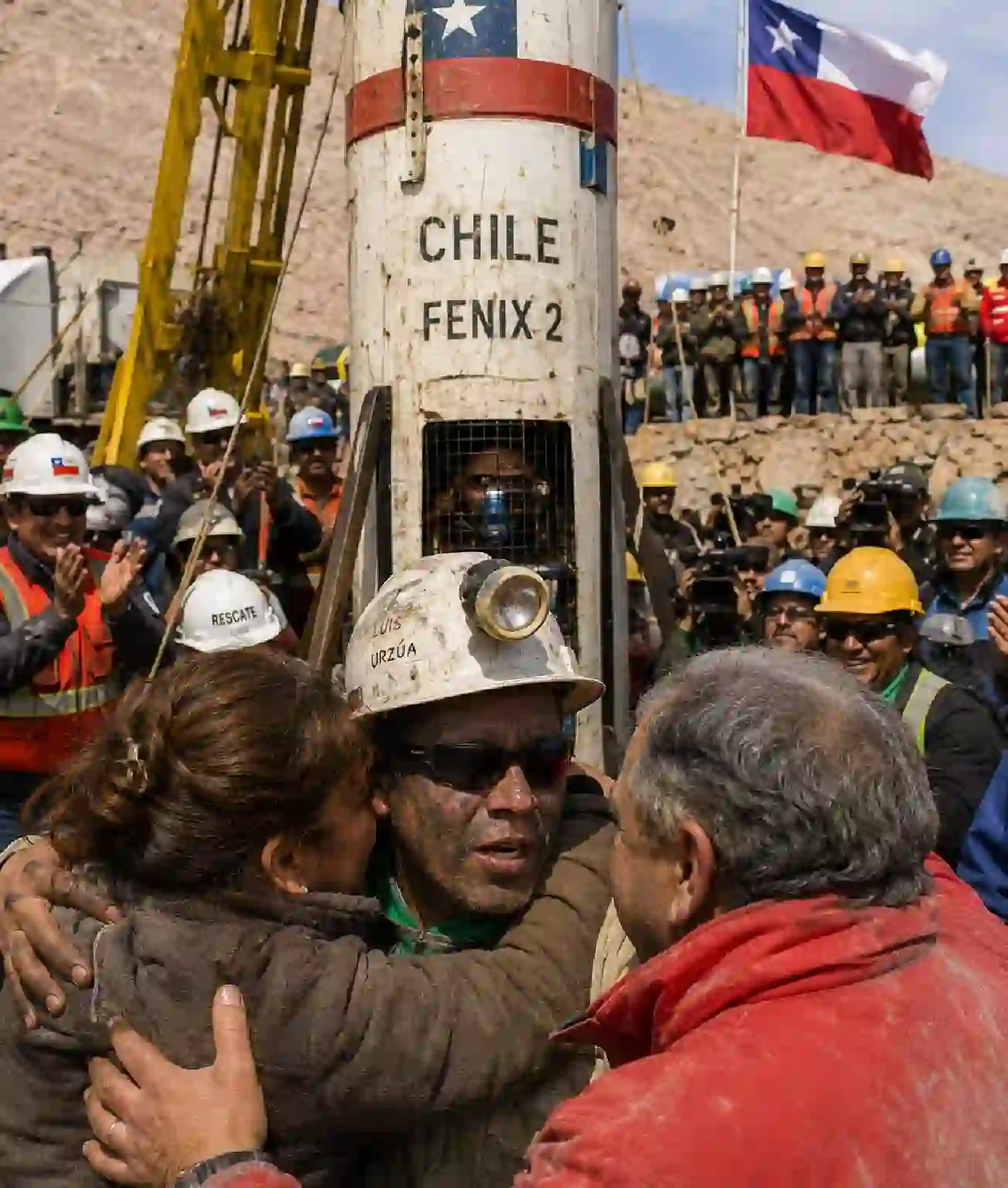
The rescue team ultimately succeeded in creating a shaft large enough to make the extraction of the miners possible. A specially designed rescue capsule would then carry the men individually from the underground chamber toward the surface. The capsule later became known as the Fénix, or Phoenix.
NASA became involved after the Chilean government requested technical assistance. This part of the story is often exaggerated in social-media posts, so the distinction is important: NASA did not single-handedly rescue the 33 miners. Instead, NASA provided specialized advice to Chilean officials and rescue teams, drawing on the agency’s experience with keeping people alive and psychologically prepared during long periods in isolated and hostile environments.
A four-person NASA team consisting of two physicians, a psychologist and an engineer visited Chile. Their recommendations covered medical care, nutrition, psychological support and aspects of the rescue capsule’s design. NASA itself described its contribution as a small part of the much larger Chilean rescue effort.
The connection between spaceflight and the trapped miners may sound unusual, but the underlying problem was surprisingly similar. Astronauts are trained to survive in confined environments where communication, food, exercise, health and psychological stability must be carefully managed. The miners were not astronauts, of course, but some of the challenges they faced involved the same basic human needs: how to maintain physical health, how to cope with confinement and how to preserve mental stability when normal life has disappeared.
NASA’s specialists therefore brought experience that could be adapted to the unusual circumstances underground. Their advice included considerations for exercise, hygiene, organization and communication, along with recommendations related to the miners’ eventual return to the surface.
The rescue capsule was another remarkable part of the operation. Engineers had to design a vehicle that could travel through a relatively narrow shaft while carrying a human being safely between the underground mine and the surface. There was no ordinary off-the-shelf machine that could simply be purchased and lowered into the shaft for this purpose.
The capsule had to be designed around the limitations of the rescue hole, including its diameter, length and the possibility that the vehicle could become stuck. NASA engineer Clint Cragg and other specialists provided recommendations concerning safety, strength, cushioning, communication and ways to reduce friction during the capsule’s movement. Chilean engineers incorporated many of these suggestions into the developing rescue system.
While engineers concentrated on the physical rescue, doctors and psychologists had to prepare for what would happen after the miners reached the surface. Being rescued was not simply a matter of opening a door and allowing 33 men to walk away. They had spent weeks in an extreme environment, and their return to normal life required careful medical and psychological consideration.
NASA’s specialists advised Chilean authorities on how to manage the men’s health, nutrition and psychological needs during and after the rescue. The operation therefore involved two separate challenges: first, getting the miners out alive, and second, helping their bodies and minds cope with what they had endured.
Then came October 12, 2010, when the rescue finally entered its dramatic final stage. One by one, the miners began entering the Fénix capsule for the journey to the surface. The world watched as the narrow rescue system carried each man upward through the newly drilled shaft. Every successful arrival brought another wave of relief to the families waiting above.
The images became unforgettable: a miner emerging into daylight after weeks underground, embracing relatives and rescue workers, and finally standing beneath the open sky again. For the people who had followed the story from the beginning, each appearance from the capsule represented another step toward the moment everyone had been waiting for.
The final miner reached the surface on October 13, 2010. At that point, all 33 men had been successfully brought out alive after spending 69 days underground. NASA records confirm that the miners were rescued 69 days after the collapse, alive and in surprisingly good condition considering the extraordinary ordeal they had experienced. The successful rescue brought an end to a disaster that had begun with uncertainty and fear and transformed into a worldwide demonstration of engineering, teamwork and human endurance.
What makes the story especially powerful is that the rescue did not depend on a single miraculous invention or one heroic individual. It was built from thousands of small decisions and countless hours of work. The miners underground had to cooperate and maintain routines. Families had to endure weeks of uncertainty. Engineers had to solve problems that had never been solved in exactly the same way before.
Doctors had to consider the effects of starvation and confinement. Psychologists had to think about the mental consequences of prolonged isolation. Rescue workers had to keep drilling despite setbacks and uncertainty. Every part of the operation mattered because a mistake could have endangered the men who were waiting hundreds of meters below.
The story also offers a lesson about the importance of hope without pretending that hope alone can solve an emergency. The miners needed food, water, medical care and a physical route to the surface. The rescue teams needed machinery, engineering knowledge and careful planning. But behind all of those practical necessities was a decision that mattered just as much: nobody was willing to simply give up on the 33 men. Their rescue became possible because people continued searching, drilling, communicating and adapting their plans until a workable solution was found.
The 69 days underground therefore represent much more than a number. They represent more than two months during which 33 men lived in darkness while their families waited above ground. They represent the patience required to solve an almost unimaginable engineering problem and the determination required to keep a large group together under extreme conditions. When the final miner stepped out of the Fénix capsule on October 13, the world did not simply witness the end of a mining rescue. It witnessed the result of thousands of people combining their knowledge and effort to accomplish something that had once seemed almost impossible.
Today, the rescue of the 33 Chilean miners remains a powerful reminder of what can happen when people refuse to accept that a difficult situation has no solution. The mine collapse was sudden, frightening and potentially fatal, but the response that followed was deliberate and determined. The miners survived by supporting one another, while the people above them kept working to create a path back to the surface. Engineers, doctors, psychologists and rescue specialists contributed different pieces of knowledge, and those pieces eventually came together in one extraordinary operation.
The most memorable image is still the simplest one: a man who has spent weeks beneath the Earth emerging into sunlight and seeing his family again. Behind that moment were 69 days of fear, discipline, planning and perseverance. All 33 miners made it home, and their survival turned a devastating mining disaster into one of the most remarkable rescue stories of the 21st century. It is a story worth remembering not because it sounds like a miracle from a viral post, but because the real story is even more impressive: ordinary people survived an extraordinary situation, and an enormous team of people worked together until every one of them could finally return home.
Author’s Note
This article is based on documented accounts of the 2010 San José mine disaster and the rescue of the 33 Chilean miners. We’ve focused on verified facts while avoiding the exaggerations often found in viral versions of the story, including misunderstandings about NASA’s role. The story is shared as an informative account of survival, teamwork, determination, and one of the most remarkable rescue efforts in modern history.
Related Posts
- My Brother Destroyed My $78000 SUV Because I Refused to Give It to His Wife—Then the Police Asked One Question That Silenced My Entire Family

- Every Ride Home Left Me With Missing Memories And I Thought My Husband Was Worried About My Blackouts Until I Heard His Voice on the Recording

- My Mother Banned Me From My Brother’s Wedding, Then One Phone Call Revealed Who I Really Was

- My Mommy Has Been Sleeping for Three Days”—A Six-Year-Old Girl Pushed Her Newborn Twins to the Hospital in a Wheelbarrow
- My 5-Year-Old Son Screamed “Stop the Car!” When He Saw Two Boys Sleeping Beside the Trash — Then I Realized They Had His Face and My Dead Wife’s Eyes
- My 60-Year-Old Boyfriend Came to Meet My Son for the First Time but When He Saw Him, He Went Pale ,and Whispered, “I Need to Leave”







Hammad Ali
Co-Owner & Author
Hammad Ali is a co-owner and author at MidnightReads, contributing thoughtful and engaging articles across human-interest, life, history, relationships, and entertainment topics.
They help develop and create original, useful content designed to inform, entertain, and give readers something meaningful to take away.