
The note had been sitting in the top drawer of my husband’s desk for almost two years.
It was only a single sheet of lined paper, folded twice and tucked beneath an old photograph. Calder had written it shortly before he died, when he was already too weak to spend much time downstairs with us. He had written it for our son, Emmett, but he never got the chance to give it to him.
I had found it after the funeral.
I couldn’t bring myself to throw it away.
For two years, I kept that little piece of paper hidden in the drawer, telling myself that one day I would know when the time was right to give it to Emmett. But grief has a strange way of making ordinary decisions feel impossible. Every time I opened the drawer, I would see Calder’s handwriting and close it again.
Then, one rainy Thursday afternoon, my twelve-year-old son found it.
I had been in the kitchen when I heard the desk drawer slam upstairs.
A few seconds later, Emmett came down holding the folded paper.
“Mom, what’s this?”
I froze.
“Where did you find that?”
“In Dad’s desk.”
He unfolded it carefully.
“Is this his handwriting?”
I nodded.
Emmett looked at me.
“Why didn’t you give it to me?”
I didn’t have a good answer.
“Because I didn’t know if you were ready.”
He looked back at the page.
“What does it say?”
I hesitated.
Then I let him read it.
The note wasn’t long. Calder hadn’t had the strength for long letters by then.
It said:
Emmett,
If you’re reading this, I’m probably not there to tell you this myself. So listen carefully. You don’t have to become me. Be yourself. Be kind when you can, be brave when you’re afraid, and remember that sometimes the smallest thing you do for another person becomes the thing they remember for the rest of their life.
Love, Dad.
That was all.
Emmett read it twice.
Then he folded it again.
“Can I keep it?”
“Of course.”
He put it carefully into his pocket.
I thought that was the end of it.
It wasn’t.
The next afternoon, Emmett asked if he could come with me to the hospital.
I needed to drop off some paperwork for my sister, and he wanted to get out of the house. The rain had stopped, but the sidewalks were still wet and the sky was the color of old silver.
We parked near the hospital entrance.
“Stay here for a minute,” I told him. “I’ll only be upstairs for a few minutes.”
He nodded.
When I returned, he wasn’t on the bench where I’d left him.
My heart jumped.
I looked around the entrance.
Then I saw him standing near a woman sitting alone at the far end of the waiting area.
She looked exhausted.
She was probably in her sixties, wearing a brown coat and holding a plastic hospital bag on her lap. Her eyes were red, as though she’d been crying.
Emmett was talking to her.
When he saw me, he immediately came over.
“Mom.”
“What happened?”
He glanced toward the woman.
“She lost her husband.”
I looked at the woman.
She lowered her eyes.
“I heard her talking to the nurse,” Emmett whispered. “Her husband died this morning.”
I looked at my son.
Then I noticed his hand was empty.
“Where’s the note?”
He didn’t answer.
My stomach dropped.
“Emmett.”
“I gave it to her.”
For a moment, I couldn’t understand what he meant.
“You gave her Dad’s letter?”
He nodded.
“She needed it more than I did.”
I felt anger rise inside me.
That letter had been all I had left in Calder’s handwriting.
I wanted to tell him he had no right.
I wanted to tell him that some things are not his to give away.
But then I looked at the woman.
She was holding Calder’s note with both hands.
And she was crying.
Not the kind of crying that asks for attention.
The quiet kind.
The kind people do when they are trying not to fall apart in front of strangers.
I sat beside her.
“I’m sorry.”
She looked at me.
“Your son gave me this.”
“I know.”
“I don’t understand why.”
I looked at Emmett.
Neither did I.
She wiped her eyes.
“My husband was my best friend. We were married for forty-three years. This morning I thought I was going to die with him.”
She looked down at the note.
“Then your son sat beside me and told me his father had died too.”
I swallowed.
“He told me he still missed him.”
Emmett looked embarrassed.
The woman continued.
“Then he told me that his father had written this before he died.”
She held the paper against her chest.
“He said maybe my husband would have wanted me to keep going.”
I couldn’t speak.
Because that was exactly the kind of thing Calder would have said.
The woman thanked us.
We left.
The entire drive home was quiet.
When we reached the house, Emmett went straight upstairs.
I stood in the kitchen for several minutes, staring at nothing.
I was still angry.
But beneath the anger was something else.
I realized that Emmett hadn’t given away a piece of his father because it meant nothing to him.
He had given it away because it meant everything.
That night, I opened Calder’s desk drawer.
There was nothing inside.
For the first time since my husband died, the drawer looked completely empty.
And strangely, it didn’t hurt as much as I expected.
Three days later, someone knocked on our door.
It was early Sunday morning.
I wasn’t expecting anyone.
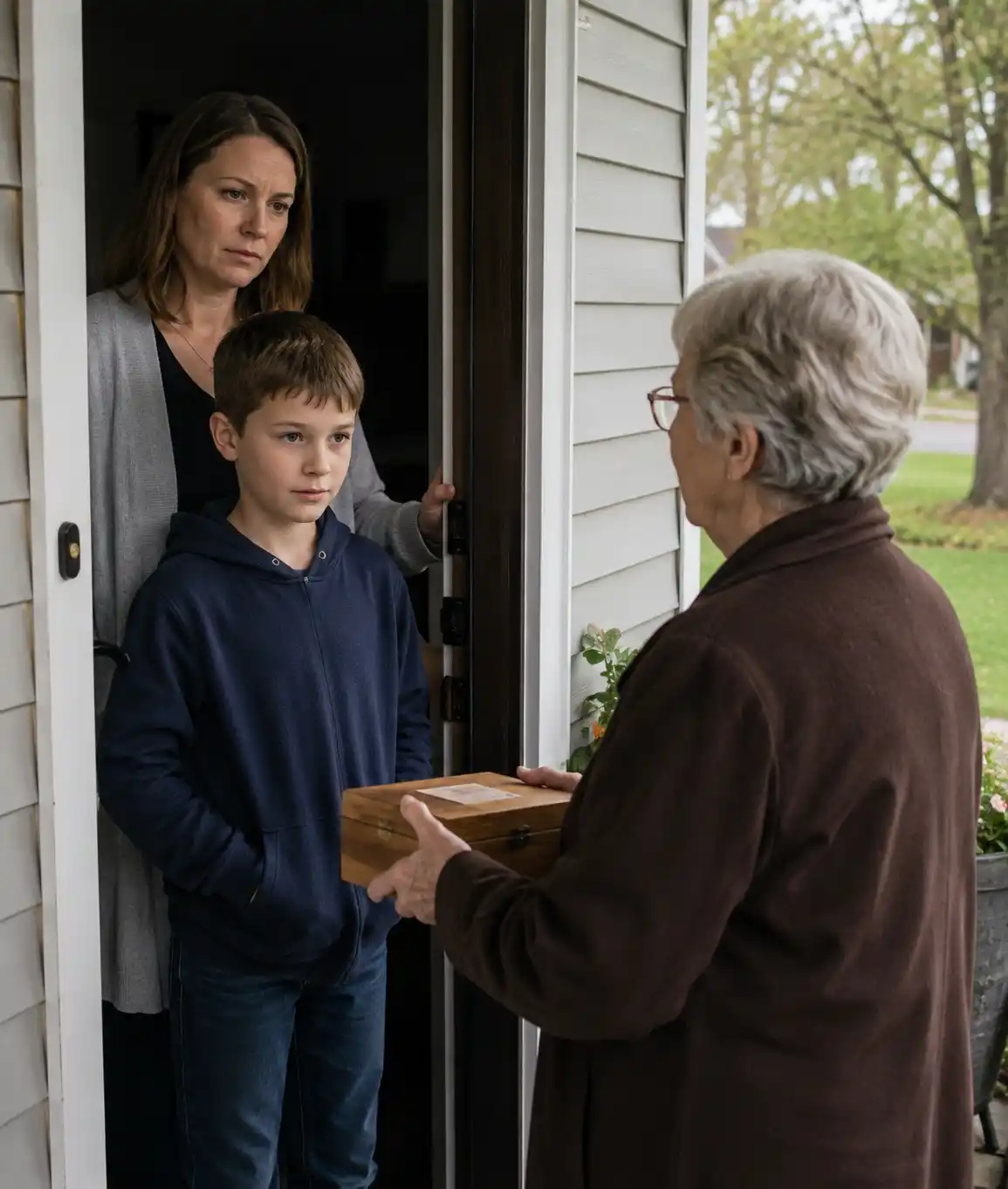
When I opened the door, I found the woman from the hospital standing on our porch.
She was holding a small wooden box.
“I hope I’m not disturbing you.”
I recognized her immediately.
“You’re…”
“Evelyn.”
She smiled faintly.
“I never properly introduced myself.”
Emmett came downstairs when he heard the voices.
Evelyn looked at him.
“I came to return something.”
She opened the wooden box.
Inside was a small brass key.
“What is that?” I asked.
“My husband’s.”
She took a breath.
“He had a workshop behind our house. He spent forty years making things there. Tables, chairs, toys, little wooden boxes. Nothing valuable, but he loved that workshop.”
She looked at Emmett.
“He always said that if something was made with your hands, it carried part of you.”
She reached into the box.
There was another folded piece of paper.
“I found this the night after he died.”
She handed it to me.
It was a note from her husband.
It said:
Evelyn,
Don’t close the workshop forever. Give something away before you do. Someone will need it more than we do.
I looked at her.
“You brought this to us?”
She nodded.
“I couldn’t understand it when I found it.”
She looked at Emmett.
“Then your son gave me your husband’s permission to keep living.”
Emmett’s eyes filled with tears.
Evelyn smiled.
“I thought perhaps I could do the same for someone else.”
She handed him the brass key.
“My husband had a small workbench where he taught children how to make things. I want you to have it.”
Emmett stared at the key.
“I can’t take that.”
“You can.”
“But it’s your husband’s.”
“I know.”
She smiled.
“That’s why I’m giving it to you.”
I watched my son close his fingers around the key.
And suddenly I understood what had happened.
The note hadn’t disappeared.
It had traveled.
Calder had written it for Emmett.
Emmett had given it to Evelyn.
Evelyn had found courage in it.
And now she was passing something of her husband’s life to my son.
One week later, we drove to Evelyn’s house.
Behind it stood a small wooden workshop.
Dust covered the windows, but inside, everything had been left exactly as her husband had used it. There were unfinished wooden toys on the shelves, jars of nails and screws, old tools hanging neatly on the wall, and a workbench covered with years of scratches.
Emmett walked inside slowly.
“He really made all this?”
Evelyn smiled.
“For forty years.”
She pointed toward a shelf.
“There.”
On it sat dozens of small wooden stars.
“Those were his favorite.”
“What did he do with them?” Emmett asked.
“Gave them away.”
“To who?”
“Anyone who needed one.”
Emmett picked one up.
There was a tiny handwritten message on the back.
You are not alone.
He looked at me.
I looked at Evelyn.
None of us said anything.
We didn’t need to.
Over the next few months, something beautiful happened.
Evelyn reopened the workshop.
Emmett began going there every Saturday.
They repaired old toys and built simple wooden objects together. Sometimes they gave them to children at the hospital. Sometimes they left them anonymously at shelters. Sometimes they simply gave them to people who looked like they needed a reason to smile.
The workshop became a place where grief and generosity somehow learned to exist together.
Evelyn eventually told me that she had considered selling the house after her husband’s death.
Instead, she kept it.
And Emmett helped her turn the workshop into something new.
They called it The Little Star Workshop.
The first time I saw a child leave with one of their wooden stars, I thought about Calder’s note.
Be kind when you can.
Be brave when you’re afraid.
Sometimes the smallest thing you do for another person becomes the thing they remember for the rest of their life.
I finally understood why my son had given away that letter.
He hadn’t thrown away his father’s memory.
He had trusted it enough to share it.
And perhaps that was the greatest gift Calder had ever given him.
Not the words on a page.
Not the photograph in a drawer.
Not something that could be locked away and protected.
A way of living.
A way of looking at another person’s pain and saying, “I know what this feels like. You don’t have to face it alone.”
Years after Calder died, I still have moments when grief catches me unexpectedly. I still miss his voice, his terrible jokes, and the way he used to leave coffee cups everywhere despite my constant complaints.
But now, when I think about the letter I once kept hidden in a drawer, I don’t think about losing it.
I think about where it went.
It went from a dying husband to his son.
From his son to a grieving widow.
From that widow to an old workshop.
From that workshop to hundreds of children and strangers who never knew Calder at all.
One small piece of paper traveled farther than I ever could have imagined.
And I learned something I wish someone had told me when my husband died:
Sometimes holding on isn’t the only way to remember someone.
Sometimes the best way to keep a person’s love alive is to let it move.
To let it leave your hands.
To let it reach someone who needs it.
Because a memory locked inside a drawer belongs to one person.
But a kindness set free can belong to everyone.
Author’s Note
This is an original fictional story created for entertainment and reflection. The characters, names, dialogue, and events are fictional and are not presented as a real-life account.
At its heart, the story explores grief, compassion, and the way a simple act of kindness can continue long after the person who inspired it is gone. The story’s message is simple: sometimes the most meaningful way to honor someone we love is not by holding tightly to what they left behind, but by allowing their kindness to reach someone who needs it.
Related posts
- My Brother Destroyed My $78000 SUV Because I Refused to Give It to His Wife—Then the Police Asked One Question That Silenced My Entire Family

- My Father-in-Law Lived Under My Roof for 20 Years, and I Called Him a Burden, Until His Lawyer Opened a Blue Ledger at His Funeral and Revealed What He’d Been Hiding All Along

- Every Ride Home Left Me With Missing Memories And I Thought My Husband Was Worried About My Blackouts Until I Heard His Voice on the Recording

- My Mother Banned Me From My Brother’s Wedding, Then One Phone Call Revealed Who I Really Was
- My Ex-Husband’s Mother Arrived With Two Moving Trucks Minutes After Our Divorce—She Demanded My Mansion, but She Had No Idea What My Attorney Had Discovered2.

- My Mommy Has Been Sleeping for Three Days”—A Six-Year-Old Girl Pushed Her Newborn Twins to the Hospital in a Wheelbarrow


Hammad Ali
Co-Owner & Author
Hammad Ali is a co-owner and author at MidnightReads, contributing thoughtful and engaging articles across human-interest, life, history, relationships, and entertainment topics.
They help develop and create original, useful content designed to inform, entertain, and give readers something meaningful to take away.