
Editor’s Note: This is an original fictionalized story created for entertainment and reflection. The characters, names, and events are fictional, and any resemblance to real people or actual events is purely coincidental.
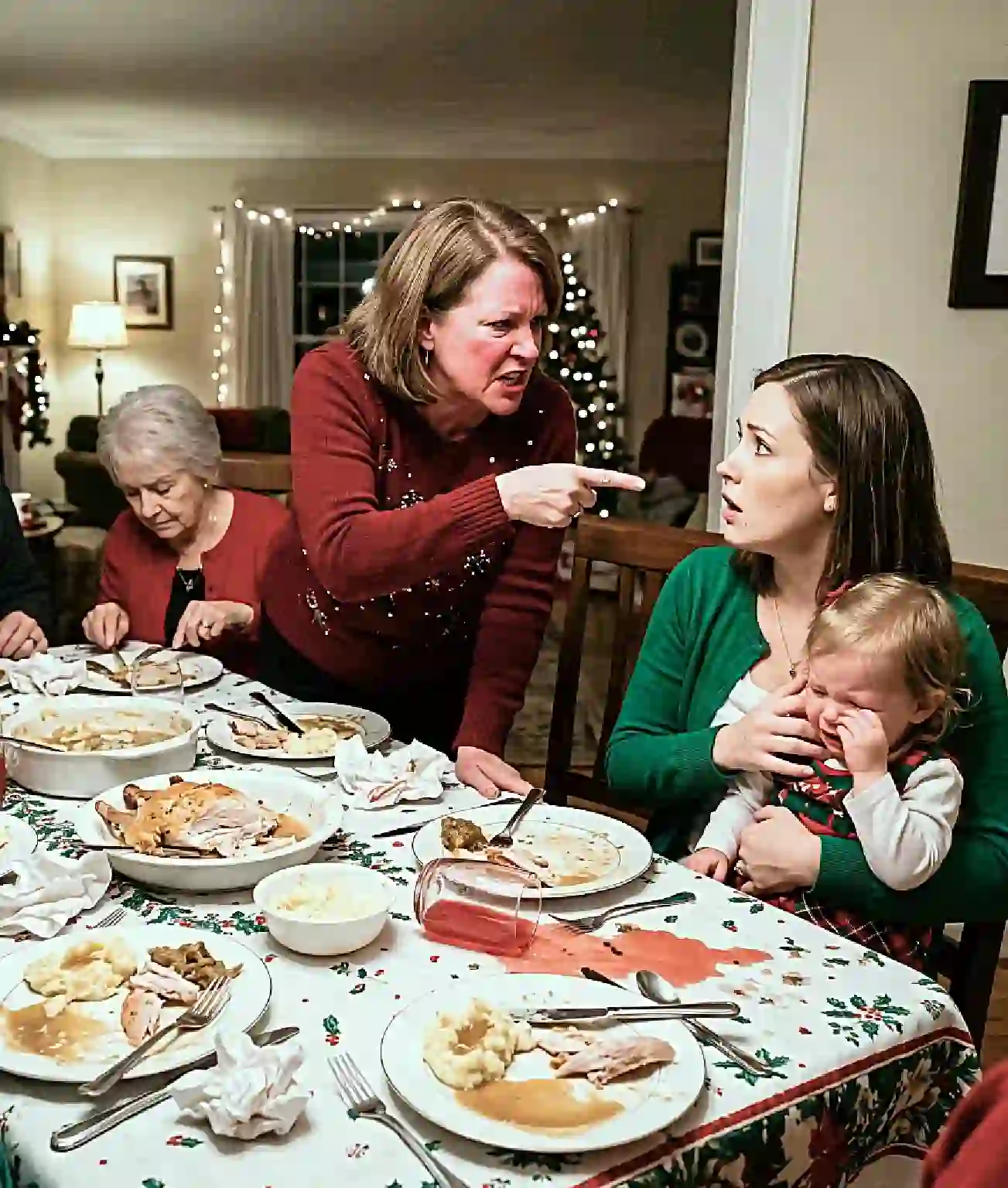
By the time my mother spat in my face, the Christmas ham had already gone cold. We were gathered around my parents’ dining table in Columbus, Ohio, with my younger sister Megan, her husband, my father, two cousins, and my three-year-old daughter, Lily. The room was decorated beautifully, the Christmas tree lights were glowing in the corner, and everything had started out like an ordinary family dinner.
The argument began over a glass of juice. Lily reached across the table and accidentally knocked it over, sending orange juice across the white tablecloth. I immediately grabbed some napkins, but Megan sighed dramatically and said, “Can she ever sit still?” I reminded her that Lily was three years old and that accidents happened, but Megan clearly wasn’t interested in letting it go.
“You always make excuses for her,” Megan said. I looked at her and tried to keep my voice calm, because I knew how quickly these family arguments could turn ugly. “She’s a child, Megan. She didn’t do it on purpose.” My mother, Diane, immediately sided with Megan, just as she had done countless times before.
“You always have to defend yourself,” Mom said. I stared at her because that accusation had followed me for most of my life. Megan could make mistakes, spend money recklessly, or make decisions that caused problems for everyone else, and Mom would find a way to explain them away, while even the smallest mistake I made somehow became evidence that I was irresponsible.
Years earlier, after Lily was born, I had borrowed two thousand dollars from my parents because unexpected medical bills had wiped out our savings. I paid every dollar back, but Mom continued bringing it up whenever she wanted to make me feel dependent on her. She had apparently decided that one difficult period in my life was enough to define me forever.
“You’re exhausting,” Mom suddenly said, pushing her chair away from the table. My father looked at her and quietly said, “Diane, that’s enough,” but she ignored him. She stood there glaring at me and accused me of coming into her house, eating her food, bringing my child with me, and behaving as if the family owed me something.
“I never said anyone owed me anything,” I replied. Mom’s expression hardened, and before I could understand what she was about to do, she leaned across the table and spat directly into my face. The room went completely silent, and Lily stared at me with wide, frightened eyes.
Daniel, my husband, stood so quickly that his chair fell backward. Mom pointed at me and screamed, “You are a leech. My money is not for you.” Then she pointed toward Lily and said the words I don’t think I will ever forget: “Take that burden and get out.”
I didn’t argue with her. I wiped my face, picked up Lily’s coat, and helped her get dressed while Daniel gathered our things. My father remained at the table, staring down at his plate with an expression of shock and shame. Nobody tried to stop us as we walked out into the cold Christmas night.
Lily fell asleep in the back seat before we reached home, still clutching the stuffed rabbit my father had given her. Once we got inside, I tucked her into bed and changed out of the dress I’d worn to dinner. I stood in the bathroom for several minutes, staring at myself in the mirror and wondering how a family dinner could have turned into something I never imagined experiencing from my own mother.
About two hours later, my phone rang. It was Dad, and for several seconds I considered letting it go to voicemail because I wasn’t ready to hear another explanation for what had happened. When I finally answered, his voice sounded nervous and unusually quiet.
“Claire,” he said, “your mother just found out about the house.” I frowned because I had no idea what he meant. “What house?” I asked, and after a long silence, Dad replied, “The house your grandmother left you.”
I sat down hard on the edge of the couch. “Grandma didn’t leave me a house,” I said, but Dad insisted that she had. He told me that my grandmother, Evelyn, had owned the historic four-bedroom Craftsman on Elm Street, the same house where I had spent so many childhood afternoons.
I knew the property well, but I had always assumed it would be sold after Grandma’s death. Dad explained that there was a separate addendum to her will that had recently been processed by the estate attorney, and it named me as the sole owner of the property. The house was mortgage-free and worth more than seven hundred thousand dollars.
I could barely process what I was hearing. “Then why didn’t anyone tell me?” I asked. Dad hesitated before admitting that Mom had known about the property and had expected Megan to receive it. Apparently, she had spent months telling people that the house would eventually belong to my sister.
“Your mother opened the certified documents today,” Dad continued. “She wasn’t supposed to, but she did. That’s how she found out the property was going to you.” Suddenly, the strange anger at dinner made sense in a way that made my stomach turn.
Dad told me there was something else in the estate documents. Grandma had left me a handwritten letter, and the attorney had instructions to make sure I received it personally. Before I could ask what the letter said, someone knocked loudly on our front door.
Daniel looked at me from across the room. “Who would come here this late?” he asked, but I already had a pretty good idea. I walked to the door and opened it to find my mother standing beneath the porch light, her mascara streaked and a thick manila envelope clutched tightly in her hands.
Megan was sitting in the car behind her. Mom tried to smile, but she looked exhausted and frightened rather than angry. “Claire, we need to talk,” she said.
“You already said everything you needed to say tonight,” I replied. Mom looked down for a moment and then whispered that she had been angry and wasn’t thinking clearly. I reminded her that being angry didn’t explain spitting in my face or calling my daughter a burden.
She held out the envelope. “Your grandmother made a mistake,” she said. According to Mom, Grandma had been confused near the end of her life and couldn’t possibly have understood what she was signing. Mom wanted me to sign a quitclaim deed transferring the house to Megan.
I opened the envelope and found the legal documents along with Grandma’s handwritten letter. The familiar handwriting immediately brought tears to my eyes because I hadn’t seen it since before her death. I unfolded the letter while Mom stood silently in front of me, waiting for me to accept the story she had prepared.
The letter explained that Grandma knew exactly what she was doing when she changed her will. She wrote that she had watched the way Mom treated me and that she had noticed how often I was expected to apologize simply to keep peace in the family. Most importantly, she wrote that she wanted the house to become a place where Lily would always feel safe and loved.
Grandma’s final words were simple: she told me never to give the house away because someone made me feel guilty about receiving it. She said she wasn’t leaving it to me because she thought I needed rescuing, but because she trusted me to understand what a home was supposed to mean. Reading those words made me realize that she had understood much more about my family than I had ever realized.
Mom watched my face carefully. “So?” she asked.
I folded the letter and looked at her. “No,” I said.
She stared at me as if she hadn’t expected the answer. She told me Megan had already made plans for the property and that giving her the house would keep the family together, but I reminded her that Megan’s plans had nothing to do with me.
“You already have an apartment,” Mom argued. “You don’t need a four-bedroom house.” I told her that wasn’t the point and that Grandma had made her decision long before either of us knew about it. Mom’s expression changed from pleading to anger.
“If you don’t sign that deed, you’re dead to me,” she said. I felt the familiar urge to defend myself, but this time I didn’t have anything left to prove. I simply told her that I was going to accept the inheritance Grandma had left me and that I wasn’t going to surrender it because someone demanded that I feel guilty.
Mom warned me that I would regret it, but I told her the only thing I regretted was spending so many years believing I had to earn my family’s approval. Then I closed the door and left her standing on the porch.
The following morning, Daniel and I met the estate attorney at the Elm Street property. Mr. Harris gave me the keys and explained that Grandma had anticipated the possibility that someone might challenge the transfer. She had left detailed instructions confirming that the property was to remain in my name unless I voluntarily chose to sell or transfer it.
Walking through the house was surprisingly emotional. Grandma’s old piano was still in the living room, her favorite chair remained beside the window, and the kitchen still had the wooden spice rack she had used for decades. Dust covered the furniture, but the house still felt familiar enough that I could almost hear her moving around in the kitchen.
Lily followed us through the rooms, looking at everything with fascination. When she saw the smallest upstairs bedroom overlooking the backyard, she immediately announced that she wanted it. Daniel laughed and told her she hadn’t even seen the other rooms, but Lily had already made up her mind.
“This is my room,” she declared. I looked at Daniel, and we both smiled. After everything that had happened, hearing my daughter excitedly claim a room in Grandma’s house felt like the first genuinely happy moment of the week.
We spent the next several months repairing the property. The porch needed work, several windows had to be replaced, and the garden had become badly overgrown, but we wanted to preserve as much of Grandma’s home as possible. We kept her piano, restored the kitchen cabinets, and planted flowers in the backyard where she had once spent countless summer mornings.
Not long after we moved in, Megan called me. She told me that she had spent more than thirty thousand dollars because Mom had convinced her the house would eventually be hers. She had already hired contractors, ordered furniture, and made plans for her wedding around the property.
I was angry at first, but then Megan said something I wasn’t expecting. She admitted that she had believed Mom because she had spent her entire life hearing that I was the difficult daughter and that Megan was the one who deserved to be protected.
“I thought Mom loved me more because she always took my side,” Megan said. “Now I’m starting to realize she wasn’t protecting me. She was making excuses for me.”
I didn’t know how to respond. Megan apologized for the way she had treated me at Christmas and especially for what she had said about Lily. I told her I appreciated the apology, but I wasn’t ready to pretend that everything was suddenly fine.
That conversation changed our relationship, although it didn’t repair everything overnight. Megan eventually accepted that the house wasn’t hers, and she had to deal with the financial consequences of the decisions she had made based on Mom’s promises. For the first time, I didn’t step in to solve another person’s problem simply because I felt guilty saying no.
My relationship with Mom changed too, although it was much slower. She called several times during those first months, sometimes to apologize and sometimes to complain about how distant I had become. Eventually, I told her that if she wanted a relationship with me and Lily, she would have to respect the boundaries I had set.
She didn’t change overnight, but she began trying. There were still awkward conversations and moments when old habits returned, but I stopped pretending that forgiveness meant forgetting. I could accept an apology without pretending that the past hadn’t happened.
Several months later, Mom came to Elm Street carrying a small wrapped package for Lily. She stood outside the gate for a moment before asking whether she could come in. I opened it and let her walk up the path.
Lily ran toward her grandmother and wrapped her arms around her. Mom knelt down and hugged her tightly, and for a moment I saw the mother I had always wished she could be. When Lily ran upstairs to open her present, Mom turned to me and said she didn’t expect me to forget what she had done.
“I don’t,” I told her. She nodded and said she didn’t expect me to trust her immediately either, but she wanted the chance to earn it. I told her she could have that chance, but I also made it clear that things would never go back to the way they were before.
The following Christmas, we gathered at Elm Street for dinner. This time the ham was warm, Lily was laughing with her cousins, and my father was telling one of his terrible jokes while Megan argued with him about the gravy. Mom sat across from me, quieter than usual, and there was no tension hanging over the table like it had the year before.
At one point, Dad looked around the room and said Grandma would have loved seeing everyone together in her old house. I looked at the piano, the Christmas lights, and the people sitting around the table, then watched Lily run through the hallway wearing a paper crown.
She eventually climbed onto my lap and asked, “Mommy, is this our house forever?” I looked at her and thought about the letter Grandma had left me, the painful Christmas that had led us here, and everything that had changed since then.
“As long as we take care of it,” I told her. Lily smiled and promised she would, then rested her head against my shoulder. I held her close and realized that the house had become much more than an inheritance.
Grandma hadn’t given me the property because she thought I needed money. She had given it to me because she believed I could turn it into the kind of home she knew I had always needed. More importantly, she had trusted me to make sure Lily grew up knowing that she was loved, wanted, and never responsible for carrying the weight of someone else’s resentment.
For years, I had believed that winning meant proving my mother wrong or finally getting her to admit that I was good enough. I eventually realized that I didn’t need either of those things, because my worth wasn’t something my family could give me or take away.
The real inheritance wasn’t the seven-hundred-thousand-dollar house. It was the courage to stop accepting disrespect simply because it came from people I loved, and the chance to create a home where my daughter would never have to question whether she belonged.
Grandma had left me the keys to a house, but what she really gave me was a new beginning. And every Christmas when Lily runs through those rooms laughing, I remember the lesson Grandma left behind: sometimes the most valuable thing you can inherit isn’t property at all, but the freedom to build a life where the people you love finally feel safe.
Latest Posts
- My Mom Spat in My Face at Christmas and Called My Daughter a Burden, Then Dad Revealed a Family Inheritance She Tried to Hide

- My Neighbor Borrowed $200 for Her Sick Son—Two Months Later, I Saw What She Had Done and Was Speechless
- My Mother-in-Law Called My 8-Year-Old Daughter a Disappointment at Dinner—Then I Discovered Why She Had Always Treated Her Differently
- My Family Forced Me to Cook Thanksgiving Dinner Alone—Then a Man in a Black Suit Walked In, Kissed My Hand, and Called Me “Darling”
- At My Wedding, I Caught My Brother Putting Something in My Champagne—So I Switched Our Glasses, and Thirty Minutes Later, His Secret Came Out
- My Husband Threw Me Out After Inheriting $75 Million, Calling Me Dead Weight—Then His Father’s Lawyer Revealed the One Thing He Never Knew


Hammad Ali
Co-Owner & Author
Hammad Ali is a co-owner and author at MidnightReads, contributing thoughtful and engaging articles across human-interest, life, history, relationships, and entertainment topics.
They help develop and create original, useful content designed to inform, entertain, and give readers something meaningful to take away.