
Editor’s Note: This is an original fictional story created for entertainment and reflection. The characters and events are fictional, and any resemblance to real people or events is purely coincidental.
“Mrs. Crowley, you know what people say about me, right?”
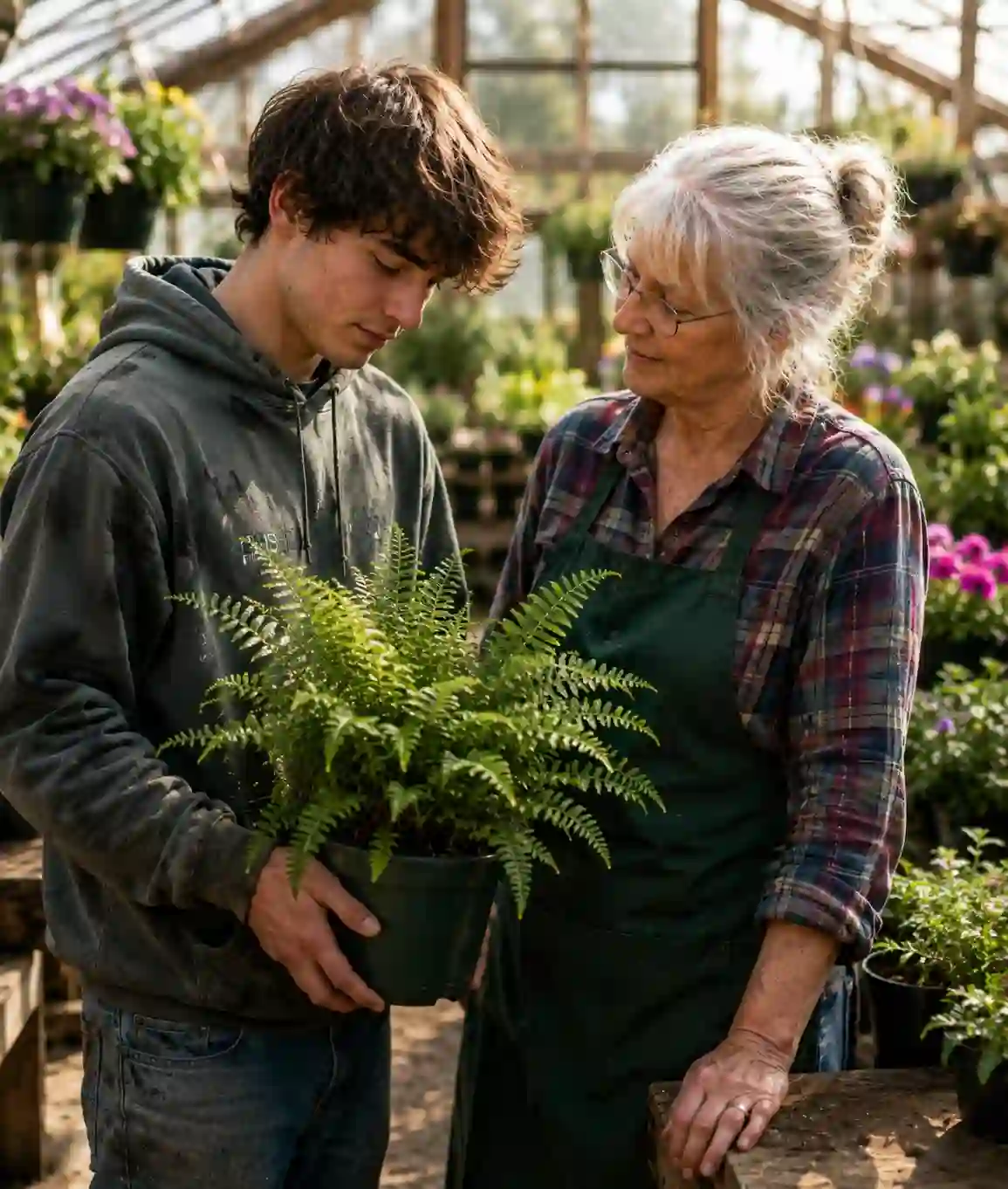
Seventeen-year-old Dylan stood just inside my greenhouse door, his hands buried deep in the pockets of a faded gray sweatshirt. His sneakers were muddy, his hair needed cutting, and he kept looking at the floor as if he already knew what I was going to say.
I did know what people said about him. In a town as small as ours, everyone seemed to know everyone else’s business, and Dylan’s reputation had traveled much farther than he had.
He had been expelled from school after too many fights and too many missed days. There were also rumors that he had stolen tools from a neighbor’s garage and that things had a habit of disappearing whenever he was around.
By the time Dylan walked into my greenhouse asking for work, most people had already decided what kind of person he was.
I studied him for a moment before asking, “Can you show up here at seven tomorrow morning?”
He finally looked up.
“You’re hiring me?”
“I asked if you can show up at seven.”
He nodded quickly. “Yes, ma’am.”
“Then I’ll see you at seven.”
He thanked me and walked away, leaving me standing there wondering whether I had just made a decision I would regret.
The truth was, I needed help badly. My husband, Frank, had died the previous November after forty-one years of marriage, and for thirty-three of those years, we had run Crowley’s Greenhouse together on a small piece of Iowa land behind our farmhouse.
Frank had always handled the heavy work. He unloaded bags of soil, repaired broken benches, carried trays, fixed equipment, and somehow managed to make every difficult job look easier than it really was.
I handled the seedlings, customers, orders, bookkeeping, and everything else that required sitting at a desk. We had our own rhythm, and after so many years together, we rarely needed to explain what had to be done.
Every February, when snow still covered the ground and the greenhouse was cold enough to make your fingers ache, Frank would walk inside, rub his hands together, and say, “Well, Bernie, time to wake the place up.”
That spring, there was no one to say it.
His work gloves still hung from a nail beside the potting bench. I couldn’t bring myself to move them, even though every time I saw them, I felt the same heavy ache in my chest.
The greenhouse seemed enormous without him.
By March, the work had started piling up. Trays needed filling, hanging baskets needed planting, deliveries had to be unloaded, and customers were already calling about their spring orders.
I was coming home exhausted every evening, sometimes too tired to cook myself dinner. So when Dylan appeared asking for work, I decided I could either keep struggling alone or give the boy a chance.
At exactly 6:52 the next morning, I saw him walking up the gravel driveway through the morning fog.
He was early.
That surprised me.
I handed him a pair of work gloves and pointed toward the back of the greenhouse. “Start with those pots. Wash every one of them.”
He looked at the enormous stack.
“All of them?”
“All of them.”
He nodded and got to work.
During his first week, I gave him the jobs nobody wanted. He scrubbed dirty pots, swept wet leaves from beneath the benches, carried bags of soil, cleaned old trays, and dragged broken containers to the dumpster.
He never complained.
He wasn’t much of a talker, either. Most mornings, he simply arrived, put on his gloves, and worked until I told him it was time to stop.
The customers noticed him, though.
One afternoon, an older woman waited until Dylan stepped outside before leaning toward me across the counter.
“Bernice, are you sure about that boy?”
I knew exactly what she meant.
“So far, he’s done everything I’ve asked,” I replied.
She lowered her voice. “I’d keep an eye on your cash drawer.”
After she left, I stared at the register.
Nothing was missing.
Not one dollar.
Still, I counted the money twice.
That bothered me more than I expected. Not because anything had happened, but because someone else’s suspicion had managed to get inside my head.
I felt ashamed.
Dylan hadn’t given me a reason not to trust him.
A few days later, I found him behind the greenhouse kneeling beside a row of neglected ferns.
They were in terrible condition. Their leaves were brown around the edges, their roots were packed tightly into old pots, and several had nearly died after a sudden cold snap.
I had already decided to throw them away.
“Those are headed for the trash,” I told him.
Dylan carefully lifted one of the brittle leaves.
“All of them?”
“Pretty much.”
He looked at the plants for another moment.
“Can I try to save them?”
I almost laughed. There were more than thirty ferns, and most of them looked hopeless.
“Dylan, those plants are nearly dead.”
“Maybe,” he said. “But can I try?”
I shrugged.
“They’re yours.”
I didn’t think much more about it.
Dylan did.
From that day forward, the ferns became his project.
Every morning, before starting his regular work, he checked them. He trimmed dead leaves, repotted the worst ones, changed the soil, moved some into the shade, and adjusted how much water they received.
One morning, I caught him carrying water from an old rain barrel.
“You’re spending an awful lot of time on five-dollar plants,” I teased.
He gave me a small smile.
“Maybe they just need somebody to be patient with them.”
At the time, I thought he was talking about the ferns.
I didn’t realize he was talking about himself.
Spring continued moving forward. The greenhouse slowly changed from a quiet building filled with trays of dirt into a colorful maze of flowers, herbs, vegetables, and hanging baskets.
Customers began coming through the doors every morning. They filled wagons with geraniums, petunias, tomato plants, basil, and everything else they needed for their gardens.
And Dylan’s ferns started coming back.
Not all at once.
It happened slowly, almost invisibly. One tiny green shoot appeared, then another. A week later, several plants had new leaves.
Out of thirty-two ferns, twenty-seven survived.
They weren’t perfect. Some were smaller than they should have been, a few had crooked stems, and several still carried brown scars from the damage they’d suffered.
But they were alive.
One Saturday morning, I unlocked the greenhouse and immediately noticed something different.
Dylan had arranged all twenty-seven ferns on the front display table. Each pot had a small piece of cardboard tied to it with twine.
I picked one up.
Written in black marker were the words:
SECOND CHANCE — $5
Dylan appeared from behind a row of hanging baskets and immediately looked nervous.
“I can take those down,” he said.
“Why would you?”
“I didn’t know if you’d like it.”
I looked at the plants.
Then I looked at him.
“No. Leave them.”
The first customer who walked in that morning stopped at the table.
“What are these?”
“Second-chance ferns,” I told her.
She smiled and bought two.
A retired teacher bought three. A young mother let her little daughter choose one, and the girl picked the crooked fern because she said it was “the prettiest one.”
By lunchtime, customers were asking about the story behind the plants.
Dylan didn’t say much. He simply carried the ferns to their cars and thanked everyone who bought one.
By three o’clock, every fern was gone.
I found Dylan sweeping underneath the empty display table.
“You sold every one,” I said.
He shrugged.
“They were good plants.”
I smiled. “You saved them.”
He stopped sweeping.
For several seconds, he said nothing.
Then he looked at the empty table and quietly said, “I wish people came with those tags.”
I didn’t know what to say.
He kept his eyes on the floor.
“Everybody knows the worst thing I’ve ever done,” he continued. “Nobody knows anything I did after.”
Something about those words hit me harder than I expected.
For the first time, I stopped seeing the boy the town had described and started seeing the seventeen-year-old standing in front of me.
A kid who had made mistakes.
A kid who was carrying a reputation that seemed much heavier than he was.
I pulled out a chair.
“Tell me what happened.”
Dylan hesitated, then sat down.
He told me about the twenty dollars he had taken from his uncle’s workbench when he was fifteen. He had been caught, admitted it, apologized, and paid the money back.
It was wrong. He knew it was wrong.
But somehow, one bad decision became the story people told about him.
The fights at school were real, too. Dylan didn’t try to pretend otherwise. He told me that things had been difficult at home that year, that he was angry all the time, and that he didn’t know how to deal with what he was feeling.
“I messed up,” he said.
I nodded.
“Yes, you did.”
He looked surprised that I hadn’t tried to tell him otherwise.
Then I said, “But making mistakes doesn’t mean you have to spend the rest of your life repeating them.”
He looked down at his hands.
“I’m just tired of being the thing I did.”
I thought about Frank.
My husband had always been the kind of man who hated throwing things away too quickly. He saved bent nails in old coffee cans, repaired broken tools, and kept pieces of wood that I would have tossed into the trash.
Whenever I asked him why, he’d smile and say, “You can straighten most things if you’re willing to work at them.”
Suddenly, I knew what I wanted to do.
The following week, I visited a local sign maker.
I ordered a simple wooden sign for the greenhouse entrance. Nothing fancy. Just white wood with dark lettering.
When Dylan arrived at work the following Saturday, the sign was already hanging above the door.
He stopped beneath it.
Then he read it.
He read it again.
The sign said:
MOST THINGS GROW BETTER WHEN SOMEBODY DECIDES THEY’RE WORTH SAVING.
Dylan stood there silently.
I pretended to be busy arranging seed trays, giving him time.
Finally, he wiped his face quickly with the sleeve of his sweatshirt.
“You planning on working today?” I asked.
He laughed through the tears.
“Yeah.”
His voice cracked.
“Yes, ma’am.”
That was nearly eight years ago.
Dylan finished high school through an alternative program and stayed at the greenhouse for three more seasons. He eventually enrolled in a community college program to study landscape design.
He learned a lot there, but some of the most important lessons he’d already learned in my greenhouse.
He learned that showing up mattered.
He learned that trust was earned slowly.
He learned that mistakes had consequences, but consequences didn’t have to become a life sentence.
After college, Dylan started a small landscaping company two towns away.
Today, he’s married and has a little boy who loves visiting the greenhouse.
Every spring, Dylan still stops by.
Sometimes he brings coffee. Sometimes he brings pastries. And sometimes his son runs between the same greenhouse tables his father once swept as a nervous seventeen-year-old.
The sign is still hanging above the entrance.
The paint has faded, and the wood has weathered from years of Iowa winters and summers.
I’ve had customers ask why I don’t replace it with a newer one.
I always give them the same answer.
“It looks better with age.”
But the truth is, I don’t want a new sign.
That old piece of wood reminds me of something I nearly forgot after Frank died.
People are more than the worst thing they’ve ever done.
A mistake can be serious. People should take responsibility for their actions, apologize when they’ve caused harm, and work to make things right.
But accountability doesn’t mean we have to believe a person is incapable of changing.
Sometimes what a person needs most isn’t someone pretending their mistakes never happened.
Sometimes they simply need someone willing to say, “I know what you did. But I also believe you can become better than that.”
Frank spent most of his life growing things.
Flowers.
Vegetables.
Trees.
But I think he understood something about people, too.
Give something good soil. Give it light. Give it water. Give it time.
And don’t decide something is worthless simply because it isn’t thriving yet.
Some things take longer than others.
Some plants need a different place in the greenhouse.
Some people need a second chance.
And sometimes, the smallest act of faith from one person can become the turning point in another person’s life.
Dylan once believed his past had already decided his future.
He was wrong.
And I was grateful that, for one small moment, I had been willing to be wrong about him, too.
Because that spring, I thought I was hiring a troubled teenager to help me run a greenhouse.
I didn’t realize I was giving someone a place where he could finally prove to himself that he wasn’t the person everyone had decided he was.
The ferns needed patience.
Dylan did, too.
And both taught me the same lesson:
Sometimes people don’t need someone to forget their past. They just need someone to believe their past doesn’t have to be their ending.
Trending Posts
- My Brother Destroyed My $78000 SUV Because I Refused to Give It to His Wife—Then the Police Asked One Question That Silenced My Entire Family

- My Father-in-Law Lived Under My Roof for 20 Years, and I Called Him a Burden, Until His Lawyer Opened a Blue Ledger at His Funeral and Revealed What He’d Been Hiding All Along

- Every Ride Home Left Me With Missing Memories And I Thought My Husband Was Worried About My Blackouts Until I Heard His Voice on the Recording

- My Mother Banned Me From My Brother’s Wedding, Then One Phone Call Revealed Who I Really Was
- My Ex-Husband’s Mother Arrived With Two Moving Trucks Minutes After Our Divorce—She Demanded My Mansion, but She Had No Idea What My Attorney Had Discovered2.

- My Mommy Has Been Sleeping for Three Days”—A Six-Year-Old Girl Pushed Her Newborn Twins to the Hospital in a Wheelbarrow



Hammad Ali
Co-Owner & Author
Hammad Ali is a co-owner and author at MidnightReads, contributing thoughtful and engaging articles across human-interest, life, history, relationships, and entertainment topics.
They help develop and create original, useful content designed to inform, entertain, and give readers something meaningful to take away.