
My daughter Nora was sixteen when she disappeared.
We were spending the afternoon at a crowded beach when she told me she was going to walk down to the ice cream stand at the far end. I watched her disappear into the crowd, thinking only about how much taller she had gotten over the winter.
Twenty minutes later, her towel was still beside mine. Her sandals were sitting neatly on top of it, and her phone was still inside her beach bag.
At first, I assumed she had gotten distracted. Then I started asking people if they had seen her.
Within minutes, the entire afternoon changed. Lifeguards searched the water while police officers checked the restrooms, parking lots, nearby hotels, and every road leading away from the beach. They found the ice cream stand, but none of the employees remembered seeing Nora.
There was no clear explanation for where she had gone.
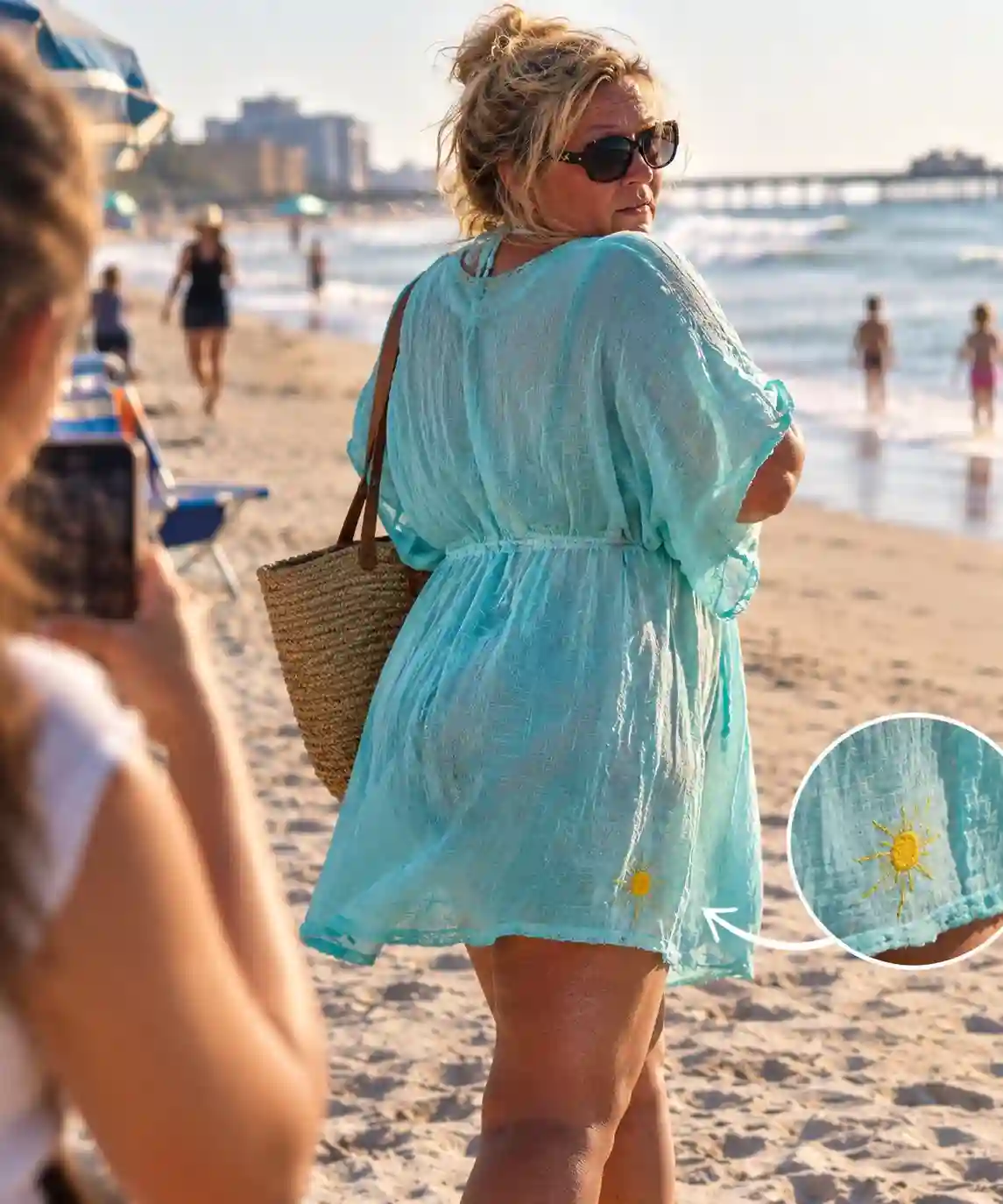
The last thing she had been wearing was a turquoise cover-up my mother had sewn for her earlier that spring. My mother had embroidered Nora’s initials, N.V., inside the bottom hem.
On the first day of our trip, Nora had caught one corner of the fabric on a piece of driftwood and torn it. My mother repaired the hole by stitching a tiny yellow sun over it. The stitching was slightly crooked, which made Nora laugh.
“It looks ruined now,” she had said.
My mother smiled. “It looks unique.”
Nora touched the little sun and shrugged. “I think I like it better this way.”
About forty minutes before when my daughter disappeared, I had taken a photograph of her wearing that cover-up. She was standing barefoot on the sand, squinting into the sunlight and raising one hand because she wanted me to stop taking pictures.
For eight years, that photograph stayed on my phone.
Police had copies. News stations had shown it. Volunteers had printed it on missing-person flyers. We followed every lead we could find, but nothing brought Nora home.
Eventually, our lives settled into a strange version of normal. We still talked about her, still kept her room, and still wondered what she might look like as an adult. But the constant searching slowly gave way to something harder to describe. We had to continue living without knowing whether she was alive.
Eight years after Nora disappeared, my husband, Michael, convinced me to take a short trip to a coastal town nearly six hundred miles from the beach where she had vanished.
I hadn’t wanted to go. Beaches had become difficult for me, even after all those years. Michael understood that, but he also knew we couldn’t spend the rest of our lives avoiding every place that reminded us of her.
So we went.
One afternoon, we were walking past a small café near the boardwalk when I noticed a woman standing outside near the tables. She looked to be in her fifties and had her back toward us.
What caught my attention was the turquoise cover-up she was wearing.
I told myself immediately that it meant nothing. Turquoise beach clothes weren’t unusual, and there was no reason to believe a piece of clothing could possibly be the one I’d been searching for.
Then a breeze lifted the bottom of the fabric.
I saw the yellow sun.
The stitching was crooked in exactly the same way.
For a moment, I couldn’t make sense of what I was looking at. Then I was walking toward her.
“Excuse me,” I said.
The woman turned.
“Where did you get that?”
She glanced down at her clothes.
“This?”
“Yes. The cover-up.”
“I’ve had it for years.”
“Where did you get it?”
Something about my voice must have made her uncomfortable. She looked at me carefully before answering.
“A secondhand store.”
My hands were already shaking as I pulled out my phone. It took me two attempts to find the photograph.
When I finally held it toward her, she stared at the screen.
It was Nora at sixteen, standing on the beach in the same turquoise cover-up, with the little yellow sun visible near the bottom.
The woman’s face went pale.
She looked at the photograph again, then past my shoulder toward the street.
Without warning, she reached for my wrist.
“Put that away,” she whispered.
I didn’t understand.
“What?”
“Please. Put the picture away.”
Michael stepped closer. “Why?”
The woman looked toward the street again. A man in a gray baseball cap was standing across from the café with a paper cup in his hand.
“He can’t see that,” she said.
“Who?”
She lowered her voice.
“Not him. Her.”
I felt my stomach tighten.
“Who are you talking about?”
The woman looked directly at me.
“She can’t know you’re here.”
I stared at her.
“Who can’t know?”
Instead of answering, she glanced toward the man across the street.
By the time I looked again, he was walking away.
The woman grabbed my arm.
“Come inside.”
We followed her through a side door into a small storage room behind the café. Once the door closed, she introduced herself as Evelyn Carter.
“I didn’t know whose cover-up this was when I bought it,” she said. “I only noticed the initials later.”
“N.V.?”
She nodded.
“About six years ago, a teenage girl came into the clinic where I worked. She was frightened and had bruises on her arm. She said her name was Anna.”
My heart began racing.
“What did she look like?”
Evelyn studied my face.
“She looked enough like your daughter that I think you already know what I’m going to say.”
I sat down.
“What happened to her?”
“She wouldn’t tell us much. She said she had fallen, but she kept watching the door. I reported my concerns to the police, but before anyone could follow up properly, she left the clinic.”
“Did you ever see her again?”
“Yes.”
Evelyn opened a drawer and took out an old photograph.
“She came back almost two years later.”
The photograph was blurry, but there was no mistaking the young woman’s face.
She wasn’t sixteen anymore. She had changed her hair and grown older, but the eyes were the same.
I had spent eight years looking at Nora’s childhood photographs. I knew those eyes.
Evelyn told us the woman in the photograph had continued calling herself Anna. She had asked about the turquoise cover-up and wanted to know whether anyone had recognized it.
“She told me it belonged to someone who was looking for her,” Evelyn said.
“Did she say her real name?”
Evelyn nodded.
“Nora.”
Michael covered his face with one hand.
I couldn’t speak.
For eight years, we had been asking whether our daughter was alive. Now a stranger was telling us that she had been alive for years.
I asked the question that mattered most.
“Where is she?”
“I don’t know.”
Evelyn explained that Nora had been terrified of a man named Daniel. He had helped several vulnerable teenagers find places to stay, but over time, according to Evelyn, he became controlling and began keeping track of the people who depended on him.
Nora had eventually escaped.
“She was afraid he’d find her if she contacted you,” Evelyn said. “She believed he had people watching her.”
I immediately thought about the man outside the café.
“Who was he?”
Evelyn hesitated.
“Daniel’s brother.”
Michael opened the old police records on his phone. We had kept copies of everything connected to Nora’s case.
When he found Daniel’s photograph, we recognized the same man we had just seen outside.
He had been questioned eight years earlier.
At the time, he had been working near the beach and was one of the people police interviewed after Nora disappeared. There had never been enough evidence to connect him to her disappearance, and he eventually left town.
Evelyn looked at the photograph.
“Daniel died three years ago,” she said.
“Then why is his brother following us?”
She didn’t know.
The police were called, and the café’s security footage was collected. The man was gone by the time officers arrived, but investigators later identified him as Thomas Carter.
That was the beginning of the second investigation.
Evelyn gave police everything she had, including the photograph of Nora and an old note she had received from her.
There were only a few words on it:
Tell my mother I’m sorry.
The handwriting was unmistakable.
Nora had written it.
Investigators eventually traced a phone number connected to someone who had known her several years earlier. That lead took them to a small town in another state.
When the detective told us they had reason to believe Nora was there, I was afraid to believe him.
After eight years, hope had become dangerous. Every time we thought we were getting close, there had been another dead end.
We drove there anyway.
The house was small and ordinary, sitting on a quiet street lined with trees. The detective asked us to wait while he went to the door.
A few minutes later, it opened.
A young woman stepped onto the porch.
She was twenty-four.
Her hair was darker than I remembered, and her face had changed with age. She looked thinner than the girl in the photograph on my phone.
But I knew her.
She looked at me for several seconds before saying the one word I had imagined hearing thousands of times.
“Mom?”
I walked toward her, and she came down the steps.
We held each other for a long time. There was no speech prepared for a moment like that. There was only the shock of finally having my daughter standing in front of me after eight years of wondering whether I’d ever see her again.
Michael came next.
Nora looked at him and started crying before she reached him.
“Dad.”
He pulled her into his arms.
That evening, she finally told us what she could.
She had been approached near the beach by someone who claimed to know her father. She had followed because she believed he was helping her find him.
She realized too late that something was wrong.
Daniel had moved her between several locations and convinced her that contacting her family would put us in danger. Nora escaped when she was eighteen, but by then she was terrified that anyone connected to her could be found.
She changed her name and tried to build a life somewhere nobody knew her.
“I thought about coming home all the time,” she told us.
“Why didn’t you?”
She looked down at her hands.
“I wasn’t ready.”
Then she told me something I had never known.
She had called our old number once.
Four years earlier.
“I heard your voicemail,” she said. “I almost stayed on the line.”
“Why didn’t you?”
“I was scared you’d ask where I was, and I didn’t know if it was safe to tell you.”
I reached across the table and held her hand.
“You didn’t have to come home all at once,” I told her. “You could have just told us you were alive.”
She nodded.
“I wish I had known that.”
The investigation continued after Nora returned home. Thomas Carter and several others connected to the group were eventually arrested, and Nora gave investigators the information she was able to provide.
There were still parts of those eight years she didn’t want to talk about. We respected that.
We didn’t try to force everything back to the way it had been before the beach.
Instead, we started over.
Sometimes Nora came to our house for dinner. Sometimes she stayed for hours. Other times she needed to leave early and be alone. We learned to accept that rebuilding a relationship after eight missing years would take time.
Nearly a year after we found her, Nora came into my kitchen carrying something folded over her arm.
I recognized the turquoise fabric immediately.
She laid the old cover-up on the table.
“I found it in my things,” she said.
The fabric was faded and worn. The little yellow sun had started to come loose around one edge, but it was still there.
My mother was visiting that day.
When she saw it, she reached out and touched the stitching.
“It still looks crooked,” she said.
Nora smiled.
“That was always my favorite part.”
My mother laughed through her tears.
“I told you it made it unique.”
Nora looked at her, then at me.
“For a long time, I hated this thing,” she admitted. “It was the last thing I had from that day.”
She paused.
“But eventually I realized it was also proof that there had been a life before all of that.”
We didn’t say much after that.
We took a photograph together instead.
Nora stood between us, holding the turquoise cover-up over one arm.
When I looked at the picture later, I thought about the photograph I’d kept on my phone for eight years—the one showing a sixteen-year-old girl standing on a beach, completely unaware that her life was about to change.
For years, that had been the last picture I had of my daughter.
Now I had another.
This one wasn’t a photograph of the girl I lost.
It was a photograph of the woman who had survived, found her way back, and finally had the chance to decide what came next.
And the crooked little yellow sun was still there.
Author’s Note:This story is a work of fiction created for entertainment and storytelling purposes. The characters, events, and locations are fictional, and any resemblance to real people or events is coincidental.
Related Posts
- My Pregnant Wife Was Beaten by Her Father and Eight Brothers Until We Lost Our Baby—Then They Laughed at Me, Not Knowing the Secret I Had Hidden for Six Years

- My Family Mocked My “Nursing Job”—Until My Nephew Nearly Drowned and the Hospital Chief Called Me “Doctor”
- My Fiancée Wanted Me Dead Before Friday, She Whispered the Deadline Beside My Hospital Bed, Never Knowing I Was Awake and Hearing Every Word
- My Husband Held My Wrists While His Father Burned My Pregnant Belly at Our New Year’s Dinner, Then They Ordered Me Out of the Penthouse, Until My Attorney Revealed Where Their Money Had Really Come From


Hammad Ali
Co-Owner & Author
Hammad Ali is a co-owner and author at MidnightReads, contributing thoughtful and engaging articles across human-interest, life, history, relationships, and entertainment topics.
They help develop and create original, useful content designed to inform, entertain, and give readers something meaningful to take away.