A 7-Year-Old Girl Called 911 After Her Father Disappeared For Four Days and then Police Discovered What Really Happened
“Daddy promised he would be home in thirty minutes.”
The little girl’s voice was so quiet that Victor Hayes, the emergency dispatcher, initially thought she was crying.
“Can you tell me your name, sweetheart?”
“Ashley Miller. I’m seven.”
“Hello, Ashley. My name is Victor. I’m going to help you, okay? Can you tell me where your daddy is?”
There was a long pause.
“He went to get my medicine and something to eat. He said I should lock the door and wait for him. But he hasn’t come back.”
“How long ago did he leave?”
“Four days.”
Victor straightened in his chair.
Four days?
He checked the address she provided and immediately sent an officer to the house.
“Are you alone right now, Ashley?”
“Yes.”
“Have you eaten anything today?”
“I had some crackers yesterday. Daddy usually makes my breakfast, but I don’t know how to use the stove.”
Victor softened his voice.
“You did exactly the right thing by calling us. An officer is coming to see you. I want you to stay somewhere safe until she arrives.”
“Will you tell Daddy I called?”
Victor paused.
“If we find him, I’ll make sure he knows.”
Ashley sniffled.
“Please tell him I’m not angry. I just want him to come home.”
That sentence stayed with Victor long after he dispatched the call.
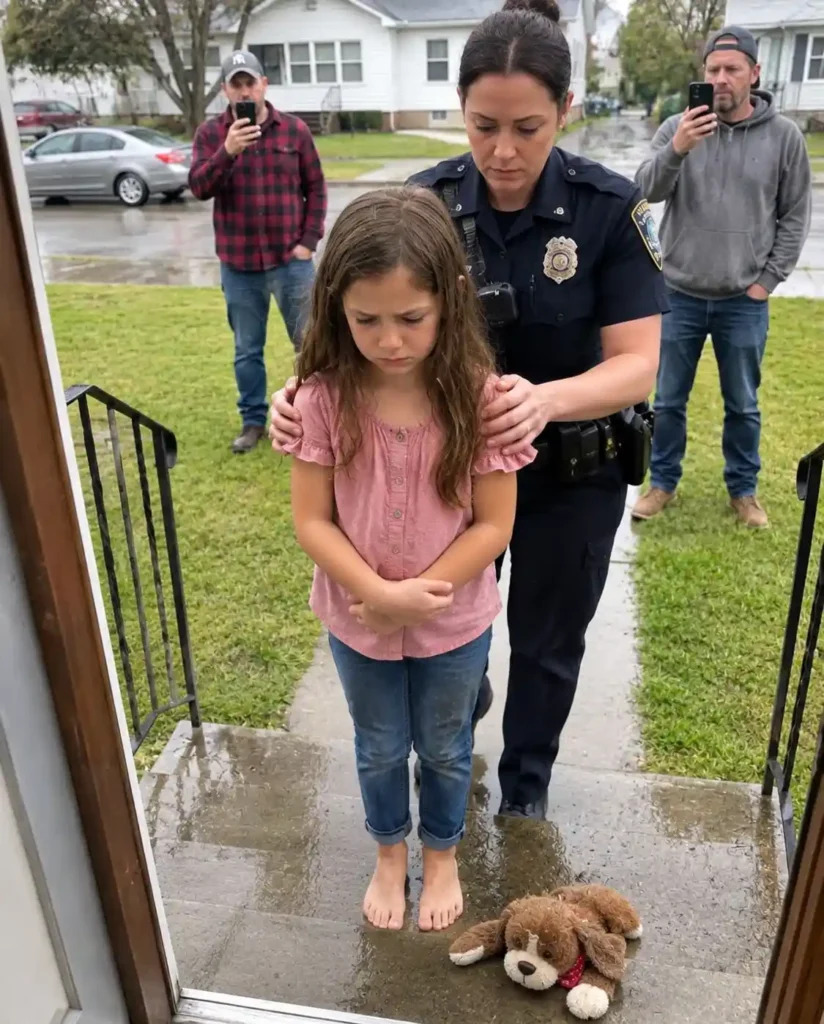
Officer Laura Benson arrived at the small house on Linden Street about fifteen minutes later.
Rain had been falling since early morning. The front yard was untidy, a few leaves were scattered across the porch, and a children’s bicycle lay on its side near the driveway.
Laura knocked gently.
“Hello? Is anyone home?”
A moment later, the door opened a few inches.
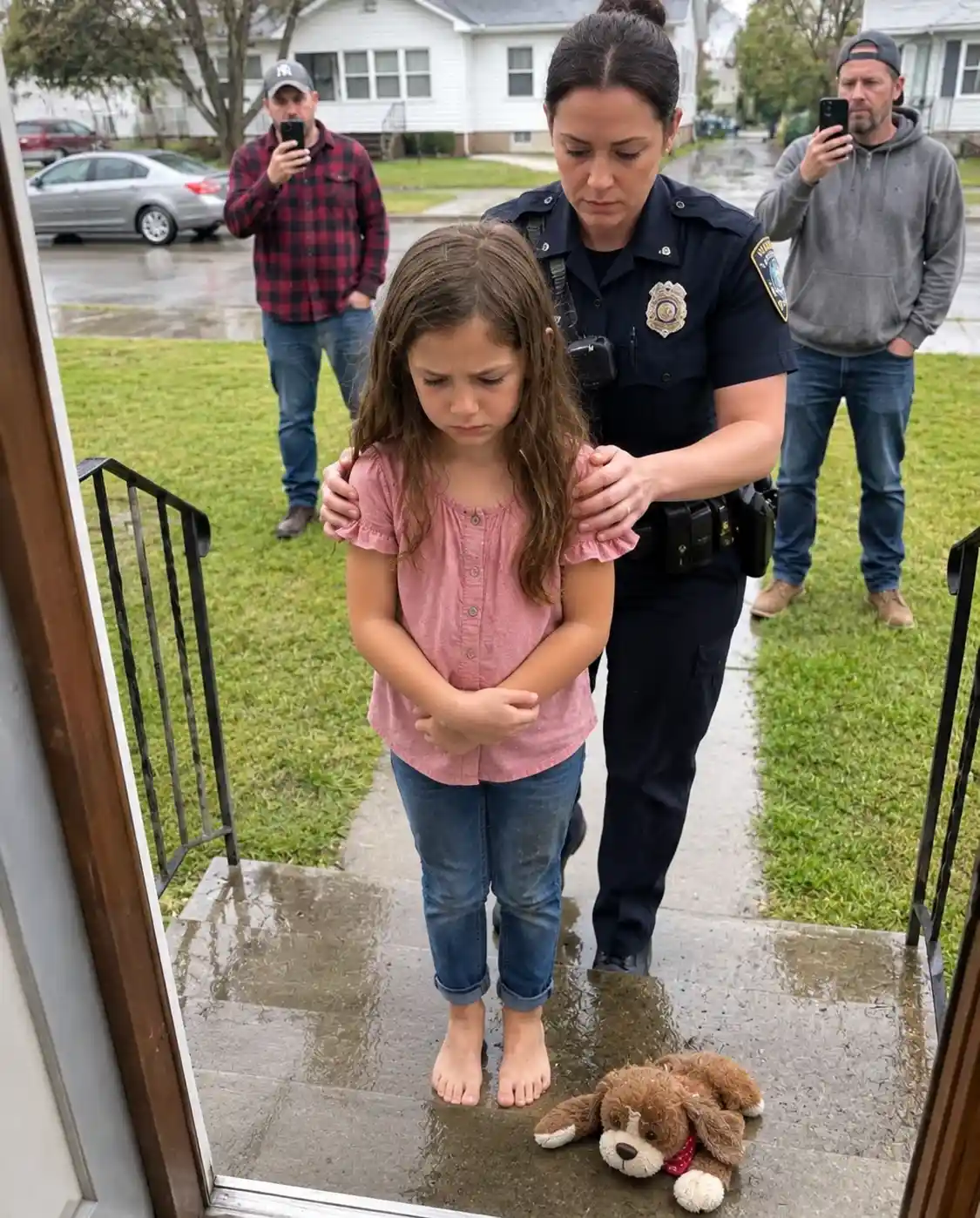
A little girl stood behind it, wearing an oversized gray shirt and holding a stuffed puppy with one floppy ear.
“Are you the police officer?”
“Yes, sweetheart. I’m Laura. Victor asked me to come and check on you.”
Ashley looked at the uniform and then at Laura’s face.
“Are you going to take me away?”
Laura immediately crouched down.
“No, honey. I’m here to make sure you’re safe. Can I come inside?”
Ashley stepped aside.
The house was surprisingly tidy. A small blanket was folded on the couch, toys were arranged in a plastic basket, and a photograph of a smiling woman stood on the living room shelf.
Laura recognized the woman from a family photograph she had seen in the missing-person database.
It was Ashley’s mother.
She had died two years earlier.
“Is this your mommy?” Laura asked.
Ashley nodded.
“Daddy says she would be proud of me because I try to be brave.”
Laura smiled gently.
“I’m sure she would be.”
As she looked around, Laura noticed several things that seemed important.
The refrigerator was almost empty. There were two medicine bottles on the kitchen counter, and a handwritten shopping list was lying beside them.
Milk.
Bread.
Chicken soup.
Grape juice.
Ashley’s medicine.
Underneath the list was a hospital appointment card.
Pediatric kidney clinic — Tuesday, 10:30 a.m.
Laura picked it up carefully.
“Does your daddy usually take you to the doctor?”
“Every time. He never misses my appointments.”
“Did he tell you why he was going out that morning?”
“He said my medicine was almost finished. He wanted to buy more before the pharmacy closed.”
Ashley looked down at her stuffed puppy.
“He also said he would bring me grape juice because I was being a good girl.”
Laura noticed something else.
Three small marks had been drawn on the inside of the front door with a pencil.
“What are these?”
Ashley looked up.
“That’s how Daddy knocks. Three times. He told me never to open the door unless I heard those knocks.”
Laura glanced at the lock.
The door had been secured from the inside.
Four days had passed, and Ashley had followed her father’s instructions faithfully.
But he had never returned.
Outside, several neighbors had gathered after noticing the police vehicle.
A woman named Margaret Wilson approached Laura.
“I heard about the little girl,” she said. “It’s terrible what happened.”
“Do you know her father?” Laura asked.
“Everyone around here knows Raymond. He’s a quiet man, but honestly, I’ve never understood how he manages everything by himself.”
Another neighbor joined the conversation.
“He works long hours, doesn’t socialize, and barely talks to anyone. Maybe he finally decided he couldn’t handle raising a child alone.”
Margaret nodded.
“It’s sad, but some people shouldn’t become parents if they can’t take responsibility.”
Laura looked at her.
“Has anyone actually seen him leave his daughter alone before?”
Neither neighbor answered.
“Then let’s not decide what happened before we know the facts,” Laura said.
She returned inside and examined the shopping list once more.
Raymond had not left a suitcase behind. His clothes were still hanging in the bedroom, his work boots were beside the door, and a half-finished cup of coffee sat on the kitchen counter.
Everything suggested he had expected to return.
Laura contacted medical responders and arranged for Ashley to be examined immediately.
Before leaving, Ashley turned toward the living room.
“Can I bring Buddy?”
“Of course.”
The little girl picked up her stuffed puppy and followed Laura outside.
At the hospital, doctors discovered that Ashley was dehydrated and needed careful monitoring because of her kidney condition. She had also missed several doses of her prescribed medication.
Fortunately, the medical team was able to stabilize her.
Laura stayed nearby while another officer began investigating Raymond’s disappearance.
They checked nearby pharmacies, grocery stores, hospitals, and traffic cameras.
At first, there was no useful information.
Then a pharmacy employee remembered a man who had visited on Monday morning.
“He was in a hurry,” the employee explained. “He asked whether we had his daughter’s prescription ready. He seemed worried about something.”
“Did he leave with the medicine?”
“Yes. He also bought a bottle of grape juice. I remember because he asked whether we had the smaller bottles for children.”
Laura immediately wrote that down.
“Did you see where he went afterward?”
The employee thought for a moment.
“He walked toward the main road. I remember him stopping to help an older woman who was having trouble carrying her shopping bags.”
“Do you know the woman’s name?”
“No, but I think she lives around here.”
That detail gave Laura a new direction.
She requested nearby traffic camera footage.
A recording from a convenience store showed Raymond walking along the sidewalk at approximately 9:25 a.m.
He was carrying a small pharmacy bag.
A few minutes later, an elderly woman dropped her groceries near a pedestrian crossing. Raymond stopped to help her.
The recording showed him placing the bags beside a bench.
Then he suddenly grabbed the side of his head, stumbled, and collapsed near the curb.
A delivery van driver pulled over and called emergency services.
The ambulance arrived shortly afterward.
But there was one problem.
The hospital had admitted the unidentified man without connecting him to the missing-person report.
Laura immediately contacted the hospital.
At County General, a nurse checked the admission records.
“There was a man brought in on Monday morning,” she said. “He suffered a serious head injury after collapsing near the road. He hasn’t been able to provide his identity.”
Laura showed her the photograph.
The nurse studied it carefully.
“I believe that’s our patient.”
Laura followed her down the corridor.
Room 214 was quiet except for the steady sound of medical equipment.
A man lay beneath a white blanket, with a bandage covering part of his forehead.
Laura approached the bedside.
It was Raymond Miller.
Ashley’s father had been in the hospital for four days.
While his daughter waited at home, he had been unconscious in a room less than twenty minutes away.
The nurse explained that Raymond had suffered a head injury during the fall. He had also experienced a medical complication that required additional treatment.
“He’s stable,” she said, “but his recovery may take some time.”
Laura looked at the small bag of belongings beside his bed.
Inside were his wallet, keys, and a pharmacy receipt.
There was also a small bottle of grape juice.
Laura stared at it for several seconds.
He had remembered his promise.
Even after everything that happened, he had been carrying the very thing he had promised to bring home to his daughter.
The next morning, Laura returned to the hospital with news.
Ashley was sitting in a chair beside her bed, coloring a picture of a house.
“Officer Laura!”
“Hello, sweetheart.”
“Did you find Daddy?”
Laura smiled.
“Yes. We found him.”
Ashley dropped her crayons.
“Where is he?”
“He’s at this hospital. He’s been hurt, but the doctors are taking care of him.”
“Can I see him?”
Laura nodded.
“Let’s go.”
Ashley held Buddy tightly as they walked down the hallway.
When the nurse opened the door to Room 214, the little girl stopped.
Her father was lying in bed, looking much thinner and paler than she remembered.
“Daddy?”
She approached slowly.
“Daddy, it’s me.”
She placed her hand over his.
“I waited for you. I didn’t open the door for anyone. I even saved Buddy’s place beside me.”
Raymond remained still.
Ashley looked toward Laura.
“Why isn’t he talking?”
“He’s still recovering, sweetheart. Sometimes it takes a little while.”
Ashley climbed onto the chair beside the bed.
“I brought you something.”
She placed a folded drawing on his blanket.
It showed a little girl standing beside a tall man. Above them was a yellow sun, and beneath the picture were the words:
Daddy and Ashley. Always together.
Then she leaned forward and whispered:
“I knew you weren’t leaving me.”
A few seconds passed.
Raymond’s fingers moved.
Ashley froze.
“Daddy?”
His eyelids fluttered.
The nurse hurried over as Raymond slowly opened his eyes.
He looked confused at first, then his gaze settled on the little girl beside him.
“Ashley?”
She burst into tears.
“Daddy!”
Raymond tried to lift his hand.
Laura helped Ashley hold it.
“I’m sorry, sweetheart,” he whispered.
Ashley shook her head.
“You came back. That’s all that matters.”
Raymond closed his eyes briefly, fighting back tears.
Then he looked at Laura.
“Did you find the woman?”
Laura frowned.
“Which woman?”
“The one I was helping. The woman near the crossing.”
Laura understood immediately.
“Yes. We’re still trying to identify her.”
Raymond took a shallow breath.
“I remember helping her with the groceries. Then everything went dark.”
He looked toward Ashley.
“Is she okay?”
Laura nodded.
“Your daughter is safe. She’s receiving treatment, and we’re arranging everything she needs.”
Raymond’s shoulders relaxed.
For the first time since waking up, he seemed able to breathe without fear.
Later that afternoon, Laura returned to the police station and reviewed the remaining evidence.
She had also received a call from Emily Carter, the social worker whose number appeared on a paper found at the pharmacy.
Emily explained that Raymond had visited her office the previous week.
“He was worried about what would happen to Ashley if he ever became seriously ill,” she said. “He has very little family nearby, and he’s been raising her alone since his wife passed away.”
“Was he planning to give up custody?”
“No. Quite the opposite. He wanted to make sure Ashley would have someone she trusted if he ever needed medical treatment.”
Emily explained that Raymond had been working with the hospital to arrange a family support plan.
He had also been trying to contact a woman named Margaret Wilson.
Laura was surprised.
Margaret was the neighbor who had criticized him outside his house.
But there was more to the story.
Margaret had been a close friend of Raymond’s late wife. Before she died, she had asked Margaret to look after Ashley whenever Raymond needed help.
Over time, however, Raymond had become uncomfortable asking for favors. He worked extra shifts, handled every appointment, and rarely discussed his personal difficulties.
He had finally decided to approach Margaret again.
The envelope at the pharmacy contained a letter asking whether she would be willing to become Ashley’s emergency caregiver if he ever needed hospitalization.
There was also a note explaining that he had been struggling to manage his daughter’s medical expenses and wanted to make sure she would never be left without support.
Laura realized that Raymond’s greatest fear had never been losing his freedom or escaping his responsibilities.
It was leaving Ashley without anyone to care for her.
The following afternoon, Laura visited Raymond’s hospital room.
He was awake and able to speak more comfortably.
“I owe you an explanation,” he said.
“You don’t owe me one,” Laura replied. “But your daughter has been asking questions.”
Raymond looked toward Ashley, who was sitting on the floor drawing with a nurse.
“I know.”
He explained that his wife, Susan, had died after a long illness. Since then, he had organized his entire life around Ashley.
He worked at a repair shop during the day and occasionally took evening shifts to cover medical bills.
He rarely complained because he didn’t want his daughter to feel that she was a burden.
On Monday morning, he had gone to the pharmacy to collect her medication. On his way back, he noticed an elderly woman struggling with her groceries.
He stopped to help.
A few minutes later, he experienced a sudden medical episode, fell, and struck his head against the pavement.
He remembered hearing someone asking whether he could hear them.
After that, everything disappeared.
“Did you think I had abandoned her?” he asked quietly.
Laura shook her head.
“I knew something wasn’t right. Your shopping list, the appointment card, and the things you had left behind told a different story.”
Raymond looked down.
“People around here probably think I’m a terrible father.”
Laura didn’t answer immediately.
Then she said something he would remember for a long time.
“Some people formed an opinion before they knew what happened. But the people who matter will eventually learn the truth.”
Three days later, Raymond was discharged from the hospital.
Ashley was waiting near the entrance with Buddy tucked under her arm.
When she saw her father walking toward her with the help of a nurse, she ran forward.
“Daddy!”
He bent carefully and wrapped his arms around her.
“I missed you, princess.”
“I missed you more.”
Raymond kissed her forehead.
“I’m never going to forget how brave you were.”
Ashley looked up at him.
“Can we go home now?”
“Yes, sweetheart. We’re going home.”
Before they left, Laura handed Raymond the envelope recovered from the pharmacy.
“I think this belongs to you.”
He opened it and found the letter he had written to Margaret.
He read it quietly, then looked toward the hospital entrance.
“There’s something I need to do first.”
When Raymond and Ashley returned to Linden Street, several neighbors were outside.
Margaret was standing near her fence.
She approached slowly.
“Raymond, I’m glad you’re home.”
He nodded politely.
She looked at Ashley and then back at him.
“I owe you an apology.”
Raymond said nothing.
Margaret continued.
“I heard people talking, and I joined them. I assumed the worst without knowing anything about what had happened. I should have come to your door and asked whether you needed help.”
Raymond looked down at his daughter.
For a moment, he seemed unsure what to say.
Then he handed Margaret the envelope.
“I was actually trying to ask you for something before all this happened.”
She opened it and read the letter.
Her eyes filled with tears.
It was a request for her to become Ashley’s emergency caregiver whenever Raymond needed medical treatment.
At the bottom, he had written:
I know Susan trusted you. I hope you can help me keep one promise to her: that Ashley will always have someone she can turn to.
Margaret covered her mouth.
“Oh, Raymond.”
“I didn’t want to bother you,” he said. “But I realized I couldn’t do everything alone.”
Margaret folded the letter carefully.
“You should never have had to feel that asking for help was a burden.”
She looked at Ashley.
“And I would be honored to help take care of her.”
Ashley smiled.
“Does that mean you can come over and make pancakes with us?”
Margaret laughed through her tears.
“If your daddy agrees, I’d love that.”
Raymond finally smiled.
“I think we can arrange that.”
Over the following weeks, things slowly returned to normal.
Raymond attended his follow-up appointments and worked with the hospital to organize Ashley’s medical care. Margaret helped with school pickups and occasionally brought dinner when he had difficult days.
For the first time in a long while, Raymond allowed himself to accept help.
The neighbors also began treating him differently.
Some apologized. Others quietly offered assistance.
But Raymond never asked anyone to feel sorry for him.
One Saturday morning, Laura stopped by to check on the family.
Ashley was sitting at the kitchen table, drawing another picture.
This time, it showed three people standing outside a little blue house.
There was Raymond, Ashley, and Margaret.
Above them, she had drawn a bright yellow sun.
Laura smiled.
“That’s a lovely picture, Ashley. Who are all these people?”
Ashley pointed proudly.
“That’s Daddy, that’s me, and that’s Miss Margaret. She’s helping us now.”
Laura nodded.
“And where’s Buddy?”
Ashley held up the stuffed puppy.
“He’s here. He’s part of the family too.”
Everyone laughed.
As Laura prepared to leave, Raymond walked her to the front door.
“Officer Benson, I don’t know how to thank you.”
“You don’t have to thank me. You were trying to get home to your daughter. I’m just glad we found you.”
Raymond looked back at Ashley.
“She waited four days.”
Laura nodded.
“And she never stopped believing you would return.”
He swallowed, his eyes growing wet.
“I hope she never has to be that brave again.”
Laura paused before answering.
“Then let the people around you help. You don’t have to carry everything alone.”
Raymond nodded.
When Laura stepped onto the porch, Ashley ran toward the door.
“Officer Laura!”
Laura turned.
“Yes, sweetheart?”
Ashley held up her latest drawing.
“Can you give this to Victor? The man who answered my phone call?”
“Of course. He would love that.”
At the top of the picture, Ashley had written a message in colorful letters:
Thank you for helping me find my daddy.
Laura promised to deliver it.
And as she drove away, she thought about the four days when a little girl had sat beside a locked door, listening for three familiar knocks.
Her father hadn’t forgotten his promise.
He hadn’t walked away.
He had simply been unable to make it home.
And perhaps the most important lesson was not that the neighbors had been wrong about Raymond.
It was that they had been so quick to judge a man whose greatest struggle had been trying to make sure his daughter never felt alone.
Editor’s Note: This fictional story highlights a father’s devotion, a child’s courage, and the importance of offering help instead of making assumptions about families facing difficult circumstances.
Latest Posts
- After spending two peaceful weeks visiting my sister in Florida, I returned and found 15 strangers sleeping in my living room.

- After serving almost four years in prison for a crime I maintained I never committed, I was released with $75, a small bag of clothing, and nowhere to go.

- My 14-Year-Old Stepdaughter Pulled My Little Boy Away From His School Bus, and the Missing Piece of His Backpack Explained Everything

- A 7-Year-Old Girl Called 911 After Her Father Disappeared For Four Days and then Police Discovered What Really Happened

- A Sheriff Arrested a Woman in a Diner, Never Knowing She Was a Federal Judge Investigating Him

- My Husband Said I Lost Both Arms in a Car Accident. Three Years Later, a Doctor Revealed the Truth He Had Hidden From Me



About the Author
Hassan is the founder and editor of MidnightReads, a publication featuring thoughtful stories, human-interest articles, history, relationships, and entertaining reads.
He is involved in researching, writing, and editing content for the site, with a focus on creating original, clear, and useful articles that give readers something meaningful to take away.
Hassan believes good content should inform, entertain, and encourage curiosity.
— Hassan, Founder & Editor, MidnightReads