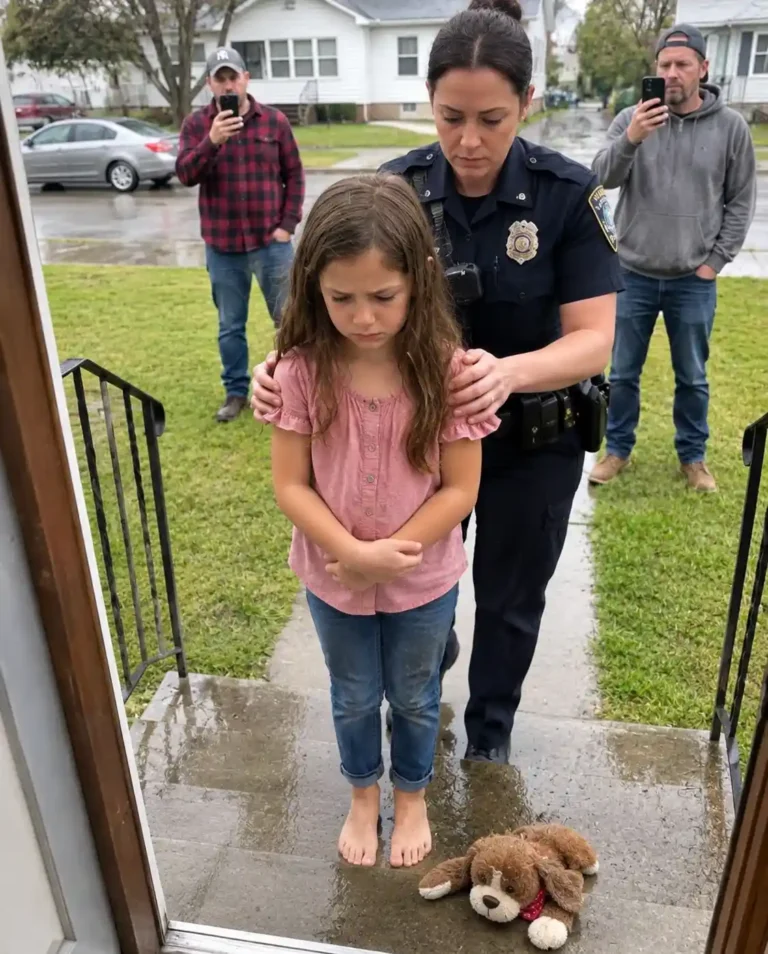

After serving almost four years in prison for a crime I maintained I never committed, I was released with $75, a small bag of clothing, and nowhere to go.
My husband had taken control of my business, my younger sister was managing its finances, and neither of them would return my calls.
I spent nine days looking for work before a seventy-four-year-old widow offered me a live-in housekeeping position. She knew about my conviction, but it didn’t seem to change her decision.
For twelve days, I concentrated on rebuilding my life. Then, during dinner one evening, she asked what had actually landed me in prison.
After hearing how my husband and sister had betrayed me, she quietly left the dining table and returned with a man’s name and telephone number.
I had no idea that one phone call would eventually lead me back to my former home and uncover something my family had gone to extraordinary lengths to hide.
My name is Rebecca Hale. I’m thirty-six years old, and I spent almost four years behind bars on a five-year sentence for financial fraud.
Fraud I never committed.
Before my arrest, I owned Buckeye Medical Supply, a medical equipment distribution business based in Ohio.
I’d started with a small rented shop and gradually built the company into a business supplying equipment to several private medical clinics.
I owned a comfortable house in Dublin, earned a dependable living, and was married to a man I trusted completely.
His name was Trevor Mallory.
He managed the company’s sales operations, while my younger sister Monica supervised the office finances.
I believed the three of us were building something together.
That mistake nearly destroyed everything.
When I finally walked out of the Ohio Reformatory for Women in Marysville, Trevor was running my company, Monica remained in charge of its finances, and the home I’d helped purchase had been mortgaged without my knowledge.
I called both of them.
Neither answered.
I left the prison gates with seventy-five dollars and a small bag containing my clothes.
That was everything I owned.
I had no vehicle, nowhere to stay, and no job.
Whenever a potential employer conducted a background check, my conviction appeared.
Over the next nine days, I approached several businesses looking for work.
One employer rejected me after an interview. Another stopped speaking to me when I disclosed my criminal record. A third explained that hiring someone with my history would be too much of a risk.
Eventually, I found a handwritten notice pinned to a bulletin board inside a small grocery store in Worthington.
Live-in housekeeper needed. Duties include cooking, cleaning, and general household assistance. Housing and meals included. Weekly pay: $600.
I copied the telephone number and called immediately.
An older woman answered.
“Are you able to cook?” she asked.
“Yes, ma’am.”
“Can you maintain an orderly household?”
“Absolutely.”
“Then come by tomorrow morning. We can discuss it.”
Her name was Opal Hargrove.
She was a seventy-four-year-old widow who lived alone in a beautiful old house surrounded by trees.
When she answered the door, she was dressed in navy blue. Her white hair was neatly arranged, and her eyes were surprisingly sharp.
She invited me inside and led me to the kitchen.
We discussed cooking and housekeeping before she brought out a shoebox filled with receipts.
“Could you organize these for me?”
I examined the contents.
“Of course. If you’d like, I could also set up a proper bookkeeping system.”
One eyebrow rose.
“You have experience with bookkeeping?”
“A great deal.”
“Interesting. How soon could you begin?”
I hesitated.
“Mrs. Hargrove, there’s something you should know before making your decision. I recently got out of prison.”
She looked at me calmly.
“What was the conviction for?”
“Financial fraud.”
She watched me for a moment.
“Are you capable of doing the work we’ve discussed?”
“Yes, ma’am.”
“Then that’s where we’ll begin.”
I could hardly believe what I was hearing.
“You mean you’ll still give me the job?”
Opal folded her hands.
“Rebecca, I wanted to know whether you could prepare meals, keep my home clean, and organize my household paperwork. I never asked you to prove you’d gone through life without experiencing difficulties.”
I came close to crying.
For the first time since my arrest, someone had treated me like a person rather than a criminal record.
The following evening, I carried my belongings into a little bedroom overlooking Opal’s garden.
There was a comfortable mattress, a wooden chest of drawers, and a window I could actually open.
On my first night, I sat on the edge of the bed for nearly an hour.
Eventually, I closed the bedroom door.
Nobody turned a key on the other side. Nobody instructed me to switch off the lamp.
For the first time in several years, I experienced a small measure of peace.
I threw myself into the work.
I prepared Opal’s meals, cleaned the rooms, washed the clothes, and organized years of household receipts.
Within a week, I’d established a straightforward system for tracking her expenses and bills.
Opal seemed impressed.
“You certainly have a talent for numbers for someone who came here looking for kitchen-cleaning work.”
I smiled.
“I owned a company once.”
She looked at me briefly, then nodded.
She didn’t ask me to explain.
But something unusual happened during that first week.
While sweeping the porch, I noticed a gray sedan parked across the street.
I couldn’t make out the person behind the wheel.
When I moved toward the driveway, the car drove away.
Two days later, it returned.
This time, I noticed a man inside who appeared to be photographing the property.
As soon as he realized I was watching, he pulled away.
I wondered whether Trevor had discovered my new address, but I had no proof.
I recorded the time and the few characters of the license plate I’d managed to catch.
Then I hid the notes in my room.
On the twelfth evening after I arrived, Opal asked me to join her for dinner.
Usually, I served her food and waited until she finished before eating my own meal.
That evening was different.
She had prepared chicken soup herself.
“Have a seat, Rebecca. I made plenty for two.”
We ate quietly for several minutes.
Then Opal lowered her spoon.
“Would you mind if I asked you something personal?”
I nodded.
“What actually happened that caused you to end up in prison?”
My fingers went still around the spoon.
For a few seconds, I considered giving her a simple explanation.
But something about the way she looked at me made me feel that I could finally tell someone the truth.
“My husband and my sister used my identity to transfer money out of my business,” I explained. “Afterward, they persuaded everyone that I’d done it myself.”
Opal listened without interrupting.
I told her how I’d established Buckeye Medical Supply with almost no resources.
I’d worked weekends, delivered orders with my own hands, and spent countless evenings trying to secure contracts.
Eventually, Trevor joined the company to manage sales. Later, I brought Monica into the business to handle financial records.
They were my family.
That was why I trusted them.
Then Trevor’s mother, Loretta, became gravely ill.
I spent weeks helping care for her at the hospital.
It was during that time that questionable transactions started appearing in the company’s accounts.
Substantial amounts were being paid to a supplier I’d never worked with.
The records indicated that I’d authorized the payments.
I hadn’t.
When investigators began examining the transactions, Trevor told them I’d instructed him to transfer the money.
Monica supplied paperwork that appeared to support his version of events.
I insisted they were lying, but the documents seemed to implicate me.
My lawyer couldn’t establish that someone had altered the records, and the jury found me guilty.
Meanwhile, the two people I’d trusted most continued enjoying the life I’d spent years creating.
By the time I finished, the soup in front of me was cold.
Opal remained quiet.
Finally, she asked, “Do you have any documents left from before your arrest?”
“A few. I managed to store some personal copies in a safe place before everything fell apart.”
“Any bank records?”
“A few statements. Some contracts as well.”
She nodded thoughtfully.
“That’s good.”
I looked at her.
“Why do you ask?”
Rather than answer, Opal rose and walked into the adjoining room.
I heard her open a drawer, then another.
About a minute later, she returned with a folded sheet of paper.
She placed it on the table.
A man’s name was written across it.
Russell Keane.
A telephone number appeared underneath.
“Who is Russell Keane?” I asked.
“He’s a financial investigator. He assisted me several years ago when I was dealing with serious complications connected to my late husband’s business.”
I stared at the paper.
“Do you think he might be able to help?”
“I can’t guarantee anything. But Russell is exceptionally skilled at tracing financial transactions. He also knows how to spot paperwork that isn’t telling the complete truth.”
Tears gathered in my eyes.
For almost four years, I’d tried to make people understand that I was innocent.
Most eventually refused to listen.
Some accused me of lying. Others simply turned away.
Yet here was a woman who had known me for fewer than fourteen days, offering me something I’d almost forgotten existed.
Hope.
“Why are you willing to do this for me?” I asked.
Opal looked toward the front window.
“Because sometimes, Rebecca, the truth gets hidden under stacks of documents. And sometimes the people responsible for hiding it are the very people we trust most.”
I folded the paper carefully and put it in my pocket.
I had no idea whether Russell could help me.
But at least I finally had somewhere to start.
The following morning, I sat at the kitchen table for almost twenty minutes before dialing Russell’s number.
I picked up the paper, put it down, and picked it up again.
What if he didn’t believe me?
What if he thought I was another former prisoner trying to blame someone else?
Eventually, I took a breath and called.
A man’s voice answered after the fourth ring.
“Russell Keane speaking.”
“Hello, Mr. Keane. My name is Rebecca Hale. Opal Hargrove gave me your number.”
There was a brief silence.
“Rebecca Hale? Opal mentioned you might call. She told me a little about your situation.”
I tightened my grip on the telephone.
“I don’t know what she told you, but I was convicted of financial fraud involving a business I owned. I maintain that I was innocent. My husband and younger sister were involved, but I couldn’t prove what they had done.”
Russell didn’t interrupt.
Then he asked, “Do you still have access to any original business documents?”
“Not to the company records. My husband took control of the business after my arrest. But I saved a few personal copies before everything happened.”
“Good. Don’t send anything to anyone just yet. I’d like to meet you and examine what you have.”
We arranged to meet three days later at a small office in Columbus.
When I hung up, Opal was standing near the kitchen doorway.
“Well?”
“He agreed to meet me.”
She smiled faintly.
“That’s a start.”
Russell’s office was on the second floor of an older commercial building.
He was in his early sixties, with silver hair, thin-framed glasses, and a habit of listening without rushing people.
After introducing himself, he asked me to explain everything from the beginning.
I described how I’d established Buckeye Medical Supply, how Trevor joined the company, and how Monica eventually became responsible for its financial records.
I also explained the transactions that had led to my arrest.
Russell examined the documents I’d brought.
Inside the folder were several bank statements, copies of supplier agreements, and printed emails.
He stopped at one particular statement.
“Do you recognize this company?”
I leaned forward.
The name printed on the document was Northfield Distribution Services.
“No. I’ve never done business with them.”
“According to this statement, your company transferred $48,600 to that account.”
I stared at the figure.
“I never authorized that payment.”
Russell turned the page.
“What about this signature?”
It looked like mine.
But something about it was wrong.
I examined it more closely.
“That’s supposed to be my signature, but I didn’t sign this document.”
He placed another paper beside it.
“Look at the letter R.”
I compared the two signatures.
My genuine signature had a distinctive shape. I always finished the final stroke with a slight upward curve.
The signature on the payment authorization ended differently.
“Could someone have copied my signature?” I asked.
“Possibly. But we need more than a visual comparison. A qualified document examiner would have to assess the originals.”
He made a few notes.
Then he asked another question.
“Who had access to your company’s financial accounts?”
“Trevor and Monica. I also had access, but I was usually away from the office during that period.”
“Did either of them have permission to authorize payments?”
“Yes. Trevor could approve certain operational expenses, and Monica handled the financial records. But transfers of that size required my approval.”
Russell leaned back.
“That distinction may be important.”
I felt my heart beating faster.
“Do you think they framed me?”
“I think there are questions here that deserve proper investigation. I’m not going to promise you an answer before we’ve examined the evidence.”
It wasn’t the reassurance I wanted, but it was the first honest assessment anyone had given me in years.
Before I left, Russell asked me to prepare a detailed timeline of everything I remembered.
He also advised me not to contact Trevor or Monica about the investigation.
“People sometimes destroy records when they realize someone is looking for them. Let your attorney handle any formal requests.”
I agreed.
As I walked outside, I noticed a missed call on my phone.
It was from an unfamiliar number.
I ignored it.
A few minutes later, the same number called again.
This time, I answered.
“Rebecca?”
I froze.
I recognized the voice immediately.
It was Trevor.
“Where are you?” he demanded.
I stopped walking.
“Why are you calling me?”
“Don’t play games. I know you’ve been asking questions about the company.”
My mouth went dry.
I hadn’t mentioned Russell’s investigation to anyone except Opal.
“Who told you that?”
“That’s not important. Listen carefully. You need to stop contacting people connected to Buckeye Medical Supply.”
I felt anger rising inside me.
“You mean the company I built?”
A bitter laugh came through the telephone.
“That company belongs to me now.”
“No, Trevor. You took it from me.”
“Watch your words, Rebecca. You’ve already spent enough time in prison. I wouldn’t recommend making accusations you can’t prove.”
For a moment, I couldn’t speak.
Then I remembered Russell’s advice.
Don’t give them information.
Don’t let them know what you have.
“Goodbye, Trevor,” I replied.
I ended the call.
My hands were shaking.
He hadn’t called to ask how I was doing.
He hadn’t asked where I was living or whether I had found work.
He had called because he was worried about what I might discover.
That realization stayed with me all the way back to Opal’s house.
When I told her what had happened, she didn’t appear surprised.
“Did you tell him about Russell?”
“No.”
“Did you tell him what documents you showed Russell?”
“No.”
“Good. Keep it that way.”
She paused.
“Rebecca, you don’t have to prove your innocence by confronting those people. You need evidence, proper legal advice, and patience.”
I nodded.
For once, I listened.
Over the following week, Russell examined the documents and began identifying companies connected to the suspicious transactions.
He also helped arrange for an attorney experienced in post-conviction cases to review my situation.
I learned that reopening a criminal case would not be easy.
There were legal deadlines, evidentiary requirements, and procedures that had to be followed.
But there was something else.
Russell had discovered that Northfield Distribution Services had been registered only a few months before the suspicious transfers began.
Its listed business address was a rented mailbox.
The company had no obvious record of operating a medical equipment distribution business.
And the bank account receiving the money had been opened using identification connected to someone named Daniel Mercer.
I recognized the name.
Daniel had once worked as a bookkeeper for Buckeye Medical Supply.
He had left the company shortly before the investigation began.
“Do you know where he is now?” Russell asked during our next meeting.
“Not exactly. I heard he moved out of Ohio.”
Russell wrote down the name.
“That gives us another lead to examine.”
He explained that the account ownership and transaction history would need to be obtained through proper legal channels.
Nothing was conclusive yet, but the information was important enough for the attorney to request further investigation.
Then, two days later, something unexpected happened.
Opal received a letter.
It had been delivered by regular mail without a return address.
She brought it into the kitchen and placed it on the counter.
“Is this yours?” she asked.
I shook my head.
She opened it carefully.
Inside was a single sheet of paper.
There were only two sentences.
Tell Rebecca to stop digging into the past. Some things are better left buried.
I read it twice.
My throat tightened.
“Do you think Trevor sent this?”
“I don’t know,” Opal replied. “And neither should we assume anything without evidence.”
She placed the letter back inside its envelope.
“We’ll give it to Russell and let the appropriate people decide what to do with it.”
I looked toward the front window.
The same uneasy feeling I’d experienced when I first noticed the gray sedan returned.
Someone knew I was asking questions.
Someone wanted me to stop.
But I wasn’t going to let an anonymous letter decide what happened to the rest of my life.
Three weeks after my first meeting with Russell, my attorney arranged for me to collect some personal belongings that had remained at my former house.
I hadn’t seen the property since my arrest.
The house stood in Dublin, on a quiet street lined with mature trees.
When the car pulled into the driveway, my chest tightened.
I remembered painting the front door.
I remembered planting flowers beside the walkway.
I remembered Trevor carrying boxes into the house on the day we moved in.
For a moment, I could almost imagine that nothing had happened.
Then the front door opened.
Monica stepped outside.
She was wearing an expensive cream-colored coat and holding a set of keys.
“Well, look who’s back,” she said.
I stepped out of the car.
My attorney remained beside me.
“I’ve come to collect my personal belongings.”
Monica folded her arms.
“There’s nothing here that belongs to you.”
“That’s not true.”
She looked toward my attorney.
“Who is this?”
“My attorney.”
Her expression changed slightly.
Then she turned back toward me.
“Rebecca, you need to accept that your old life is over.”
I looked at her carefully.
“Did you really believe I’d never come back?”
She gave a small laugh.
“You spent almost four years in prison. What exactly do you think you’re going to accomplish now?”
I didn’t answer.
My attorney explained that we were there under an arrangement to retrieve specific personal property.
Monica reluctantly stepped aside.
While we waited near the entrance, I noticed something on her wrist.
A gold watch.
I stared at it.
It was my father’s.
He had given it to me when I graduated from college, telling me that I should always remember the value of time and the importance of using it wisely.
I’d kept it in a small wooden box in my bedroom.
After his death, it became one of the few possessions I treasured more than anything else.
“Where did you get that watch?” I asked.
Monica glanced down.
“This?”
“That belonged to Dad.”
She smiled.
“He gave it to me.”
“No, he didn’t.”
Her expression hardened.
“You’re confused. You should be careful about making accusations.”
I felt something inside me break.
“Monica, I kept that watch for years. You know exactly where it came from.”
She stepped closer.
“Maybe you should worry less about a watch and more about your own situation.”
My attorney intervened before the argument could continue.
We collected the few belongings that had been agreed upon and left.
But as we drove away, I couldn’t stop thinking about that watch.
It wasn’t simply an object.
It represented my father.
And Monica had taken it just as she had taken so many other things.
I thought that seeing her wearing the watch was the worst part of that visit.
I was wrong.
Because two days later, she called me again.
She wanted to meet privately.
And this time, she wasn’t coming to talk about my belongings.
She was bringing something that would reveal just how little she thought my freedom was worth.
Read Part 2 to discover what Monica threw at Rebecca’s feet, why she was so desperate to silence her, and what a former company bookkeeper had kept hidden for years.
Part 2
Two days after my visit to my former home, Monica called me again.
She told me she wanted to speak privately.
I knew it was probably a mistake, but I agreed to meet her outside the house.
When I arrived, she was already standing on the lawn.
She had an envelope in her hand.
“If you ever bring up my name again, Rebecca, I’ll see to it that you’re sent right back to prison.”
I stared at her.
Before I could respond, she tossed the envelope onto the grass.
Cash slipped out of the opening and scattered across the lawn.
“Take the money and get out of my life.”
I looked down at the bills.
Then I looked at her wrist.
The gold watch was still there.
“I don’t want your money,” I said quietly. “You’ve already stolen four years from me. You don’t get to purchase whatever’s left.”
Monica laughed.
“You honestly believe you can beat me?”
I bent down, picked up the envelope, and held it out toward her.
“Keep it.”
She didn’t take it.
So I placed it on the garden wall.
Then I looked her straight in the eyes.
“You should be worried about the truth, Monica. Not about me.”
For the first time, her smile disappeared.
Only for a second.
But I noticed.
And that was enough.
I turned around and walked toward my car.
I didn’t shout, threaten her, or give her the argument she wanted.
I simply left.
That evening, I told Russell everything that had happened.
He listened, then asked me to write down the exact words Monica had used and preserve any messages or other evidence connected to the encounter.
He also reminded me not to accept money or make private agreements with either of them.
I agreed.
Then he said something that made me sit up.
“Rebecca, there’s been a development.”
“What kind of development?”
“We’ve located someone who may have information about the Northfield account.”
I gripped the telephone.
“Who?”
“Daniel Mercer.”
I couldn’t believe it.
“Have you spoken to him?”
“Not directly yet. His attorney has been contacted, and we’re trying to arrange a formal interview. But there’s something else.”
I waited.
“One of the financial records we’ve obtained through the proper channels suggests that the suspicious account received money from more than one source connected to your former company.”
My heart began racing.
“Does that mean Trevor and Monica were involved?”
“It means we need to investigate further. I don’t want you jumping to conclusions.”
I understood.
But I also knew we were getting closer to something.
Before ending the call, Russell asked me to come to his office the following Monday.
He said there was a document I needed to see.
I barely slept that weekend.
On Monday morning, I arrived at Russell’s office shortly before ten.
He was waiting with my attorney.
A thick folder sat on the desk.
“Rebecca,” he began, “we’ve made progress.”
He opened the folder and placed several pages in front of me.
The first was a financial transaction record.
The second was a copy of an old supplier agreement.
The third was an internal company authorization form.
I recognized the document immediately.
It was one of the forms used at Buckeye Medical Supply whenever a large payment was approved.
But something on it made my blood run cold.
A handwritten note appeared beneath the authorization section.
It contained my sister’s initials.
M.H.
I stared at the page.
“That’s Monica’s handwriting.”
Russell nodded.
“An initial observation, not a final conclusion. Your attorney will need a qualified examiner to assess the document.”
Then he turned to another page.
“This is where things become particularly interesting.”
He pointed toward a date.
It was the same date as one of the largest transfers that had been used against me during my criminal trial.
According to the records, the transaction had been authorized using my company credentials.
But the supporting correspondence appeared to have been created after the payment was already processed.
I read the dates again.
Then once more.
“How is that possible?”
Russell folded his hands.
“That’s exactly what we’re trying to establish.”
My attorney leaned forward.
“If the original records confirm that the supporting documents were created later, it could be significant new evidence. But we need to establish who created them and whether they were presented during your trial.”
I felt tears gathering in my eyes.
For nearly four years, I’d told everyone that the paperwork was wrong.
Now, for the first time, someone was examining the paperwork itself.
Russell closed the folder.
“There’s one more thing you should know. Daniel Mercer has agreed to speak with us through his attorney.”
I looked at him.
“What does he know?”
Russell hesitated.
“He says he was asked to prepare certain financial documents after the transactions had already taken place. And he believes the people who requested those documents were your husband and sister.”
The room became completely silent.
I felt as though the walls were moving closer.
“Did he say why?”
Russell looked at my attorney before answering.
“He says he has something else. Something he kept because he was afraid that one day he might need to prove what happened.”
I swallowed.
“What is it?”
Russell reached into the folder and removed a sealed envelope.
He placed it on the desk.
“An original email printout and an accompanying attachment. We haven’t completed the authentication process, but the material may help establish who was involved in preparing the financial records.”
I stared at the envelope.
For the first time, I understood that the truth might not be lost.
It might simply have been hidden.
A few days later, Russell arranged a meeting with Daniel Mercer through his attorney.
We met in a conference room at a law office.
Daniel looked older than I remembered.
His hair had thinned, and he seemed uncomfortable being in the same room as me.
For several seconds, neither of us spoke.
Finally, I asked the question that had haunted me for years.
“Daniel, did you know I was innocent when I was arrested?”
He lowered his eyes.
“I knew something wasn’t right.”
“That’s not what I asked.”
He looked at me.
“I knew the documents I prepared weren’t telling the whole story.”
My hands tightened around my purse.
“Why didn’t you tell anyone?”
He took a long breath.
“Because I was afraid. Trevor told me the company was already under investigation and that I could be charged if I got involved. Monica told me the paperwork had been approved by you.”
I shook my head.
“They knew I hadn’t approved those transfers.”
Daniel didn’t answer immediately.
Then he opened his briefcase and removed a small folder.
“I kept copies of some emails and financial instructions. I shouldn’t have taken them, but I knew something was wrong.”
Russell leaned forward.
“Are these the originals you mentioned?”
“Some are original printouts. Others are copies of records I retained.”
Daniel explained that he had been asked to prepare supplier documentation after certain payments had already been made.
He said Trevor had provided the information, while Monica had supplied the financial details.
The documents were then placed into the company’s records as if they had been prepared and approved before the transactions.
I felt sick.
“Why would they do that?”
Daniel hesitated.
“I don’t know everything. But I remember one conversation.”
“What conversation?”
He looked directly at me.
“Trevor said the company needed to be transferred before you discovered what was happening.”
I stared at him.
“Transferred to whom?”
Daniel looked down at the folder.
“That’s the part I think you need to understand.”
He removed another page.
It contained the name of a company I’d never heard before.
Hale Family Holdings.
I recognized the surname immediately.
“Why does it have my father’s name?”
Daniel explained that the company had been established shortly before my father’s death.
I had never known about it.
According to the records he had retained, my father had created a separate holding arrangement connected to certain family assets.
I looked at the page again.
“Did Dad own this company?”
“According to the documents, he was one of its original directors.”
My throat tightened.
“What did it have to do with Buckeye Medical Supply?”
Daniel glanced at Russell.
Russell nodded for him to continue.
“There was an agreement involving your father, your business, and a future ownership arrangement. I believe Trevor and Monica discovered it.”
I couldn’t move.
My father had always been careful with money, but he rarely discussed his business affairs with me.
He had told me to keep important documents safe and never sign anything without understanding it.
I had never imagined there was something significant he hadn’t told me.
Russell and my attorney began examining the documents Daniel had supplied.
They explained that the existence of Hale Family Holdings did not automatically prove that anyone had committed fraud.
The company records, ownership history, and relevant agreements needed to be independently verified.
But the documents raised important questions.
A few days later, my attorney contacted me.
“Rebecca, we found something.”
I sat down.
“What?”
“Your father appears to have established an arrangement that could have given you a significant interest in certain business assets.”
I closed my eyes.
“Why didn’t he tell me?”
“There’s a possibility he intended to explain it later. We need to examine the original estate and company documents.”
She explained that one of the documents appeared to connect the holding company to a portion of the business assets I’d used to establish Buckeye Medical Supply.
If authentic, the arrangement might explain why Trevor and Monica had been so determined to gain control of the company.
They hadn’t simply wanted the business.
They may also have wanted to control assets that had been connected to my father’s estate.
I remembered Monica wearing his watch.
I remembered the way she had insisted he gave it to her.
Suddenly, the watch felt like another piece of a much larger puzzle.
But I still didn’t know why she had it.
Several weeks later, Russell contacted me with an update.
The original email records Daniel had retained were being examined as part of the investigation.
One message was particularly important.
It had been sent between Trevor and Monica shortly before the financial investigation began.
The subject line read:
Company Transfer – Final Arrangements
My attorney read the relevant section aloud.
The message discussed moving control of the business, organizing certain financial documents, and ensuring that the company appeared to have been managed according to the proper authorization procedures.
I felt my stomach turn.
There was also a reference to an agreement connected to my father’s estate.
The email didn’t prove everything by itself, but it gave investigators a clear direction for further examination.
Then Russell showed me something else.
A copy of an attachment referenced in the email.
It was a document bearing my name.
But I had never seen it before.
At the bottom was a signature that appeared to be mine.
My attorney examined it carefully.
“Rebecca, have you ever signed this?”
“No.”
“Are you certain?”
“Absolutely.”
She placed the document beside one of my genuine signatures.
The difference was subtle, but noticeable.
The next step was to have the original document examined by a qualified forensic document examiner.
For the first time, I had evidence that could potentially challenge the version of events presented during my trial.
I cried that evening.
Not because everything was fixed.
It wasn’t.
But because I finally felt that someone was taking my words seriously
The following week, Monica contacted me again.
This time, she didn’t sound angry.
She sounded nervous.
“Rebecca, we need to talk.”
“I don’t think there’s anything left to discuss.”
“Please. Just hear me out.”
I remained silent.
She continued.
“Things have become complicated. Trevor is upset, and there are people asking questions about the business.”
I almost laughed.
“People are asking questions because there are documents that don’t match your story.”
“You’re making a mistake.”
“Am I?”
She lowered her voice.
“You don’t understand what happened.”
“Then explain it.”
There was a long pause.
Finally, she said, “We were trying to protect the family.”
I felt a chill move through me.
“By sending me to prison?”
“That’s not what we wanted.”
I closed my eyes.
For years, I had imagined what I would say if I ever got the chance to confront her.
I had thought I would shout.
I had thought I would demand an apology.
But now that the moment had arrived, all I felt was exhaustion.
“You had years to tell the truth, Monica. You had years to correct what happened.”
She started crying.
I couldn’t tell whether the tears were genuine.
“I didn’t know it would go this far.”
I looked out the window.
“Neither did I.”
Then I ended the call.
The investigation continued.
My attorney began preparing the appropriate legal filings to seek review of my conviction, supported by the newly located records.
The financial documents were being examined, and the information Daniel provided was being assessed through proper legal procedures.
There were no guarantees.
A new investigation did not automatically mean my conviction would be overturned.
But for the first time, there was a realistic path toward having the evidence reconsidered.
Trevor and Monica could no longer rely on the assumption that I would remain silent forever.
I still lived in Opal’s house.
I still worked in her kitchen, prepared her meals, and organized her receipts.
But my life was different.
I wasn’t simply the woman who had walked out of prison with seventy-five dollars.
I was a woman who had found the courage to ask questions again.
One evening, Opal and I sat on the porch watching the sun disappear behind the trees.
She turned toward me.
“Have you heard anything new?”
I nodded.
“My attorney believes we may finally have enough material to request a proper review of the case.”
Opal smiled.
“Then perhaps things are moving in the right direction.”
I looked at her.
“I don’t know how I’ll ever repay you.”
She shook her head.
“You don’t owe me anything. Just make sure you give yourself the chance to live again.”
I looked down at my hands.
For almost four years, I’d believed my life had ended the day the prison gates closed behind me.
But Opal had given me a room when I had nowhere to sleep.
Russell had listened when I thought nobody would believe me.
And Daniel had finally produced documents that might help reveal what happened.
I still had a long road ahead.
I didn’t know whether I would ever recover my business, my home, or the years I’d lost.
But I knew one thing.
I wasn’t going to let the people who betrayed me decide how the rest of my story would end.
And the next time Monica saw me, I wouldn’t be standing on her lawn asking for my father’s watch or begging her to tell the truth.
I’d be standing there with the evidence in my hands.
Author’s Note: This is a fictional story about family betrayal, resilience, and the search for truth. The characters and events are created for storytelling purposes.
Related Posts
- After spending two peaceful weeks visiting my sister in Florida, I returned and found 15 strangers sleeping in my living room.

- After serving almost four years in prison for a crime I maintained I never committed, I was released with $75, a small bag of clothing, and nowhere to go.

- My 14-Year-Old Stepdaughter Pulled My Little Boy Away From His School Bus, and the Missing Piece of His Backpack Explained Everything

- A 7-Year-Old Girl Called 911 After Her Father Disappeared For Four Days and then Police Discovered What Really Happened

- A Sheriff Arrested a Woman in a Diner, Never Knowing She Was a Federal Judge Investigating Him

- My Husband Said I Lost Both Arms in a Car Accident. Three Years Later, a Doctor Revealed the Truth He Had Hidden From Me






About the Author
Hassan is the founder and editor of MidnightReads, a publication featuring thoughtful stories, human-interest articles, history, relationships, and entertaining reads.
He is involved in researching, writing, and editing content for the site, with a focus on creating original, clear, and useful articles that give readers something meaningful to take away.
Hassan believes good content should inform, entertain, and encourage curiosity.
— Hassan, Founder & Editor, MidnightReads