A Sheriff Arrested a Woman in a Diner, Never Knowing She Was a Federal Judge Investigating Him
The sheriff had already decided I was guilty before he even asked my name.
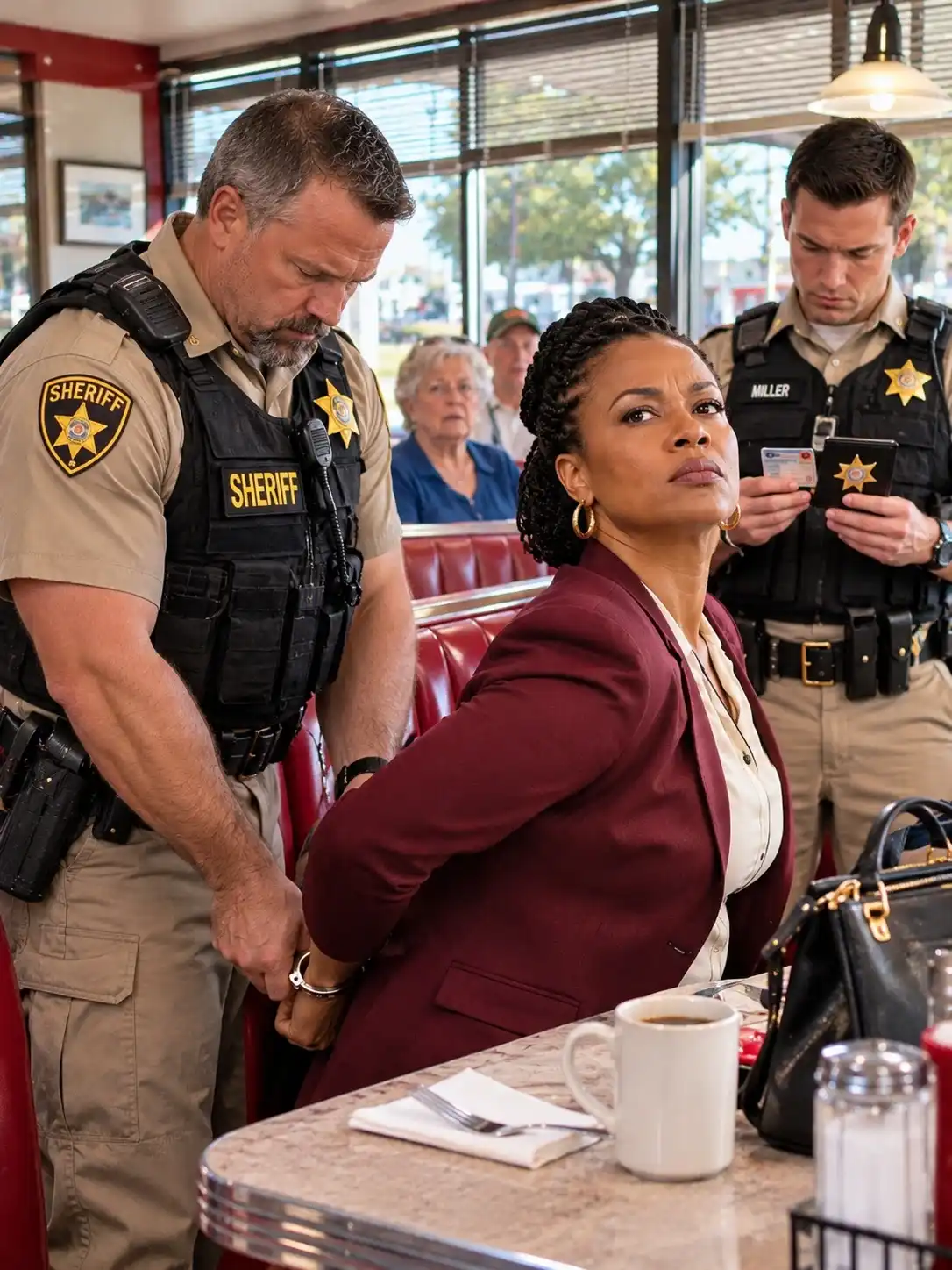
I was halfway through lunch at a small-town diner when Dalton Voss walked through the front door. He scanned the restaurant briefly before heading straight toward my booth.
“Stand up. You’re coming with me.”
I looked at him and then at the sandwich on my plate.
“May I ask why?”
“Do not make this difficult.”
Before I could say anything else, he grabbed my arm and twisted it behind my back. The handcuffs snapped shut, attracting the attention of nearly everyone in the restaurant.
A waitress stopped carrying a coffee pot. An elderly man lowered his newspaper. Two customers exchanged worried glances.
Nobody said a word.
My name is Amara Whitlock. I am forty-four years old, originally from Georgia, and I’ve served as a United States District Judge for six years.
But Sheriff Voss know nothing about my professional background.
He saw a Black woman wearing a denim jacket, sitting alone and enjoying lunch. Apparently, he believed I was someone he could intimidate without consequences.
“My name is Amara Whitlock,” I said. “I woul’d like to know why I’m being arrested.”
“You’re suspected of involvement in an armed robbery.”
“Which robbery?”
“That’s something we’ll discuss at the station.”
I looked directly at him.
“You should verify your information before taking someone’s freedom away.”
His expression hardened.
“People around here don’t tell me how to do my job.”
That statement confirmed something I had suspected for months.
My office had received several complaints involving misconduct within the Dalton County Sheriff’s Department. Residents described questionable arrests, unlawful searches, missing property, and threats against people who attempted to report officers.
I had traveled to the county without announcing my arrival because I wanted to understand how residents were treated when nobody influential was watching.
Now I was experiencing it firsthand.
Voss pulled me out of the booth. My water glass overturned, spilling across the table.
“She’s resisting arrest!” he announced.
I hadn’t struggled or attempted to escape.
A young waitress stepped forward.
“Officer, she wasn’t doing anything.”
Voss turned toward her.
“Do you want to get involved in this?”
The waitress immediately stopped.
That small exchange told me something important. People weren’t simply afraid of the sheriff. They had learned that questioning him could create problems for them.
Outside, Voss pushed me toward his patrol vehicle.
His young deputy, Ethan Miller, followed with my handbag.
“Sir,” Miller said quietly, “shouldn’t we verify her identification?”
“I know what I’m doing.”
The deputy fell silent.
I was placed in the back of the vehicle, and we drove toward the station.
During the journey, Voss spoke confidently about how quickly he could make people cooperate. He seemed particularly pleased with himself.
I listened without arguing.
Every unnecessary threat, every accusation, and every attempt to discourage questions was another detail worth documenting.
When we arrived, he escorted me into the booking area and instructed Miller to prepare the paperwork.
“Write that she was aggressive and refused to cooperate,” he ordered.
Miller looked at me.
“She hasn’t been aggressive, sir.”
Voss stared at him.
“Are you questioning my judgment?”
“No, sir.”
“Then write the report.”
The deputy sat down, although he appeared uncomfortable.
I looked toward him.
“Before you prepare anything, I’d like to contact an attorney.”
Voss laughed.
“You’ll make your phone call when we’re finished.”
“That’s not how the process works.”
“You’re going to learn how things work in this county.”
I remained calm.
I had spent years working in the federal judicial system. I understood the importance of lawful procedures, accurate documentation, and the rights of people accused of crimes.
I also knew that a sheriff’s office was not a place where an officer could simply invent allegations because he disliked someone.
“Deputy Miller,” I said, “please retrieve my identification from my handbag.”
Voss interrupted.
“She doesn’t give the orders here.”
Miller hesitated before opening the bag.
He removed my wallet and began examining its contents.
Then he stopped.
His expression changed so quickly that even Voss noticed.
“What’s wrong with you?” the sheriff demanded.
Miller didn’t answer immediately.
Instead, he carefully removed a government-issued identification card and read it twice.
“Sir, I think you need to see this.”
Voss snatched the card.
For several seconds, he stared at it without speaking.
Then he looked at me.
“Amara Whitlock?”
“Yes.”
His eyes returned to the identification.
United States District Court.
Federal Judicial Identification.
His face had gone pale.
“You’re a federal judge?”
“That’s correct.”
The room became unusually quiet.
Voss slowly placed the card on his desk.
“Why didn’t you tell me that earlier?”
I looked at the handcuffs still attached to my wrists.
“Would you have treated me differently if you had known?”
He didn’t answer.
I continued.
“You didn’t need to know my profession to understand that I deserved a lawful arrest and basic human dignity.”
Voss turned toward Miller.
“Take those cuffs off.”
The deputy immediately unlocked them.
I rubbed my wrists and retrieved my identification.
Then my phone began vibrating inside my handbag.
The screen displayed the name of Chief Judge Eleanor Reeves.
I answered.
“Amara, where are you?” she asked. “We’ve been trying to reach you.”
“I’m at the Dalton County Sheriff’s Department.”
“Is everything all right?”
I glanced toward Voss.
“Not particularly. I’ve just been arrested without a clear explanation, and the sheriff instructed his deputy to prepare a report containing allegations that haven’t been established.”
There was a brief silence.
Then her voice became serious.
“Do not leave that building. I’m contacting the appropriate federal authorities.”
I ended the call.
Voss approached me, his earlier confidence replaced by nervous politeness.
“Judge Whitlock, perhaps we can resolve this misunderstanding privately.”
“There is nothing private about an arrest conducted in front of an entire restaurant.”
He lowered his voice.
“I’ve served this county for eighteen years. I have a family. I’m sure we can work something out.”
I looked at him.
“Your years of service don’t put you above the law.”
Before he could respond, a phone rang at the booking desk.
Miller answered it.
His expression changed as he listened.
Then he slowly looked toward the sheriff.
“Sir, federal investigators are on their way.”
Voss froze.
But that wasn’t the worst news.
A few minutes later, one of the investigators called ahead with a question that made the sheriff’s expression collapse.
They wanted to know whether the department still possessed the original records connected to a missing complaint.
A complaint that had reportedly disappeared months earlier.
I recognized the name immediately.
Patricia Ellis.
She was one of the residents whose allegations had helped bring me to Dalton County in the first place.
And if the investigators had finally located the original document, Sheriff Voss was about to face something far more serious than the arrest of a federal judge.
Because the records they were coming to collect could expose what had really been happening inside his department for years.
Part 2:
The phone was still in Deputy Miller’s hand when Sheriff Dalton Voss finally spoke.
“What exactly did they say?”
Miller looked uncomfortable.
“They’re requesting the original complaint filed by Patricia Ellis. They want the complete record, including the initial statement and every subsequent amendment.”
Voss stared at him.
“Tell them we’ll provide whatever records are available.”
“Sir, they specifically requested the original version.”
For a moment, the sheriff said nothing.
I watched him carefully.
The name Patricia Ellis had clearly unsettled him more than my identification had.
Within twenty-five minutes, two federal investigators and an assistant United States attorney arrived at the station.
Their lead investigator, Daniel Mercer, approached me first.
“Judge Whitlock, are you injured?”
“My wrists are sore, but I’ll be fine.”
He nodded before turning toward Voss.
“Sheriff, we need access to the department’s records concerning several complaints.”
Voss folded his arms.
“Those are confidential departmental documents.”
Mercer presented the appropriate legal authorization.
“We have the authority to examine the records identified in this investigation.”
The sheriff looked through the paperwork.
“What investigation?”
Mercer opened a folder.
“Allegations involving questionable arrests, searches conducted without documented legal justification, missing property, and retaliation against residents who filed complaints.”
Voss shook his head.
“People make accusations all the time. That doesn’t mean they’re true.”
“That’s why we’re investigating them,” Mercer replied.
He placed several documents on the booking desk.
One concerned a mechanic who claimed officers had searched his property without a proper explanation.
Another involved a woman whose complaint had been marked resolved despite her insistence that nobody had interviewed her.
A third contained financial records involving unexplained payments to a private towing company.
Voss glanced through the papers.
“Those are routine departmental matters.”
“Then the records should help establish that,” Mercer replied.
The sheriff looked increasingly uncomfortable.
Discover More :
Then Deputy Miller stood up.
“There’s something else you should know.”
Voss turned sharply.
“Sit down, Miller.”
The young deputy remained standing.
“I’ve seen some of these reports before. The original statements didn’t always match the final versions.”
The sheriff’s expression hardened.
“Be careful.”
Miller swallowed.
“I kept copies of several original reports because I was concerned about the changes.”
The room became silent.
Mercer approached him.
“Do you still have those copies?”
“Yes. Some are on a separate storage drive at home. I can provide them.”
Voss stepped toward him.
“You’re accusing your own department?”
Miller looked directly at him.
“I’m telling them what happened.”
The deputy’s voice wasn’t particularly loud, but it was the first time I had heard him speak without immediately looking toward his superior for permission.
Mercer gave him instructions to preserve the records and arranged a formal interview.
Then he turned toward the sheriff.
“We’ll also need an explanation for the arrest that took place this afternoon.”
Voss tried to regain his composure.
“She matched a description connected to an armed robbery.”
“Which description?”
The sheriff hesitated.
“An individual reported in the area.”
“Do you have the original dispatch information?”
Voss looked toward Miller.
The deputy opened the computer system.
After examining the available information, he turned around.
“Sir, I can’t find a dispatch entry matching that explanation.”
Mercer looked at the sheriff.
“Then we’ll need to establish where the allegation originated.”
Voss rubbed his forehead.
For the first time, he seemed unable to control the direction of the conversation.
The investigators eventually located the original complaint from Patricia Ellis.
It was stored in a separate archive rather than the department’s active complaint system.
Mercer brought the document to my attention.
“Judge Whitlock, this is the report you mentioned.”
I read it carefully.
Patricia had reported that her adult son had been stopped, questioned, and searched without a satisfactory explanation. When she attempted to file a complaint, she claimed that an officer threatened to arrest her if she continued asking questions.
Her statement included the date, the location, and the names of two officers.
But the final departmental report told a completely different story.
It described the complaint as an informal disagreement that had been resolved through a conversation.
There was no record of an interview with Patricia.
At the bottom of the original document was a handwritten instruction:
“Do not forward. Sheriff has handled this personally.”
I looked up.
“Who wrote this?”
Mercer examined the document.
“We’re working to establish that through handwriting analysis, records, and interviews.”
Voss interrupted.
“I don’t remember that complaint.”
Mercer turned toward him.
“Your signature appears on the closure document.”
The sheriff looked at the page.
“I sign hundreds of documents.”
“Then this should be straightforward to explain.”
Voss didn’t respond.
I placed the report on the desk.
“Make sure Patricia Ellis receives an independent opportunity to provide her statement.”
Mercer nodded.
“We’ve already contacted her.”
I remembered her original letter to the federal court.
She hadn’t demanded money or attention. She had simply asked someone to listen.
Now, for the first time, someone was examining the complaint properly.
Over the following weeks, the investigation expanded.
Former employees provided information about departmental practices. Investigators examined electronic records, reviewed financial transactions, and interviewed residents who had previously been reluctant to cooperate.
Some of the allegations were substantiated by documents and testimony. Others required further examination.
The county placed Voss on administrative leave while the investigation continued.
An independent agency temporarily assumed responsibility for the department’s operations.
Deputy Miller provided investigators with copies of the original reports he had preserved.
He also explained how he had felt pressured to remain silent.
“I knew something wasn’t right,” he said during his interview. “But every time I questioned an instruction, I was reminded that my job depended on following orders.”
The investigators listened and examined the evidence.
Miller eventually resigned from the department.
He later accepted a position with a local organization that helped residents understand their legal rights and navigate complaint procedures.
Meanwhile, federal prosecutors announced charges against Voss involving alleged civil-rights violations and related misconduct supported by their investigation.
He pleaded not guilty, and his case proceeded through the legal system.
The allegations would be decided through evidence and due process, just as they should be for any defendant.
Several months later, I received a letter from Patricia Ellis.
She wrote that investigators had finally interviewed her and reviewed her original complaint.
She described how difficult it had been to speak openly about the incident.
For months, she had believed that nobody would listen because the people she was complaining about controlled the very system that was supposed to investigate them.
But things had changed.
At the bottom of her letter, she wrote:
“For the first time in years, I don’t feel like my voice disappears when I walk into a government building.”
I read that sentence twice.
Then I placed the letter inside my desk.
It reminded me why the investigation mattered.
The most important outcome wasn’t the embarrassment of a sheriff or the arrival of federal investigators.
It was the fact that people who had been afraid to speak were finally being heard.
Almost a year after my arrest, I returned to Dalton County for a judicial conference.
Before leaving town, I decided to stop at the same diner.
The waitress recognized me immediately.
“Judge Whitlock?”
I smiled.
“Yes. It’s good to see you again.”
She brought me a cup of coffee and pointed toward the booth where I had been sitting that afternoon.
“That’s where it happened, isn’t it?”
“That’s right.”
She shook her head.
“People were frightened that day. Some of us wanted to say something, but we didn’t know what would happen if we did.”
I looked around the restaurant.
A family was sharing breakfast. Two construction workers were discussing their next project. An elderly couple sat near the window.
It looked like an ordinary afternoon.
“Have things improved?” I asked.
She considered the question.
“Some things have. The department has new leadership, and people seem more willing to report problems.”
I nodded.
“That’s a good beginning.”
When my food arrived, I looked at the empty seat across from me.
I remembered Sheriff Voss’s confidence, the frightened customers, and the young deputy who had initially been too afraid to question his superior.
I also remembered Patricia’s letter.
The most important moment had never been when Voss discovered my judicial identification.
It was what happened afterward.
Residents who had once been afraid came forward. Original records were examined. Complaints that had been dismissed received proper attention.
And one young deputy learned that wearing a uniform didn’t mean surrendering his conscience.
I finished my lunch and paid the bill.
As I approached the door, the waitress called after me.
“Judge?”
I turned.
“Yes?”
“Thank you for not giving up on people like us.”
I smiled.
“You never needed someone important to give you rights. You had them all along.”
Outside, the afternoon sunlight reflected off the restaurant windows.
I thought about how easily authority could be mistaken for power, and how often ordinary people were expected to remain silent because someone else carried a badge.
But a badge is not a license to intimidate.
A position is not permission to ignore the law.
And justice should never depend on whether the person being mistreated has an impressive title.
The real test of authority isn’t how someone treats a person they fear. It’s how they treat someone they believe cannot fight back.
Editor’s Note: This story is a work of fiction created for entertainment. All characters, events, and locations are imaginary. Any resemblance to actual people or events is purely coincidental.
Related Posts
- After spending two peaceful weeks visiting my sister in Florida, I returned and found 15 strangers sleeping in my living room.

- After serving almost four years in prison for a crime I maintained I never committed, I was released with $75, a small bag of clothing, and nowhere to go.

- My 14-Year-Old Stepdaughter Pulled My Little Boy Away From His School Bus, and the Missing Piece of His Backpack Explained Everything

- A 7-Year-Old Girl Called 911 After Her Father Disappeared For Four Days and then Police Discovered What Really Happened

- A Sheriff Arrested a Woman in a Diner, Never Knowing She Was a Federal Judge Investigating Him

- My Husband Said I Lost Both Arms in a Car Accident. Three Years Later, a Doctor Revealed the Truth He Had Hidden From Me



About the Author
Hassan is the founder and editor of MidnightReads, a publication featuring thoughtful stories, human-interest articles, history, relationships, and entertaining reads.
He is involved in researching, writing, and editing content for the site, with a focus on creating original, clear, and useful articles that give readers something meaningful to take away.
Hassan believes good content should inform, entertain, and encourage curiosity.
— Hassan, Founder & Editor, MidnightReads