
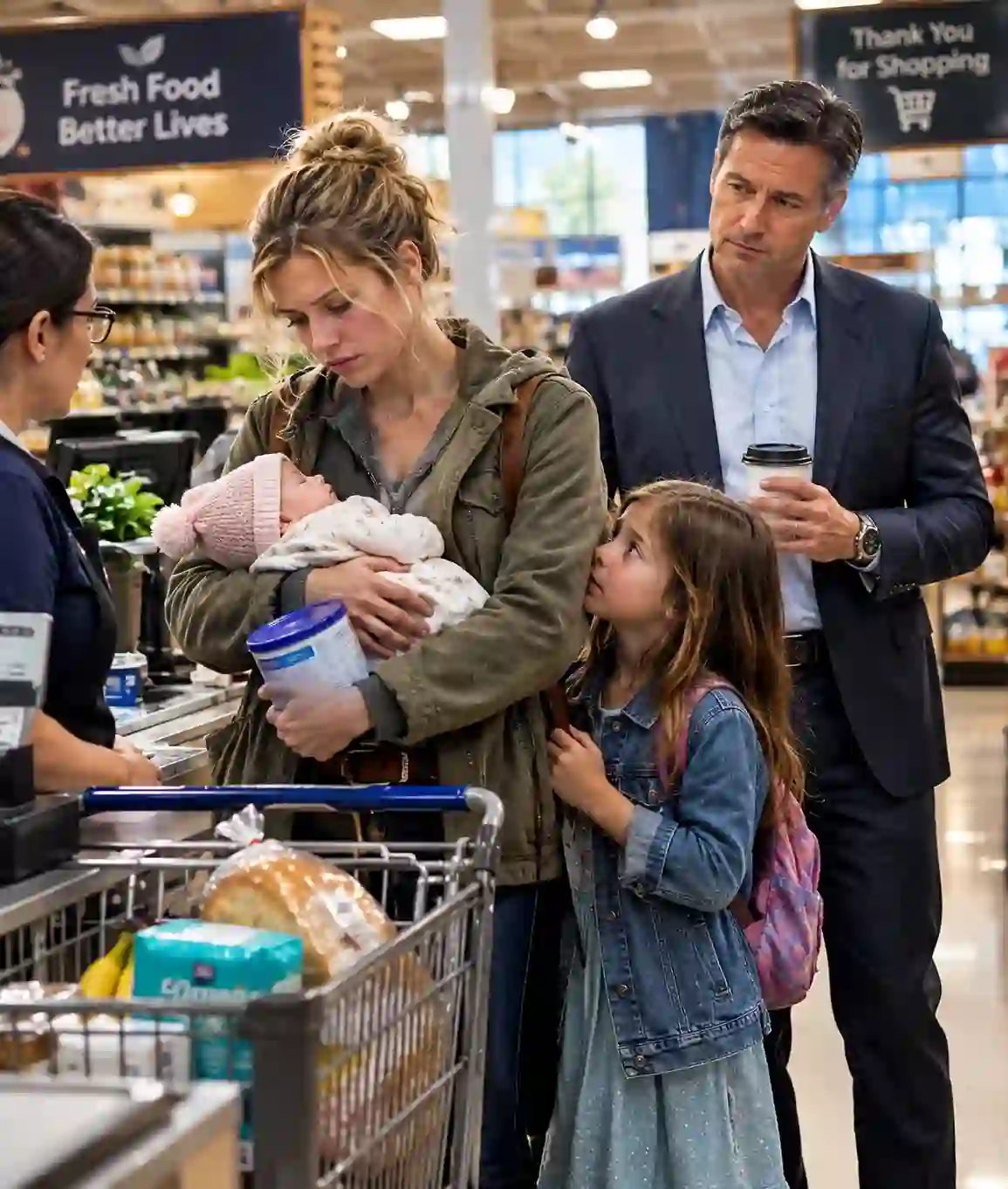
David Harper was used to seeing large numbers on paper. Millions of dollars moved across his desk every week, and most of them barely held his attention anymore.
But a grocery receipt for $18.42 stopped him in the middle of a supermarket on a Friday night.
The receipt belonged to a young mother who had just asked the cashier to take a can of baby formula off her order. She had already returned the bread. Now she was looking at a small one-dollar birthday cupcake as though deciding whether her daughter could afford to have a birthday at all.
David had noticed her because she kept putting the same three items back.
First came the bread. Then the cupcake. Finally, the formula.
Each time, she waited until her little girl wasn’t looking before quietly returning something to the shelf.
The supermarket was almost empty. It was close to closing time, and the workers were already wiping down the counters and checking the aisles. David had stopped there after a long day at his office, intending to buy coffee and something quick for dinner before driving home.
He had no reason to pay attention to another customer’s groceries.
But something about the woman’s expression made him look twice.
She was probably in her early thirties. Her coat was clean but worn around the cuffs, and she held a baby against her chest with one arm while trying to keep track of her seven-year-old daughter with the other.
The little girl, Lily, was standing beside the shopping cart.
She had a faded blue jacket, pink sneakers, and a small stuffed rabbit tucked under one arm.
Her mother placed the formula back into the cart.
Then she took it out again.
The cashier scanned the remaining items.
“Your total is $18.42.”
The woman handed over her card.
The machine beeped.
“I’m sorry,” the cashier said quietly. “It didn’t go through.”
The woman swallowed.
“Can you try it again?”
The cashier did.
Another beep.
“I’m sorry.”
The woman looked down at the counter. For a moment, she didn’t say anything.
Then she glanced toward Lily.
“It’s okay,” she whispered. “We’ll figure something out.”
Lily looked up at her mother.
“Mama, is Emma still going to eat tonight?”
The question was innocent, but David saw the way the woman’s face changed.
She looked toward the cashier and quietly pushed the formula away.
“I’ll come back tomorrow.”
David stepped closer.
“Excuse me.”
The woman turned toward him.
He pointed at the formula.
“I can get that for you.”
Her expression immediately became guarded.
“No, thank you.”
“It isn’t a problem.”
“I said no, thank you.”
There was no anger in her voice. She simply sounded like someone who had learned not to accept help easily.
David understood that.
He lowered his voice.
“Then let me put it another way. I was already going to buy groceries tonight. I’m just adding one more thing.”
She shook her head.
“You don’t have to do that.”
“I know.”
Lily looked between them.
Then she looked at David’s wrist.
“That’s a really nice watch.”
David glanced down.
“Thanks.”
“Are you rich?”
Her mother closed her eyes for a second.
“Lily.”
“What? I was just asking.”
David smiled.
“Your mom is right. That’s not usually something we ask people.”
“But are you?”
David looked at the little girl.
“I’ve been fortunate.”
Lily seemed satisfied with the answer.
Her mother wasn’t.
“I appreciate what you’re trying to do,” she said. “But we don’t need charity.”
David looked at the cart.
There was a nearly empty package of diapers, the formula, a loaf of bread, and a small bakery cupcake with blue icing.
He pointed toward the cupcake.
“Is that for her?”
The woman looked down.
“It was.”
Lily immediately smiled.
“My birthday is tomorrow.”
Her mother gave her a small smile.
“I know.”
“You said we’d have cake.”
“I said we’d try.”
Lily nodded as though that answer was enough.
David looked at the cupcake again.
It was small, probably one of the cheapest things in the bakery section. It had uneven blue icing and a single white sugar flower on top.
He turned to the cashier.
“Please add the formula.”
The mother started to protest.
David gently interrupted.
“And the bread.”
She stared at him.
He added, “And the cupcake.”
For a few seconds, she said nothing.
Then she quietly nodded.
“Thank you.”
David paid for everything.
The cashier handed him the receipt.
He glanced at it before putting it into his wallet.
$18.42.
It was such a small amount that he almost laughed at himself for noticing it.
But as the woman gathered the groceries, David saw something written on the back of her hand.
Formula.
Bread.
Diapers.
Gas.
Rent.
Birthday cake.
The list was written in blue ink, with several items crossed out.
The mother noticed him looking.
“It’s nothing,” she said.
“It doesn’t look like nothing.”
She gave a tired smile.
“It feels like nothing most days.”
David didn’t know what to say to that.
So he didn’t pretend he did.
Instead, he asked, “Is Emma your only baby?”
She looked down at the infant.
“Yes.”
“How old?”
“Four months.”
“She’s beautiful.”
The woman smiled for the first time.
“She doesn’t sleep much.”
David laughed softly.
“Most babies don’t read the parenting manuals.”
That made Lily giggle.
For a moment, the four of them stood there like ordinary people having an ordinary conversation in an almost-empty supermarket.
Then the woman’s expression became serious again.
“My name is Sarah.”
“David.”
“I really am grateful.”
“You don’t have to explain anything.”
She looked at him carefully.
“My husband died eight months ago.”
David’s smile disappeared.
“I’m sorry.”
“He had a heart problem. We knew he had one, but we didn’t think…” She stopped and looked down at Emma. “You always think there’s going to be more time.”
David knew that sentence too well.
“My wife died three years ago,” he said.
Sarah looked at him.
“I’m sorry.”
“Cancer.”
Neither of them said anything for a moment.
There was no need.
They didn’t know each other, but grief had given them something to recognize in one another.
Sarah finally picked up the grocery bag.
“I’ve been trying to keep everything together.”
“You don’t have to apologize for having a hard night.”
She looked at him.
“That’s what it feels like sometimes. Like every hard night is my fault.”
“It isn’t.”
She nodded, but David could tell she wasn’t sure she believed him.
Lily tugged on her mother’s sleeve.
“Mama, can we go?”
“Of course.”
Sarah turned back to David.
“Thank you. Really.”
David nodded.
“Happy birthday to Lily.”
Lily smiled.
“Thank you.”
As they walked toward the exit, David watched Lily carefully carry the small cupcake as if it were something fragile and valuable.
He stood there for a moment before leaving.
He had spent most of his adult life solving problems with money.
As the CEO of a successful logistics company, he was used to making decisions that involved large amounts of it. A delayed shipment could cost thousands. A bad contract could cost millions. His employees often came to him when something needed to be fixed quickly.
Money could fix many practical problems.
But standing in that supermarket, David realized that he had almost forgotten what a small amount of money could mean to someone.
For him, $18.42 was barely worth noticing.
For Sarah, it was the difference between taking formula home or putting it back.
The next morning, David found himself thinking about her again.
He was sitting in his kitchen with a cup of coffee when he noticed the receipt from the supermarket still in his wallet.
He took it out.
Formula.
Bread.
Cupcake.
$18.42.
He turned the receipt over.
There was nothing written on it.
For some reason, he thought about Sarah’s list.
Formula.
Bread.
Diapers.
Gas.
Rent.
Birthday cake.
It wasn’t a list of things she wanted.
It was a list of things she was trying to keep from falling apart.
David called his assistant.
“I need you to find out whether the supermarket has any kind of community assistance program.”
His assistant paused.
“For the company?”
“No. Personally.”
By Monday, David had made a donation to the store’s community assistance fund. He didn’t give the store Sarah’s name. He didn’t ask anyone to contact her. He simply wanted the next person standing at that checkout with an embarrassed look and a declined card to have another option.
He also arranged for several local food banks and family support organizations to receive donations through his company.
He never told Sarah.
Weeks passed.
David returned to his usual routine.
Meetings.
Flights.
Contracts.
Late nights.
Early mornings.
But every now and then, he remembered Lily’s question.
“Are you rich?”
He had answered honestly.
“I’ve been fortunate.”
At the time, he had thought the answer was about money.
Now he wasn’t so sure.
One Saturday afternoon, his phone buzzed with a message from an unknown number.
“Hi, David. This is Sarah. I hope you don’t mind that I got your number from the store manager. Lily wanted to thank you.”
A photograph followed.
Lily was sitting at a small kitchen table with a cupcake in front of her. Seven candles stood in the blue icing, and a handwritten sign behind her read, “Happy Birthday.”
Emma was asleep in a carrier beside Sarah.
David smiled.
Another message arrived.
“She says you were right. Seven is important.”
David typed back.
“Happy birthday, Lily. I hope you have a wonderful day.”
A few seconds later, another message appeared.
“She says thank you for believing Mom.”
David read the sentence twice.
Then he looked across his office at the photograph of his wife.
He had spent three years thinking that having enough money meant he could handle whatever life put in front of him. That night at the supermarket, he realized there were some things money could never repair. It could pay for a hospital room, replace what was broken, and make difficult circumstances easier, but it couldn’t bring his wife back or erase Sarah’s grief.
What he could do was much smaller.
He could notice when someone needed help without making them feel ashamed for accepting it.
A week later, David returned to the supermarket. The cashier recognized him and smiled.
“Back for more coffee?”
“Apparently.”
She laughed.
“The mother with the baby was here yesterday.”
David paused.
“How was she?”
“She bought bread, cereal, and another cupcake.”
David smiled.
“Another cupcake?”
“She said Lily wanted to make it a tradition.”
David nodded.
As he walked toward the checkout, he thought about the receipt Sarah had handed him that night.
$18.42.
To him, it had once looked like an insignificant amount of money.
Now he understood why she had kept it.
It wasn’t really a receipt for groceries. It was a record of one difficult evening when a mother had tried to give her children what they needed, a little girl had still managed to hope for something as ordinary as a birthday cupcake, and a stranger had stopped long enough to notice.
David picked up his coffee and headed for the exit.
For the first time in years, the quiet of his house didn’t feel quite as empty.
He had finally found something his money had never been able to buy: a reason to care about what happened after he walked away.
Editor’s Note
This fictional story explores kindness, financial hardship, grief, and the unexpected impact of a small act of compassion. The characters and events are fictionalized for storytelling purposes.
Related Posts
- My Ex-Husband’s Mother Arrived With Two Moving Trucks Minutes After Our Divorce—She Demanded My Mansion, but She Had No Idea What My Attorney Had Discovered2.

- My Mother-in-Law Pushed Me Down the Stairs at Nine Months Pregnant—She Never Expected Her “Unemployed” Son to Arrive With the Entire Board of Directors

- Her Father Sold Her to a Deaf Rancher for $50—But on Their Eighth Night, She Discovered Something Moving Inside His Ear and Uncovered a Secret Buried for 29 Years
- I Found the Black Lace Gift My Husband Bought for Another Woman, Then a Hotel Key Fell From His Jacket and Revealed Something Much Bigger






Hammad Ali
Co-Owner & Author
Hammad Ali is a co-owner and author at MidnightReads, contributing thoughtful and engaging articles across human-interest, life, history, relationships, and entertainment topics.
They help develop and create original, useful content designed to inform, entertain, and give readers something meaningful to take away.