
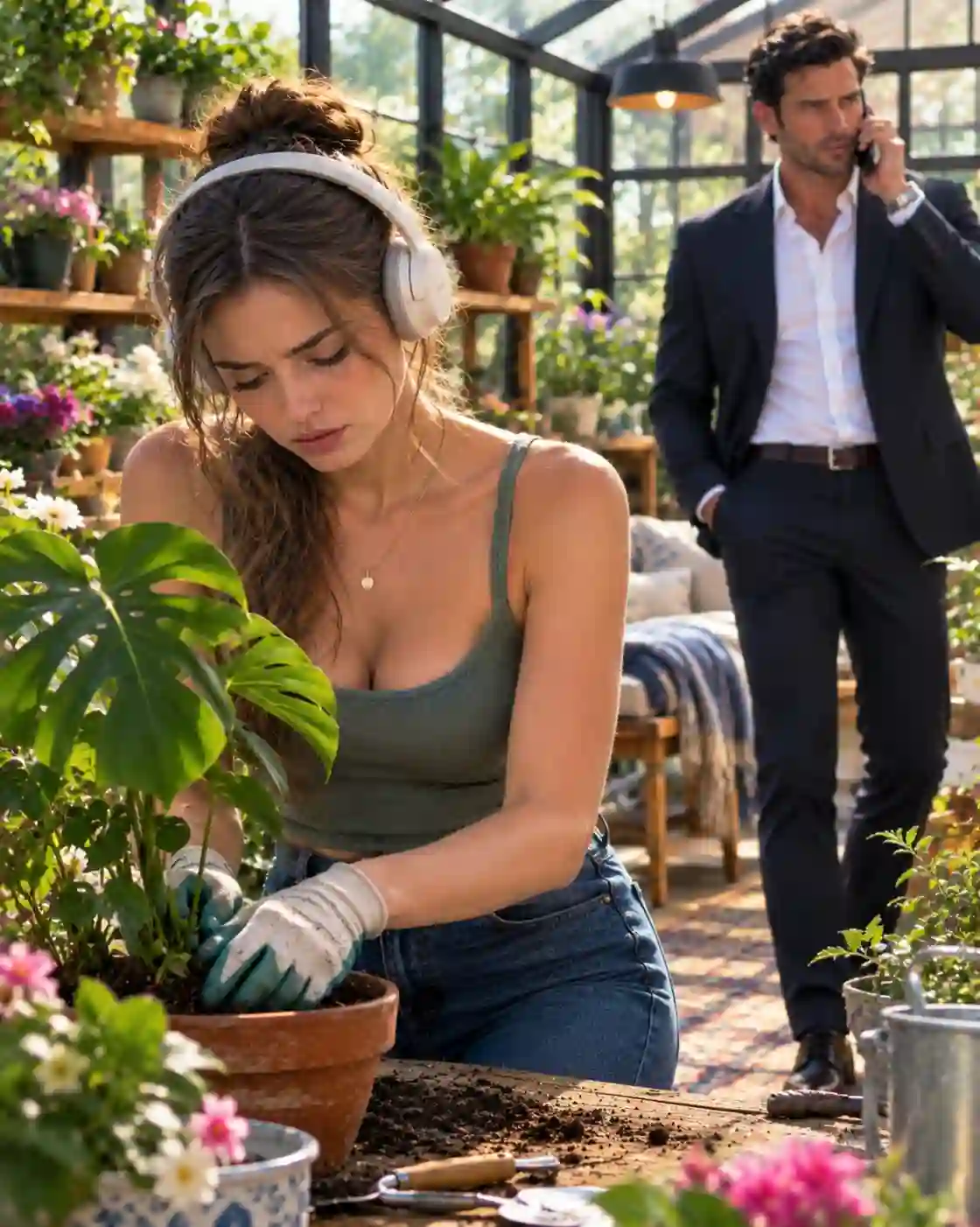
When I heard my husband come home that evening, I kept my headphones on and pretended I was still listening to music. I was in the small greenhouse I had built inside our San Diego home, trimming an overgrown monstera, when I heard Gavin answer a phone call in the hallway. I wasn’t trying to listen, but then I heard my name.
“Tomorrow I’m asking her for a divorce,” he said. “She’ll take the little girl and leave. I’m not going to spend another year pretending this is the life I want.”
I stopped trimming the plant.
Gavin continued talking, apparently unaware that the music in my headphones had stopped several minutes earlier. “The little girl is going with Valerie. I’m not taking responsibility for a daughter I never wanted. You just get your things ready, Chloe. Once Valerie is out of the house, you can move in.”
My fingers tightened around the pruning shears. For months, I had suspected there was another woman. I had noticed the unexplained phone calls, the late nights, the sudden interest in dressing well before leaving for work, and the way Gavin had started protecting his phone as if it contained something more valuable than our marriage. Still, hearing him make plans with another woman was different from suspecting an affair.
He wasn’t considering leaving me. He had already planned the life that would replace mine.
“I’ll tell her tomorrow,” he continued. “I’ve already filed the paperwork. The house belongs to my mother, so Valerie can’t claim it. I’ll give her a few weeks to find somewhere else, and then we’re done.”
I quietly put down the pruning shears and waited until he walked away. I didn’t confront him that night. Instead, I went to check on my four-year-old daughter, Isabelle, who was sleeping peacefully in her bedroom. Watching her made my decision easier. Whatever happened between Gavin and me, I wasn’t going to let his decisions determine whether my daughter felt safe.
I had met Gavin four years earlier, when I was working as an agronomist for a company that designed urban gardens. He worked for a construction company and seemed responsible, ambitious, and dependable. My mother liked him immediately, and I married him eight months after we met because I believed I had found someone who wanted the same stable family life that I did.
For the first few years, I thought I was right.
Everything changed after Isabelle was born.
Gavin had wanted a son, and his mother, Florence, had spent most of my pregnancy talking about the grandson she was expecting. When the nurse told us we had a daughter, Gavin smiled for the photographs and held Isabelle proudly, but the excitement disappeared once we returned home. Within months, he began complaining about the crying, the sleepless nights, and the fact that our house no longer felt like the carefully organized home he had enjoyed before becoming a father.
“You’re home all day,” he would say whenever Isabelle cried. “Can’t you handle one baby?”
I had temporarily left my job to take care of our daughter, so those comments gradually made me feel as though I had stopped contributing to the family. His mother wasn’t much kinder. One afternoon, while looking at Isabelle in her crib, she casually remarked that the baby didn’t look much like Gavin.
Two days later, Gavin demanded a paternity test.
“If you have nothing to hide, you shouldn’t have a problem taking one,” he told me.
I agreed because I was too exhausted to turn the situation into another argument. The results confirmed what I already knew: Gavin was Isabelle’s father. I expected him to apologize for doubting me, but he simply looked at the report and said, “Well, now we know.”
That was the beginning of a slow change in me.
I stopped expecting Gavin to understand how much his words hurt. Instead, I started spending more time with plants, something my mother had taught me to love when I was a child. She had lived near Eugene, Oregon, and knew everything from propagating fruit trees to preparing soil for difficult plants. When I began growing plants in our unused sunroom, I discovered that caring for them gave me a sense of peace I wasn’t finding anywhere else.
Eventually, I started selling them online.
What began as a small side project became surprisingly successful. I began shipping plants to customers throughout California, then received orders from landscapers and collectors. Gavin occasionally told his friends that his wife had “a cute little plant business,” but he never seemed to understand how much work went into it.
By then, I also knew about the women.
I discovered his first affair by accident. The second wasn’t much harder to find. There were messages, unexplained hotel charges, and phone calls that ended whenever I entered the room. I confronted him once, and he promised it wouldn’t happen again. Eventually, I stopped confronting him because I had convinced myself that keeping our family together was more important than admitting how unhappy I was.
Then I heard his conversation with Chloe.
The following morning, Gavin sat across from me at the kitchen table and announced that he had started the divorce process. He expected tears, anger, or pleading, but I simply asked, “How long have you been planning this?”
“A while,” he admitted.
“And Chloe?”
His expression changed.
“You already know?”
“I heard you last night.”
He looked uncomfortable for a moment, but his confidence quickly returned. “Then this should be easier. I’m not going to fight with you, Valerie. The house belongs to my mother. I’ll let you keep the car, and I’ll pay child support. You have three weeks to find somewhere else.”
I looked at him across the table. “And where do you expect Isabelle and me to go?”
“That isn’t my problem.”
He stood and reached for his keys. Before leaving, he added, “And don’t leave all those plants behind. Chloe wants that room as an office.”
That was the moment I realized how completely Gavin had separated himself from the life we had built together. He wasn’t simply ending a marriage. He had already assigned my home, my space, and even my belongings to someone else.
That evening, after Isabelle went to bed, I returned to the greenhouse. I was looking for an old notebook when I found a folder tucked behind several gardening books. The label on the front immediately caught my attention.
Miriam — Estate Documents.
My mother had died three years earlier, and shortly before her death she had arranged a meeting between me and an attorney named Daniel Mercer. I remembered sitting in his office and signing several documents, but at the time I was overwhelmed with grief and didn’t pay much attention to the details. My mother had simply told me, “Keep these somewhere safe. You may not understand why now, but someday you will.”
I opened the folder.
Among the estate papers was a property agreement I had completely forgotten about.
I read the first page, then the second. By the time I reached the section describing the ownership of our house, I was sitting down.
The property wasn’t entirely under Florence’s control.
Three years earlier, a substantial interest in the house had been placed into a family trust, and I was named as a beneficiary. The agreement had been signed shortly after Isabelle was born.
I immediately called Daniel.
“You still have the original documents?” I asked when he answered.
“Yes.”
“Why didn’t you tell me about this?”
“Your mother asked me not to push you. She knew you were trying to make your marriage work, and she didn’t want legal arrangements to become another source of conflict between you and Gavin.”
I looked at the document again. “Does Gavin know?”
“No.”
“What about his mother?”
Daniel paused. “Florence signed the agreement.”
I felt a strange mixture of relief and confusion.
“So she knew all along?”
“She should have known exactly what she signed.”
Daniel then told me there was another agreement involving my plant business. My mother had invested part of her estate into the company three years earlier, and the agreement had been structured to preserve my ownership interest.
I remembered my mother sitting across from me in Daniel’s office that day, telling me that she wanted me to have something that belonged to me regardless of what happened in my marriage. I hadn’t understood what she meant then. Now I finally did.
The next morning, Gavin arrived with Chloe.
She remained in the driveway while he came inside and told me that I needed to start packing. When I asked whether he was certain that his mother owned the entire house, he immediately became defensive.
“Of course she does.”
“Then you shouldn’t have anything to worry about.”
He stared at me. “What did you do?”
“Nothing. I spoke with my attorney.”
His confidence disappeared for the first time.
A few days later, Gavin’s attorney contacted Daniel. The tone of the divorce negotiations changed almost immediately. The three-week deadline disappeared, and Gavin suddenly wanted to discuss the property “amicably.”
Daniel handled the legal side while I concentrated on Isabelle and my business. I didn’t threaten Gavin or tell him everything I knew. There was no reason to argue with him when the documents could explain the situation better than I ever could.
The custody issue was more difficult.
Gavin suddenly wanted to present himself as a devoted father, even though he had spent years complaining about the responsibilities that came with having a child. During the proceedings, messages between Gavin and Chloe became part of the evidence. Some showed him discussing our marriage, while others revealed how little responsibility he actually wanted for Isabelle.
One message particularly stood out because Gavin had written that once I was gone, he and Chloe could finally have the house to themselves.
Another described Isabelle as a responsibility he had never wanted.
I didn’t take satisfaction from reading those messages. They were painful, especially because my daughter would one day be old enough to understand what her father had written. I gave the evidence to Daniel and let the legal process deal with it.
Months passed before everything was settled.
The property agreement prevented Gavin from simply treating the house as his mother’s unrestricted asset. My business remained mine, and the custody arrangement was structured around Isabelle’s needs rather than Gavin’s desire to start a completely new life.
Gavin and Chloe eventually separated.
I never asked what happened between them. By that point, I had stopped paying attention to the life Gavin had chosen after leaving ours.
My own life had become much busier.
The plant business grew into a real company. I hired employees, expanded the greenhouse, and began supplying plants to local landscapers. The room Gavin had once dismissed as useless became the center of a business that supported several families.
I kept the original greenhouse exactly as it was.
Almost a year after Gavin’s phone call, Isabelle came running inside one afternoon carrying a small yellow flower cupped carefully in both hands.
“Mom, look! It opened.”
Valerie smiled and knelt beside her. “That’s beautiful. What are you going to do with it?”
“Give it to you.”
Isabelle placed the flower in her mother’s hand, then looked around the greenhouse. Plants filled nearly every shelf, orders were stacked near the door, and a new sign with Valerie’s business name hung above the workbench. What had started as a place where she went to escape her marriage had become the heart of a business she never imagined building.
“Are we still going to live here?” Isabelle asked.
Valerie looked through the glass doors toward the house. For a moment, she remembered the night Gavin had told her she had three weeks to leave. She remembered sitting in the greenhouse, terrified that she and her daughter would soon have nowhere to go. Then she remembered the folder her mother had left behind.
“Yes,” she said. “But there’s something I want you to see.”
That evening, Valerie opened the old folder on the kitchen table and took out the document that had changed everything. She had read it dozens of times during the divorce, but there was one page she had never examined closely because it had seemed like nothing more than a legal attachment.
At the bottom was her mother’s handwritten note.
For Valerie, when she is ready.
Underneath it was another sentence:
The house was never meant to be your prison. It was meant to give you a place to begin again.
Valerie sat quietly for a long time.
Her mother had known.
Not the details, not Gavin’s affair, not Chloe, and certainly not the exact night everything would fall apart. She had simply understood that Valerie had spent too much of her life believing that keeping a family together meant holding on to something that was already hurting her.
The next morning, Valerie made a decision.
She didn’t sell the house, and she didn’t give it back to Florence. Instead, she turned part of the property into something her mother would have loved. The old greenhouse became a community garden where local families could grow vegetables, children could learn about plants, and people who couldn’t afford expensive landscaping could take home starter plants for free.
Valerie kept the nursery business on the other side of the property and hired two women who, like her, were rebuilding their lives after difficult divorces.
Years later, when people asked Valerie how she had managed to turn everything around, she never mentioned Gavin’s affair or the woman he had planned to move into her home. She simply told them that her mother had taught her something important: a plant doesn’t spend its life trying to convince a damaged branch to become healthy again. Sometimes you have to cut away what is dying so the rest of the plant can grow.
Valerie had once thought that lesson was about gardening.
It wasn’t.
One Saturday morning, Isabelle walked into the greenhouse carrying a small envelope.
“Mom, this came in the mail.”
Valerie opened it.
Inside was a photograph from three years earlier—the day she had signed the documents in Daniel Mercer’s office. Her mother was standing beside her, smiling at the camera.
On the back, Miriam had written:
You won’t understand this picture yet. Keep it. One day you will.
Valerie laughed softly.
For years, she had thought her mother had left her a legal document.
Now she realized she had left her something much more valuable: a way out of a life Valerie had been too afraid to leave on her own.
She put the photograph beside the yellow flower Isabelle had given her.
Outside, customers were arriving for the weekend garden market. Isabelle ran ahead to help set up the tables while Valerie followed with a box of young lemon trees.
She paused at the greenhouse door and looked back at the room where everything had begun.
The night Gavin told her she had three weeks to leave, she thought the hardest part would be losing her marriage.
She had been wrong.
The hardest part was realizing that she had spent four years asking someone else to recognize her worth.
She didn’t ask anymore.
She had built a life where she didn’t need his permission to belong.
And somewhere along the way, the woman who had once been afraid of starting over had become the woman who no longer needed to.
Author’s Note: This story is fictional and written for entertainment. It explores betrayal, family relationships, personal resilience, and the importance of understanding the choices and documents that can shape our lives.
Related Posts
- My Father-in-Law Lived Under My Roof for 20 Years, and I Called Him a Burden, Until His Lawyer Opened a Blue Ledger at His Funeral and Revealed What He’d Been Hiding All Along

- My Ex-Husband’s Mother Arrived With Two Moving Trucks Minutes After Our Divorce—She Demanded My Mansion, but She Had No Idea What My Attorney Had Discovered2.

- My Mother-in-Law Pushed Me Down the Stairs at Nine Months Pregnant—She Never Expected Her “Unemployed” Son to Arrive With the Entire Board of Directors

- Her Father Sold Her to a Deaf Rancher for $50—But on Their Eighth Night, She Discovered Something Moving Inside His Ear and Uncovered a Secret Buried for 29 Years




Hammad Ali
Co-Owner & Author
Hammad Ali is a co-owner and author at MidnightReads, contributing thoughtful and engaging articles across human-interest, life, history, relationships, and entertainment topics.
They help develop and create original, useful content designed to inform, entertain, and give readers something meaningful to take away.