lI Came Home From Deployment to Meet My New Grandson—Then I Found My Daughter Barely Conscious on the Floor in a Terrifying Family Crisis
The first thing I noticed when I walked into my daughter’s house wasn’t the silence.
It was the sound of my grandson screaming from the bedroom.
I had just returned from an overseas deployment and was supposed to meet Noah, my first grandchild, for the first time. I had imagined holding him, taking too many pictures, and watching my daughter smile as she introduced us.
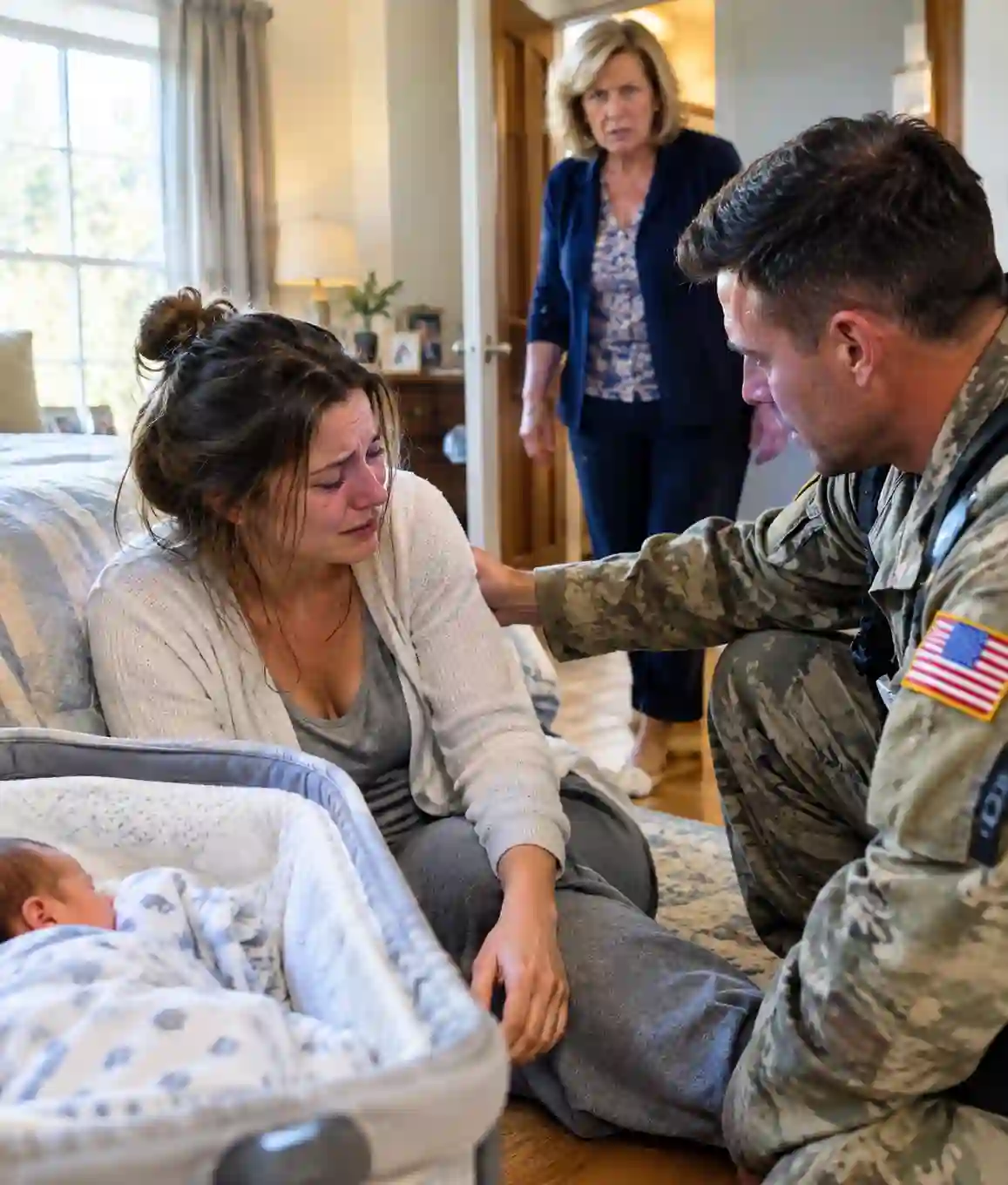
Instead, I found Emily lying on the floor, barely conscious, while her newborn cried beside her.
And standing over her was her mother-in-law, Margaret, complaining that my daughter was too lazy to take care of her own baby.
My name is Colonel Robert Hayes. I spent more than twenty-five years in the United States Army, including assignments where staying calm wasn’t a choice. I had seen soldiers injured, families separated, and people pushed to their limits.
But seeing my daughter in that condition was different.
Emily had given birth to Noah only a few days earlier. The delivery had been difficult, and she was still recovering. She was exhausted, in pain, and struggling to get enough sleep.
Her husband, Daniel, had been sent out of state for an unexpected business trip.
That left Emily in the house with Margaret and Daniel’s younger sister, Vanessa.
I had never trusted Margaret.
She had always found something wrong with Emily. If my daughter spoke her mind, Margaret called her disrespectful. If she made her own decisions, Margaret said she was trying to control Daniel. Even during Emily’s pregnancy, Margaret repeatedly reminded her that she was becoming part of “our family,” as if Emily had somehow married into a club rather than a partnership.
A few months before Noah was born, the situation became worse.
Margaret wanted Emily to give her access to money Emily had inherited from her grandmother. When Emily refused, Margaret became furious.
She told Daniel that Emily was selfish.
Daniel defended his mother.
Emily tried to move past it.
When Noah arrived, Margaret suddenly became affectionate. She brought flowers to the hospital, held the baby for photographs, and told everyone she was excited to help Emily during Daniel’s trip.
I wanted to believe the tension was finally over.
Then my phone calls started going unanswered.
Whenever I called the house, Margaret picked up.
“Emily’s sleeping.”
“She’s tired.”
“The baby’s doing fine.”
Nothing sounded obviously wrong, but Emily wasn’t speaking to me herself.
On the fourth day, she finally answered.
“Hi, Dad.”
Her voice was so weak that I immediately sat down.
“Emily, are you okay?”
There was silence.
Then she whispered, “Please come.”
Before I could ask what was happening, I heard Margaret in the background.
“Give me that.”
The phone went dead.
I called back twice.
No one answered.
The following morning, I drove to their house.
I had packed diapers, groceries, some pastries Emily loved, and a stuffed bear for Noah. I expected to find a tired new mother who needed a few hours of rest.
The front door was partially open when I arrived.
I knocked anyway.
Nobody answered.
I stepped inside and heard the television running in the living room. Margaret and Vanessa were asleep on the couch, surrounded by dirty dishes and empty coffee cups.
Then I heard the baby.
I followed the sound down the hallway and pushed open Emily’s bedroom door.
My daughter was lying on the floor beside the bed.
Her face was pale.
Her hair was damp.
She tried to lift herself when she saw me but didn’t have enough strength.
Noah was crying beside her.
An unopened bottle sat on the nightstand.
I picked up my grandson and immediately knelt beside Emily.
“What happened?”
She tried to answer, but her words were barely understandable.
Margaret appeared in the doorway.
Instead of rushing to help, she folded her arms.
“She’s been like this all morning,” she said. “I told her she needs to stop being so dramatic.”
I stared at her.
“Why isn’t she getting medical attention?”
Margaret rolled her eyes.
“Because she’s exhausted. New mothers are supposed to be tired.”
Then she looked at Emily.
“If you can’t handle one baby, maybe you shouldn’t have had one.”
I didn’t argue with her.
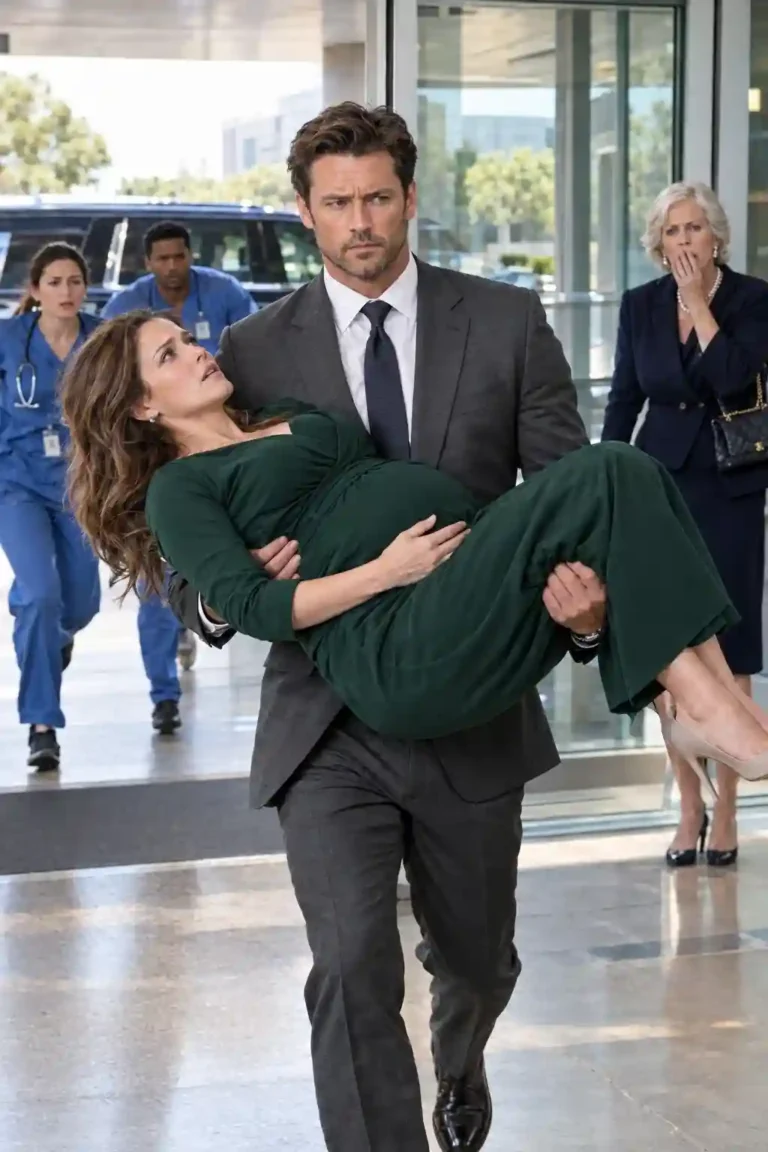
I helped Emily into the car, secured Noah in his carrier, and drove straight to the emergency room.
Within minutes of arriving, nurses took Emily back for examination.
I stayed with Noah in the waiting area.
I had barely sat down when a nurse came looking for me.
“Are you Emily Carter’s father?”
“Yes.”
“The doctor would like to speak with you.”
The ER physician explained that Emily was severely dehydrated and extremely exhausted. They were also running additional tests because she had several unexplained injuries.
A few minutes later, the doctor returned to Emily’s room.
I could see through the doorway as she examined my daughter’s arms.
Then she gently pulled Emily’s sleeve higher.
There were dark bruises around both wrists.
The doctor’s expression changed.
She asked Emily something.
My daughter started crying.
The doctor stepped outside.
“Mr. Hayes, I need you to understand something. Those injuries concern me.”
“What happened to her?”
“I don’t know yet.”
She paused.
“Has anyone been hurting your daughter?”
I looked through the doorway at Emily.
She wouldn’t look at me.
The doctor lowered her voice.
“Document every injury. And call the police.”
I did.
While officers spoke with me, Emily remained under observation.
At first, she didn’t want to tell anyone what had happened.
She was afraid that if she spoke, Margaret would somehow find a way to take Noah from her.
Eventually, she began talking.
It hadn’t started with physical violence.
Margaret had first taken control of the house.
She decided when Emily should sleep, what she should eat, and when she should hold her own baby. If Emily disagreed, Margaret accused her of being ungrateful.
Vanessa backed her mother up.
When Emily asked them to leave her alone, Vanessa laughed and told her she was making everyone uncomfortable.
Then Margaret started asking about Emily’s inheritance again.
Emily refused.
After that, Margaret began telling Daniel that his wife wasn’t mentally stable.
She said Emily was overwhelmed.
She said Emily was angry.
She said Emily didn’t want help.
Daniel believed her.
That was what frightened Emily most.
“He never asked me,” she told me from her hospital bed. “He just believed whatever she told him.”
I asked her about the bruises.
Emily looked down at her hands.
“Margaret grabbed me.”
“Why?”
“Because I tried to call you.”
She told me Margaret had taken her phone and warned her not to contact anyone without permission.
Vanessa had been standing nearby.
She didn’t intervene.
Emily had tried to resist, and Margaret had grabbed both of her wrists.
The marks had remained.
The police later searched the house after obtaining the appropriate authorization.
They found Emily’s phone hidden beneath a drawer.
There were messages she had written but never managed to send.
One was addressed to me.
“Please come. I don’t feel safe.”
Another was addressed to Daniel.
“Please call me when Mom isn’t around.”
There were also photographs Emily had secretly taken of bruises on her arms.
Then investigators found something that changed the case.
Margaret’s phone contained messages between her and Vanessa.
They had discussed Emily’s inheritance.
They had discussed convincing Daniel that Emily was incapable of caring for Noah.
They had even talked about making sure Emily had as little contact with her own family as possible.
Margaret had not simply been interfering.
She had been building a story about Emily and trying to make Daniel believe it.
The financial motive became clearer when investigators looked into Margaret’s situation.
She was dealing with serious debts and had been trying to find a way to access Emily’s money.
The house she had wanted Emily to help finance wasn’t for the benefit of the family.
Margaret needed the money for herself.
But the investigation also uncovered something Emily hadn’t known.
Margaret had been telling Daniel that Emily had voluntarily stopped taking care of Noah.
The medical records showed otherwise.
Emily had repeatedly asked for help.
She had been exhausted and unwell.
She had not abandoned her baby.
She had been struggling while the people around her made the situation worse.
Daniel returned the following evening.
He walked into the hospital expecting to see his wife recovering from childbirth.
Instead, he found a police officer outside her room.
“What’s going on?” he asked.
I looked at him.
“You need to talk to Emily.”
He stared at me.
“Where’s Mom?”
“That’s something you need to ask the police.”
Daniel went into the room.
Emily looked at him but didn’t speak.
He sat beside her bed.
“I’m sorry.”
She looked at him for several seconds.
“You believed her.”
Daniel’s eyes filled with tears.
“I thought you were overwhelmed.”
“I was overwhelmed,” Emily said. “I had just given birth. I needed my husband.”
Daniel lowered his head.
“I should have listened.”
Emily didn’t argue.
She didn’t forgive him immediately either.
She simply told him that trust wasn’t something he could ask for after everything that had happened.
It would have to be earned.
The police investigation continued, and Margaret and Vanessa were eventually arrested in connection with the alleged abuse and unlawful restraint. The specific charges and outcome would be determined through the legal process.
Emily’s recovery took much longer than I expected.
Being physically safe didn’t erase what had happened.
She had trouble sleeping. She became nervous whenever someone raised their voice. She apologized whenever she needed assistance, even when nobody was upset with her.
Her doctors connected her with appropriate postpartum care and counseling.
I stayed nearby whenever she wanted me there.
I didn’t make decisions for her.
I didn’t tell her what she had to do about Daniel.
I simply reminded her that she had choices.
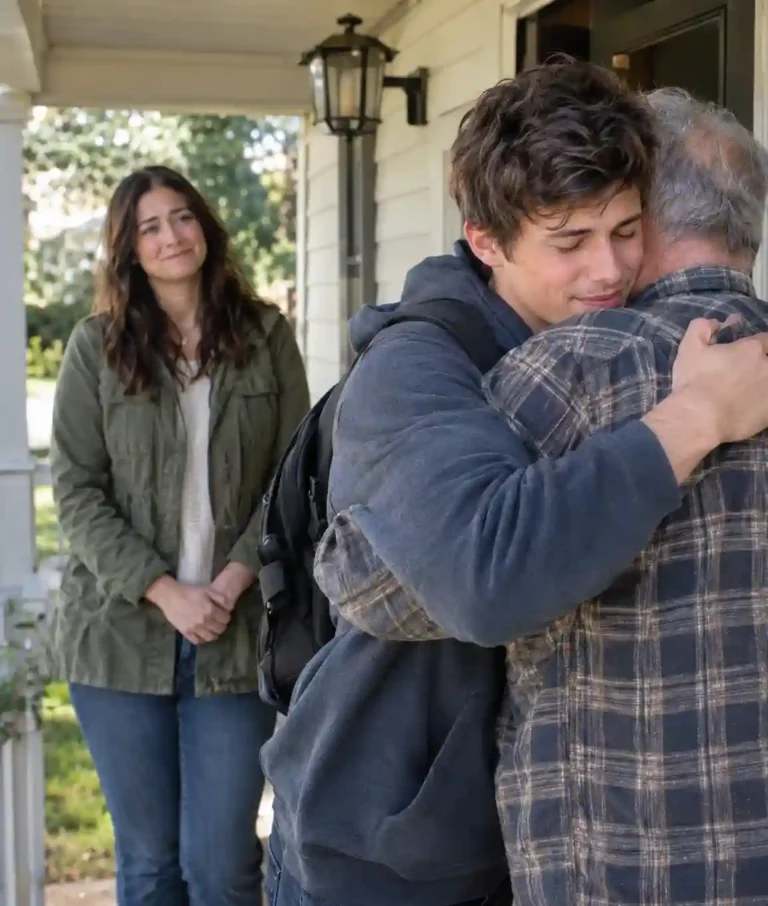
Several months later, Emily moved into a small house of her own.
The first time I visited, I noticed how different the place felt.
There were baby toys on the floor, pictures on the refrigerator, and a pile of clean laundry waiting to be folded on the couch.
It wasn’t perfect.
It was peaceful.
Noah was crawling across the living room when I walked through the door.
Emily smiled.
“Look who’s here.”
Noah looked up and crawled toward me.
I picked him up, and he immediately grabbed the collar of my shirt.
Emily laughed.
It was the first completely relaxed laugh I’d heard from her in a long time.
She later handed me a photograph.
It showed the three of us together.
On the back, she had written:
“Thank you for coming when I couldn’t find the words to ask for help.”
I read it quietly.
Then I looked at my daughter.
For years, I had believed that courage meant standing in front of danger without fear.
Emily taught me something different.
Sometimes courage is admitting that you aren’t okay.
Sometimes it means telling someone the truth when you’re afraid nobody will believe you.
And sometimes the most important thing a person can do is simply listen.
I had driven to Emily’s house that morning expecting to meet my grandson for the first time.
Instead, I discovered that my daughter had been living in a situation she was terrified to describe.
I couldn’t undo what had happened.
I couldn’t erase those days from her memory.
But I could make sure she never had to face something like that alone again.
Months later, while I held Noah in my arms, Emily stood beside the window watching the two of us.
She looked healthier.
Stronger.
More like herself.
I thought about the ER physician who had noticed those bruises and understood that they meant more than what was being said.
If she hadn’t asked the right questions, I don’t know how much longer Emily would have remained silent.
Sometimes the person in trouble doesn’t need someone to make a grand speech.
They need someone to notice.
They need someone to believe them.
And sometimes, one question can change everything:
“Are you safe?”
Editor’s Note: This fictionalized story deals with family abuse, postpartum vulnerability, and emotional manipulation. Anyone experiencing abuse or immediate danger should seek help from trusted people, medical professionals, or appropriate local authorities.
Related Posts
- On My Wedding Day, My Brother Sank My Grandfather’s Vintage Mustang Into a Lake—Then I Asked One Question That Wiped the Smiles Off Their Faces

- I Pretended I Was Dying to Find Out If My Struggling Girlfriend Loved Me or My Money—Then She Disappeared for Five Days and Returned With Something That Made Me Break Down in Tears
- My Son’s Best Friend Wore a Bright Red Dress to His Funeral, The Reason Left Us all in Tears
- My Brother Destroyed My $78000 SUV Because I Refused to Give It to His Wife—Then the Police Asked One Question That Silenced My Entire Family





About the Author
Hassan is the founder and editor of MidnightReads, a publication featuring thoughtful stories, human-interest articles, history, relationships, and entertaining reads.
He is involved in researching, writing, and editing content for the site, with a focus on creating original, clear, and useful articles that give readers something meaningful to take away.
Hassan believes good content should inform, entertain, and encourage curiosity.
— Hassan, Founder & Editor, MidnightReads