
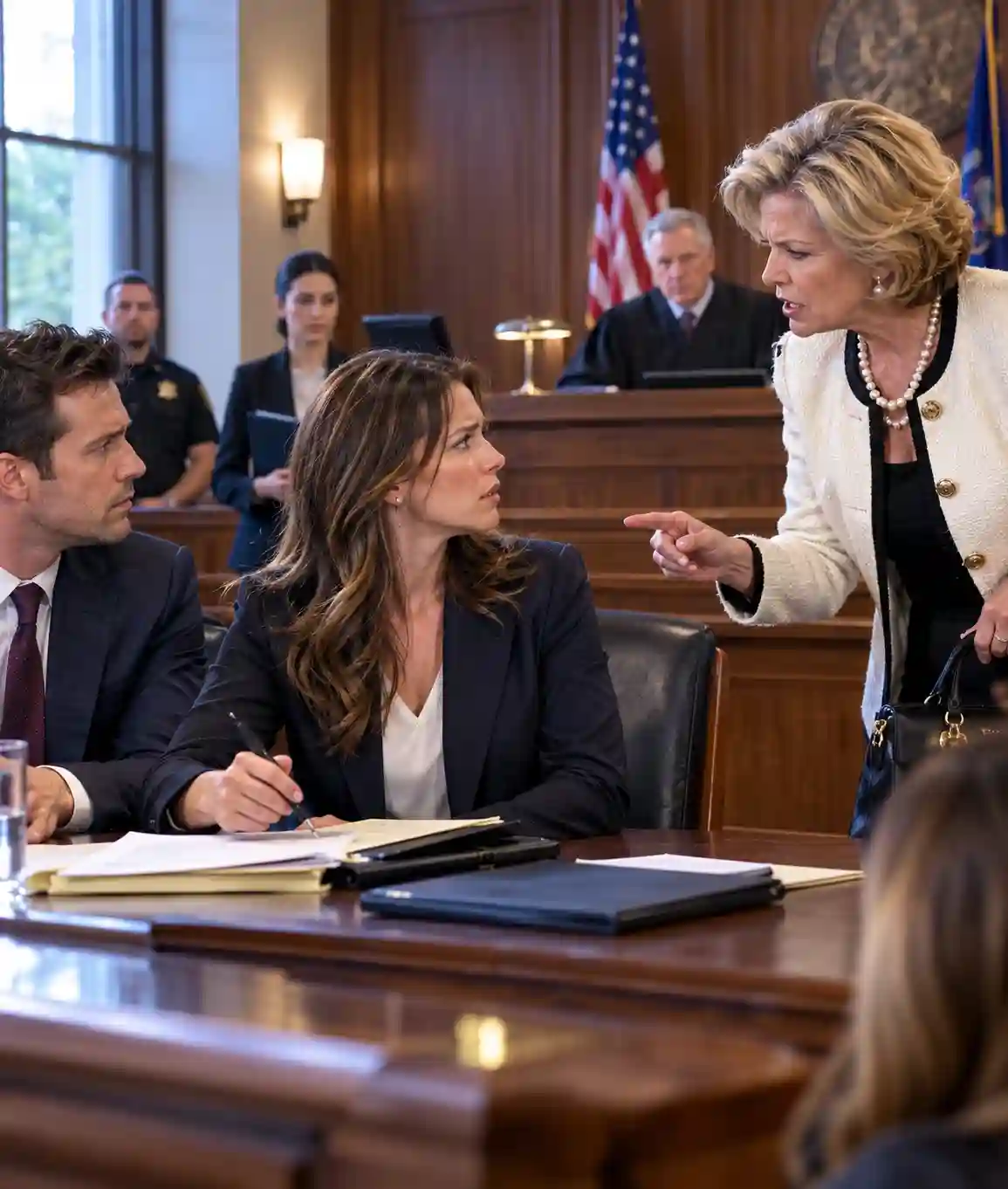
Three weeks after my husband’s funeral, my mother-in-law walked into my attorney’s office with a leather folder and a list of everything she believed my husband had left behind. She wanted our Virginia house, the family business, his investment accounts, his vehicles, and nearly every valuable possession connected to his name. She spoke with such confidence that it was obvious she had already imagined herself walking away with the entire estate.
“My son was the only reason that company became successful,” Evelyn Mercer told my attorney. “And the house belonged to his father before Daniel ever married her. I want everything returned to the family.”
My attorney, Maya Patel, let her finish before opening the copy of Daniel’s will on her desk. “Mrs. Mercer, Daniel’s will names his wife as the beneficiary of his probate estate. If you believe you have a separate claim, we’ll need to see the documents supporting it.”
Evelyn smiled.
“My attorney has already explained everything to me.”
Maya glanced at me after Evelyn left. “Most of what she is demanding isn’t hers. Some of it may not even be part of Daniel’s probate estate. You have every reason to fight this.”
I looked through the office window at the gray Virginia sky. Three weeks earlier, I had buried the man I had expected to grow old with. The thought of spending the next several years arguing with his mother over property made me feel more exhausted than angry.
“Let her have it,” I said.
Maya looked at me in disbelief.
“She has no legal right to simply take everything.”
“I know.”
“Then why would you give her the opportunity?”
“Because I’m not giving her what she thinks I’m giving her.”
That was the first time Maya realized there was something I hadn’t told her.
My husband, Colonel Daniel Mercer, had retired from the United States Army after thirty-two years of service. He had spent most of his adult life moving between military assignments, training exercises, and overseas deployments. He had survived two helicopter crashes and a roadside bomb, and his final deployment had left him with serious heart problems.
After retiring, Daniel became heavily involved in his family’s defense business. His father had started the company decades earlier as a small manufacturing operation, and Daniel eventually helped turn it into a much larger government contractor.
At sixty-two, Daniel died from an aneurysm.
There was no warning that morning. No long goodbye. No final conversation where he could tell me what he wanted done with everything he had spent his life building.
One minute he was planning a business trip, and the next my entire future had changed.
I was forty-six.
Our house suddenly felt enormous.
His coffee mug remained beside the kitchen sink because I couldn’t bring myself to put it away. His boots were still near the back door, and his reading glasses were on the nightstand. I kept catching myself turning toward the hallway whenever I heard a noise, expecting to see him coming into the room.
Then Evelyn arrived with her list.
Daniel’s death had clearly reopened something in her. She had lost her husband years earlier, and now she had lost her only son. I understood her grief, but I couldn’t understand why she had decided that taking control of Daniel’s property was the way to deal with it.
A few weeks later, she filed a claim against his probate estate.
Her attorney, Peter Lang, argued that Daniel’s father had helped establish the business and that certain company assets should ultimately belong to Evelyn. He also claimed Daniel had intended for the family home to return to her after his death.
There were no signed agreements establishing either claim.
That didn’t stop Evelyn from demanding a jury trial.
Maya warned me that if the dispute continued, the estate could remain tied up for years. Legal fees would accumulate, business decisions could become complicated, and every disagreement would require another court appearance.
“I can fight this,” Maya told me. “But you need to understand what you’re choosing if you do.”
I looked at Daniel’s photograph sitting on my kitchen counter.
“I don’t want to spend the rest of my life fighting his mother.”
Maya nodded.
“Then we need another strategy.”
There was one thing she still didn’t know.
Two months before Daniel died, he had asked me to sit with him in his study after dinner. A thick blue folder was lying on his desk.
“You need to understand these,” he had said.
Inside were trust documents, corporate records, property deeds, and agreements I had never bothered to study closely. Daniel had always handled the legal and financial side of the business, and I trusted him completely.
That night, he explained everything.
His father had established a family trust years earlier, and significant ownership interests in the company had eventually been transferred into that structure. Daniel had worked for the company and helped expand it, but that did not mean every company asset was personally owned by him.
Our house had a separate history.
Although Daniel and I had lived there together for years, the property had been transferred into a separate trust before our marriage.
Daniel also had personal accounts and property that were genuinely part of his estate. Those were covered by his will.
But the company and our home were different.
I remembered looking at him across the desk.
“Why are you showing me all this now?”
“Because if I go first, Mom may think everything connected to me belongs to her.”
“She wouldn’t do that.”
Daniel gave me a tired smile.
“You don’t know my mother as well as I do.”
I laughed.
He didn’t.
“If she starts making demands, don’t spend your life fighting with her. But don’t sign away something just because she insists it’s hers.”
I didn’t realize how soon I would need those words.
When Maya reviewed the documents after Daniel’s death, she immediately understood why I had remained calm.
The settlement Evelyn wanted could release claims belonging to Daniel’s probate estate. It could not magically transfer property that wasn’t owned by the estate in the first place.
Maya carefully drafted the settlement so that it did exactly that.
I would surrender any claims the estate had to the property listed in the agreement.
I would not transfer assets held independently through the trusts and corporate structures.
Evelyn, however, seemed to read the agreement differently.
She believed my willingness to sign meant I had finally accepted defeat.
I didn’t correct her.
The final hearing took place on a cold Tuesday morning.
Evelyn arrived in a cream-colored suit with Peter Lang beside her. She looked relaxed, almost pleased. She had spent months telling relatives that the family business and house were finally coming back under her control.
I sat beside Maya.
Judge Samuel Whitaker reviewed the settlement documents and then questioned both parties to make sure we understood what we were signing.
“Mrs. Mercer, are you entering this agreement voluntarily?”
“Yes, Your Honor.”
“Has anyone forced you to sign?”
“No.”
“Do you understand that the agreement resolves the claims being released by the estate?”
“Yes.”
The judge turned toward Evelyn and asked her the same questions.
She answered confidently.
“Yes, Your Honor.”
The judge reviewed the final pages, signed the order, and closed the probate matter.
Evelyn turned toward me with a small smile.
For a moment, I wondered whether she would say something.
Instead, she simply gathered her papers.
Then Judge Whitaker looked back at Peter.
“Mr. Lang, before we finish, I have one question.”
Peter looked up.
“Have you explained to your client that the house and Mercer Defense Systems are not probate assets of Colonel Mercer’s estate?”
Peter stopped moving.
Evelyn’s expression changed.
“What?” she said.
The judge continued looking at Peter.
“I want a clear answer.”
Peter glanced toward his client before speaking.
“No, Your Honor. I explained that Colonel Mercer had an interest in the company and that the assets were associated with his estate. I did not explain the distinction in those terms.”
Judge Whitaker looked at the estate inventory.
“Then I suggest you do so now.”
Peter slowly opened his folder.
Evelyn leaned toward him.
“What is he talking about?”
Peter turned several pages before answering.
“The house isn’t owned by the estate.”
Evelyn stared at him.
“But Daniel lived there.”
“That doesn’t determine legal ownership.”
“He paid for it.”
“Some of the payments were made through the property trust.”
She looked at him as if he had suddenly begun speaking another language.
“And the company?”
Peter hesitated.
“The controlling ownership interests were transferred into Mercer Family Holdings years ago.”
Evelyn’s face tightened.
“So what exactly did I get?”
Peter looked down at the settlement.
“You received the rights that were being released from the probate estate.”
“That isn’t what I thought I was getting.”
“I understand.”
“No, you don’t.”
Judge Whitaker raised a hand.
“Mrs. Mercer, I understand that this is frustrating, but the court cannot transfer property simply because one party believed it was included in a settlement.”
Evelyn turned toward me.
“You knew this.”
I didn’t deny it.
“Yes.”
Her voice became quieter.
“You knew I wasn’t getting the company.”
“Yes.”
“And you still signed everything?”
“I signed away what Daniel’s estate legally owned.”
She stared at me.
“You let me believe I had won.”
“I didn’t tell you what to believe.”
For several seconds, neither of us spoke.
Then Peter pulled another document from the folder.
“Your Honor, there is one more matter.”
Judge Whitaker looked at him.
Peter held up a copy of the family trust.
“The trust was amended several years ago. Mrs. Mercer is a beneficiary.”
Evelyn turned toward him.
“A beneficiary?”
“Yes.”
“What does that mean?”
Peter explained that Daniel had established a continuing financial provision for his mother. She was entitled to scheduled distributions and certain expenses under the terms of the trust. She also retained rights concerning the home where she lived.
Evelyn looked genuinely confused.
“Daniel did this?”
“Yes.”
“When?”
“Several years ago.”
She looked at me.
“Did you know?”
“Yes.”
“Why didn’t you tell me?”
“Because it wasn’t my decision to make.”
Judge Whitaker examined the trust documents before returning them to Peter.
“Mrs. Mercer, if you believe there is a legal defect in the trust, you may seek independent legal advice. But the probate settlement before this court does not transfer trust assets to you, and it does not invalidate the trust.”
Evelyn looked down at the papers in her hands.
The confidence she had carried into the courtroom was gone.
For months, she had believed she was fighting me for Daniel’s property.
Now she was discovering that Daniel had already arranged his affairs years before his death.
The judge confirmed the settlement and closed the matter.
Evelyn left the courtroom without speaking to me.
I didn’t feel victorious.
I felt tired.
Outside the courthouse, Maya walked beside me toward the parking lot.
“You could have told her months ago,” she said.
“I know.”
“Why didn’t you?”
I thought about Daniel.
“Because he asked me not to turn this into a war.”
Maya didn’t answer.
After a moment, she simply nodded.
The following months were not as dramatic as the courtroom had been, but they were far more important.
As successor trustee, I had responsibilities that had nothing to do with inheritance. I had to oversee the property trust, coordinate with the company’s officers, review financial reports, and make sure Daniel’s long-term arrangements continued to operate properly.
Robert Hayes, the company’s chief financial officer, became one of my closest advisers.
He had worked with Daniel for more than twenty years.
One afternoon, Robert brought an old photograph into my office. It showed Daniel standing beside his father outside the original factory.
“Daniel kept this in his desk,” Robert said.
I smiled.
“He loved that picture.”
Robert nodded.
“He used to say his father taught him something important.”
“What?”
“Ownership and responsibility aren’t always the same thing.”
I looked at the photograph again.
For years, I had thought Daniel’s complicated legal arrangements were simply another part of his work.
Now I understood why he had cared so much about them.
He had seen how quickly families could destroy businesses when ownership became an emotional weapon.
Several weeks later, Evelyn called me.
I almost didn’t answer because we hadn’t spoken since the hearing.
When I finally picked up, she didn’t mention the lawsuit.
Instead, she asked whether she could bring me some of Daniel’s things.
She arrived that weekend carrying a small cardboard box.
Inside were several old photographs, Daniel’s military medals, and a handwritten recipe.
I recognized the handwriting immediately.
“His pancake recipe,” Evelyn said.
I laughed.
“He never followed this.”
“I know. I used to tell him that.”
We stood in the kitchen looking at the recipe, and for the first time since Daniel’s death, the memory of him didn’t immediately hurt.
We sat down and talked for nearly two hours.
Evelyn told me stories about Daniel as a boy. She told me how he had once tried to repair a broken lawn mower and made it worse. I told her about the time he attempted to cook Thanksgiving dinner while refusing to use a recipe because he claimed he could “figure it out.”
By the time we finished, we had talked about Daniel more than either of us had talked about him since the funeral.
As Evelyn prepared to leave, she stopped near the front door.
“I owe you an apology.”
“You don’t have to.”
“I do.”
She looked down at the box.
“I thought if I got the house and the company, I would somehow be holding onto my son. I didn’t realize until that day in court that I was fighting over things because I was afraid of losing him completely.”
I understood more than she probably realized.
After Daniel died, I had done the same thing in different ways. I had kept his clothes exactly where they were, left his office untouched, and refused to move his coffee mug because some irrational part of me believed that changing those things meant accepting that he wasn’t coming home.
Grief had made both of us hold onto objects because objects felt easier than accepting absence.
Evelyn looked at me.
“Did he really provide for me?”
“Yes.”
“Even after everything?”
“Yes.”
She nodded slowly.
“That sounds like Daniel.”
“It does.”
She smiled sadly.
“He always planned three steps ahead.”
“He did.”
After she left, I returned to Daniel’s study and opened the blue folder one final time.
The documents no longer seemed complicated.
They were simply evidence of a man who had spent years trying to make sure that the people he loved would be protected even after he was gone.
The next spring, we placed Daniel’s military medals in a glass display case at Mercer Defense Systems. Beside them was the old photograph of Daniel and his father outside the original factory.
There was no elaborate ceremony.
A few longtime employees gathered, Robert said a few words about Daniel’s service, and Evelyn stood quietly beside me.
When everyone had left, she looked at the photograph.
“He would have hated all of this fighting,” she said.
“He would have told us to read the documents before arguing.”
She laughed.
“That too.”
We stood there for a while without saying anything.
The courtroom battle had started because Evelyn believed Daniel’s estate contained everything he had touched during his lifetime. She thought my signature meant she had finally taken control of his legacy.
It didn’t.
I had signed away the claims of the probate estate because those were the claims I was legally able to release. The trusts and corporate structures Daniel had established years earlier remained governed by their own documents.
But the most important thing wasn’t what Evelyn failed to receive.
It was what she eventually understood.
Daniel hadn’t spent his life building a company so his family could spend the rest of theirs fighting over it. He hadn’t arranged his affairs because he wanted to control everyone from beyond the grave. He had simply recognized that money and grief could turn even loving families against one another.
I had entered the courtroom believing I was there to end a lawsuit.
I left understanding something much larger.
Sometimes protecting what someone leaves behind doesn’t mean fighting to possess every piece of it. Sometimes it means having enough restraint to let the legal documents speak for themselves, even when someone else is convinced they know what belongs to them.
Evelyn had walked into that courtroom believing I had surrendered everything.
The truth was much simpler.
I had signed away only what Daniel’s estate could legally give away.
And the question the judge asked her lawyer that morning finally forced everyone to understand the difference.
Editor’s Note: This fictional story explores grief, family conflict, inheritance disputes, and the difficult decisions that can arise after the loss of a loved one. The characters, events, and legal circumstances are created for storytelling purposes.
You May Also Like
- My Brother Destroyed My $78000 SUV Because I Refused to Give It to His Wife—Then the Police Asked One Question That Silenced My Entire Family

- Every Ride Home Left Me With Missing Memories And I Thought My Husband Was Worried About My Blackouts Until I Heard His Voice on the Recording

- My Mother Banned Me From My Brother’s Wedding, Then One Phone Call Revealed Who I Really Was

- My Mommy Has Been Sleeping for Three Days”—A Six-Year-Old Girl Pushed Her Newborn Twins to the Hospital in a Wheelbarrow





About the Author
Hassan is the founder and editor of MidnightReads, a publication featuring thoughtful stories, human-interest articles, history, relationships, and entertaining reads.
He is involved in researching, writing, and editing content for the site, with a focus on creating original, clear, and useful articles that give readers something meaningful to take away.
Hassan believes good content should inform, entertain, and encourage curiosity.
— Hassan, Founder & Editor, MidnightReads