
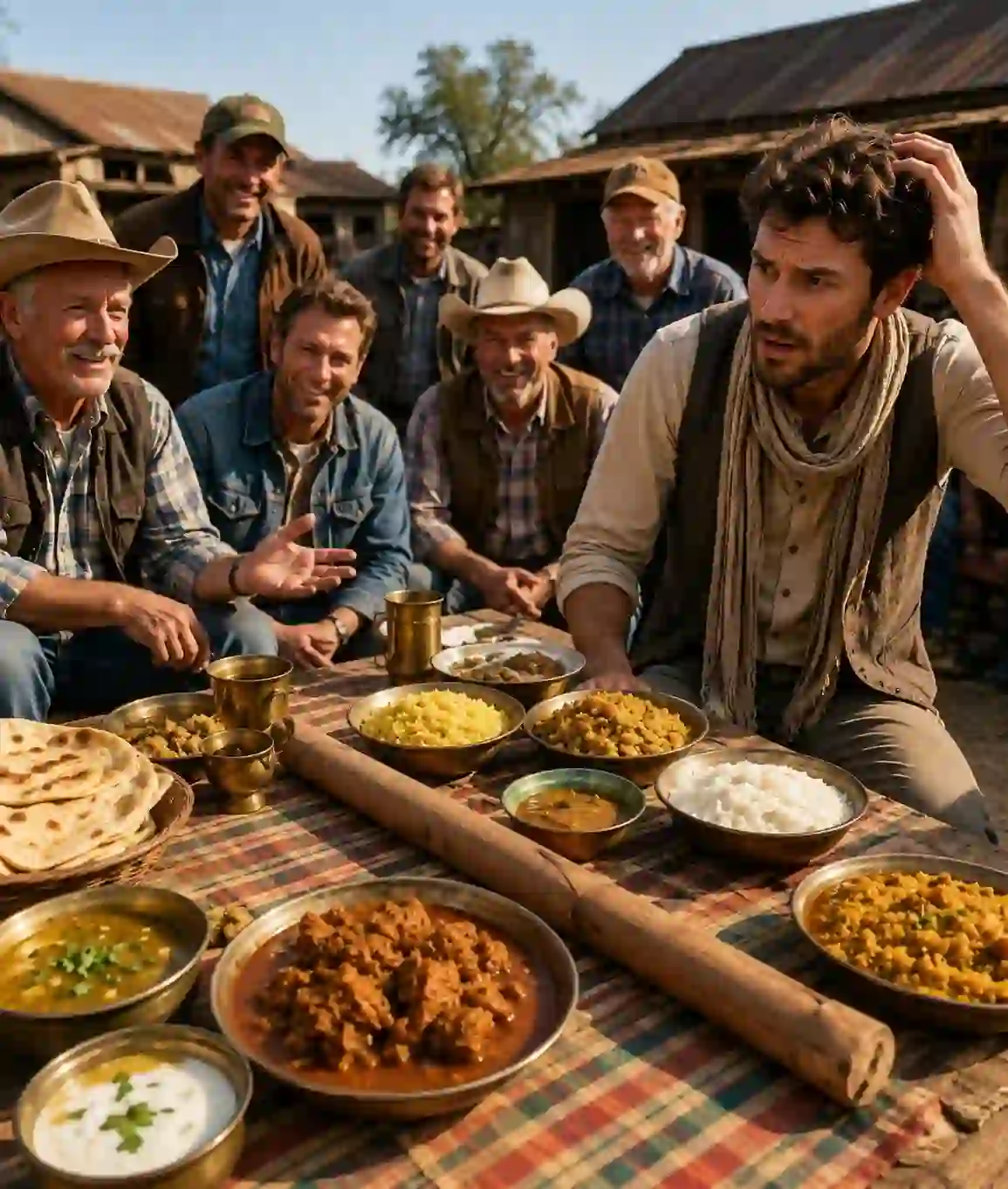
One afternoon, a traveler arrived in a small, dusty village that was famous far beyond its borders for one thing-its hospitality.
People said that if you ever stepped into that village as a stranger, you would not leave as one. You would be welcomed, fed, and treated with a warmth that felt almost overwhelming. It was not just kindness—it was a matter of pride. The villagers believed that a guest was a blessing, and they honored that belief with full intensity.
So when the traveler walked in, he was tired, sunburned, and carrying little more than a small bag–the reaction was immediate.
Children spotted him first and ran through the narrow streets shouting, “A guest has come! A guest has come!”
Within moments, doors opened. Women hurried into kitchens. Men gathered around him with wide smiles, insisting he sit, rest, and refresh himself. Before he could even properly introduce himself, he was guided to a shaded courtyard and seated comfortably on a woven cot.
“Please sit, brother,” one man said warmly. “You must be tired. Food is coming.”
The traveler nodded, slightly overwhelmed but grateful. He had been on the road for days, and the promise of a good meal felt like a gift from heaven.
But what he did not expect… was what came next.
The food did not just come—it arrived in waves.
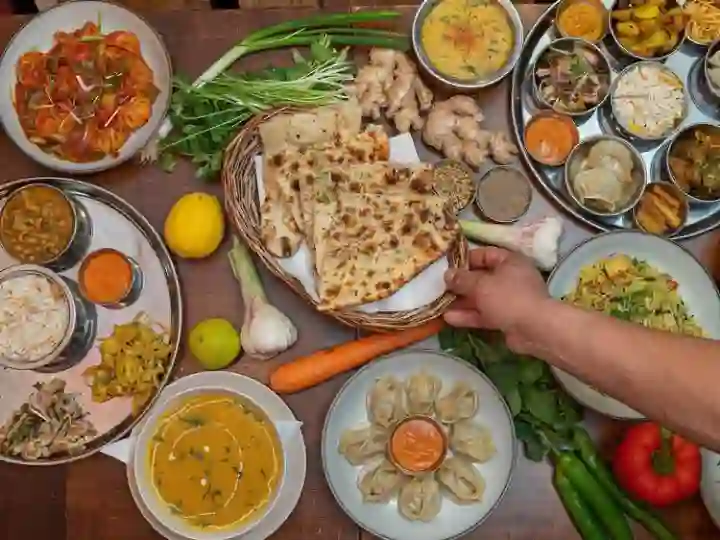
First came steaming bowls of lentils, rich with spices and aroma. Then plates of tender meat, cooked slowly until it nearly fell apart. Stacks of freshly made flatbread followed, brushed with butter that melted instantly on contact. Then came sweet halwa, glistening with ghee, and tall glasses of frothy buttermilk. To finish it all, thick yogurt was placed gently at the side.
The traveler stared.
This was not a meal.
This was a feast.
He looked around at the smiling faces of the villagers, who watched him with eager anticipation. Their pride was visible. Their joy came not from eating—but from feeding.
And suddenly, the traveler laughed.
A full, heartfelt laugh escaped him. It wasn’t mocking—it was genuine surprise mixed with admiration.
“You people…” he said, still smiling, “this is incredible.”
The villagers beamed.
But then,
His laughter stopped.
Not gradually. Not softly.
It stopped all at once.
Because his eyes had just noticed something strange.
Something completely out of place.
Right in the center of the beautifully arranged food… lay a large wooden stick.
Not a utensil.
Not a decoration.
A thick, solid, unmistakable stick.
The traveler blinked.
He leaned slightly forward, as if seeing it from a different angle might change what it was.
But it did not.
The stick remained.
His smile faded. His throat tightened slightly.
Carefully, choosing his words, he asked,
“Excuse me… but… why is there a stick on the table?”
The villagers exchanged brief glances, then one of them chuckled lightly.
“Oh, do not worry about that,” he said casually. “It is just part of our tradition. Please, start eating.”
The traveler nodded slowly.
But inside, something shifted.
Tradition?
His eyes moved again to the stick.
Then back to the food.
Then to the villagers.
They were all smiling. Calm. Comfortable.
Too comfortable.
A thought formed in his mind—quiet at first, but quickly growing louder.
What if this is part of some ritual?
What if they feed me… and then use that stick afterward?
His fingers curled slightly.
His appetite disappeared.
He straightened his posture and said firmly,
“I’m sorry… but I cannot eat until I understand what that stick is for.”
The atmosphere changed.
The smiles softened.
A few villagers looked confused.
“Well…” one of them began, “it is just something we always do.”
“But why?” the traveler asked.
There was a pause.
A longer one this time.
The villagers looked at each other.
No one answered.
Because no one knew.
They had grown up seeing that stick on the table. Their elders had done it. Their parents had done it. So naturally, they continued it.
But the reason?
That had been lost somewhere in time.
Still, they could not admit that—not in front of a guest.
“Wait here,” one man said quickly. “We will ask someone who knows.”
Several villagers hurried off, determined to find an answer.
The traveler sat still, watching the untouched food in front of him… and the stick that seemed to guard it.
Minutes later, they returned with an elderly man—respected, experienced, someone whose words carried weight.
He approached slowly, his eyes scanning the scene.
Then he saw the stick.
And his expression changed instantly.

“What is this nonsense?” he snapped.
The villagers looked startled.
“This is the traditional stick, isn’t it?” someone said cautiously.
The old man shook his head sharply.
“You fools! It is supposed to be a three-foot stick! Who told you to bring one this big? This is almost seven feet long!”
The villagers gasped.
“Oh! That must be the mistake!”
Without hesitation, they grabbed the stick, measured it, cut it down, and reshaped it until it was exactly three feet long.
They placed it back on the table, satisfied.
“There,” one of them said proudly. “Now it is correct.”
The traveler stared at the smaller stick.
His fear did not go away.
If anything… it became sharper.
Before, the large stick seemed clumsy.
Now, this one looked precise.
Controlled.
Purposeful.
He leaned back again.
“I still won’t eat,” he said. “Not until I know why it is still there.”
The villagers grew uneasy.
Their guest was refusing food—and that was serious.
“We need someone older,” another villager insisted.
Again, they rushed off.
This time, they brought back a man even older—nearly ninety years of age. He walked slowly, and they had to speak loudly so he could hear.
They explained everything.
He leaned in, squinted at the stick, and suddenly became furious.
“Who told you this is a stick?” he shouted. “It is not a stick! It is a small flexible rod—something you can hold easily in your hand!”
The villagers blinked.
“Oh… so we misunderstood again…”
Immediately, they removed the stick and replaced it with a thin, flexible rod.
They stepped back confidently.
“This is the correct version.”
The traveler felt his patience slipping.
First a giant stick… then a smaller one… now this?
His imagination was no longer subtle.
It was vivid.
If they use this on me… I am finished.
He raised his voice this time.
“No. This is not enough. I need a clear answer. Why is this here?”
Now the villagers were truly worried.
They gathered in a tight group, whispering urgently.
“There is one last person…”
“The oldest man in the neighboring village…”
“If anyone knows, it’s him.”
They didn’t waste time.
They traveled quickly and returned with a frail, extremely old man—over a hundred years old—carried carefully on a stretcher.
The entire village stood still.
The traveler watched closely.
This was the moment of truth.
They explained everything loudly into the old man’s ear.
He listened.
Slowly turned his head.
And looked at the rod.
His face tightened.
“This…” he said quietly, “is ignorance.”
The villagers leaned in.
“What do you mean?”
He spoke with effort, but his words were clear.
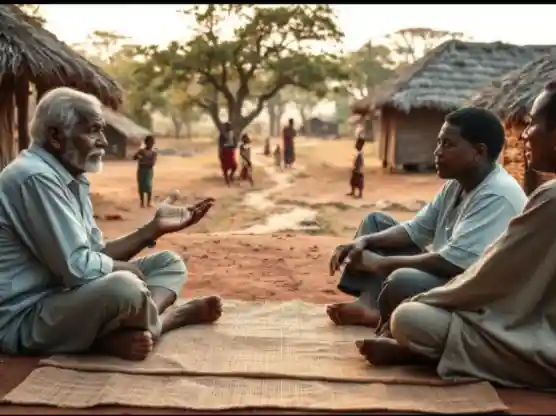
“This is not tradition. This is distortion. Additions over time. People copying without understanding.”
He pointed weakly toward the table.
“The real tradition… is simple.”
They waited.
“It is a toothpick.”
Silence fell.
“A… toothpick?” someone repeated.
“Yes,” he said. “A small piece of wood. Placed in a bowl. So that if food gets stuck between the teeth… the guest can remove it easily.”
The villagers stood frozen.
What had started as something so small… had grown into something so unnecessary.
The traveler stared.
Then suddenly—
He laughed.
Louder than before.
“I knew it!” he said, wiping his eyes. “I thought you were going to beat me after feeding me!”
The villagers looked at each other.
Then slowly… they began to laugh too.
The rod was removed.
A small bowl was placed.
And inside it—a simple toothpick.
At last, the table looked normal again.
The traveler leaned forward, picked up a piece of bread, and began to eat.
This time, without fear.
He ate everything—every dish, every flavor, every effort made for him.
When he finished, he leaned back, satisfied.
“Your hospitality is truly special,” he said. “But sometimes… traditions should be understood, not just followed.”
The villagers nodded.
And that day, they learned something they would never forget.
Not every tradition carries wisdom.
Some only carry habit.
This story made you smile… but it also made you think. Share it with someone who needs this lesson today.
Related Posts
- 69 Days Beneath the Earth: The Extraordinary True Story of the 33 Chilean Miners

- A Husband’s Sacrifice for the Woman He Loved
- A King’s Hidden Visit and a Woman’s Strong Reply
- A Millionaire Watched a Struggling Mother Remove Baby Formula From Her Cart, Then He Noticed the One Small Item She Was Trying to Save





About the Author
Hassan is the founder and editor of MidnightReads, a publication featuring thoughtful stories, human-interest articles, history, relationships, and entertaining reads.
He is involved in researching, writing, and editing content for the site, with a focus on creating original, clear, and useful articles that give readers something meaningful to take away.
Hassan believes good content should inform, entertain, and encourage curiosity.
— Hassan, Founder & Editor, MidnightReads