
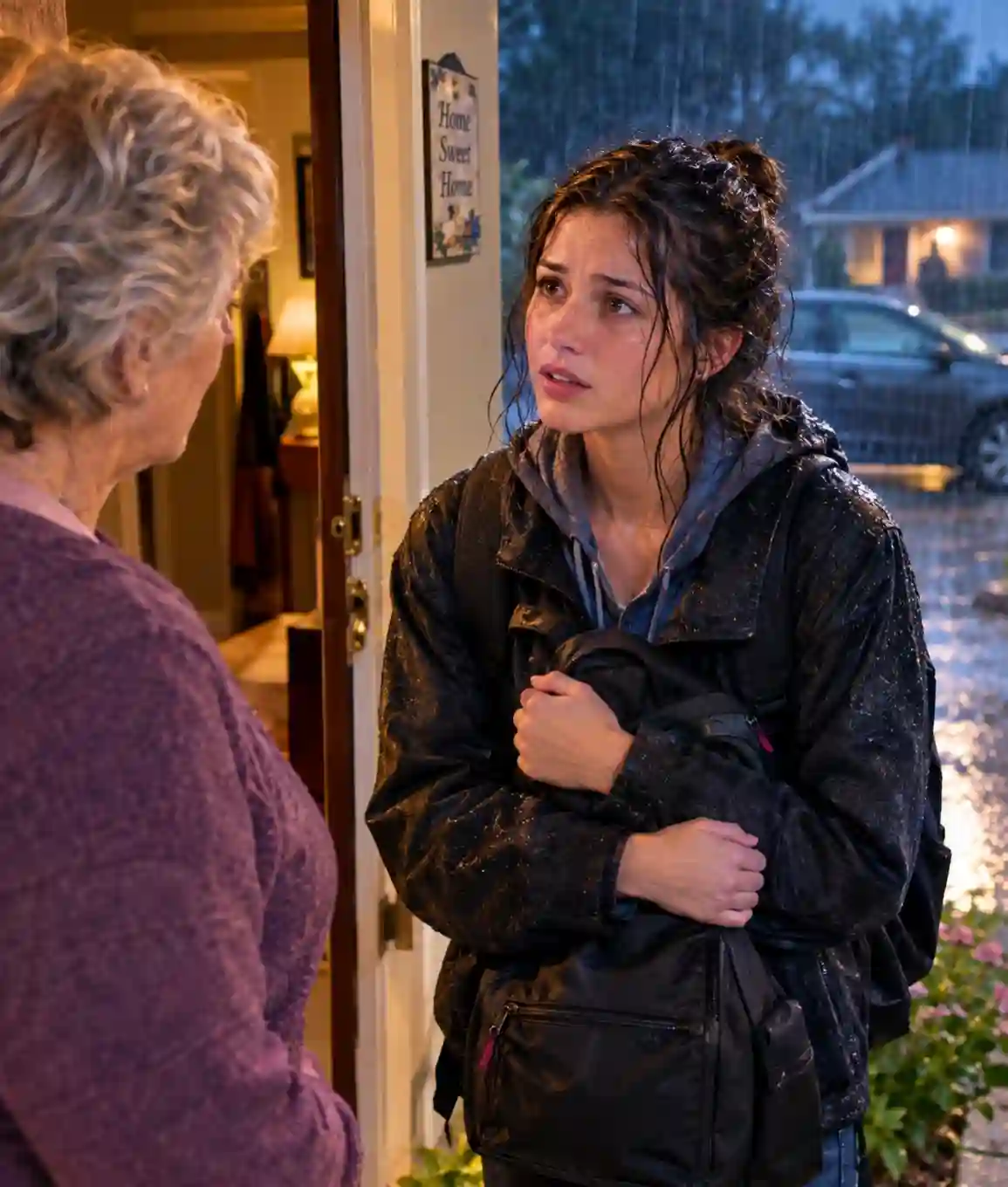
At 68, Marjorie Tate opened her front door to a young woman she had never met.
The girl was soaked from the rain, clutching a backpack and looking like she hadn’t slept properly in days. She stood awkwardly on the porch, almost as if she were already preparing herself to be turned away.
Then she said something that made Marjorie forget all about the spare room she had planned to rent.
“Mrs. Tate, I need to be honest with you. I don’t actually have anywhere to live.”
Marjorie stared at her.
The young woman lowered her eyes.
“I’ve been sleeping in my car.”
Her name was Kayla Monroe. She was 22 years old, halfway through nursing school and working shifts as a nursing assistant whenever she could get them.
She had found Marjorie’s handwritten notice on a bulletin board at the local community college.
ROOM FOR RENT.
QUIET HOUSE.
REASONABLE PRICE.
Kayla needed all three.
A few months earlier, she had shared an apartment with two other students. When the landlord raised the rent, Kayla could no longer afford her share. Her mother lived several states away and didn’t have the money to help. Her father had been mostly absent for years.
Kayla tried finding another place, but everything she could afford disappeared quickly.
Eventually, she started sleeping in the back seat of her aging sedan.
Some nights, she parked near the hospital where she worked. Other nights, she found a quiet spot behind a 24-hour grocery store. She showered at the college gym, kept her clothes in a duffel bag and stored her nursing textbooks in the trunk.
“I can pay something,” Kayla said quickly. “It isn’t much, but I’ll pay every week. I just need somewhere safe while I finish school.”
Marjorie looked down the hallway.
At the end was the spare bedroom.
For nearly four years, she had barely opened the door.
The room had officially been the guest room, but it had once belonged, in every way that mattered, to her late husband, Earl.
His fishing magazines were still stacked on the dresser. His old radio sat beside the window. His reading glasses were still in the top drawer.
A faded blue quilt lay folded at the end of the bed.
Earl had died four years earlier, and Marjorie had never found the courage to completely pack away his things.
She had considered selling the house several times. Working at the diner five days a week was becoming harder, and the mortgage and household bills seemed to swallow more of her paycheck every year.
But this wasn’t just a house.
It was where she and Earl had raised their children. It was where family Christmases had filled every room with noise. It was where they had spent 31 years together.
Years earlier, one evening while Marjorie was washing dishes, their favorite song came on the radio. Earl had taken her by the hand and danced with her barefoot across the kitchen floor.
Memories like that made selling the house feel impossible.
So instead, Marjorie had decided to rent the spare room.
She had expected another older woman. Maybe a teacher. Maybe someone who worked at the factory outside town.
She hadn’t expected a frightened 22-year-old nursing student who carried almost everything she owned in a car.
“How much can you afford?” Marjorie asked.
Kayla told her.
It was less than half of what Marjorie had originally planned to charge.
For several seconds, Marjorie said nothing.
Then she looked through the window at the rain pouring across the yard.
“Breakfast is at six if I’m working mornings,” she said. “You wash your own sheets, and I don’t want loud music after ten.”
Kayla blinked.
“Does that mean I can stay?”
“It means you should get your things out of that car before the rain gets any worse.”
Kayla covered her mouth with one hand.
“Thank you.”
Marjorie turned toward the hallway before the young woman could see the tears forming in her eyes.
“Come on, then.”
Neither of them realized how important that decision would become.
The first few weeks were awkward.
Kayla was so used to worrying about money and taking up as little space as possible that she apologized for almost everything.
She apologized for using the washing machine. She apologized when she came home late from work. She even asked before taking a shower.
One morning, Marjorie finally put down her coffee and shook her head.
“You’re paying rent,” she said. “You don’t need permission to use the toaster.”
Kayla laughed.
It was such a small moment, but something about that laugh stayed with Marjorie.
The house had been quiet for so long that she had almost forgotten what it sounded like when someone young was happy inside it.
After that, their routines slowly began to change.
Marjorie worked at a family diner on the edge of town. She had been there for more than 20 years and knew most of the regular customers by name. She served coffee, biscuits, meatloaf and pie, often working longer shifts than her aching knees appreciated.
Kayla spent her days at college and picked up nursing assistant shifts whenever she could.
Neither woman had much money to spare, but they soon found other ways to help each other.
One afternoon, Marjorie came home carrying two heavy grocery bags. Before she could even reach the front steps, Kayla opened the door.
“Give me those.”
“I’ve been carrying groceries since before you were born.”
“And tonight you’re taking the night off.”
Kayla took both bags before Marjorie could argue.
Marjorie rolled her eyes, but she was smiling by the time they reached the kitchen.
A few days later, Marjorie noticed that a loose cabinet hinge had been repaired.
Then the dripping bathroom faucet stopped.
A week later, the porch light that had been flickering for months suddenly worked perfectly.
“Did you fix all this?” Marjorie asked.
Kayla shrugged.
“I watched a few videos.”
“You’re training to be a nurse, not a handyman.”
“Tuition is expensive. I’m keeping my options open.”
Marjorie laughed so hard she had to sit down.
Their friendship grew through moments like that.
Marjorie began making extra food whenever she cooked. There was usually chicken and dumplings, vegetable soup, roast dinner or cornbread waiting in the kitchen when Kayla came home from a late shift.
Sometimes Marjorie left little notes beside the food.
EAT BEFORE YOUR SHIFT.
DON’T LIVE ON VENDING MACHINE CRACKERS.
THERE’S PIE. HAVE TWO PIECES.
Kayla kept every one.
Marjorie didn’t know that.
There were difficult nights, too.
Kayla sometimes came home after midnight and found Marjorie sitting alone at the kitchen table. Those were the nights when grief seemed to return without warning.
A particular song could bring Earl back into her thoughts. So could an old photograph, the smell of his favorite aftershave or even rain hitting the roof in a certain way.
Kayla never told her to move on.
She never offered one of those easy phrases people use when they don’t know what else to say.
Instead, she would make tea and sit beside her.
One night, Marjorie stared at the empty chair across the kitchen.
“People think loneliness means you’re alone,” she said.
Kayla waited.
“But sometimes that’s not what loneliness is.”
Marjorie looked down at her hands.
“Sometimes it’s having a thousand things you want to tell someone who isn’t there anymore.”
Kayla reached across the table and held her hand.
They stayed there quietly for nearly an hour.
There was nothing to fix.
Marjorie simply needed someone willing to sit beside her while the difficult feeling passed.
And Kayla, who had spent so much of her own life feeling as though she had to handle everything alone, understood that better than most.
Months passed.
Then another year.
Kayla struggled through difficult semesters, long shifts and exhausting exams. Marjorie continued working at the diner and doing everything she could to keep up with the house.
When Kayla failed an important exam, she came home convinced that she wasn’t good enough to become a nurse.
Marjorie listened without interrupting.
Then, at 11 p.m., she made pancakes.
“You’re allowed to be disappointed,” she told her. “You’re not allowed to decide you’re finished.”
Kayla smiled through her tears.
When Marjorie caught a bad case of the flu a few months later, Kayla became the one giving orders.
She brought her water, checked her temperature, made sure she ate and refused to let her return to work before she had recovered.
“You’re bossier than Earl ever was,” Marjorie complained from the couch.
“Good.”
Marjorie smiled.
“He’d have liked you.”
Kayla became quiet for a moment.
“I think I would’ve liked him too.”
By the final year of nursing school, the spare bedroom no longer looked like the room Marjorie had been afraid to touch.
Kayla’s textbooks filled the desk. A graduation countdown was taped beside the mirror. A string of inexpensive lights ran along one wall, and nursing notes covered nearly every available surface.
For years, Marjorie had worried that changing the room meant erasing Earl.
Now she understood something she hadn’t been ready to accept before.
Nothing had been erased.
His photographs were still there. His memories were still part of the house. But the room was being used again.
It had become a place where someone studied late into the night, dreamed about the future and came home after difficult days.
The house was alive again.
And Marjorie was beginning to feel alive with it.
Then graduation day arrived.
Marjorie had requested the entire day off from the diner. She wore the yellow blouse Earl had always loved and headed to the ceremony with more excitement than she had felt in years.
The auditorium was packed with families holding flowers, balloons and cameras.
When Kayla’s name was called, Marjorie stood up and applauded before she even realized she was doing it.
Kayla looked into the crowd.
The moment she spotted Marjorie, she smiled.
After the ceremony, they took pictures outside beneath a large tree. Kayla was still wearing her graduation gown, her cap sitting slightly crooked on her head. Marjorie’s glasses kept sliding down her nose.
Neither cared.
It became Marjorie’s favorite photograph.
That evening, after they returned home, Kayla handed her a small envelope.
“What is this?” Marjorie asked.
“Just open it.”
Inside was a card.
Behind it were dozens of tiny folded pieces of paper.
Marjorie recognized them immediately.
Her notes.
EAT BEFORE YOUR SHIFT.
GOOD LUCK ON YOUR EXAM.
SOUP’S ON THE STOVE.
DRIVE CAREFULLY.
PROUD OF YOU.
DON’T FORGET YOUR UMBRELLA.
Marjorie looked at her.
“You kept these?”
“All of them.”
She opened the card.
There were only a few sentences, but Marjorie had to read them more than once.
“You gave me a room when I had nowhere to go.
But you gave me more than a bed.
You gave me somewhere I knew I was expected home.
And somehow, Marjorie, I think you gave yourself a home again too.”
Marjorie pressed the card against her chest.
For several seconds, neither woman spoke.
Then Marjorie smiled through her tears.
“Earl would have said renting that room was a terrible idea.”
Kayla laughed.
“He would?”
“Oh, definitely.”
Marjorie wiped her eyes.
“Then ten minutes later, he’d have helped you carry your boxes inside.”
Kayla wrapped her arms around her.
Marjorie held on tightly.
Kayla eventually moved out after accepting her first nursing job.
The spare bedroom became a spare bedroom again, but the house never returned to the silence Marjorie had once known.
Kayla came home for Sunday dinners. She changed light bulbs, fixed little things around the house and called Marjorie after difficult shifts.
Sometimes she showed up without warning simply because she had been nearby.
Years later, when people asked how the two women were related, Marjorie stopped giving them a complicated explanation.
She simply smiled.
“That’s my girl.”
For a long time, Marjorie believed keeping her home meant holding tightly to everything that reminded her of Earl.
Kayla taught her something different.
A home doesn’t have to remain exactly as it was to honor the people who once filled it.
Sometimes opening the door to someone new isn’t a betrayal of the past.
Sometimes it’s how a home gets a future.
Kayla had arrived with a backpack, a few belongings and nowhere safe to sleep. Marjorie had offered her a room because she needed the money and couldn’t bear to see a young woman struggling alone.
Neither expected friendship.
Neither expected family.
And neither realized, on that rainy evening, that they were both about to be saved in completely different ways.
Because sometimes the person who needs your spare room gives you something you never knew you were missing.
Sometimes a small act of kindness becomes a friendship that lasts for years.
And sometimes home isn’t about the size of the house, the number of rooms or how long you’ve lived there.
It’s about knowing that when you walk through the door, someone is glad you’re back.
Author’s Note: This is an original fictional story about kindness, loneliness, and the unexpected connections that can change our lives. Names, characters, and events are fictional and created for storytelling purposes.
Related Posts
- My Father-in-Law Lived Under My Roof for 20 Years, and I Called Him a Burden, Until His Lawyer Opened a Blue Ledger at His Funeral and Revealed What He’d Been Hiding All Along

- My Ex-Husband’s Mother Arrived With Two Moving Trucks Minutes After Our Divorce—She Demanded My Mansion, but She Had No Idea What My Attorney Had Discovered2.

- My Mother-in-Law Pushed Me Down the Stairs at Nine Months Pregnant—She Never Expected Her “Unemployed” Son to Arrive With the Entire Board of Directors

- Her Father Sold Her to a Deaf Rancher for $50—But on Their Eighth Night, She Discovered Something Moving Inside His Ear and Uncovered a Secret Buried for 29 Years





Hammad Ali
Co-Owner & Author
Hammad Ali is a co-owner and author at MidnightReads, contributing thoughtful and engaging articles across human-interest, life, history, relationships, and entertainment topics.
They help develop and create original, useful content designed to inform, entertain, and give readers something meaningful to take away.