
For almost four years, I had been serving overseas with the U.S. Army and sending money home whenever I could. By the time I returned, the total was close to $100,000. I never thought twice about it. Chloe was my wife, and I wanted her to be comfortable while I was away. I also trusted my mother, Patricia, and my younger sister, Brenda, to help keep an eye on her.
When I was suddenly granted emergency leave, I decided not to tell anyone I was coming home. I wanted to surprise Chloe. During the long flight back, I kept imagining the same scene: I’d walk through the front door, she’d stare at me for a second in disbelief, and then she’d throw her arms around me.
Instead, I arrived at a house I barely recognized.
The old siding had been replaced, the front yard had been landscaped, and a large gate surrounded the property. A nearly new pickup truck sat in the driveway. Through the front window, I could see furniture that certainly hadn’t been there when I left.
For a moment, I felt a strange kind of satisfaction. I had spent years away from home, missing birthdays, holidays and ordinary evenings with my wife. Looking at the house, I thought maybe all those sacrifices had at least given Chloe a better life.
I unlocked the door quietly and stepped inside.
My mother and Brenda weren’t there.
I called Chloe’s name, but nobody answered.
Then I heard water running behind the house.
I walked around the side of the building and stopped.
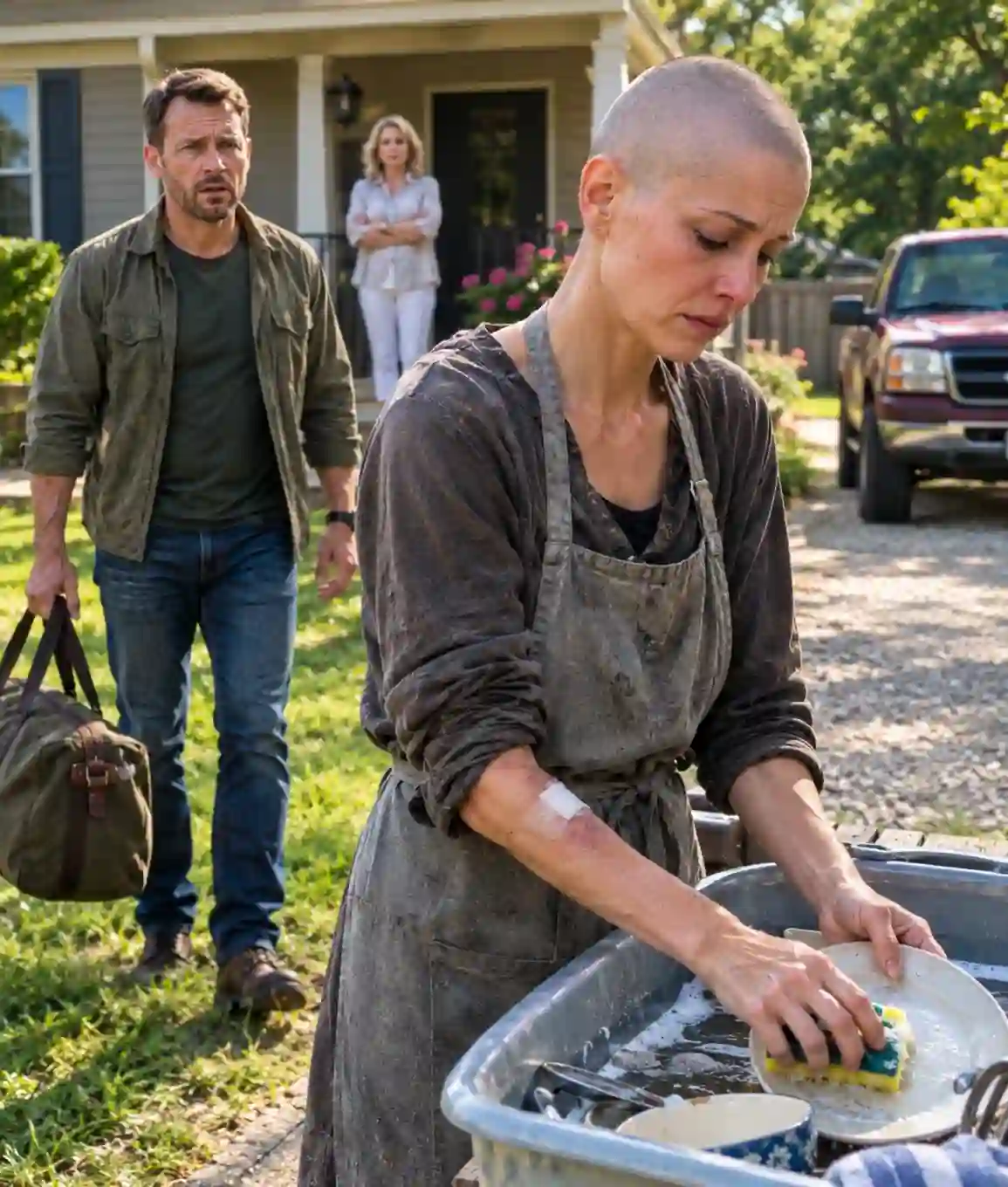
Chloe was standing over a large plastic basin, washing dishes.
At first, I didn’t recognize her.
She had lost so much weight that her clothes hung from her body. Her face looked tired and drawn, and she was wearing an old knitted cap despite the warm afternoon. Her hands were red from the water and soap.
She was so focused on what she was doing that she didn’t notice me.
Then Brenda’s voice came from the back door.
“Chloe, those dishes still aren’t clean. Mom has people coming over.”
Chloe lowered her eyes.
“I’m almost finished.”
Brenda stepped outside.
She saw me.
The color drained from her face.
Chloe turned around a second later.
For several seconds, neither of us moved.
“Daniel?”
It was barely more than a whisper.
I smiled because I didn’t know what else to do.
“Surprise.”
Instead of running toward me, Chloe took a step backward.
Her hand went straight to her head.
That was when I knew something was terribly wrong.
“Chloe, what’s happening?”
“Nothing.”
“Don’t tell me nothing. Look at me.”
She wouldn’t.
I walked closer and gently touched the knitted cap.
She grabbed my wrist.
“Please.”
I had never heard fear in her voice like that.
“Please don’t.”
I slowly lowered my hand.
“Why?”
She began crying.
Before she could answer, my mother came through the back door.
Patricia looked at me, then at Chloe.
“Well,” she said awkwardly, “I suppose the surprise is ruined.”
I looked at Chloe again.
“What happened to her?”
My mother sighed as though I had asked about something trivial.
“She did it to herself.”
I frowned.
“What does that mean?”
“She ruined her hair with some kind of chemical treatment. Then she started losing weight. We’ve tried to get her to take better care of herself, but Chloe can be very stubborn.”
Brenda folded her arms.
“She doesn’t listen to anybody.”
I looked at Chloe.
She stood there with her head down, saying nothing.
Something didn’t fit.
Then her sleeve moved as she reached for another plate, and I noticed a small bandage near her elbow.
“What’s that?”
Chloe quickly pulled her sleeve down.
My mother answered before she could.
“She had some tests done. Nothing important.”
I looked at Patricia.
“What kind of tests?”
“Daniel, you just got home. Can we not do this right now?”
I should have demanded an answer.
Instead, I remembered something I had learned during my years in the Army: when a situation feels wrong, reacting too quickly can make it harder to understand what’s actually happening.
So I said nothing.
I walked inside and took a shower.
At dinner, I mentioned the good news I’d brought home.
My military compensation had finally been processed, and along with other benefits and savings, I expected to have access to almost $400,000.
The reaction was immediate.
My mother wanted to know when the money would arrive. Brenda started talking about replacing the pickup truck. They discussed renovating the kitchen and taking a family vacation.
I watched them talk.
Not once did anyone ask Chloe how she was doing.
She barely touched her food.
When dinner ended, I couldn’t find her upstairs.
I eventually discovered her in a narrow storage room behind the laundry area.
There was a mattress on the floor.
A thin blanket was folded beside it.
I stood in the doorway.
“Chloe, why are you sleeping here?”
She looked embarrassed.
“It’s quieter.”
“That’s not an answer.”
She stared at the floor.
“How long?”
She took a breath.
“About eight months.”
I felt a knot forming in my stomach.
“Why didn’t you tell me?”
She looked at me for several seconds before reaching beneath the mattress.
She pulled out a plastic folder.
“I tried.”
I opened it.
The first document was from a hospital.
The diagnosis was there in black and white.
Cancer.
I read it once.
Then again.
I couldn’t make the words feel real.
“Chloe…”
“They found it five months ago.”
I looked up.
“You’ve known for five months?”
She nodded.
“Why didn’t you tell me?”
“I called you.”
“Why didn’t I know?”
Her eyes filled with tears.
“Your mother told me you were in the middle of a deployment. She said you were already exhausted and that you didn’t need me putting more pressure on you.”
I sat down beside her.
“What happened after that?”
“I asked her for help.”
“How much?”
“Three hundred dollars.”
I almost laughed from disbelief, but there was nothing funny about it.
“Three hundred?”
“She wouldn’t give it to me.”
“Why?”
“She said you had already sent enough money. She said I was always looking for another reason to spend it.”
I stared at the floor.
“How much money did I send home?”
“I don’t know.”
“Almost $100,000.”
Chloe closed her eyes.
“I know.”
“Then where did it go?”
She didn’t answer.
I looked at her.
“Chloe, where did my money go?”
She began crying.
“I don’t know all of it. Your mother handled most of it.”
Then she told me about the day she sold her hair.
She had been desperate to get to a specialist. She had no cash and didn’t know how to reach me without causing trouble for me overseas.
So she cut off her hair and sold it.
She received $150.
She used part of it to get to the hospital.
I looked at her bare head beneath the cap.
“You sold your hair?”
She nodded.
“For $150.”
I couldn’t speak.
I had sent enough money to pay for a dozen things she needed.
Yet my wife had sold her hair for the price of a few grocery bags.
I reached for her hand.
“Why didn’t you leave?”
She looked confused.
“Leave where?”
“Anywhere.”
She gave me a tired smile.
“I didn’t have anywhere to go. And I kept thinking you’d come home eventually.”
That sentence hurt more than anything else.
I spent that night beside her.
Neither of us slept much.
Before sunrise, I went upstairs.
I remembered an old cabinet beneath the staircase. Patricia had always kept paperwork there.
It was locked.
I found a key in a kitchen drawer.
Inside were folders, receipts and bank statements.
I started going through them.
The first few receipts were enough to make me angry.
Furniture.
A truck payment.
Jewelry.
Restaurant bills.
A hotel.
Then I found withdrawals I didn’t recognize.
I kept going.
Near the bottom of the cabinet was an envelope with Chloe’s name on it.
Inside was a hospital bill for $287.
Across the top someone had written in red:
“Not necessary.”
I photographed it.
Then I found something else.
A printed copy of a text conversation between my mother and Brenda.
One message from Brenda said, “He doesn’t need to know about this.”
My mother’s response was, “As long as Chloe doesn’t contact him directly, he won’t.”
I sat there for a long time.
There are moments when anger comes so quickly that it almost feels calm.
That was one of them.
I put everything back exactly where I’d found it.
Then I went downstairs and waited.
At breakfast, my mother was already talking about the money I had told them about the night before.
“We should think carefully about how to use the benefits,” she said. “The house could use some improvements.”
Brenda nodded.
“I’d start with the kitchen.”
I placed the bank statements on the table.
“I agree,” I said. “We should start with the money you’ve already spent.”
The room went quiet.
My mother looked at the papers.
Then she looked at me.
“Daniel…”
“Where did it go?”
“We used it for the household.”
“Most of it?”
She didn’t answer.
I pointed to the hospital bill.
“Why couldn’t Chloe get $287?”
My mother sighed.
“She was making it sound worse than it was.”
“You knew she had cancer?”
“We weren’t sure.”
“The hospital was sure enough to run a biopsy.”
Brenda suddenly stood up.
“You’re acting like we wanted her to get sick.”
“I didn’t say that.”
“But that’s what you’re implying.”
“No,” I said. “I’m saying you knew she was sick and chose not to help her.”
My mother started crying.
“Daniel, we were trying to protect you.”
I stared at her.
“From what?”
“From worrying.”
I shook my head.
“You weren’t protecting me. You were keeping me from finding out.”
Nobody spoke.
Then Brenda said something that changed the way I saw her forever.
“Chloe could have called you herself.”
I looked at her.
“She did.”
Brenda’s expression changed.
I knew then that she knew exactly what she had done.
I pulled out my phone and showed them the messages I’d found.
My mother started shaking.
“Daniel, please.”
I stood up.
“I need both of you to leave.”
My mother stared at me.
“This is my home too.”
“No,” I said quietly. “It stopped being your home when you started treating my wife like she didn’t belong here.”
She cried.
She accused Chloe of turning me against her.
She reminded me of everything she’d done for me growing up.
I listened.
Then I told her something I had never said before.
“I will always be your son. But that doesn’t mean I have to ignore what you did.”
I hired an attorney and began sorting through the financial records.
It turned out that some of the money could be traced and recovered. Much of it couldn’t.
The truck was sold. Some of the furniture and jewelry were returned or sold. My mother and Brenda eventually moved out.
But none of that fixed what had happened to Chloe.
She needed treatment.
That became my priority.
Her first weeks of treatment were harder than anything I’d prepared myself for. There were mornings when she was too weak to get out of bed, and there were nights when she became so sick that I stayed awake beside her.
One afternoon, she stood in front of the bathroom mirror and touched her bald head.
“I hate this,” she said.
“I know.”
“I don’t look like myself.”
I stood behind her.
“You don’t have to look like yourself right now.”
She looked at me through the mirror.
“What does that mean?”
“It means you’ve been through something terrible. You don’t have to pretend you’re okay just because other people are uncomfortable seeing you struggle.”
She turned around and cried into my chest.
For the first time, she stopped apologizing for being sick.
Treatment continued.
The doctors remained careful about making promises, but eventually we received the news we had been hoping for.
The tumor was responding.
It was shrinking.
There was still a long road ahead, but we finally had something neither of us had allowed ourselves to imagine for months.
A future.
We moved out of the old house.
Our new place was smaller and far less impressive. There was no giant television, no expensive furniture and no huge gate around the property.
But Chloe had a bedroom.
A real one.
She had a little garden outside the kitchen window, and eventually she filled it with flowers.
One evening, several months after moving, we sat on the back porch while the sun went down.
Chloe looked around the yard.
“You know what’s strange?”
“What?”
“I used to think that house was the thing I was supposed to be grateful for.”
I looked at her.
“And now?”
She smiled.
“Now I think I was just grateful you came back.”
I reached for her hand.
“I wish I’d come back sooner.”
“You came when you could.”
“No,” I said. “I came when I finally saw what was happening.”
She squeezed my fingers.
“And you stayed.”
That mattered to both of us.
Chloe’s recovery wasn’t quick or simple. There were setbacks, difficult appointments and days when fear returned without warning. But little by little, she became herself again.
Her hair began growing back.
She started eating normally.
She laughed more.
She even complained about things again, which she later admitted was a sign she was feeling better.
About a year after I returned home, she stood in front of the bathroom mirror and ran her fingers through the short hair covering her head.
“It’s finally growing.”
I smiled.
“It looks good.”
She turned toward me.
“You really mean that?”
“I’ve never meant anything more.”
She laughed.
“It’s still too short.”
“Then we’ll wait.”
She looked at me for a moment.
“Thank you for coming home.”
I wrapped my arms around her.
“I should be thanking you.”
“For what?”
“For waiting.”
She rested her head against me.
“I almost didn’t.”
I pulled back.
“What do you mean?”
She hesitated.
“Before you came home, I had decided that if the treatment didn’t work, I wasn’t going to tell you. I thought you deserved to move on without having to remember me sick.”
I stared at her.
“You thought I would rather lose you than come home to you?”
“I thought you had already given enough.”
I shook my head.
“You were never something I gave up for.”
That conversation stayed with me.
For years, I had thought being a good husband meant earning money and making sure the bills were paid.
I eventually realized it meant something much simpler.
It meant making sure the person beside you never felt like she had to suffer alone.
My mother eventually apologized.
It took a long time.
I accepted the apology, but I didn’t immediately restore the relationship. Forgiving someone and trusting them again are two different things, and I wasn’t willing to put Chloe through the same situation twice.
Brenda never offered a real apology.
We rarely spoke.
I stopped wondering whether that made me a bad son or brother.
My responsibility was to my wife.
Years later, Chloe still keeps the knitted cap from that afternoon.
It’s tucked away in a drawer.
One day I asked her why she kept it.
She smiled.
“Because I don’t want to forget how scared I was.”
I didn’t understand.
She touched the cap.
“If I forget that woman, I might forget how much she survived.”
I looked at her and realized she was right.
The woman I found behind that house had been exhausted, frightened and sick, but she had still gotten up every morning and kept going.
She had washed dishes while hiding a diagnosis.
She had slept in a storage room because she didn’t want to cause trouble.
She had sold her hair because she couldn’t get anyone to listen.
And somehow, after all of that, she still believed there was a chance I’d come home.
I had spent four years sending money back because I believed money was the best way to protect the people I loved.
It wasn’t.
Money had bought the house.
It had bought the truck.
It had bought the furniture and everything else that had made me think my family was doing well.
But it hadn’t protected Chloe.
What protected her in the end was the moment someone finally listened to her.
And for me, that was the hardest lesson of all.
When I came home, I thought I was going to surprise my wife.
Instead, she surprised me with the truth.
I didn’t come home to discover that my family had spent nearly $100,000.
I came home and discovered what they had been willing to let my wife endure while they spent it.
And if I had one thing to do differently, it wouldn’t be about the money.
It would be this:
I would have asked Chloe one more time whether she was really okay.
Because sometimes the person who says, “I’m fine,” isn’t telling you that everything is fine.
They’re telling you they’re afraid of what will happen if they finally tell you the truth.
Author’s Note
This is a fictional story created for entertainment and reflection. Names, characters, and events are either fictional or adapted into an original narrative. We hope this story reminds readers that love, honesty, and compassion matter far more than money or material things.
Trending Posts
- My Father-in-Law Lived Under My Roof for 20 Years, and I Called Him a Burden, Until His Lawyer Opened a Blue Ledger at His Funeral and Revealed What He’d Been Hiding All Along

- My Ex-Husband’s Mother Arrived With Two Moving Trucks Minutes After Our Divorce—She Demanded My Mansion, but She Had No Idea What My Attorney Had Discovered2.

- My Mother-in-Law Pushed Me Down the Stairs at Nine Months Pregnant—She Never Expected Her “Unemployed” Son to Arrive With the Entire Board of Directors

- Her Father Sold Her to a Deaf Rancher for $50—But on Their Eighth Night, She Discovered Something Moving Inside His Ear and Uncovered a Secret Buried for 29 Years




Hammad Ali
Co-Owner & Author
Hammad Ali is a co-owner and author at MidnightReads, contributing thoughtful and engaging articles across human-interest, life, history, relationships, and entertainment topics.
They help develop and create original, useful content designed to inform, entertain, and give readers something meaningful to take away.